
I’m a sucker for AI films. Whether it’s an older classic like The Terminator and The Matrix or a newer gem like Upgrade and The Artifice Girl, if you give me a sci-fi thriller about artificial intelligence, I’ll probably be a happy man. Naturally, when I first heard about T.I.M., I knew I had to check this movie out. I requested a screener as soon as I could, and I couldn’t wait to see how the film would tackle this increasingly relevant issue.
T.I.M. was directed and co-written by Spencer Brown, and it stars Georgina Campbell, Eamon Farren, Mark Rowley, Amara Karan, and Nathaniel Parker. The story follows Abi and Paul, a married couple going through a bit of a rough patch, as they travel to the countryside to get a fresh start. At first, everything seems to go pretty well, but their life together takes a turn for the worse shortly after Abi, an engineer, starts working on a very special android dubbed the Technologically Integrated Manservant. Or, for short, T.I.M.
One of the perks of her job is that she and her husband receive a T.I.M. of their own, and as the name suggests, this robot integrates with all of their smart technology. For example, it can send and receive phone calls and emails, it has access to their house’s security system, and it can even read Abi’s vitals through her smart watch. In short, this thing can do it all, but as you can probably guess, it also has a bit of a dark side. It quickly becomes obsessed with Abi, and it does everything it can to replace her husband and become the only man she needs.
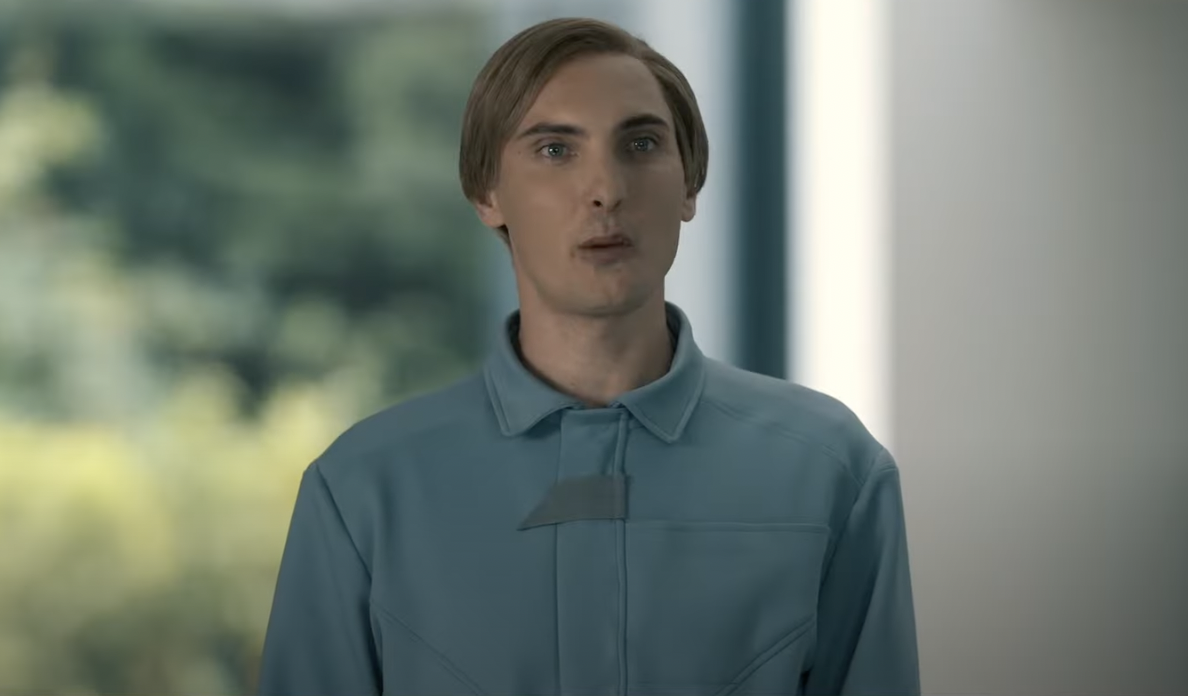
On paper, that’s a pretty terrifying concept. Thankfully the execution in T.I.M. mostly lives up to the premise. Above all else, I have to give huge props to Eamon Farren, the actor who plays T.I.M. This guy moves and talks in the kind of choppy, emotionless manner you’d expect from an advanced android, and he somehow manages to imbue his character with legit uncanny valley vibe as well. Even his facial expressions are spot on, so there were a few times I had to remind myself that he was an actor and not a real robot.

The rest of the cast in T.I.M. isn’t quite as good, but they get the job done. In particular, I really enjoyed Georgina Campbell’s performance as Abi. Campbell is asked to convey a wide range of emotions, like elation, terror, and dejection, and she nails every single one of them. That emotional authenticity makes her character feel completely believable, so it’s easy to immerse yourself in her story and almost forget that you’re watching a movie.
On top of those strong performances, the dynamic between Abi, Paul, and T.I.M. is also pretty engrossing. T.I.M. knows that his owners are trying to patch things up, and he uses the fragile state of their relationship to drive a wedge between them. For instance, there’s a scene where Abi is looking for Paul around the house, but he’s nowhere to be found. T.I.M. then informs her that Paul’s cell phone became unreachable somewhere around their neighbor’s property, and that sets off warning bells in her head.
Granted, this isn’t proof positive that Paul is cheating on her, but given their rocky history, she can’t help but wonder. T.I.M.’s words plant a seed of paranoia in her mind, and the android employs similarly sneaky tactics throughout the entire film. He subtly and skillfully manipulates Abi into mistrusting her husband. T.I.M.’s so effective that there were even a few times he had me wondering if Paul was having an affair.
It’s pretty captivating, but surprisingly, it’s also the film’s biggest weakness. As much as I enjoyed seeing T.I.M. shrewdly paint Paul as a bad guy, the story goes to that well a few too many times. Around the halfway point, it starts to feel like you’re just watching the same basic idea play out again and again in different ways, so the schtick eventually wears out its welcome.
Along similar lines, the mystery here also gets stretched a bit too thin. Like I said, there were a few times I genuinely wondered if Paul was cheating on his wife, but as the stakes get higher, the film’s misdirects become easier and easier to spot. They eventually become so transparent that it feels like the movie is almost insulting your intelligence, so by the time the “twist” finally comes, it’s practically devoid of any impact.

These flaws got so bad that at one point, I thought I was going to end up disliking T.I.M. overall, but then the film redeemed itself in the last 15 minutes. I can’t get into any specifics without spoiling the ending, but suffice it to say that this is where the movie turns into a full-on horror flick. It’s creepy and edge-of-your-seat thrilling, and it feels like the perfect capstone to this entire story.
Last but not least, I want to talk a bit about the themes of T.I.M. AI films tend to fall into one of two camps. Either they’re Terminator-esque thrillers about rogue machines that turn on their creators in deadly ways, or they use their robotic characters as metaphors for the way we treat other people. But T.I.M. lies somewhere in the middle.
Yes, it’s about an android that goes bad, but it’s more than just a fun thrill ride. It uses its story to send an important message, so it’s also a bit akin to the second group. In particular, this movie highlights the dark side of many people’s obsession with smart tech and their need to integrate all of their technology. That kind of hyper-integration makes it all too easy for our entire lives to come crashing down in the blink of an eye, and T.I.M. is an excellent sci-fi metaphor for that very real danger.
At the end of the day, I’m happy to report that T.I.M. is a worthy addition to the AI thriller canon. Granted, it has its fair share of flaws that keep it from being a must-see, but it’s still worth a watch if you’re a fan of these films.
Leave a Reply