Good werewolf films are notoriously hard to find. Sure, there are a handful of diamonds in the rough, but they’re few and far between. For some reason, this subgenre is just awash in mediocrity, so I’ve been pretty down about it for the past several years. But when I first heard about Blackout, I felt a new surge of optimism. This film was made by one of the best indie filmmakers the horror genre has ever known, so I thought it just might be the werewolf gem I’ve been looking for. I requested a screener as soon as I could, and when I finally sat down to watch it, I crossed my fingers and hoped for the best.
Blackout was written, edited, directed, and produced by Larry Fessenden, and it stars Marshall Bell, Joseph Castillo-Midyett, Rigo Garay, Alex Hurt, and Addison Timlin. In the film, a painter named Charley thinks he’s a werewolf. He doesn’t have any direct proof, but the evidence he does possess is pretty definitive.
This guy blacks out some nights (hence the name), wakes up in weird places covered with blood, and seems to leave a trail of corpses behind him. In other words, yeah, he’s 100% a werewolf, but nobody else knows it. Instead, a lot of people blame his murders on a local Hispanic man named Miguel, and as the monster’s body count increases, the racist furor against this innocent scapegoat reaches a fever pitch.
Right from the get-go, Blackout had me totally hooked, and the number one reason why was the main character, Charley. He’s played brilliantly by Alex Hurt, and I totally bought into this guy from the very first time I saw him. Hurt completely nails every emotion he’s asked to convey, and when he speaks, you can’t help but hang on his every word.
Most notably, there’s a scene in the middle of the movie where Charley explains his condition to one of his friends, and his monologue had me on the edge of my seat. To be fair, I’m a huge fan of monologues, so your mileage may vary. But either way, Hurt’s performance is still one of the best things about this film.
Along similar lines, the writing also makes Charley out to be a really sympathetic person. When Blackout begins, we see him stand up to a few racist jerks in his town, and that immediately endeared him to me. He just seems like a standout guy, so you can’t help but root for him.
However, as the story goes on, we learn that there’s more to Charley than meets the eye. He’s not just a good person. Rather, he’s planning on killing himself to end his wolfish reign of terror, but before he does, he wants to make some amends for all the lives he’s taken. That revelation adds an interesting and tragic layer to the guy and made me even more interested in his story.
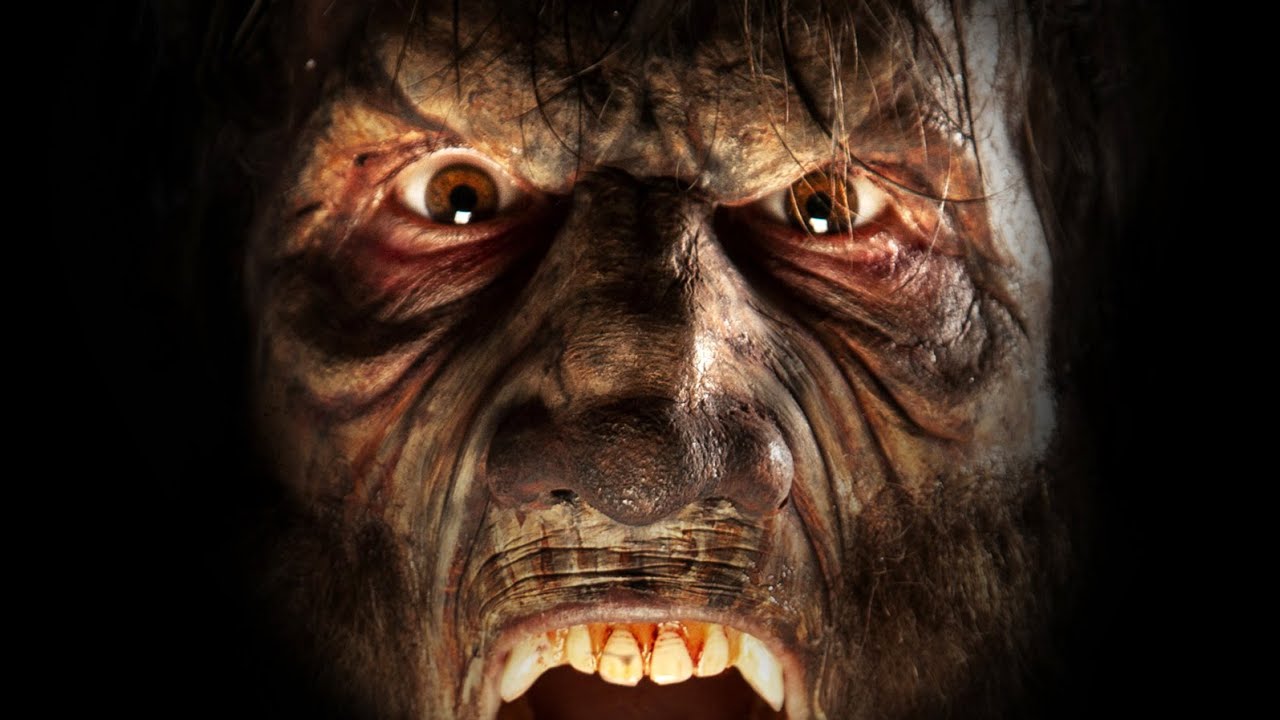
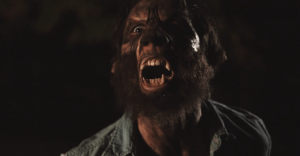
On top of its excellent lead character, Blackout also features some really good horror. Let’s start with the werewolf itself. Unlike some cinematic lycanthropes, this one isn’t just a straight-up wolf. Instead, it’s more of a traditional, The Wolf Man-esque humanoid creature, and it’s brought to life with some convincing makeup effects.
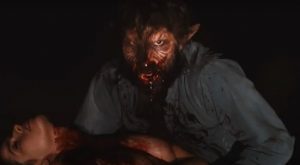
What’s more, when this thing goes on the prowl, the blood flows pretty freely, but somewhat unexpectedly, we never get to see much of the werewolf attacks themselves. The camera shows us the injuries the monster’s victims sustain, but we very rarely see it actually tear into anybody’s flesh.
That’s most likely a budgetary constraint, and thankfully, it’s completely forgivable. Not only are the gore effects in Blackout excellent, but editor/director Larry Fessenden also uses some slick camerawork and editing to skillfully hide what you don’t see. He makes up for the lack of on-screen bites and slashes so well that you might not even notice it, so you’ll never feel like you’re missing out on the good stuff.
Last but not least, we have to talk a bit about the message of Blackout. Werewolf movies are typically allegories for the dark side of human nature, so they’re often very personal stories about a character struggling to control the beast within. But this one is a bit different. Granted, Charley does try to fight against his wolfish nature, so on the surface, this seems like a fairly standard werewolf flick.
However, unlike most of its cinematic peers, the film uses Charley’s personal struggle to represent something much larger. As you might be able to guess from my plot synopsis, this is essentially a metaphor for racism. It’s about the dark side of entire communities, not just individuals. It’s a clever twist on the typical werewolf template, and in a subgenre, as seemingly cursed as this one, it feels like a breath of fresh air.
In particular, I have to say that as a Hispanic myself, I really appreciated the movie’s focus on the Hispanic community. It made Blackout hit a bit closer to home for me than most other cinematic depictions of racism. While that obviously doesn’t make the film any better or worse in itself, I’d be remiss if I didn’t give Larry Fessenden props for effectively reaching me in that way.
In case you couldn’t tell, I really enjoyed Blackout. It’s a captivating story with a timely (and timeless!) message, so this is hands down the best new werewolf movie in years. It’s the shot in the arm this subgenre desperately needs, so if you’ve been aching for a good new werewolf film too, I highly recommend that you check this one out.
Leave a Reply