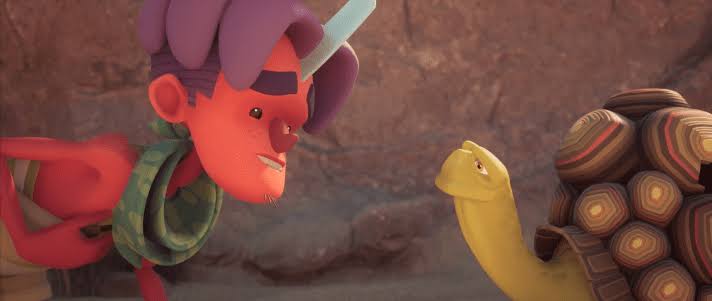
Animated films are a sweet spot for me. As I’m often writing about dark aspects of reality, relating horror films to the socio-political elements of our society, it’s good to hit the reset button every once in a while, if only momentarily shaking off the macabre for my own mental health. Of course, not every animated film is a Disney title. The joyous wrap-up of a singing protagonist’s adventure will not be found in a film like Nick Johnson’s Sunburnt Unicorn, which macabrely details a young boy’s perilous quest through the desert to find his father, who has been dragged away after an automobile accident.
Awakened by the painful burning of his flesh in the dry desert heat, Frankie (Diana Kaarina) awakens to a grizzly scene. The family car rests beside him, flipped over with the glass scattered in the sand. His piercing headache is exactly that. When he raises his hand to his forehead, Frankie is shocked to find a protruding glass fragment lodged in his skull. Frantic and unnerved, he looks for his father, who is nowhere in sight. Gently shaken by this immediate tone and dark storytelling, the audience braces itself for whatever’s next because Sunburnt Unicorn isn’t shying away from the realities of the scenario, even if it’s about to go in a more surreal direction.
Right away, Frankie hears a voice that is willing to help point him in the right direction to reunite with his father. A nearby Tortoise (Kathleen Barr) reveals themselves to Frankie and shows him the marks in the sand where The Cactus King (Brian Drummond) dragged his father away. Tortoise offers to help Frankie, thinking he’s the return of a mythical desert unicorn. However, he humbly declines when he sees Tortoise was involved in the accident as well, which claimed their back legs and a portion of their shell and has left a bridal train of entrails exposed and dragging in the sand.
I audibly gasped during the initial reveals Sunburnt Unicorn bestowed upon these opening moments. It was jarring to see an animated film that looked suitable for children in both color temperature and light become so morbidly bleak that quickly. All of Henry Selick’s films have a specific tonal aesthetic that hints at the darkness awaiting the viewer, but those are intended for a young audience. Sunburnt Unicorn is decidedly for an older ten-and-up crowd. It features the kind of complicated thematic material and anxiety-filled sequences that millennials were often exposed to in their youth, similar to The Neverending Story’s Artax scene that traumatized an entire generation. To exaggerate the perspective here, Sunburnt Unicorn is akin to thinking you’re about to watch Rango and finding out Wake in Fright or some other brutal desert adventure is about to play out instead. Regardless, from an old horror buff’s point of view, the journey became beguiling and captivating.

After Frankie finds himself lost among The Cactus King’s minions, he’s reunited with Tortoise, who helps guide him through the desert. Frankie tells Tortoise about his argument with his dad just before the crash, telling them that he didn’t want to follow in his father’s collegiate footsteps, hoping to become a writer despite there not being any money in it. Meanwhile, their adventures unite them with cannibalistic and domineering characters that test the boundaries of Frankie’spsyche.
At times, the story of Sunburnt Unicorn feels similar to the early 2000s video game American McGee’s Alice, which corrupts the traditional Lewis Carroll story to create a horrific psychological experience. With his glass Unicorn horn speared into his frontal lobe and confronting a situation where the risk of death is far higher than the probability of survival, Frankie persists. Still, with his poetic imagination, brain injury, heat exhaustion, and Frankie’s courageousness in the face of danger, the mind is likely to fabricate the details of his journey to some extent.
For the most part, Sunburnt Unicorn is a tenacious film, but as the movie reaches its showdown with The Cactus King, it fumbles its message, presenting it poorly and muddled. The film wants to imply softness in situations where children and parents tend to clash, brought forth by the very prickly visual representations of the characters. After witnessing Frankie’s grandiose grandstanding throughout the movie, the implication that not everyone gets to be whatever they want to be and not to lose yourself in the ire of resistance while pursuing it seems insincere, specifically when it’s only Frankie who needs to change. One essential line holds a depressing poignancy for the character that all but suggests conformity is on the horizon. I don’t think this is the film’s intent, but it is likely how it will be perceived.
Story-wise, Frankie has finally processed the ideas his imposing father was trying to press upon him. Still, there’s plenty to be said for encouragement and inspiration, particularly in those adolescent years and especially for a movie where the main character fearlessly traverses one of the harshest terrains imaginable in an odyssey to save his father. It may even seem like gloating to viewers who are literally watching the product of countless hours of perseverance. Worse, there isn’t even mention of failing and trying again. A lesson I’m certain many of the animators who made Sunburnt Unicorn will tell you was a constant in getting them to where they are today, even if it was only to complete the film.
While the finale of Sunburnt Unicorn left me slightly disparaged, there are many other parts worth treasuring in Nick Johnson’s film. The animation is gorgeous, with depth and coloring that directly oppose the dreadful events transpiring on screen. That alone makes the film enchanting. Those morose sequences are beyond well done and sometimes genuinely disarming, made further atmospheric by the incredible score by Piqsiq. Unfortunately, the finale undoes much of the charm and imagination of Sunburnt Unicorn’s otherwise spirited fare.
Leave a Reply