
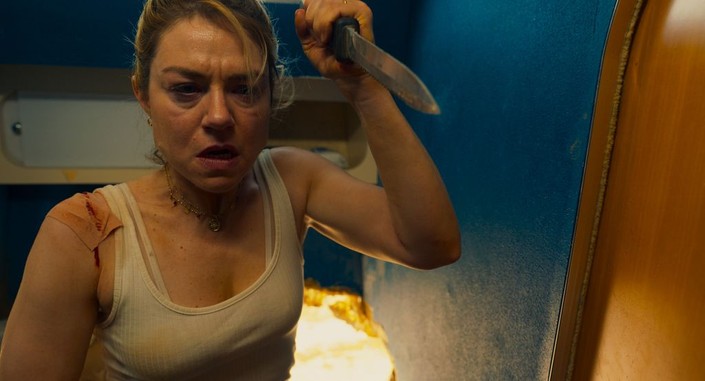
I will try to do this in my best Rod Serling voice, as it’s fitting for the new year: Imagine, if you will, a world upside down. A place where the laws of nature have been reversed, and the laws of man have gone out the window. That’s the nightmare one family finds themselves waking up to, going to bed aboard a boat in the Caribbean for their son’s birthday, and waking up in the arid, desolate remains of what was once an endless ocean. With grit and perseverance, this family will need to adapt and scavenge across this topsy-turvy landscape, relying on each other if they ever hope to Survive in the Twilight Zone.
I have a soft spot for apocalyptic thrillers and disaster films. I think everyone does. Movies like Survive scratch a horror “what if” itch that is indescribably and existentially felt among every generation. Whether it’s Nostradamus predicting the end of the world or the expiration of a Mayan calendar capturing an irrational trepidation, there’s decisive anxiety about a fate that everyone is tied to and, in some cases, the story about what happens next.
There are many great survival dramas and action films out there. Greenland is a low-key favorite of mine, as it’s assembled like a “greatest hits” of the disaster movie subgenre, and The Impossible is a harrowing and heart-wrenching film about a family reconnecting after being on a beach during a tsunami. Other favorites like The Day After, Threads, and When the Wind Blows highlight social anxieties regarding nuclear war in startling and heartbreaking ways. One thing remains universal about disaster movies: they exist to capture fears of extinction and force viewers to reckon with the fearsome nature and limitations of the planet we call home.
Survive has an air of climate change horror attached to it. There are somber images of beached whales, nuclear waste dumps, and plastic trash heaps fettered throughout the family’s journey from their broken boat to their potential rescue aboard a small submersible. The trek is made all the more harrowing when oceanographer Tom (Dark’s Andreas Pietschmann) discovers that the world has suffered a cataclysmic geomagnetic reversal, forcing north to become south and redirecting the oceans to the currently designated land areas. Tom then gives credit where it’s due while fact-based people everywhere prepare for ulcers, proclaiming, “The conspiracy theory nuts were right.”
While the idea sounds like science fiction, it is rooted in some fact. According to NASA, the poles have swapped one hundred and eighty-three times in the last eighty-three million years, with the process occurring every three hundred thousand years, and will likely not happen while humans occupy the Earth. Some online conspiracy theorists have claimed that reversal is imminent, citing a nine percent weakening in the Earth’s magnetic field over the past two hundred years. But scientists believe the field remains twice as strong as they think it had been a million years ago. While the chances of a meteor hitting the Earth are much higher than anything in director Frédéric Jardin’s movie, it’s fun to think about pole reversal in a Roland Emmerich (The Day After Tomorrow, 2012, Moonfall) sort of way, which is why I think I was drawn to the film in the first place.
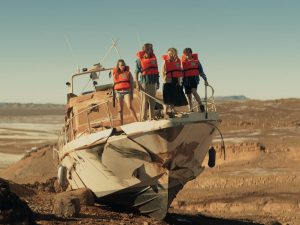
However, while I’m open to suspending belief for ninety minutes, the sheer preposterous nature of the ocean vanishing here genuinely hurts to think about. Let’s start with the pure barren wasteland that was ocean less than twenty-four hours ago. The years of water saturation would have, at the very least, made this a very swampy walk to safety. There should also be some semblance of coral, barnacles, or seaweed beyond one or two frames toward the end of the film. I understand this isn’t a tentpole disaster film, and it’s operating on a limited budget, but Survive’s relocation to desert conditions looks more like the family landed in the Land of the Lost against anyone really putting any thought into the set design. I also wonder if they spent most of that budget destroying what appears to be a once lovely boat.
What’s funny about this is that none of that is a dealbreaker. While Survive may be constrained by its budget, it still has the ability to succeed in other ways, but it just doesn’t show up. The acting, or perhaps the direction, is sometimes a little disingenuous. Some scenes are overdone, while others are undercooked. I also get the feeling that a portion of the script was written as a Fallout fan film, as Survive’s first Mad Maxian villain arrives with a German Shepherd in tow. A puddle filled with nuclear barrels made me wonder how much radiation poisoning or “Rads” the family would have to undertake. A crab attack sequence seemed reminiscent of running away from mirelurks in the game. I can’t prove that the survival game influenced any part of the film, but Survive certainly feels like a side mission you might find along the way.

Survive’s story is difficult to get on board with, which is why I think Jardin decides to focus more on the film’s cinematography, a strength that was vigorously used to make the film’s trailer more appealing. The film incorporates a fair amount of CGI moments, contains two-dimensional characters who don’t seem to achieve any personal growth, and just generally never punches up any thematic concepts it’s trying to convey. While art is subjective, I’m sure very few will find fun in this disasterpiece, which remains wholly dramatic.
As I stated earlier, some shots do provide consideration for oceanic causes and climate change, but no additional commentary is offered. Surely, no one wants to be preached to, but Survive seems to want to appease the broadest possible audience by capturing the ideals of conspiracy theorists and spinning those concepts around an evidentiary threat to appease the fact-based crowd. However, I think it may only make most viewers upset by pandering to both crowds and taking no sides.
Leave a Reply