Few films can get to you the way a good religious horror movie can. The Exorcist, for instance, pitches a priest amid a crisis of faith set against the cruelty of watching his mother’s health deteriorate while also being called to an actress’ aid as her daughter becomes increasingly sick. With nuance and subtlety, Father Karras tightrope walks between death scenarios and contemplations on the existence of God and the devil. It’s a film that still holds up fifty-two years later. With the reemergence of religious horror films like The First Omen, Immaculate, and Heretic examining faith through the lens of individual rights and choices, religious horror has never been more appealing, specifically as it relates to today’s political landscape. This reason helped land Andy Crane’s (Dead Before They Wake) and Nathan Shepka’s (When Darkness Falls) directorial collaboration, The Baby in the Basket, a spot on my radar.
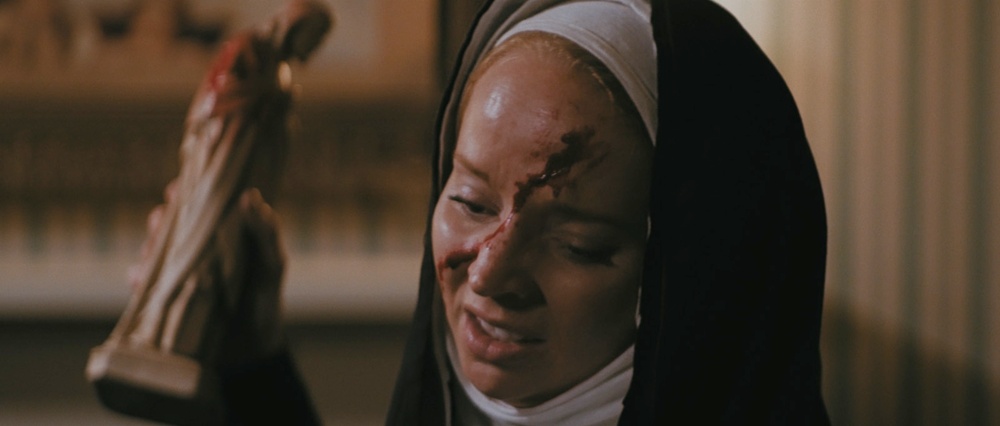
It’s 1944, and the World is at War. As Germany’s troops advance throughout Europe nothing much changes on the isolated Scottish isle where St. Augustine’s monastery resides. The caretaker (Paul Barber) is considering retirement, mentoring an ex-soldier, Daniel (Shepka), as his replacement, and rides to the mainland have become more frequent given the scarcity of products. One late and stormy night, A baby boy arrives on the monastery’s doorstep, swaddled and left in a small wicker basket. But when Sister Agnes (Winnie the Pooh: Blood and Honey’s Amber Doig-Thorne) retrieves the basket and brings it to Mother Superior (The Living Daylights’ Maryam d’Abo), the sisters soon begin to experience inexplicable events that drive them to unholy acts. Is the baby cursed, or is there something else driving the sisters mad?
Tom Jolliffe co-wrote The Baby in the Basket with actor-director Nathan Shepka, which certainly holds roots in a classic story. The first thought that crossed my mind while I was reading the synopsis for this dark tale of nunsploitation was how much it was steeped in Black Narcissus’ themes of isolation and madness, and as I watched, I could see more parallels in the costume and set design. A few of the catalysts have changed. There’s no high-altitude sickness or freezing Himalayan mountaintop winds to cause these women to give up their vows for Shepka’s David Farrar impersonation, instead allowing for the presence of a child to bring about that psychological battle. But while Black Narcissus is a fantastic film to Mad Libs in some B-movie fun, the premise sounds better than its execution.
Beginning with a cold open that seemingly has no bearing on the rest of the film a nun, Annalise (Legend’s Annabelle Lanyon), is chased around the grounds by a wolf. The wolf is an extremely good boy who looks all too happy to be chasing the habit-adorned woman. The music swells, grabbing the viewer’s attention due to its whimsical nature, which immediately breaks the fragile atmosphere it’s trying to instill. When it fades out to the caretakers drinking and swapping stories Lighthouse style, the focus then shifts to the odd costume choices for these characters that immediately look like it’s out of Charlie Sheen’s Two and a Half Men trailer.
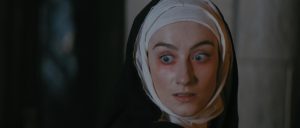
This conversation scene lasts for almost five minutes, providing oral insight into the time period, the war background, and the reason Daniel isn’t there. Still, this three-shot set-up carries no atmosphere for audience conviviality. Imagine putting on a movie and immediately losing interest just beyond the credits because the presentation couldn’t do anything very effectively. That was where I was. And The Baby in the Basket doesn’t get better right away, either. As Sherpka and Crane introduce us to a plethora of nuns with features that are so strikingly similar, you’ll have some trouble telling them apart when they’re wearing their habits.
As the film progresses, there’s a multitude of little things that aren’t great either. Most notably, a naked dance under the moonlight becomes this googled thought: When did body piercings become popular? Incidentally, they were not popular in 1944. Meanwhile, we don’t even get a sighting of the titular Baby in the Basket until we’re over the thirty-minute mark, and the story really doesn’t begin to pick up the pace until well after that. When it does, I think it’s a too-little-too-late scenario. Some of the film’s death scenes are somewhat striking, but by the time they arrive, listlessness has made the audience indifferent to the outcome.
Giving credit where it’s due, The Baby in the Basket is an ambitious overture by Crane and Shepka. Between the cast, which features talented young actresses and silver screen legends, the parts that are on location, and the cost of props and costumes coming from setting the film eighty years in the past, I’m sure the production cost a fair amount for a film that’s still considered low-budget. Still, there are things within the directors’ control. Editing, which Shepka is also credited with, for starters. I think there’s an interesting idea at play here, a sandbox concept that Ken Russell or Rose Glass would have a field day in. However, The Baby in the Basket never rises to the occasion as a symbol of maternity or even just to philosophically play into its WWII angle on the age-old ethics question of killing Hitler when he was a baby.
Unfortunately, The Baby in the Basket just isn’t for me. The film’s lack of atmosphere and detail, undercooked story, and surface-level psychology propel it into an uphill challenge for even the most wearisome B-movie viewer. Hopefully, others will have a better time, but I don’t believe it will be by much. I’m content to leave this basket alone.
Leave a Reply