Influencer horror is probably the subgenre that has taken me the most time adjusting to, but it is absolutely one that is on the rise. Movies like Influencer, #ChadGetsTheAxe, The Seed, Sissy, and Deadstream have blown up over the past few years telling stories about what’s beneath the veneer of internet personalities. My biggest gripe in many of these films comes from the caricaturish features of the influencer persona, reducing the craft of celebrity marketing to very simplistic, entitled personalities. Horror films often make influencers punching bags, and sometimes it works, but it can sometimes feel like a ranting complaint. Director Kaye Adelaide doesn’t seem to have that problem with her debut feature film, The Rebrand. A wholly original concept that shows all the dimensions of one particular persona as she falls from the graces of social media only to become caustically unhinged.

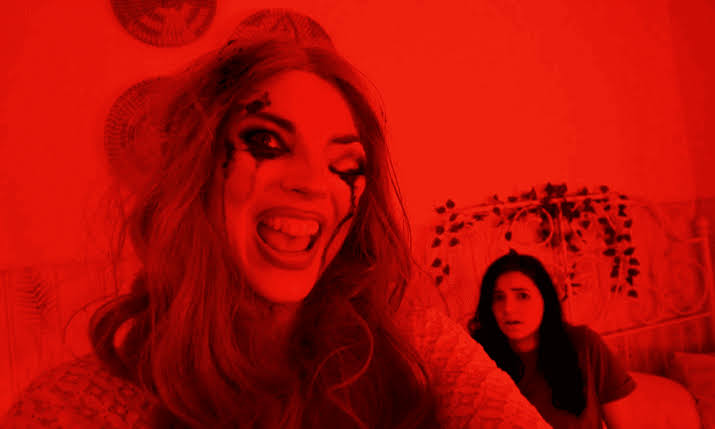
There’s a lot more than meets the eye to Adelaide’s film, which begins as an episode of an LGBTQ+ true crime news program presenting footage shot by Nicole (Naomi Silver-Vézina), an eight-months pregnant bisexual videographer, hired to soothe the ire of Blair (Andi E McQueen) and her wife Thistle’s (Nancy Webb) followers after a disparaging comment during a surprise livestream caused the couple’s public cancellation. Thistle and Blair hope that Nicole can help them recapture their audience by showing them what their daily life is like, until certain behaviors cause Nicole to question her safety in the social media trendsetters’ home. What starts as a documentary quickly becomes a horror story just as much about the audience’s voyeuristic social media habits as it is about the attention-seeking qualities of the personalities that make a living at it.
As I was saying before, the influencer subgenre has a history of getting caught up in creating annoying personas, presenting the most vapid, empty shell of a character to the audience, making it difficult to form a connection, and leaving it so that when the stakes rise, no one cares if characters live or die. It doesn’t do a whole lot for tension and excitement if the audience completely hates a character. However, writers Adelaide and Webb aren’t interested in that version of an influencer horror picture, opting to enrich these characters from the fictions they’ve constructed a reality from. And when I say reality, I mean it in the most Kardashian sense.
What The Rebrand gets right, and almost right away, is that it hinges itself on the strength of its characters and fantastically cast actors’ abilities. Blair and Thistle’s lives operate like a reality show while Nicole is filming, fusing that visual style into The Rebrand’s found footage concept. As Nicole learns more about Blair, she’s provided insight into Thistle’s domestic toxicity. Blair, a hobbyist painter, gets a visible kickboxing corner to further the narrative Thistle has created for her. Meanwhile, Blair’s passion and creativity are unleashed on canvas only to remain hidden in a dank basement hallway because it’s “not Thistle’s aesthetic.” And what is Thistle’s aesthetic? Pictures of Thistle, of course. And the walls of every room are adorned with them.
Webb and McQueen are phenomenal as The Rebrand couple on display, Thistle as a master manipulator and Blair as someone who only wants to make her happy, even at the expense of her identity, as she’s confined to dark corners of rooms and basements for a more on-screen friendly look to their home. Both actresses distill their performances with superb comedic timing, to a riotous extent at times, as situations become glitteringly awkward, then chaotically volatile. Adelaide and Webb recognize the ridiculousness of each escalating situation, provoking meta qualities through cynical reactions, sardonic positivity, and eventual violence.
The Rebrand also slyly recognizes opportunity based on analytics and algorithmic demographics, subtly commenting on the perception of queer lifestyles through meticulous curation and observable comfort, even at the discomfort of those involved. Thistle’s chameleon-like qualities are on display from the get-go, manufacturing drama to be seen later from Nicole’s first moments at the house in the name of good content, leaving many questions about Thistle’s mental state and how far she was willing to go to capture and maintain her celebrity in the first place. Cancel culture elements may act as the film’s catalyst, but they’re always there, bubbling up under the surface, occasionally popping on screen. Overindulgent apologies skirt things under the rug while echoing Thistle’s thirsty, deterministic desire to be adored, and her psychological id demands “yes, ma’am” compliance from Nicole to capture the carefully preserved fantasy life she’s manifested.

A lot is baked into The Rebrand that is worthy of discussion, including little nods to a supernatural aspect. This offers an alluring, albeit ultimately unnecessary, suggestion for Thistle’s behavior. Regardless, the inference is compelling and adds an interesting edge to the feature when you consider both social media’s persecutionary and focus-draining qualities. Unfortunately, revealing it outright may take away from the experience, and The Rebrand is certainly a movie-going experience you should seek out. The movie is nothing short of brilliant, and the fact that it hasn’t found a distributor is insane to me. The Rebrand not only joins Project MKHEXE as one of the best found footage films of the year, but it is undoubtedly one of the best horror films I’ve seen this year, underground or otherwise. And, at only eighty minutes, it tells one of the most madcap yet necessary stories for a world overly enchanted with its handheld devices.
Leave a Reply