
If I were to share with you the list of my most anticipated films of 2025, Izzy Lee’s House of Ashes would be circling the top of that list. Izzy Lee is the kind of director with a fearless eye for horror, often taking a politicized issue and intelligently contorting it to something even more terrifying. For instance, her 2019 short Re-Home took issues at the US-Mexico border to a whole other level, meanwhile a religious cult leader gets the hell he deserves in 2014’s Picket. There’s a reason Lee has had multiple shorts screened at a plethora of genre festivals across numerous countries, racking up more than a dozen wins and even more nominations. And, if you look at the cast of House of Ashes, you’ll see a list of extremely talented people (like Joe Lynch and Mick Garris) showing up in the film to support her. So, why wouldn’t Lee’s debut feature film be anywhere but at the top?
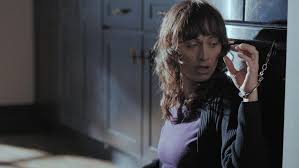
House of Ashes is a surrealist conjuring of psychological and supernatural elements, from another topic holding political space right now: Female autonomy. Fanya Sanchez (Tenants) plays Mia Sheldon, a woman who, after finding herself exonerated for her husband’s (Mason Conrad) murder, finds herself under house arrest after miscarrying their child. Deeming the incident a tragedy, the court takes it easy on Mia, but the court of public opinion has other theories, and they’re spreading like wildfire among podcasters and neighbors.
Mia’s only sense of stability in all of this comes in the form of Marc Winters (The Wheel of Heaven’s Vincent Stalba), an old friend who has come to Mia’s aid when she needed it most. Despite the many people calling him “Mia’s next victim,” Marc cares for Mia and tries to protect her from the onslaught of unsolicited opinions, that is, until his things begin to go missing around the house. Though Mia swears she hasn’t touched Marc’s things, he begins to get suspicious. When Mia claims to be attacked by something supernatural, Marc tries to convince her otherwise. The tension rises as the truth about Mia’s past comes hurtling forward in a place where neither is safe, and one cannot leave.

Sometimes, the movies you’re most excited about end up getting built up in your head, and I honestly think that is what happened with House of Ashes and me. As much as I appreciate the film’s exploration of the horrors that must absolutely be plaguing the minds of every woman living in America, the story’s structure is just a bit unwieldy. The film begins with exceptionally brief exposition, coming at you with “blink and you’ll miss it” pacing, setting up the whole movie to the day we arrive back at the house after Mia’s received her house-arrest-anklet. Marc is never introduced; he’s just there, leaving the audience to decipher his role within Mia’s new life. Yes, time has passed for Mia, but understanding that isn’t easy because of how quickly the film glosses over everything at the start.
But, ok, that’s a unique problem to have, right? Too much story? So, ok, where will House of Ashes go next? Mia is stuck in the house, making House of Ashes a chamber piece. Outside of the bedroom, kitchen, and living areas, Mia’s just not going anywhere. But right off the bat, we fall into the tropey parole officer piece as Mia forgets to charge her anklet, then she’s slipped drugs by Marc, and then we’re questioning whether what we’re seeing is real or not, because our POV character is wondering the same things.
In all honesty, House of Ashes was beginning to remind me of a 2008 Famke Janssen film called 100 Feet, in which a woman is confined to house arrest after killing her abusive husband in self-defense, only to stand at the crossroads of trauma and the supernatural as she begins to believe he’s haunting their home 100 Feet isn’t as ambitious a film as Lee’s is, but there were some striking story similarities.

Lee, however, keeps things fresh by diving deep into sociopolitical commentary, shining a light onto women’s rights issues by showing how terrifying all of this is from Mia’s perspective. There’s a nosy true-crime podcaster circling the house attempting to co-opt Mia’s story for likes and subscriptions. The overt aggressiveness of the parole officer is meant to make her feel small, defenseless, and scared. And then there’s Marc, who begins gaslighting her for all the things in the house that have gone missing. Meanwhile, Mia’s struggling with the years of trauma she probably has never had the opportunity to unpack, while those around her think she’s a monster. These pieces are well-baked into the storyline and showcase Lee and co-writer Steve Johanson’s terrific allegorical abilities to highlight the various ways this male-dominated society is letting women down.
Lee, of course, is right, and House of Ashes becomes captivating in that sense as you watch the metaphoric haunted house story play out. As the film comes to a close, many story elements come together and provide a sufficient ending, though one most will see coming. However, Lee’s final shot of Los Angeles reveals an imminent nightmare taking place in a liberal location. The idea being that in a post-Roe world, even the blue states are not immune from events taking us back in time and forcing women into homemaker roles, maybe even leading to women being locked up and objectified in cases we have little modern precedent for. The film’s catalyst may be the loss of a child, a torment most wouldn’t wish on their greatest enemy, but Izzy Lee has morphed it into a relevant horror story surrounding the loss of female bodily autonomy that would have Margaret Atwood cheering.

Though the structure of House of Ashes didn’t exactly agree with me, I greatly respect what Lee’s film opposes. The cosmic horror lighting helps viewers consider the unique smallness of the individual against the daunting reforms this administration seems to pass every day, especially as they narrow women’s civil rights. That alone, I think, makes it worth a watch. Still, there are some moments where House of Ashes meanders, possibly to illicit a disquieting atmosphere, but sometimes comes across as a little disconnected. But hey, I’m just one person, and Lee’s been getting a lot of great reviews for House of Ashes from others. For me, it’s solidly in the middle of the road, but I still look forward to her future endeavors.
Leave a Reply