There have been so many films and stories about vampires over the years that it’s always intriguing to find one that has a novel take. That’s where the new film, LandLord, has its hook: its central baddie is a vampire who doesn’t need to be invited in, as he owns the homes where his prey live. Sitting down at my laptop to interview its writer, Remington Smith, I had lots more to talk about than just that, though, starting with the visual style.
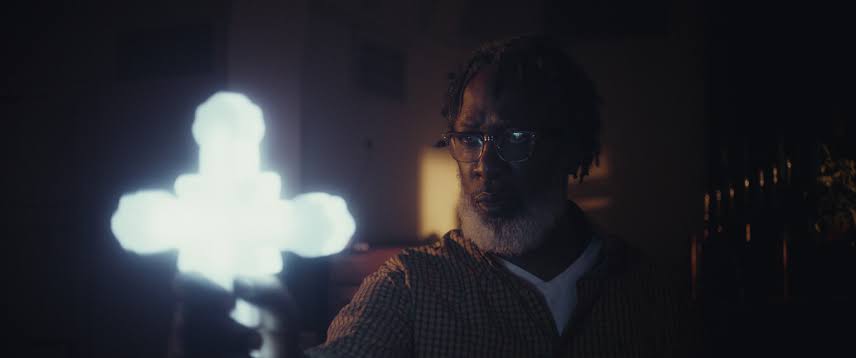
“From a very, very early stage,” he said, “maybe 2014 when it started to percolate, I knew I wanted to make a horror film that was balanced between John Carpenter’s The Fog and Andrea Arnold’s Fish Tank. When I saw Fish Tank, maybe in 2010, Mia’s life was spot on for my experience growing up, wanting to get out, and struggling with poverty. Seeing it depicted like that, in a way that was really empathetic and honest… But then also I’ve loved horror movies all my life: I think my Dad showed me The Monster Squad when I was, like, five; that’s like The Goonies versus Dracula. So especially as a kid growing up, struggling to get out, seeing these kids going up against life or death situations: that was always emboldening, encouraging. So with LandLord, I was kind of funnelling those two different spaces that got me initially into film, and enriching the experience now that I’m an adult and trying to level up with my work. I thought this could be an interesting visual collision that I hadn’t seen before.”
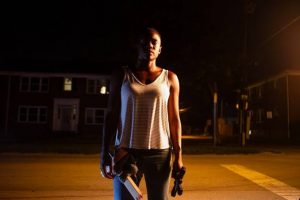
The social setting had been something I was going to ask about too: the story had plenty to say about class—along with tenancy—which, to me, brought back Candyman, with housing complexes of different kinds. I asked how the social setting influenced the story of LandLord. “When I grew up, as I say, experiencing ‘sample platter poverty’, a lot of different kinds of poverty; whether it was living in apartment complexes on the north side of Portland, Oregon, or living in trailer parks in rural Alabama, we moved around a lot. And it’s only in hindsight, of course, when people tell you what your work is about, people noted that in all my work, whether it’s documentary or horror, that place and space is a big hallmark: that made sense. I recall a couple of apartment complexes where even if things were a little bit rough in terms of how you pay the bills and get by, and I was the oldest of eventually four kids, thinking how could I help my Mom. Some apartment complexes felt almost like their own self-enclosed ecosystem, and in a way, idyllic because some of them, yes, were really rough, but there were others where the apartments all faced inwards with cars parked outside in a ring, and inside was a grassy courtyard. I think that was the thing I really appreciated about Fish Tank, or Sean Baker’s The Florida Project: not everything is super grim all the time when you experience poverty; there is still beauty, there is still joy. Especially Hollywood interpretations of poverty and issues of race: it always feels like it has to be said in the most didactic way possible, whereas that’s just not my lived experience, where these things are unstated, but they are visible. It’s so interesting to be able to pick up a camera and portray these things. So I spent a long many nights driving round trying to find the right apartment complex here in Louisville, and unfortunately one random location backed out on us just when we were getting ready to shoot, and ‘oh my God, what am I going to do?’ so went driving round some more, and went back asswards into the perfect complex that I’d been looking for this whole time. So it’s very fortunate.”
I had wondered about the locations and the scouting process. I asked Remington whether there were any that had such a strong character so as to develop some meaning of their own and influence the story as it went along. “I think there were a couple of places,” he said. “I had written the church showdown a little bit differently, and then when we actually landed on the church that would allow us to film the horror movie, my pitch to them was this is social commentary about America, and American history; asked them to check my documentary work. Told them we’d get things a little bloody, but it’s not just violence for violence’s sake. And so there were some specific things about the locations: we weren’t building any sets, so it was about how I’d mould the story with what was there. So the climax of that sequence did change, but I felt we really did bring something interesting with that changed.
“The other one was the scene where the kid hero, Alex [played by the marvellous Cohen Cooper], is being held captive by the vampire, and when we were scouting, there were these old school mansions we were looking at, a historic place with opulent-looking floors and it still looks very nice. But then there’s this random storage space on the third floor with bare wood floors and a wall on one side and wild—as you’ve seen—black and white animal print wallpaper. Through the course of the film, I realised there are lots of predator/prey relationships; and because of my documentary background, I’m used to shooting everything, especially nature, that’s in the space: so when I saw this wallpaper and then the blood red, I thought well I don’t know a hundred percent why they’re going to put him up here, but we need to have a scene here because it’s just so interesting and wild. So I stopped calling it location scouting and started calling it ‘location casting’, because it’s just so important to get the right space to nail that kind of character.”
The relationship between Alex and the main character, an unnamed bounty hunter played by Adama Abramson, reminded me of She Never Died (which played at Grimmfest in 2019) in its similar vibe. Apparently, Remington hadn’t seen that, so I asked what his influences had been: “One of the starting points was The Monster Squad; I’d always been interested in kids put in dire circumstances, but then they have to hold their own. Stephen King is really good with that, too. My experience is that you’re not always going to have adults there to look out for you; it’s the sad truth that you need to be able to fend for yourself. Alex was coming from that. I guess it was also influenced by The Professional and that dynamic of somebody trying to help a kid out who is in dire circumstances. That one was maybe a little less conscious, because a big one was Forest Whitaker in Ghost Dog: The Way of the Samurai. I figured our bounty hunter would be a little more revealed and less stoic than Whitaker’s Ghost Dog, but that was like another lode star. There was a sense of breathing pace to the movie, and we’ll take off at certain points, but I kind of liked how—in some ways leisurely or methodical—films like Ghost Dog or No Country for Old Men lay things out for you, there’s no hurry, and hopefully you’re in for the ride.”

LandLord’s pace was indeed unhurried, which made it more realistic than a typical action film or indeed most other vampire films. “I remember hearing about the way a lot of the dynamic range went out of music,” Remington said, “I guess with the advent of the digital age. In wave forms, you’d see a spike and then a quiet spot, another wave and a quiet spot; so you’d have contrast. In the writing, shooting, and editing, I tried to make sure there’d be contrast. I’m not trying to bore anyone, we’ll be going to move things along, but at the same time, it’s not just going to be hitting you all the time, like a pop track at constant volume: you get numbed to that. So it was exciting to play with that, especially in something like the projector scene, with the vampire, side-by-side with the second act climax for contrast.”
So moving on to the character of the vampire! I was interested to hear about the process of choosing elements of vampire lore; vampire mythology is so rich and complex. Remington had zoomed in on one element (about needing to be invited in), so I asked whether he made deliberate choices about elements to reject or make his own. “I think part of it is deciding which track you’re going to be in,” he said, “because the rules vary a little bit, depending on which medium. So as you’re writing, you have to decide what the logic is, even if it’s not explicitly stated. Part of it was I didn’t want anything super crazy supernatural; I wanted to hold on to the idea that he was originally human at some point. And at the same time, some of the rules, like how you get turned, I think you’d have to drink their blood after they drink you, unlike some films in which you just have to get bitten. But I think the most interesting thing was looking at what makes a good villain, and talking to people about their favourite cinematic villains, and realising you want them to want something. But I’d written in his backstory that he’d been around since the 1690s, so what would you want anymore? That’s why I had to try and make it a character the audience could relate to in some way. I mean, Alan Rickman is great because he’s smart and he wants something, he’s not just a bad guy, you can understand his motivation. So that’s why I had the projector scene of my vampire watching a sunrise, it was a very human thing, and it pointed to the way we always want one thing we can’t have.
That mention of back stories reminded me: I had really been intrigued to know more about some of LandLord’s characters. I asked Remington if everyone was fleshed out and whether there was more to be explored in that world. “I don’t know if there is more to tell in that world,” he said, “but in the writing process, I recall someone recommended to do character bios, especially when you get stuck. It was really lovely to have the time to develop these things, because I was kind of drawing on the prose of Stephen King and the way he would lay out stories like Salem’s Lot with an omniscient point of view. Just for myself, and drawing on my history degree knowledge, I asked myself if this vampire has been around since the 1690s, where has he been since then? What was America like at that time? Where is he going throughout this period to get to the present? It became a fun exercise, allowing myself to play and figure out who these characters are. By the time you’ve fleshed that out, you can see OK, given X scenario, and this bio, I know how they’d respond. And if they’ve been around this long, how inured they are, and how familiar they are with people coming to get them. So it was really lovely to have, and even better when recruiting actors, and I’d got this document to give them, which no one else had seen; it was great, but it did give me pause to think I hope I didn’t write anything really off. But I think it helped to get more of the buy-in, and to show it had been thought through from all angles.”

Moving away from Remington’s own work on the film, I now asked about his collaborations and working relationships with others in the team. “I think the biggest one is our talent,” he said quite decisively. “We were very fortunate to get Adama Abramson to be our lead, the bounty hunter, and she happened to be local here in Louisville, Kentucky. I just remember the tape was great, and then my process of casting; well, maybe there’s a better way to do this, but I just said, ‘let’s go for a walk. There’s a park nearby with an overlook, takes about an hour: let’s take a walk and talk.’ That gave a real sense that she’d be someone I could work with on set, with night shoots and whatnot; as well as finding out her backstory, along with what I’d already got lined up for our bounty hunter character. And it was a similar process for audition tapes for Cohen Cooper, who plays Alex, the kid, and William McKinney, who played the vampire. His audition tape; well, my wife was watching the tape with me, and he made us jump with the choice he made, so we knew we had to work with him. That holy trinity had us made, and we were also very fortunate to have them aboard.
“There was a very similar series of happenstance with our cinematographer, Nate Spicer: he’s one of the best cinematographers here, I thought we wouldn’t be able to get him, but fortunately for us, he was available. We had known each other already, so a lot of the process was about making sure the script was as tight as it could be. I was pitching crew members almost like they were investors—for a low-budget indie, they kind of are—and so you kind of get a sense of whether he’s a person you can communicate with: that’s what I was looking for with the cinematographer. I’d had a previous situation where it had felt that there wasn’t much communication, and it felt isolating; I needed someone who would be as babbly as me, so I’d know what they were thinking, how they were feeling, like what would make the film better. I was very fortunate to get that partnership with Nate. Similarly with Joe Stockton, who did our music; I met him at a Halloween party in 2018, told him about this idea, and he said, ‘Oh I do music,’ then later I found out that his partner and my wife had been trying to separate us for the last hour of that conversation, a little annoyed at us. But ever since, we’d stayed in touch and been talking about the development process. With those kinds of relationships, it can only make the end product better, because you have the rapport and the similar energies. If you’re not on the same page and don’t have the same energies, those are just speed bumps that you’ll encounter. So it was very fortunate to have the team we had. Oh, then Madelyn Shea doing practical effects that I’d always wanted to do since I was a kid. She’s a University of Cincinnati recent graduate, and was doing practical gags of leg wounds and so on. We did a camera test and I just couldn’t believe what we were getting: it was a dream come true to be able to raise just enough money to get these amazing people to bring it to life.”
I’d honestly love to know more about what comes next in the world or story of LandLord, but perhaps to Remington Smith, it is complete. “Yeah, that’s it now,” he admitted. “Unless I find myself in an enviable position like with The Descent or Halloween 2, and give me a load of money to be an executive producer to carry it on…”

The one who had really intrigued me was the bounty hunter’s boss on the end of the phone line. “My advisor from college, when I was running the campus movie theatre: I lured him out of retirement to be our unit production manager and to be that character. Because I always imagined him as Stu [Stuart Neff], he just has a kind of gruff, lovable demeanour, once you get past his side-eye. It’s always the tricky question of how much past the tip of the iceberg do you show? You don’t need to see everything, just enough to get a sense of the world. But if someone else wanted to take a crack at it, that could be fun.”
Inappropriate or not, I couldn’t help showing my age for a moment with a joke about the unseen boss on the end of the phone in Charlie’s Angels! Thankfully, Remington laughed, too.
Leave a Reply