Intelligent satire, humour, a demon and a cult actor or two: count me in. Portal to Hell was surprisingly deep and actually raised lots of questions, too, so I hardly knew which one to start with when I sat down at my laptop to talk to Woody Bess, its writer and director.
The film’s tone blends deadpan comedy with genuinely unsettling horror, as well as contemplative philosophy at times. I decided to start by asking Woody whether there were any particular moments when he had to decide whether to push more in the direction of absurdity versus realism. “Always, yeah,” he said straightaway. “I guess it’s a weird tonally film, because when I wrote it we were like, if there’s a scary scene, there has to be a funny scene next; and if you have an emotional scene, you have to have funny or scary next. I wanted to keep it going like this, and you’re right, it does deal with some heavy themes; but I’m a big believer that movies should be fun: the world is dark enough as it is. The tone was probably the hardest thing to get right. Even with test screenings and the edit, we had to be mindful of that the most.”
I guessed that was probably most tricky as the film included a prominent character who suffered from cancer; Mr. Bobshank, played by Keith David. I commented that it must have been great to work with such a veteran actor, and asked whether Keith David had led the development of his character at all. “Of course,” said Woody. “With regard to your last question, Trey Holland, who plays Dunn [the film’s protagonist], had also been in my last film; I knew him since we were friends at school, and we started shooting on our own together. We shot the apartment scenes, and then we got Keith, and he’s like the greatest actor in the world: The Thing is my favourite film, and he’s an incredible, kind person. We shot his scenes, and it was so grounded, very different from when we shot the apartment scenes. So we went back and looked at what we’d learned from things he’d told us, about the craft of acting and how we should go about directing; and that informed the whole tone of the movie so we reshot most of those earlier scenes to match that tone, and because we’d learned so much. Until that point, it had been all about me and Trey just making each other laugh in the small apartment.”
Trey seemed to be beautifully cast for Dunn; I asked Woody whether Dunn’s character had been written for Trey. “Yeah, he was in my first film, when I was a student at USC, and we kind of just became friends and played video games for ten years. We always talked about making a film, but Hollywood is hard. When the pandemic hit, things kind of fell apart, so we said let’s do it ourselves, but had no idea how hard it would be or how long it would take.”
I found Dunn’s character interesting in the way it was made up of many human elements: sometimes, he was awkward; other times, doing his best to be professional on the phone (a credit controller by trade). Alongside that well rounded personality, he also had a complex dilemma to work through when he encounters a demon. I asked Woody whether he had given Trey specific instructions or reference points for him to balance these traits, or whether the script was sufficient for him to simply run with it. “Trey works really hard,” Woody said. “I would write in the script pages of notes about the characters, but for a long time, it was just the two of us goofing around; but as Trey is also a producer he was involved in the edit and we’d go through and make sure we’d got it all right afterwards.”
The portal itself in Portal to Hell is to be found in a laundromat (or laundrette, as I’d call it here in the UK). I asked Woody why he chose that everyday setting for a pretty intense experience. “I wish I had a good answer for that,” Woody said. “In LA, we have a lot of cool locations, so we could have put it anywhere. It was a visual thing: I just thought it looked cool: something so mundane that you go through every day.”
There was one particular moment that had brought home the mundanity to me: a scene in which Dunn and the laundromat’s manager discussed what they should do about the portal, and she simply puts a sign in place so that customers don’t go too close. What else can one do? And the down-to-Earth setting had reminded me very much of the Circle K in Bill and Ted’s Excellent Adventure.
As is often the case when a human meets a demon (so hopefully this isn’t much of a spoiler), Dunn is presented with a bargain; and the question of how to respond to that forms the ethical dilemmas that make up much of the film. Until that point, Portal to Hell comes across as fairly light, but then suddenly, ethically unsettling. I asked Woody how he ensured viewers would feel both these emotional extremes, and did he ever consider leaning more heavily into one direction; it must have been tough to navigate. “I’m not really sure,” he said. “But the world is tough, to be honest. It’s easy to look and see good people and bad people, but that’s not true: all of us are a spectrum of good and evil. Dunn has to get over that simple belief. I guess that making it light is a response to how the world is heavy: I want people to have a good time with this movie.”
I couldn’t help asking Woody: if he was in Dunn’s shoes, how would he go about choosing someone to send into the portal? “I would get out of there,” he laughed. “I guess every day, we allow evil to exist. I mean here in the States, we know our healthcare is messed up, there’s gross inequality, there’s homelessness: it’s easy to just walk by and think ‘this problem is too big for me, I can’t fix this portal to Hell’. It’s kind of like this reaction exists.”

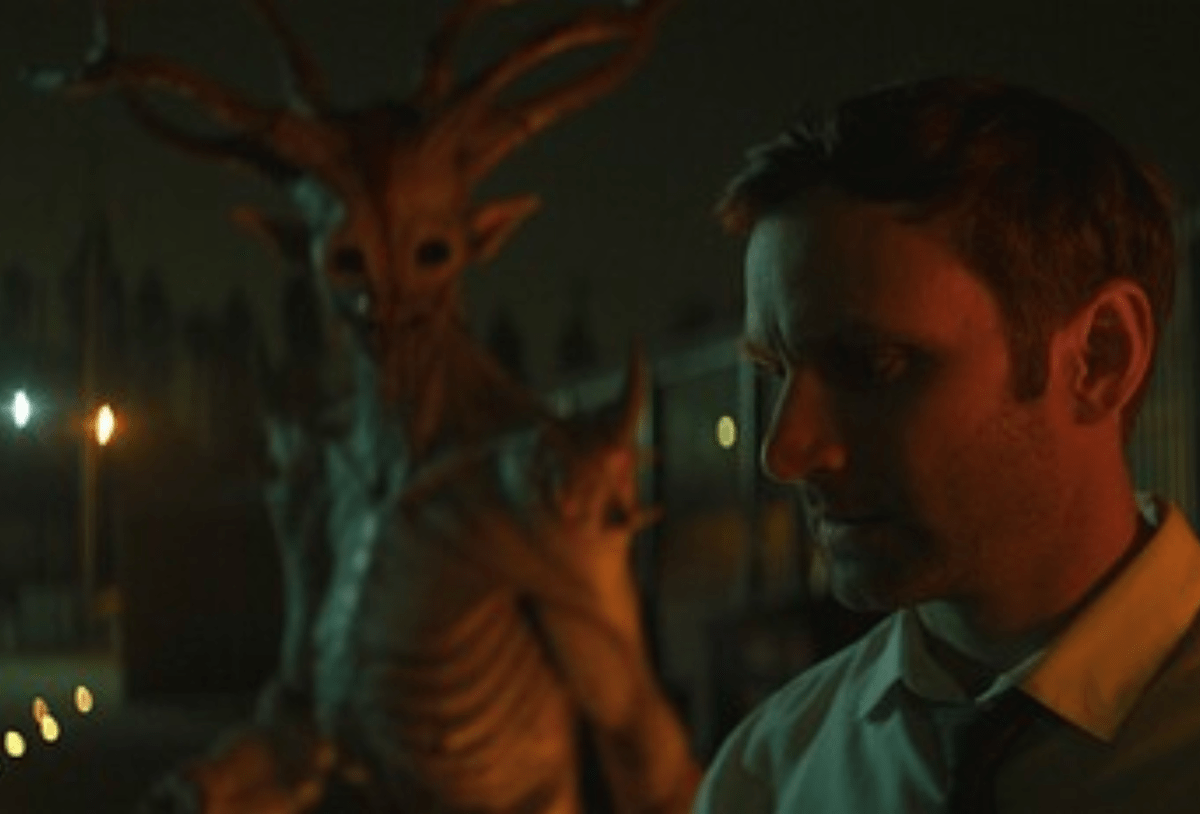
The demon (played by Trevor Newlin and voiced by Richard Kind) is just as down-to-Earth as the setting. I particularly liked the way Dunn and the demon – called Chip! – simply had a conversation in the yard when they first meet. Visually, he wasn’t at all flashy, either, but quite underplayed. I asked whether there was a philosophy or constraint that led to the restrained use of practical effects rather than going for pure spectacle. “Both,” Woody said. “The Thing is one of my favourite movies, and if you watch the original film, it holds up much better than the 2010 remake, because they were all practical effects. That was actually one of the later scenes we shot, because for the longest time, the notes just said ‘a demon shows up’, and I didn’t figure out how to do it. It’s right here [he said, pointing to the mask placed on the furniture behind him], and it’s just a Halloween mask, basically. We went to a bunch of mask makers in Los Angeles and we ended up talking to this company called Immortal, who are really great; they do silicone, which is tight onto the face. They weren’t able to make this because of the horns, they couldn’t support the structure of that, but said they could hook us up with latex mask moulder if I could do the sculpture. Custom masks were getting costly, and I guess they should be, so I ended up sculpting it out of clay myself and went to this guy up in Oxnard called Nelson Cooper and he did the moulding. The rest of it is a body suit from Immortal. So it’s ninety percent practical. The actor in the suit, Trevor Newlin, is in everything right now: he was the xenomorph in Alien Romulus, he’s 6’7”, one fifty. We did that, and had Richard Kind voice the demon after the filming. The effects were done by Baked Studios; they added a little bit of movement, such as to accentuate the mouth with some jaw movement. So it’s a combination of practical and VFX.”
Of course: there were two different people playing Chip, the demon. I asked Woody whether they got together to work on his character. “That’s actually the weirdest thing,” Woody said. “Trevor is an awesome character, and he came in with these mannerisms and point of view; then after the fact, we got Richard Kind to the voice the demon. We went to New York to shoot it, and he watched Trevor’s performance, and built the character from that, which was cool to see.”
There must have been many things to think about; dialogue, story, location, people, etc. I was curious to ask whether there were any plot points or alternative endings that perhaps didn’t make the final cut. “Not really, to be honest,” Woody said. “We spent a lot of time on the script and were then true to it. When we were in New York, we’d shoot a scene at Times Square just for the fun of it, and ended up not using it, but that’s it really. There were no crazy changes. Our first cut was longer, mind you; we did cut about twenty minutes from the film. That was mostly dialogue that didn’t really add anything or wasn’t funny.”

Thinking back to Woody’s earlier comment that the tone had been the most difficult element, I asked whether he was planning to do something different next, or stick with a similar style with his next endeavour. “I’m such a big horror fan,” he said. “I love Little Shop of Horrors and Shaun of the Dead, but I tend to watch grittier horror. I really like The Thing as I said, and Hereditary, and Weapons was really cool. I want to make a horror that’s horror first, and comedy a distant second; if I get to make a second film, that would be it.”
I really hope he will!
I’ve read some positive responses to the visual style in Portal to Hell and use of expressive lighting, especially around the portal scenes. I asked Woody if he could share a technical or aesthetic decision he made that was particularly risky or experimental. “For work, I mostly DP [Director of Photography], so I’m way more comfortable with lights than I am with actors, actually. The portal was practical: there have been a lot of cool advancements in lights which are 300D, a pretty powerful light, but it can run on V-mount batteries; which is cool, because it’s really just a big light in that washer. It’s all practical, no VFX at all. Occasionally there’s a bit of orange light showing through, which is a bit of the base, but we just had to smooth that a little. When I was a student at USC, we had an incredible professor, Bruce Block; and he would look at visual escalation in films like The Shining. He taught us that in The Shining, red is the colour of evil, and the colour of geometry: in the scene with the travel agent, everything is pink and messy, then when we get to the Overlook, things get more and more red and symmetrical. You can’t just put actors in front of the camera and have them say their lines; you need to think about the backgrounds and how things escalate. In Portal, Dunn is a guy whose world view is that people are black and white, but he learns that things aren’t that simple, so we just bled colour temperatures: if you look at the background of his office, there are more pops of colour the further he goes on this path. It’s just stupid subtle things like that which stuck in my head from that one professor, but it’s important and cool; and I wish that I’d studied better, but I did think a lot about the lighting.”
Thinking back to the demon’s dialogue and everything he told Dunn about how things worked, I recalled mention of Heaven and Hell, but no reference to any specific religions. I asked Woody if it had been his intention to keep the creed generic, unlike, say, A Dark Song. “I guess keeping it ambiguous allows everyone to see a bit of their own belief in the movie,” he said. “All religions try to say something about being a good person, and what Dunn is struggling with is the question of whether you can be a good person if you have to do bad things.
Leave a Reply