We’ve already ventured into the coffin of Hammer’s Dracula — that blood-soaked fever dream that redefined Gothic horror and drenched British cinema in technicolour blasphemy. But before the Count ever bared his fangs, before Cushing and Lee carved their names into horror’s stone altar, there was another experiment — quieter perhaps, but no less revolutionary.
That experiment was The Curse of Frankenstein (1957).
If Dracula was the scream that echoed through the night, The Curse of Frankenstein was the first spark — the act of creation that gave Hammer its monster’s heartbeat. It wasn’t Hammer’s first horror film in the strictest sense, but it was their first true Gothic — the one that cracked the coffin lid and let the monster free.
And like the creature itself, it was built from the bones of the old world — and struck alive by an unholy new vision.
The Resurrection of Horror
Before The Curse of Frankenstein, British horror was a polite ghost story — all restraint and implication, still haunted by the shadow of Universal’s 1930s classics. The monsters had been tamed, declawed, embalmed in nostalgia.
Hammer blew the dust away.
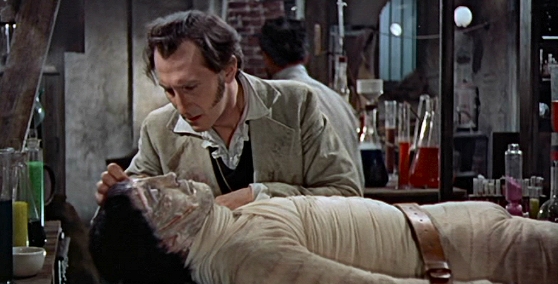
Under Terence Fisher’s direction, they didn’t remake Shelley’s tale — they resurrected it. They dragged it out of black-and-white morality and into flesh and colour. The old laboratory of creaking coils and cardboard lightning was reborn as something tactile, sensual, real.
Gone was the sympathetic creature, the tragic groan of Karloff’s misunderstood giant. In its place stood Peter Cushing’s Victor Frankenstein, lean, elegant, and absolutely ruthless.
Cushing’s Frankenstein is not tormented — he’s exhilarated. His pursuit of knowledge is pure and unrepentant, his morality surgically removed. Every soft-spoken word drips with obsession. You can see the hunger in his eyes — the god complex masquerading as intellect.
And when his experiment takes shape — Christopher Lee’s monstrous creation, stitched together like a crime scene — it’s not a moment of horror, it’s triumph. The creature’s twitching resurrection is a prayer answered in blasphemy.
This was Hammer’s statement of intent. They weren’t going to whisper horror anymore — they were going to make it bleed.
Colour, Carnality, and Controversy
To understand what The Curse of Frankenstein did to audiences in 1957, you have to imagine Britain before the flood — conservative, repressed, terrified of the body. The idea of showing blood, even a splash, was considered indecent. Horror was meant to be shadowy, tasteful, a safe nightmare.
Then Hammer came along and said: No.
Using Eastmancolor, they painted horror in flesh tones and arterial red. This wasn’t a black-and-white fairy tale anymore — this was the smell of iron and decay made visible. The moment blood appeared on that bright screen, British cinema lost its innocence.
Critics called it depraved, sadistic, obscene. Which, of course, meant it was doing its job perfectly.
The violence — mild by today’s standards — hit like a crucifix hurled at the altar. Acid burns, severed limbs, the raw texture of death. But it wasn’t exploitation for its own sake. It was aesthetic defiance. Hammer’s gore wasn’t crude; it was ritualistic. The blood was part of its art.
Fisher shot horror like a painter studying the corruption of beauty. The glint of scalpels, the trembling flesh under candlelight, the elegant chaos of Cushing’s laboratory — every frame breathes with perverse life.
And underneath it all was something forbidden yet irresistible: sensuality. Horror and desire intertwined. It’s not just about fear — it’s about the thrill of transgression, the lust of creation, the ecstasy of playing God.
Frankenstein the Creator, Not the Victim
Where Universal gave us a monster we could pity, Hammer turned its gaze inward — at the creator himself. Cushing’s Victor Frankenstein is a creature of intellect unbound by morality. He’s the ultimate British villain: polite, precise, and entirely without empathy.
When he speaks of science, it’s like a sermon; when he dissects corpses, it’s with the detachment of a saint performing communion. Fisher understood the subtext — that the real monster of the modern age isn’t the beast in the lab, but the man who believes he’s above consequence.
And that’s where The Curse of Frankenstein becomes more than just horror. It’s allegory. Post-war Britain was knee-deep in scientific pride and atomic dread. Man had split the atom, rebuilt cities, and convinced himself that progress could justify any atrocity. Frankenstein is that arrogance incarnate — the gentleman as The Devil, wearing civility like a mask.
There’s something almost satanic in his composure. He knows what he’s doing, and he doesn’t care. That’s the real curse — not the creature, but the mind that creates it.
A Gothic Rebirth
Visually, The Curse of Frankenstein redefined what Gothic cinema could look like. The sets aren’t haunted castles anymore — they’re gilded cages. The colours are lush but suffocating, every velvet curtain hiding decay beneath.
This was Fisher’s genius: he understood that horror isn’t just darkness, it’s contrast. The beauty of Hammer’s world makes its horror more obscene.
And in this film, the atmosphere breathes. You can smell the formaldehyde, feel the damp stone, hear the quiet hum of obsession in the air. It’s Gothic not as style, but as psychology — decayed splendour, doomed intellect, beauty corrupted by its own reflection.
If Dracula was Hammer’s explosion of lust and predation, The Curse of Frankenstein is its intellectual evil — the cold, deliberate sin before the passion took over.
The Shockwave That Followed
The reaction was pure outrage. Critics dismissed it as sadistic, immoral, a perversion of Shelley’s classic. The Catholic Church condemned it. Audiences queued around the block.
Hammer had found the formula: class and corruption, blood and beauty.
The success of The Curse of Frankenstein gave the studio its identity — lush colour, shocking violence, and a distinctly British sense of wicked sophistication. Without this film, there would be no Dracula, no Mummy, no Plague of the Zombies. This is the seed from which the Hammer empire grew — the moment Gothic horror stopped being American nostalgia and became European decadence.
And the impact didn’t stop there. You can trace its influence through the decades — into the crimson dreamscapes of Argento, the decadent monstrosity of Hellraiser, even the restrained moral horror of The Witch.
Every modern horror that mixes beauty and brutality owes something to The Curse of Frankenstein. It taught filmmakers that fear could be aesthetic, that the grotesque could be beautiful, that the monster could be us.
The End That Isn’t
By the film’s close, Frankenstein faces judgment — but it isn’t redemption. He pleads his sanity, demands recognition for his genius, and, most chilling of all, he doesn’t believe he’s wrong. There’s no lesson learned, no cautionary tale. Just arrogance echoing into the void.
That ending — Victor awaiting the gallows, unrepentant — is Hammer’s true signature. It’s the moment horror stopped being moralistic and became existential. The evil isn’t punished, it’s understood. The monster’s isn’t out there, it’s in a tiny cell awaiting execution and wearing a human face.
The True Beginning of Hammer Horror
So while my last article, on Dracula, covered Hammer’s most iconic creation — the fanged symbol of the studio’s power and erotic menace — it’s The Curse of Frankenstein that made that possible.
This is where the formula was forged. The blood, the colour, the moral inversion, the Gothic grandeur — all of it began here, in that laboratory, with Cushing’s cold precision and Fisher’s perverse eye for beauty.
This was Hammer’s birth cry, their act of defiance, their artistic sin.
The Curse of Frankenstein didn’t just bring a monster to life — it gave horror itself a new anatomy. Flesh, blood, intellect, and damnation stitched together into something unholy and magnificent.
This was the moment the corpse twitched.
The night began to stir.
And Hammer Horror was born screaming.
Leave a Reply