After the blood and blasphemy of The Curse of Frankenstein, you might expect Hammer’s next foray into horror to keep that arterial flow going — another plunge into the lurid, the violent, the gothic. But instead, they went cold. The Abominable Snowman (1957), directed by Terence Fisher and written by Nigel Kneale, is the quiet, haunted breath before the scream.
It’s a film of mountains and silences, of men chasing monsters and finding mirrors. Less horror in the traditional sense — no dripping crimson or stitched abominations — and more of a creeping spiritual unease. Yet it’s every bit as vital to Hammer’s evolution. This is where the studio proved it didn’t need to rely on gore to unnerve you; it could freeze you instead.
If The Curse of Frankenstein was the spark that lit the gothic inferno, The Abominable Snowman is the blizzard that followed — vast, desolate, and strangely sacred.
A Different Kind of Darkness
Released the same year as The Curse of Frankenstein, The Abominable Snowman could hardly look more different on the surface. There are no castles, no mad scientists, no blood-spattered corpses. Instead, we get the icy slopes of the Himalayas and the flickering glow of expedition lanterns. But make no mistake — this is still pure Hammer horror. The horror isn’t in what we see. It’s in what we think we know.
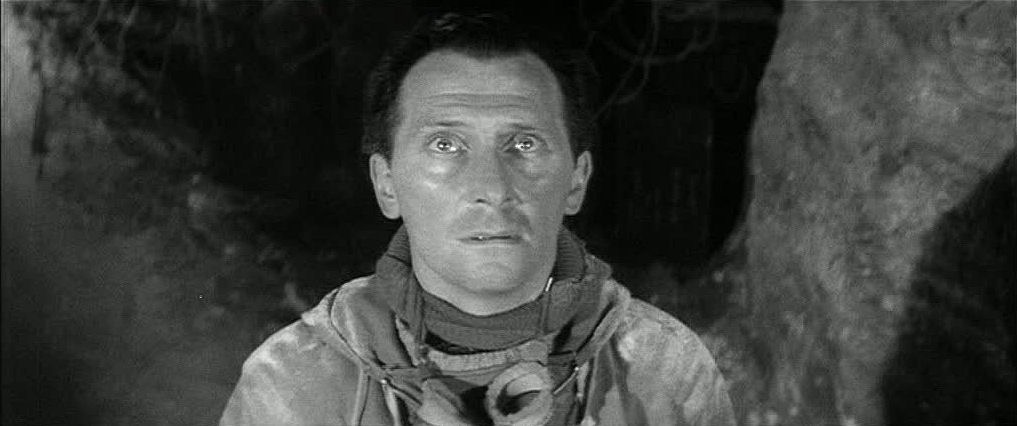
Based on Kneale’s BBC teleplay The Creature (1955), the story follows Dr. John Rollason (Peter Cushing again, in one of his most quietly powerful performances) — a scientist accompanying an expedition into the mountains to find proof of the legendary Yeti. Alongside him is Tom Friend (Forrest Tucker), a brash American adventurer more interested in fame and profit than enlightenment.
What unfolds isn’t a monster hunt. It’s a moral test.
Fisher’s direction and Kneale’s script turn the expedition into an autopsy of human arrogance. Every icy gust, every echo in those mountains feels like judgment. The deeper they go, the clearer it becomes that the real beasts here are the men themselves — driven by greed, pride, and fear of the unknown.
Hammer had just birthed its modern horror identity with Frankenstein, a film about the dangers of scientific hubris. Here, it refined that theme into something colder and more spiritual.
Cushing Ascends
Peter Cushing, still fresh from redefining Victor Frankenstein as a figure of obsessive intellect, delivers a completely different kind of madness here — the madness of belief. His Rollason isn’t cruel or driven by ego; he’s plagued by conscience. He seeks truth, but he’s terrified of what that truth will demand of him.
Cushing’s face — that perfect canvas of restraint and conviction — carries the film’s emotional weight. You can see the shift in him as the expedition begins to unravel: the way reason falters before awe, the way science bends under the pressure of something vaster, older, and mercilessly intelligent.
This is where Cushing truly became Hammer’s soul. He could play the monster-maker or the martyr with the same conviction because both roles stem from the same place — man’s struggle with forbidden knowledge.
Rollason’s final revelation — that the Yeti exist not as beasts but as higher beings, choosing isolation to outlast our self-destruction — feels almost biblical. It’s as though Frankenstein’s arrogance met its cosmic answer.
The Monster That Isn’t
One of the most fascinating choices Fisher and Kneale make is not showing the Yeti in full. We get only fragments — a hand, a shadow, a towering silhouette lost in fog. But that absence becomes its own presence.
Unlike Hammer’s later monsters, these creatures aren’t meant to horrify. They’re meant to humble. The true horror lies in the revelation that they are better than us — a race evolved beyond violence, watching humanity stumble through its own extinction.
This was Kneale’s genius. He used horror to critique humanity, not just scare it. The Abominable Snowman is a film about how small we are in the face of the unknown — and how that smallness drives us to destroy.
It’s no coincidence that the most unsettling scenes aren’t the Yeti attacks, but the moments when greed turns men into killers. Fisher frames the mountains as indifferent gods, watching man’s cruelty with silent disappointment. The snow itself becomes a shroud, covering the sins of those who dared climb too high.
There’s something almost Lovecraftian here — but without the nihilism. Kneale’s cosmos isn’t empty; it’s moral. We’re not insignificant because nothing matters; we’re insignificant because something greater does.
Fisher’s Cold Precision
Terence Fisher, fresh from splashing Hammer’s first real blood in The Curse of Frankenstein, turns everything inward here. His camera lingers not on gore but on faces, flickering flames, the endless white void.
The result is claustrophobic in a different way. Instead of being trapped in a castle, we’re trapped in open space — a world too vast to comprehend, too indifferent to care.
Where Frankenstein was baroque, The Abominable Snowman is ascetic. No lavish sets, no gothic décor — just tents, wind, and silence. Yet that minimalism is its own kind of terror. Fisher proves he doesn’t need colour and blood to craft dread; he can make the void itself the villain.
And yet, this film still feels like Hammer. There’s that same undercurrent of suppressed emotion, of civilization trembling under the weight of primal truth. It’s just that here, the monster isn’t in the laboratory. It’s in the human heart.
The Spiritual Core of Hammer Horror
The Abominable Snowman stands as Hammer’s first true exploration of the spiritual — not in the religious sense, but in the metaphysical. Its horror doesn’t come from what can be killed or contained, but from what cannot be understood.
In that way, it forms a perfect trinity with The Curse of Frankenstein and Dracula. Frankenstein represents man’s arrogance in trying to control creation. Dracula, man’s surrender to forbidden desire. And the Yeti — they represent transcendence, the price of wisdom.
These are the three faces of Hammer’s early horror: intellect, lust, and faith. Each twisted. Each incomplete.
Where Frankenstein sins through knowledge and Dracula through appetite, The Abominable Snowman sins through ignorance — man’s refusal to see himself as part of something larger.
Cold and Eternal
It’s easy to overlook The Abominable Snowman in Hammer’s bloody pantheon. It lacks the gothic spectacle, the lurid excess. But that restraint is what makes it endure. It’s a film that whispers rather than screams — and its whisper lingers longer.
In its frozen stillness, you can already sense the direction Hammer would take: moral ambiguity, atmosphere as weapon, horror that reflects rather than repels.
The Yeti aren’t monsters. They’re ghosts of the future — patient, eternal, waiting for us to vanish.
And in that quiet, Hammer found something deeper than fear. It found awe.
Final Thoughts: The Breath Before the Storm
In the chronology of Hammer Horror, The Abominable Snowman sits like an anomaly — a pause between the bloody birth of Frankenstein and the fevered hunger of Dracula. But it’s not an afterthought. It’s the conscience of the cycle.
If Frankenstein is the heart and Dracula the blood, then The Abominable Snowman is the soul — cold, distant, but essential.
It reminds us that Hammer wasn’t just about crimson and cleavage; it was about ideas. About how horror can be philosophical, ethical, even sacred.
When the final shot fades — that endless, silent snowfield — it feels less like an ending and more like an elegy. The world will go on, the mountains will remain, and somewhere in that white wilderness, something greater still watches.
Not out of malice. Not out of mercy.
But out of patience.
Because Hammer, even in its earliest days, understood one truth:
The real horror isn’t that monsters exist.
It’s that they hide inside each and every one of us.
Leave a Reply