By the time The Revenge of Frankenstein hit screens in 1958, Hammer was no longer testing the waters — it was baptizing itself in blood. The Curse of Frankenstein had shattered the old order, turning the genteel Universal monsters into something vivid, violent, and human. The Abominable Snowman had cooled the chaos, testing the moral and spiritual bones of the new Hammer age. But Revenge? This was the confirmation. The dark gospel according to Terence Fisher and Peter Cushing.
This was the film where Frankenstein ceased to be a man of science and became a creature of will — elegant, articulate, and utterly damned. The monster-maker reborn as the monster itself.
Hammer had found its rhythm.
The colours were richer, the blood thicker, the moral decay more intoxicating.
This wasn’t imitation Gothic. This was the real thing.
Resurrection
The film opens like an unholy sermon. The guillotine falls. Baron Frankenstein is “executed.” But death, for Hammer, was never an ending — only a transformation. Moments later, he’s alive again, watching his own execution with that cold flicker of satisfaction only Peter Cushing could conjure.
Already, the film declares its thesis: there is no redemption here, only refinement. Frankenstein doesn’t repent; he evolves. Under a new name — Dr. Stein — he establishes himself as a respected physician in Carlsbrück, tending to the poor by day and harvesting their limbs by night.
It’s not the grotesque horror of the first film anymore; it’s something quieter, more perverse. Frankenstein’s cruelty has matured into composure. The horror now lies in civility — the idea that evil can wear charm like a glove.
Cushing, the Cold Flame
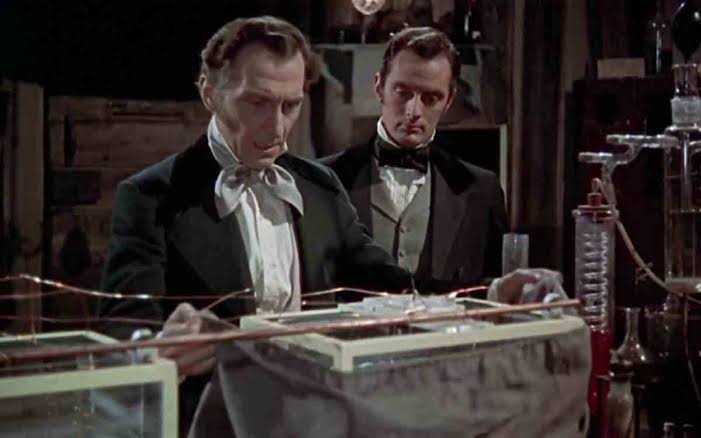
Cushing’s performance here is surgical in its precision. In The Curse of Frankenstein, he played Victor as a young man drunk on discovery. In Revenge, that fire has gone cold. He’s older, colder, and far more dangerous — no longer possessed by passion, but guided by intellect.
He’s a man who has stared into damnation and decided to set up residence there.
Watch how he moves — that delicate composure, the way every word drips with politeness while his eyes glint like a scalpel catching light. This is the definitive Hammer performance, the axis around which the studio’s entire moral universe spins.
Fisher shoots Cushing like a saint and a snake all at once — framed in holy light one moment, shadowed in corruption the next. You can feel the director and actor working in perfect blasphemy together, sculpting the new language of British horror: articulate, restrained, and poisoned at the root.
The Monster Evolves
If The Curse of Frankenstein was about creation, The Revenge of Frankenstein is about legacy — the inevitable corruption of genius. This time, Victor’s experiment isn’t stitched from graveyard corpses; it’s born from self-righteous ambition.
His new creature, Karl (played with tragic intensity by Michael Gwynn), is a man with a diseased body and a brilliant mind. Victor transplants his brain into a new body — sleek, strong, perfect. But that perfection rots from within. Karl’s body rejects its rebirth. The monster’s face collapses, his mind fractures, and the experiment once again mirrors its maker’s decay.
This is Hammer’s cruel poetry: the failure is never scientific. It’s moral.
Frankenstein’s arrogance poisons everything he touches. The body, like the soul, rejects corruption. Fisher’s camera lingers on Karl’s deformity not as spectacle but as judgment — the physical manifestation of sin.
By the time Karl staggers through the ballrooms of Carlsbrück, half-human and wholly damned, Hammer’s Gothic project has reached full bloom. The horror is no longer the supernatural; it’s human ambition dressed in civility.
The Elegance of Evil
The Revenge of Frankenstein is one of Hammer’s most visually sumptuous films, yet beneath that beauty lies rot. The lavish sets, the golden candlelight, the polite drawing rooms — all of it serves as camouflage for decay.
Fisher’s genius was understanding that true horror isn’t found in shadows, but in illumination. Evil looks best when it’s well-lit.
There’s a scene early on when Frankenstein, now posing as the respected Dr. Stein, is confronted by a rival who suspects his true identity. The exchange is polite, almost genteel — but there’s murder in every syllable. It’s a duel fought with intellect, not knives. And that’s where Hammer began to find its unique power: in the tension between refinement and depravity.
In that moment, you can feel the studio stepping beyond imitation — leaving Universal’s fogbound crypts behind and embracing a new aesthetic of blood and silk.
A Moral Abyss
Where Universal’s Frankenstein ended in tragedy, Hammer’s version thrives in moral ambiguity. There’s no sense of divine punishment or poetic justice. Frankenstein doesn’t fall. He adapts.
Even when his plans unravel — Karl’s body decaying, his crimes exposed — he simply begins again. A new name, a new city, another resurrection.
That final image, of Cushing reborn once more under a new alias, isn’t hopeful. It’s horrifying. Hammer’s message is clear: evil is intelligent, adaptable, and eternal. It doesn’t need fangs or bolts in its neck. It needs a steady hand and a reason.
And in that quiet endurance, the studio found something more chilling than any monster. It found modernity.
Between Flesh and Faith
If The Abominable Snowman was about the spiritual horror of transcendence, The Revenge of Frankenstein is about the moral horror of progress. Both films share the same heartbeat — man’s relentless pursuit of knowledge — but here, the tone shifts from wonder to arrogance.
Frankenstein is the inversion of Kneale’s scientist in Snowman. Where Cushing’s Rollason sought enlightenment, Victor seeks dominance. The same eyes that once looked upward now look inward, dissecting life itself.
And yet, both films ask the same heretical question: what happens when man becomes his own god?
Fisher answers with elegance and cruelty: he becomes immortal, yes — but also damned.
Hammer Ascendant
The Revenge of Frankenstein marks a key transition point in Hammer’s evolution. The studio had found its formula — lush colour, moral corruption, and a distinctly British perversity. But more importantly, it had found its identity.
This was no longer a company dabbling in monsters; it was a studio dissecting humanity itself. The horror wasn’t otherworldly anymore. It was institutional, scientific, polite.
And Frankenstein, more than Dracula or any of Hammer’s later villains, became its perfect avatar — the embodiment of beauty and rot, intellect and sin.
Revenge proved Hammer could build a mythology not through sequels, but through tone — that intoxicating blend of the sacred and the profane that would define its golden era.
The Gospel According to Hammer
Every resurrection is a kind of religion, and every religion has its heretic. In Hammer’s world, Frankenstein is both. He creates life not out of faith, but defiance — and in doing so, becomes a kind of anti-saint.
That’s the dark miracle of The Revenge of Frankenstein: it isn’t just a sequel. It’s a sermon. A reminder that the pursuit of perfection always leads back to the grave.
And yet, we can’t look away. Because in Cushing’s precise cruelty, in Fisher’s serene direction, we recognize something uncomfortably human. Our need to transcend. Our refusal to repent.
By the time the credits roll, we understand: Hammer didn’t just bring Frankenstein back to life. It gave him a soul. A cold, immaculate, damned soul — as beautiful as it is terrible.
Final Thoughts: The Eternal Return
In the chronology of Hammer Horror, The Revenge of Frankenstein stands as both continuation and prophecy. The Curse of Frankenstein birthed the new horror. The Abominable Snowman gave it conscience. Revenge gave it permanence.
It’s the moment when Hammer stopped apologizing for its sins and began preaching them.
And in that pulpit of crimson and candlelight, Peter Cushing — calm, elegant, inhuman — became the studio’s patron saint of damnation.
Because in the end, The Revenge of Frankenstein isn’t about monsters or science. It’s about survival.
And evil, when dressed in civility and conviction, survives forever.
Leave a Reply