Sometimes, instead of delivering you from reality, a film forces you deeper into your nightmare, pushing you, along with the characters, beyond the edge.
Such was my experience with POSSESSION. I was in the throes of a divorce when I saw the film, and it left its mark on me. With its visceral anguish, hysteria, and delirium, the movie perfectly captured the disintegration of a marriage.
Except in my case, I didn’t have the distraction of a demon lover.
Analyzing POSSESSION may seem futile, but there are indications that the film served as a way for Żuławski to study the inexplicable motivations of an estranged wife.
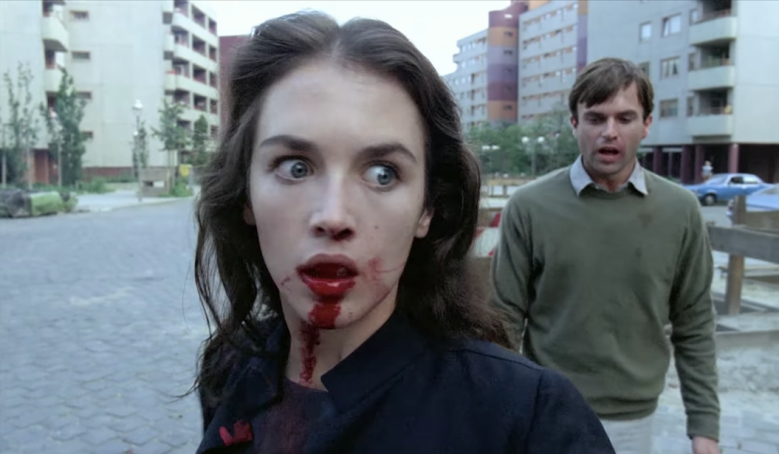
Anna, played by Isabelle Yasmine Adjani, is the wife in question and a woman on an extraordinary quest. From the onset, we see her distressed to see her husband, Mark, played by Sam Neill, who has returned home early from an assignment, possibly involving some high-level espionage.
Their austere home lacks any sense of warmth or sentimentality. No photographs or art on the walls, no remembrances or anything to suggest that they enjoyed their lives together. Other than taking care of their son Bob, do we see any tenderness, and even that appears to be out of a sense of duty.
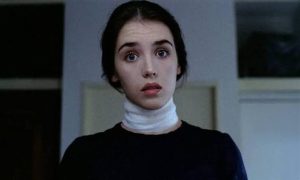
It’s clear domesticity makes Anna miserable and not the life she’d envisioned. As a young ballerina, she didn’t achieve the acclaim she desired, and later, as a dance teacher, her resentment strikes at her students, captured in her terse words, “Because you say ‘I’ for me.”
Instead of a celebrated artist, she’s a reluctant housewife. And it’s safe to assume Mark was oblivious to her growing despair. Although clever and pragmatic, he’s focused on his intelligence work and ironically missed all the clues.
While Mark’s away on a lengthy trip, Anna escapes her drudgery with a man named Heinrich. Charming, serpentine, and sleazy in the ways of the idle rich, Heinrich spends his time seeking euphoric experiences through eastern philosophy, sex, and drugs.
However, he serves as a humorous foil to Mark, especially evident during their first encounter.
Mark: Do you want me to break down the bloody door?
Heinrich: You don’t have to. It’s open.
While seeping classic charlatan vibes, Heinrich does appear to be onto something. Anna has his books in her library; she’s been taking her own notes. And it appears she’s unlocked a door to let something else in.
“I… I can’t exist by myself because I’m afraid of myself. Because I’m the maker of my own evil. Because… Because I’m… Goodness is only some kind of reflection upon evil. That’s just the way it is.”
Through some malignant alchemy, Anna has summoned, or created, an unctuous, filthy creature that commands her unholy devotion. An obsession so tightly bound she’ll sacrifice anything in the way, including her marriage, her child’s well-being, and human lives.
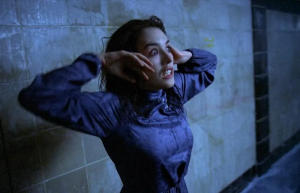
It’s Anna’s obstinacy and disregard for Mark’s demands that emasculate and break him. In fact, her relentless hunt shatters misogynistic confines and unleashes the full force of feminine rage, particularly in the indelible subway scene.
“What I miscarried there was Sister Faith, and what was left is Sister Chance. So I had to take care of my faith to protect it.”
After her violent, unnatural miscarriage, Sister Faith and Sister Chance, the two personas within Anna, were severed.
Sister Faith is likely embodied in Anna’s doppelgänger, Helen, the wholesome teacher, leaving Anna free to be fully consumed by Sister Chance. Later, we see the aftermath of this full possession as Anna mewls like a wounded animal in front of a statue of Christ.
But why all the suffering for this profane beast? Goodness and purity seem meaningless to Anna—she craves ecstasy and power. And when it comes, it’s a twisted version of Leda and the Swan, a tentacled, vulgar monster who delivers supreme pleasure that once tasted can never be spit out.
Mark, too, is seduced into her madness and eventually gives his service to the beast, helping it achieve its final iteration—a doppelgänger of himself. Yet, this desperate union is the demise of Anna and Mark.
Like many ruined marriages, one partner’s passion destroys them both.
After Mark murders Heinrich, he conspires with Anna (whose own death toll is rising), and the couple finds themselves on the run. They’re gunned down on a spiral staircase and take their final breaths in each other’s embrace.
Yet, their child remains. Bob’s with Helen, who’s keeping him safe while his parents are murdered. But late that night, there’s a pounding on the door. It’s Mark’s doppelgänger.
As Helen goes to answer, Bob screams in terror, “Don’t open it.”
It’s as if the child knows that evil cannot force its way in. That someone must invite it freely of their own will.
It wasn’t until Behind the Slate, a podcast hosted by Aaron Strand, presented POSSESSION at Ciné in Athens, Georgia, that I learned that Żuławski had also experienced a painful divorce. Many of his circumstances are echoed in this story, including his wife’s lover, who studied eastern mysticism.
In an interview, Żuławski reveals that his ex-wife’s husband arranged for him to stay in a luxurious hotel overlooking Central Park, where he wrote the script, drinking the cheapest bourbon he could find because he was broke.
“I make films about what is torturing me, and a woman serves here as a medium.”
Decades later, POSSESSION continues to astonish audiences. It achieves that rare balance of being fantastical, yet rooted in realism. For me, it was as if my suffering had been given a brutal form, one that I could have never imagined on my own, yet it resonated completely.
In Żuławski’s POSSESSION, I found kinship for my pain.
Leave a Reply