The Task of Taming H.P. Lovecraft:
The undertaking to which this lengthy treatise—and the exhaustive articles which shall follow it—is dedicated, is one of profound, yet necessary, darkness. We embark here upon a meticulous, sequential expedition through the entire major body of fiction penned by Howard Phillips Lovecraft (1890–1937); not merely to recount the lurid, haphazardly collected tales, but to dissect the very philosophical framework of that Cosmic Horror which remains his single, indelible mark upon the vast canvas of human imagination.
For those of us who perceive the dreadful emptiness of the cosmos, Lovecraft offers no mere cheap fright, no puerile drama of ghosts or ghouls. His horror is one of pure, unadulterated philosophical nihilism, a dread derived from the appalling truth of scale. It is the absolute realization that humanity is an irrelevant, temporary accident upon a negligible planet, orbiting a middling star, within a universe ruled by entities of such scale, such power, and such utter, primordial indifference that the very contemplation of them is enough to dissolve the precious, fragile membrane of human sanity.
Our laws, our morality, our history—all are swept away by the mere breath of ancient, cyclopean things whose very existence mocks all terrestrial logic. This is the truth we seek: the appalling truth that Lovecraft dared to codify, and which we shall examine, story by horrifying story, across this essential series.
The Core Credo: The Nature of Cosmicism and Existential Dread
To begin this chronological charting, one must first be fluent in the central, devastating concept that underpins every line Lovecraft wrote: Cosmicism.
This is not a system of belief that proposes the universe is malevolent; that would be too comforting. Malice implies recognition and intention. Instead, Cosmicism holds that the universe is utterly unaware of human existence. The true horror in Lovecraft’s worlds is not that the Great Old Ones, like Cthulhu or Yog-Sothoth, are actively malicious, it is the chilling, soul-crushing realisation that they are simply indifferent—vast, ancient forces of nature and geometry, existing outside our paltry dimensions and laws of physics. They pose a threat not because they hate us, but because they are physically incapable of acknowledging our existence while they move across the aeons. We are but dust motes, quickly consumed by the inevitable cosmic wind.
This philosophical principle manifests across three thematic pillars that will guide the subsequent analyses:
1. The Unbearable Weight of Deep Time
Lovecraft’s fiction is obsessed with geological and astronomical antiquity. His monsters are not recent hauntings; they are the ancient inhabitants of this planet—the Elder Things, the Great Race of Yith, the Deep Ones—who existed eons before human consciousness dawned. This obsession with Deep Time serves to reduce all of human history, culture, and achievement to a brief, pathetic flicker of light preceding a return to inevitable darkness. The sight of their ruins or the discovery of fossil records that predate all known life triggers the existential horror, as the narrator realizes humanity is merely renting space on a planet where other, greater powers hold the true, terrifying lease.
2. The Unknowable and the Shattering of Reality
The horror in Lovecraft derives from the things that cannot be described. His monsters are defined by what they are not: they are not mammalian, not terrestrial, not Euclidean. They are referred to with deliberately vague, evocative terms like eldritch, squamous, rugose, or non-Euclidean. This technique serves to protect the reader from the narrative impossibility of describing true cosmic horror, while simultaneously allowing the psychological fear of the unknowable to mount. The moment a protagonist attempts to rationalize or describe a being from outside our four-dimensional space-time, their sanity inevitably fractures. This terrifying concept of forbidden knowledge is most often channelled through the existence of the fictional tome of ultimate dread, the Necronomicon, penned by the mad Arab Abdul Alhazred.
3. The Corruption of Lineage and Place
Lovecraft’s cosmos often intrudes upon the human world through heredity and geography. The fear of atavism—the return of primal, non-human traits—drives stories like Facts Concerning the Late Arthur Jermyn and The Shadow Over Innsmouth. It is the terror that the corruption of the cosmic can be passed through the bloodline, making the human body a temporary, fragile vessel for something ancient and alien. Furthermore, his fictional New England triad of Arkham, Dunwich, and Innsmouth are not merely settings, but active participants in the horror. They are locales that have been fundamentally, metaphysically tainted by contact with the Outer Gods or their spawn, places where the veil between dimensions is worn thin.
The Man Behind the Veil: H.P. Lovecraft’s Literary Context and Tone
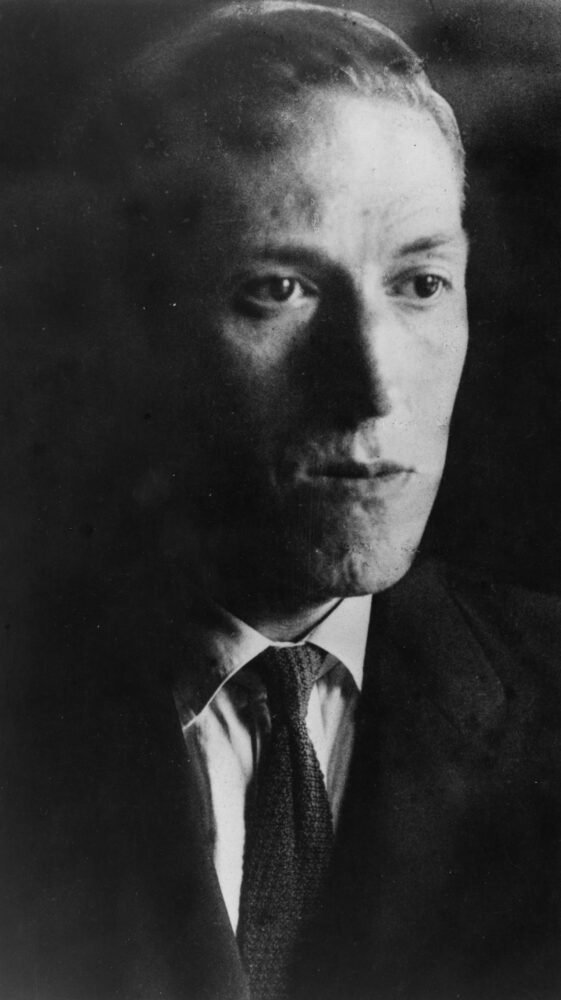
The author who engineered this desolate cosmos was a recluse from Providence, Rhode Island, steeped in the decay of the past. Lovecraft was an antiquarian by instinct, a writer whose most comfortable company was the ghostly presence of the 18th century. This profound affinity for the old, the forgotten, and the crumbling is not mere literary window-dressing; it is the fundamental scaffolding of his fictional world, grounding his cosmic terror in the palpable melancholy of his local landscape.
His resulting prose is thus famously—and intentionally—archaic, formal, and often labyrinthine. Lovecraft’s unique narrative voice eschews the common vernacular of the 20th century. Instead, his writing adopts the meticulous, verbose, yet ultimately terrified tone of a 19th-century gentleman-scholar or a meticulous academic forced to document the impossible. He deliberately crafted a prose that prioritizes atmosphere, suggestion, and the psychological process of mounting dread over fast-paced action or explicit gore. His greatest literary success lay in ensuring that his tales feel not like fiction, but like meticulously documented, if horrifying, reports or fragmented personal memoirs.
The Mythos: A Tapestry of Shared Terror
Lovecraft’s most enduring accomplishment was forging his various tales—published almost exclusively in pulp magazines like Weird Tales—into a terrifyingly cohesive, fictional tapestry known as the Cthulhu Mythos. This was achieved not through a single, continuous narrative plotted from the outset, but through the ingenious, organic repetition of entities, locales, and texts shared between himself and his extensive circle of literary correspondents (Frank Belknap Long, Clark Ashton Smith, Robert E. Howard, et al.).
This system of intertextual referencing lends the Mythos its profound sense of veracity—the chilling illusion that this fictional cosmology is, in fact, an obscured reality that his contemporaries were also glimpsing and reporting upon. Our articles, by examining these references piece-by-piece, will demonstrate how this cumulative dread was manufactured, article by article, over nearly two decades.
The Absolute Rigour of Our Chronological Reading Order
As previously established, Lovecraft never provided a definitive, structured reading order for his fiction. To attempt to impose one based on the internal, fictional timeline of the Mythos (a timeline which is often contradictory and fragmented) is to invite critical chaos and compromise the true purpose of this analysis.
The goal of this series is not merely to catalogue the names of the entities, but to chart the evolution of the writer’s craft and the intellectual genesis of the Cosmic Horror philosophy itself. Therefore, the structure of these articles shall adhere to a single, essential discipline: we will cover the entire body of work along a strict, rigorous chronology of composition—the date upon which Lovecraft completed the writing of the tale.
This methodology provides the only cohesive and logical framework for a critical analysis of this scope. It allows us to:
Trace the Evolution of Style: We will observe his rapid technical growth, documenting how he swiftly shed the derivative, overtly Gothic influences of Edgar Allan Poe to find his own distinct voice, marked by its pseudo-scientific formality and its reliance on pervasive atmosphere.
Chart the Conceptual Progression: We will pinpoint the precise moment a simple folk-horror element in a tale like The Terrible Old Man begins to mutate into the fully realized, world-shattering cosmology of The Dunwich Horror or The Whisperer in Darkness.
Validate Mythos Coalescence: We will document the scattered, almost accidental appearance of early Mythos concepts—the sea terror in Dagon, the messenger entity in Nyarlathotep, the Necronomicon in The Hound—and observe their fusion into the single, definitive template established by the crowning work, The Call of Cthulhu.
The 42 individual articles that form this series are therefore a necessary, sequential expedition into the mind of the author, rather than a mere journey through the world he created.
The Scope of Analysis: An Exhaustive Scrutiny of Every Tale
To properly address Lovecraft’s complete body of work—from the briefest early piece to the most expansive novella—requires a sustained, uncompromising level of analysis. We shall leave no corner of his mind undocumented.
For every story in this chronological sequence, the critical examination will be exhaustive and complete. Our focus for each tale will be divided into key areas, ensuring an unparalleled level of scrutiny:
Textual Analysis: Beyond mere plot summary, we will focus on the narrative techniques employed: the use of fragmented documents, the unreliable point-of-view, and the reliance on indirect or epistolary horror to heighten psychological terror.
Literary Context: We will analyze how the story fits into the literary history of its time, identifying the precise authors (Poe, Dunsany, Wells) whose influence is dominant, and charting how the tale foreshadows the later, grand developments of the Mythos.
Philosophical Interrogation: The core purpose of this series is to isolate the philosophical terror inherent in each piece. We will dissect how the story specifically challenges human insignificance, examining its engagement with Deep Time, the collapse of Sanity, or the terrors of Non-Euclidean Space.
Prose Examination: Finally, we will dedicate time to a close reading of the language itself. How does Lovecraft use his famed adjectives, his complex sentence structures, and his unique pacing to construct a palpable atmosphere of dread? This section will justify his demanding, often overwhelming prose style.
By adhering to this rigorous intellectual framework, we ensure that every single story is subject to a level of complete critical scrutiny, offering insights far beyond simple plot recitation.
The journey into the black seas of infinity begins not with a cataclysm, but with the quiet, unsettling recognition of the void. We proceed now to the first chronological entry: the tale of ancestral horror, The Tomb.
Leave a Reply