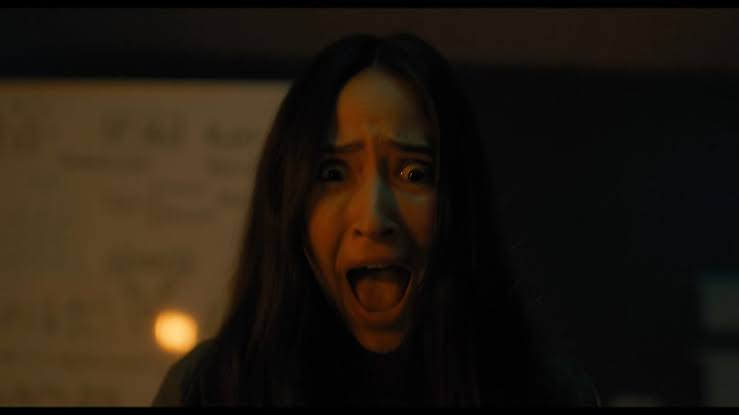
I’m not a die-hard fan of sci-fi (although I do enjoy the genre), but I love sci-fi horror. Movies like Creature from the Black Lagoon, Alien, and Event Horizon are right up my alley, so when I heard about The A-Frame, I was instantly intrigued. The film’s Fantasia plot description didn’t give away too much, but it promised an intriguing blend of these two genres, and that was enough for me. I couldn’t wait to check this movie out, and now that I’ve finally seen it, I’m happy to report that it does not disappoint.
The A-Frame was written and directed by Calvin Reeder, and it stars Laketa Caston, Nik Dodani, Dana Namerode, and Johnny Whitworth. In the film, Donna is a young woman who’s just been diagnosed with bone cancer in her hand, and her doctor recommends amputation to keep the disease from spreading. It seems like a no-brainer, but this case is different. Donna is a pianist, and if she loses her hand, she’ll no longer be able to practice her craft.
In a desperate attempt to hold onto her musical career, she opts for an alternative treatment developed by an underground quantum physicist named Sam. The guy says he’ll send the molecules in Donna’s hand to another dimension and then bring them back almost instantaneously, and to the woman’s surprise, the procedure works. It seems like a miracle, but when Sam tries to use this technology to teleport people from one location to another, the results are much more horrific.
If you’re a hardcore horror fan, that plot synopsis might sound a bit familiar to you. The A-Frame is basically a modern riff on The Fly (more so David Cronenberg’s remake than the 1950s original, but it has parallels with both versions), and it even features a brief romantic fling between Donna and Sam.
To be frank, I’m not always a fan of movies that are so obviously derivative of older classics, but in this case, that didn’t bother me. The cancer angle is quite different from either version of The Fly, and more importantly, The A-Frame is just a very well-made and enjoyable film in its own right.
To begin, the acting here is pretty good, and the dynamic between Donna and everyone else around her is different from what we’re often used to. Dana Namerode, the actress who plays the lead character, gives a somewhat understated, almost Maika Monroe-esque performance, so it’s up to the rest of the cast to liven things up.
On the surface, that might seem like an odd filmmaking choice, but it works surprisingly well. In fact, given the situations Donna finds herself in for much of The A-Frame, it makes total sense. For example, we see her attend her first cancer support group session, and when she goes to Sam’s lab for her treatment, the whole situation seems super shady.
Anyone would be shy and a bit withdrawn in those situations, so Namerode’s performance actually fits the character perfectly. What’s more, like I said before, it largely falls on her costars to liven this movie up, and thankfully, they’re more than up to the task. They provide the pep Donna lacks, so on the whole, I had no trouble at all buying into these people and their descent into sci-fi madness.
On top of that excellent acting, The A-Frame also tells a captivating story. In particular, the film does a great job of making you question whether you can really trust Sam. It’s one thing to perform a small procedure on someone’s hand, but teleporting a person from one place to another is something else entirely, so the whole situation just seems super sketchy.
Along similar lines, actor Johnny Whitworth plays Sam with a slight but noticeable hint of inauthenticity, so his vibes certainly don’t inspire much confidence. Donna notices it too and thinks he’s just weird, but it’s more than that. I wouldn’t trust the guy if I met him in real life, so when you see him in The A-Frame, you get the sense that he’s up to no good.
And in case you need more reasons to doubt this man’s intentions, there are also a number of times when writer/director Calvin Reeder cranks the atmosphere up to 11. Sure, you don’t explicitly see Sam do anything evil in these scenes, but it’s clear that his experiments are going to lead to something terrible. You’re not sure what it is, and you’re not even sure if it’s going to be intentional, but you know it’s going to happen.
That uncertainty will keep your eyes glued to the screen for the first two-thirds of the movie, and when Sam finally tries to teleport a whole person in the third act, things get pretty bonkers. I’m obviously not going to spoil anything, but I will say that this part of the film goes full-on horror. It throws buckets of blood at us and features some great practical gore effects that are very reminiscent of 1980s body horror classics like The Fly and Hellraiser.
That being said, this part of The A-Frame also has its one big flaw. I can’t be too specific without getting into spoilers, but suffice it to say that the story isn’t entirely coherent. More to the point, there’s something about the way Sam carries out his experiments that doesn’t make complete sense. Sure, you can fill the gap on your own, but I wish the film had been more explicit about it. As it stands, it feels like a big oversight, and it prevents the movie from reaching its full potential.
But in the grand scheme of things, that one problem isn’t nearly enough to ruin the entire experience. The A-Frame is still an excellent sci-fi horror film that pays tribute to its genre forebears without feeling like a rip-off, so I had a great time with it from start to finish. I can’t wait for this movie to reach a wider audience, and when it does, I highly recommend that you give it a watch.
Leave a Reply