
The year is 1969. The Summer of Love has curdled into the Manson murders, the Vietnam War is a rhythmic pulse of televised slaughter, and the Gothic dream—that mist-shrouded world of tragic monsters and velvet-clad visionaries—is bleeding out on the floor. In this cultural twilight, Hammer Film Productions released Frankenstein Must Be Destroyed. It did not offer a comforting ghost story. It offered a forensic autopsy of the human soul.
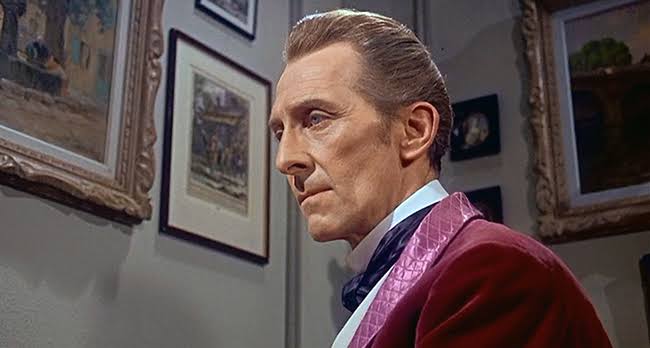
If the earlier entries in the Frankenstein cycle flirted with the Promethean myth—the idea of a man striving, however misguidedly, to conquer death for the sake of life—this film puts a bullet in that delusion. It presents a system at the end of its usefulness. It gives us a Baron who has shed the last vestiges of his humanity to become something far more terrifying: a high-functioning sociopath with a scalpel.
A Baron in Exile
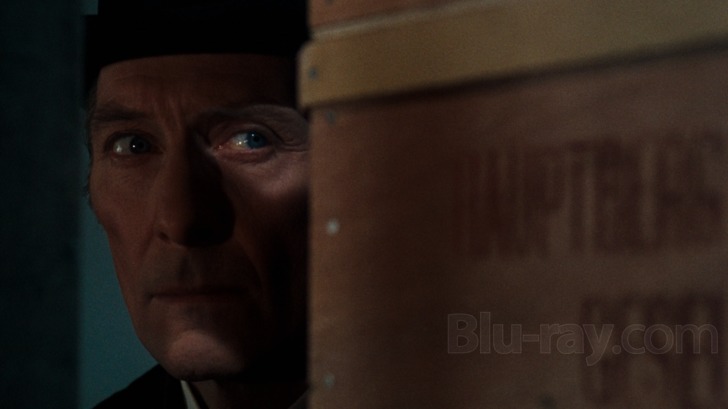
The film opens not in the soaring heights of a mountain-top laboratory, but in the grime of the gutter. We see a masked figure engaged in the first stage of a body-harvesting murder. It is efficient. It is messy. It is the work of a man who has traded his aristocratic birthright for the life of a professional fugitive.
There is a profound ontological shift here. In The Curse of Frankenstein (1957), the Baron operated from the seat of his ancestral power. His laboratory was a temple to his own ego, a place where the divine was challenged from a position of privilege. By 1969, that temple has been desecrated. Frankenstein is no longer a creator; he is a squatter. He inhabits the cellar of a middle-class boarding house run by Anna Spengler.
This displacement is crucial. The Gothic has moved from the castle to the kitchen. By placing the Baron in the basement of a respectable home, director Terence Fisher is signaling the rot within the social fabric itself. The forbidden knowledge is no longer hidden in the clouds; it is festering right beneath the floorboards of the unsuspecting middle class.
The harsh truth is that by now, Frankenstein is a common thug with a PhD. He’s a squatter. He’s the nightmare tenant from hell. He moves into Anna’s house not because he likes the decor, but because he can smell her fiancé’s weakness from a mile away. He isn’t exploring the mysteries of life. He’s a criminal technician hiding from the cops in a basement. The great scientist has become a basement-dwelling predator, and Cushing plays it with a terrifying, clipped precision that makes your skin crawl. He doesn’t need a castle to be a tyrant; he just needs a lease he has no intention of honoring.
Procedure Over Passion
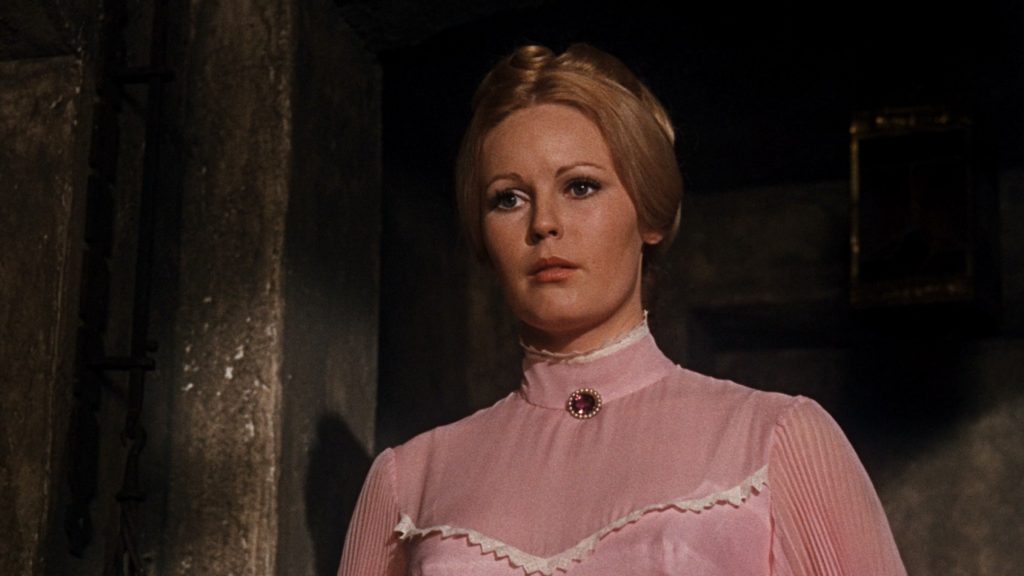
We must address the scene that remains the most controversial moment in the entire Hammer canon: the sexual assault of Anna. It is a scene that Peter Cushing famously loathed, one forced into the production by studio head James Carreras to spice up the film for the American market. Yet, in its ugliness, it serves as the ultimate distillation of this version of the Baron.
In this moment, Frankenstein crosses into Hell. There is no eroticism here, no Gothic lust that characterized the earlier films’ depictions of the relationship between creator and victim. This is an act of pure, cold leverage. It is the ultimate reduction of the human being to a piece of equipment. Anna is not a woman to him; she is a variable to be managed. To secure the loyalty of her fiancé, Karl—a man already buckling under pressure—the Baron breaks Anna. It is the spiritual death of the character.
This is where the misunderstood genius defense goes to die. There is no scientific justification for what he does to Anna. It’s a power move. It’s procedural. He does it with the same emotional engagement he uses to stir his tea. This isn’t a madman losing control; it’s a man who has decided that morality is a luxury he can no longer afford. It’s the coldest scene in horror history because there’s no heat in it. No rage. Just a calculated decision to destroy a woman’s soul to keep his experiment on schedule. If you still find yourself rooting for the Baron after this, you’ve missed the point: he’s the monster. He’s always been the monster.
Brandt and Richter
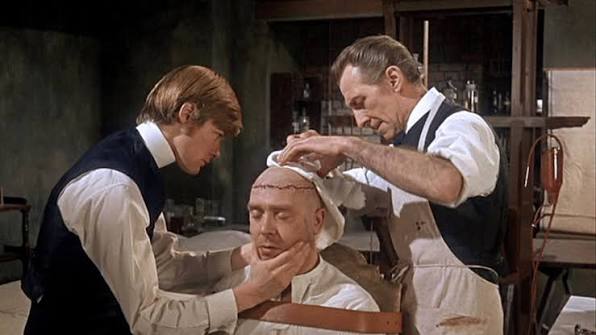
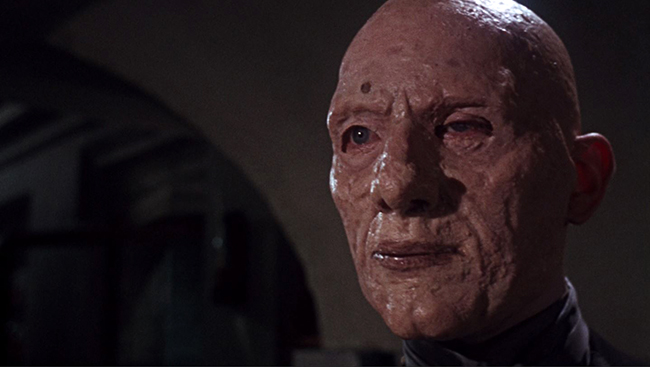
The central experiment of the film is a brain transplant, but it is framed as a hostile takeover. Frankenstein needs the secrets locked inside the mind of his former associate, Professor Frederick Brandt, who is currently rotting in the Steiner Asylum.
Here we see the redistribution of damage. Frankenstein does not create life from the void; he harvests it. He murders Professor Richter—the administrator of the asylum—not out of malice, but because Richter’s body is a healthy vessel. He then extracts Brandt’s brain and places it into Richter’s corpse.This is the ultimate commodification of the human essence. To the Baron, Brandt is intellectual property and Richter is physical housing. He is a middle-manager of the macabre, reorganizing the assets of the dead to suit his balance sheet. The tragedy is no longer about a creature who cannot find love; it is about a man who has been turned into a living container, violated by a science that treats consciousness as a software update.
Let’s look at the math Frankenstein is doing. Brandt has the info; Richter has the heart. So, Frankenstein kills Richter (who, let’s be honest, was a bureaucratic hack anyway) and stuffs Brandt’s brain into the empty shell. It’s a chop-shop operation. He’s not a doctor; he’s a scavenger. The scene where Brandt wakes up and looks in the mirror? That’s not existential dread. That’s a man realizing he’s been identity-thefted by a sociopath. Frankenstein doesn’t give a damn about Brandt’s suffering. He just wants the formula. It’s medicine as industry, and business is booming.
Logic Without Oversight
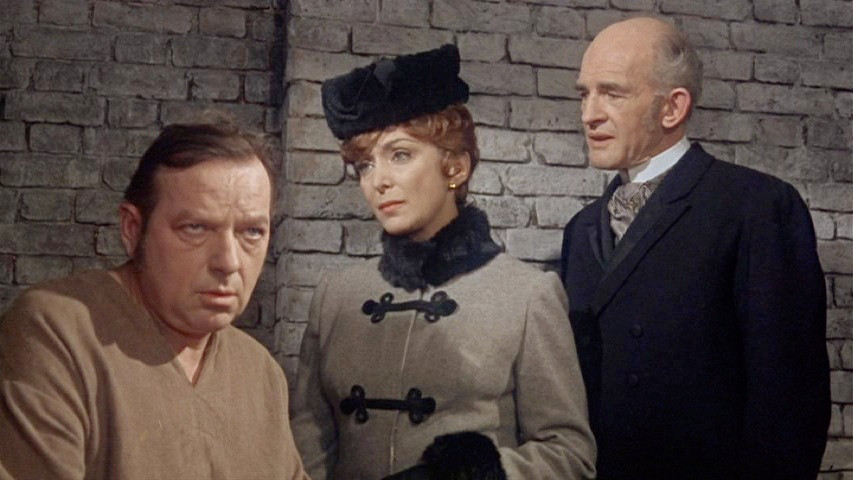
The Steiner Asylum serves as the film’s moral graveyard. It is an institution designed for care that has become a warehouse for the inconvenient. It is a place where accountability goes to die.
When Frankenstein infiltrates it, he isn’t breaking into a sacred space; he is simply moving from one failed institution to another. The fact that he can so easily manipulate the staff and kidnap a patient speaks to the collapse of the social contract. When the systems of the state (represented by the asylum) fail to protect the vulnerable, the predator (Frankenstein) steps in to fill the vacuum. He is the logical conclusion of a society that has abandoned its responsibilities.
The asylum is a joke. It’s a fortress of incompetence. Frankenstein walks in there like he owns the place because, in a world of idiots and bureaucrats, a man with a plan and zero conscience is king. Hammer is telling us that the authorities are useless. The police are always ten steps behind, and the doctors are too busy following procedure to notice a wolf in the fold. It’s a bleak, cynical view of the world where the only thing that works is the Baron’s cruelty.
Peter Cushing: The Architect of the Death
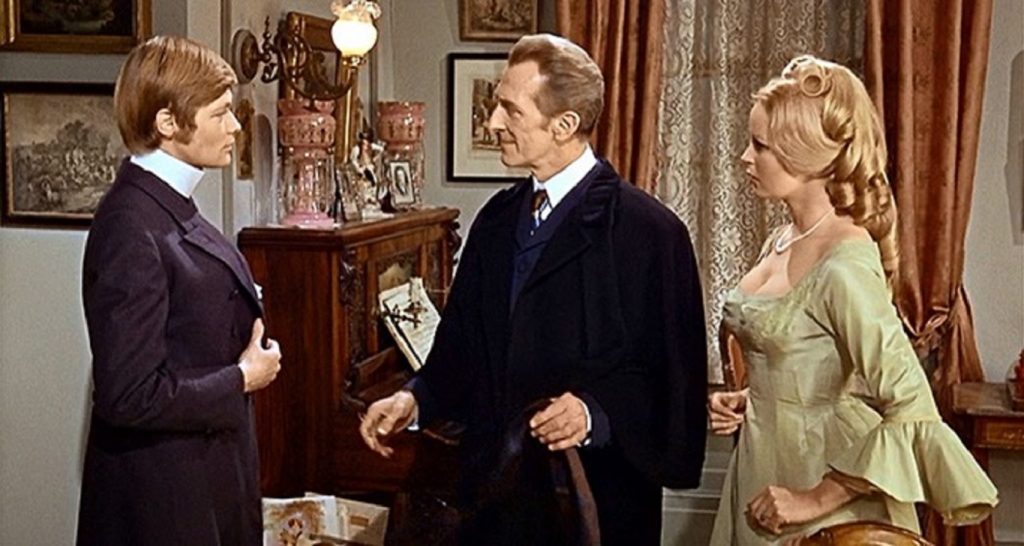
This is, without question, his most terrifying performance as the Baron. In earlier films, there was a twinkle of the dandy, a flash of the misunderstood aristocrat. Here, that light has gone out.
Cushing plays Frankenstein as a man who has outlived his own myth. He is a ghost haunting his own life. His movements are sharp, bird-like, and devoid of wasted energy. He has reached a state of pure intellect, which is another way of saying he has become a vacuum. He doesn’t snarl or rave like the mad scientists of the 1930s. He explains. He is polite. He uses the language of reason to justify the unthinkable. It is the banality of evil rendered in Victorian lace and surgical steel.
Cushing is terrifying because he’s so calm. He’s the guy who fires you from your job and tells you it’s for your own good while he’s packing your desk. He’s the ultimate professional. He treats a brain transplant like he’s fixing a broken watch. No wonder the Creature in this movie (Brandt in Richter’s body) doesn’t just want to kill him—he wants to burn the whole world down just to take the Baron with him. Cushing’s Frankenstein is the kind of man who would watch a city burn and complain about the ash on his cuffs.
The End Without Redemption
The finale of Frankenstein Must Be Destroyed is not a moment of catharsis. It is a termination of a process.
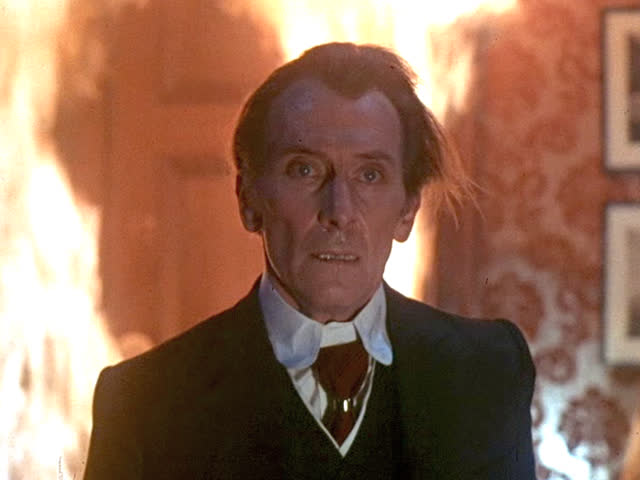
The ending is a ritual of purification. Brandt-in-Richter, realizing the horror of his existence, lures Frankenstein back to a manor house. He doesn’t want a trial; he wants an ending. The fire that consumes them both is not the cleansing fire of a hero’s sacrifice. It is the necessary destruction of an aberration.
Frankenstein does not repent. Even as the flames lick at his heels, his eyes remain fixed on his work. He does not see his death as a moral judgment; he sees it as an interruption. The tragedy isn’t that Frankenstein dies—it’s that he survived long enough to prove that his worldview, his arithmetic of human worth, actually works. He proved that he could dismantle the soul and put it back together in the wrong shape.
It ends in fire because there’s nowhere else for this story to go. You can’t put the Baron in jail. You can’t reason with him. You have to burn him. The Brandt-creature carries him into the inferno like a piece of hazardous waste being taken to the incinerator. And the most Hammer thing about it? Even while he’s being dragged into the flames, Frankenstein looks annoyed rather than scared. He’s the ultimate results-oriented prick. He didn’t fail because his science was wrong; he failed because his victims finally stopped playing by his rules and decided to commit suicide-by-Baron.
Final Thought
Frankenstein Must Be Destroyed is the darkest of the series. It is the moment where the reality of the character—the raw, terrifying truth that he is a parasite—is finally laid bare.
It argues that evil doesn’t always come with a cape and a dramatic monologue. Sometimes it arrives in a well-tailored suit, armed with logic and a commitment to progress. It warns us that the most dangerous man in the room is the one who believes his intellect absolves him of his humanity.
The Baron is not a warning about ambition. He is a warning about the death of empathy. By the time the screen fades to black and the flames have done their work, the audience is left with a cold realization: the Monster wasn’t the thing on the table. The Monster is, and always was, the man holding the knife, and he’s been walking among us all along, hiding in the basements of our respectability.
He was destroyed not because he was wrong, but because his success was a reality that no moral universe could allow to exist.
Leave a Reply