Let’s get one thing straight before we step into this particular circle of cinematic hell: Italian horror in 1989 was not a place of prestige. It was a graveyard of ambition. The golden age of Mario Bava and Dario Argento had curdled into a landscape of diminishing returns, where the masters were tired, the budgets had evaporated into a cloud of cheap hairspray, and directors like Luigi Cozzi were left scavenging the scrap heap of pop culture to see what would stick.
Enter Paganini Horror.
This isn’t just a bad movie. Calling Paganini Horror a bad movie is like calling a five-car pileup a minor traffic hiccup. It is a frantic, logic-defying, neon-soaked fever dream that feels like it was written by someone who had the plot of A Nightmare on Elm Street described to them over a crappy phone line while they were halfway through a bottle of industrial-grade Chianti. It’s trash, yes—pure, unrefined, high-fructose corn syrup trash—but it’s the kind of trash that demands a visceral autopsy. This is a film that exists at the intersection of we need to pay the rent and does anyone have a smoke machine and a spare violin?

The Prologue: Wood-Sawing and Hairdryer Homicide
The film opens with a flashback, because in the world of schlock, the past is never dead; it’s just waiting for a lower budget to resurrect it. We see a young girl “playing” a violin. I use the word “playing” with the same level of irony I use when I say I’m “resting” while passed out on a barroom floor. This kid isn’t playing the instrument; she’s sawing wood. There is zero coordination between the movement of her arm and the sound coming out of the speakers. It’s an immediate signal of the production’s commitment to reality: which is to say, they have none.
But then, because the movie needs a horror beat within the first five minutes to satisfy the distributors, the girl gets possessed by the Devil. Does she summon a legion of flies? Does she speak in tongues? No. She throws a hairdryer into her mother’s bathtub.
Why? Because reasons.
It’s the most domestic, mundane Satanic act imaginable. It’s the kind of kill you’d see in a low-rent slasher, but here it’s framed with the operatic weight of a Greek tragedy. Mother gets fried, the kid looks smug, and we’re off to the races. Already, Cozzi is telling us exactly what kind of ride we’re on: one where the terrifying reality is actually just a series of household appliances being misused for the glory of the Morning Star.

The Rock Band: Posers and Plagiarism
Fast forward to the present day. We meet our protagonists: a rock band that looks like they were assembled from the leftovers of a hair-metal casting call at a regional shopping mall. The lead singer, Kate, is our primary vessel for exposition, and she’s joined by a crew of musicians who have clearly never touched an instrument in their lives. They have the aesthetic of rebellion but the energy of people waiting for a bus.
Then, the song starts.
If you have ears, you’ll immediately recognize the melody. It doesn’t just sound like a msah-up Bon Jovi’s You Give Love a Bad Name and Livin’ On a Prayer; it is a brazen, shameless, high-daylight robbery of them. Jwsus, at least Dick Turpin wore a fucking mask.
I sat there waiting for Jon Bon Jovi to fly in on wires, raining down hellfire and litigation papers. It’s the kind of plagiarism that is so bold you almost have to respect it. It’s the musical equivalent of wearing a Rolex that clearly says Rolecks on the face. You aren’t fooled, they know you aren’t fooled, but everyone just keeps pretending because the alternative is admitting we’re all trapped in a vacuum of creativity.
But the real comedy begins when Danny the Drummer Boy—the only male in this girl-power aesthetic nightmare—shows up with a new piece of music. Who gave it to him? Donald Pleasence.
The Donald Pleasence Mystery Tour
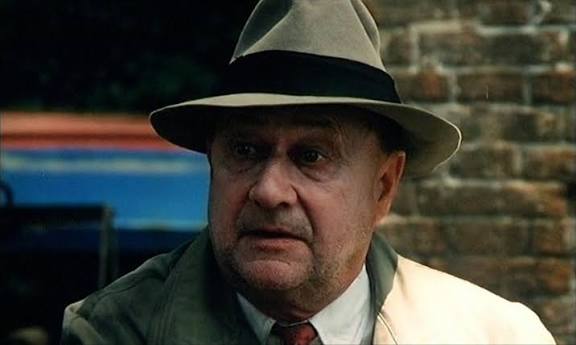
Now, let’s talk about Pleasence. At this point in his career, Donald was the patron saint of the I need a new kitchen cameo. Playing the mysterious Mr. Pickett, he shows up in this Italian schlock-fest, looks vaguely concerned, delivers his lines with the gravitas of a man reciting the Bible while secretly thinking about his lunch order, and then cashes the check.
He hands off a briefcase to Danny with a 666 combination. Subtlety? We don’t know her. We’ve never met her. She doesn’t live in this post code. The briefcase might as well have had Satan’s homework written on the side in Sharpie.
But wait, it gets weirder. Pleasence is famously British, but in this film, he’s dubbed by an Italian actor whose voice sounds like it’s being projected from the bottom of a well. It adds to the disjointed, surrealist nightmare of the whole experience. It’s not a movie; it’s a collage of bad decisions pasted together with spit and ambition.
Pleasence shows up again later to throw a literal suitcase full of American dollars—in Italy—off a building. Apparently, this is how you curse a band and carry on the work of Satan in the late 80s: you just litter with high-denomination currency. It’s the most 80s Producer way to envision evil imaginable.
The Exposition Dump: Poser Logic
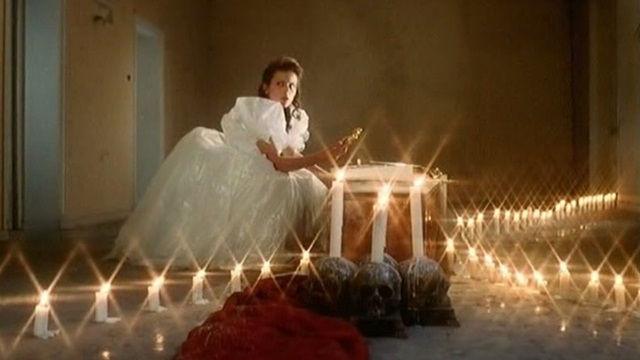
When Danny plays this “new” song for Kate and their producer, we get a scene that is a masterclass in terrible writing. Danny explains that this is an old, lost Paganini composition that has never seen the light of day. It’s the forbidden riff, the music that will tear a hole in the veil.
Kate then proceeds to vomit a Wikipedia page’s worth of exposition onto the floor. She tells us that Niccolò Paganini was rumored to have sold his soul to the Devil for fame and fortune. This is scholarly mystic territory if the scholar was a 14-year-old who just discovered Goth culture and a pack of cloves. She delivers this lore with the intensity of someone revealing the secrets of the Knights Templar, despite the fact that anyone who has ever seen a cartoon knows the sold my soul to the Devil trope.
She then suggests they call the song Paganini’s Horror because “nobody has ever done that before.
This leads me to believe that Kate has never heard of Alice Cooper, Ozzy Osbourne, or any actual rock music with a dark edge. These people aren’t musicians; they’re posers in the highest degree. They’re rock stars in the same way a mannequin in a leather jacket is a rebel. They are the target audience for a Kidz Bop version of The Satanic Bible. They are fundamentally uncool, which makes their impending doom all the more satisfying.
Then, we get another music interlude. For a movie titled Paganini Horror, there is an offensive amount of generic 80s pop-rock. We aren’t even 30 minutes in and Josie and The Pussycats have already treated us to three full tunes. It’s painfully obvious that the production didn’t have enough script to fill a feature runtime, so they just padded it out with music videos that look like they were filmed in a garage with a strobe light and a prayer.

The Kills: Violin-Shivs and Jam Blood
Finally, after half an hour of mama getting fried and the band pretending to be cool, we get our next death. It takes 30 minutes between the hairdryer incident and the next body drop, which in a horror movie is an eternity of posers talking.”
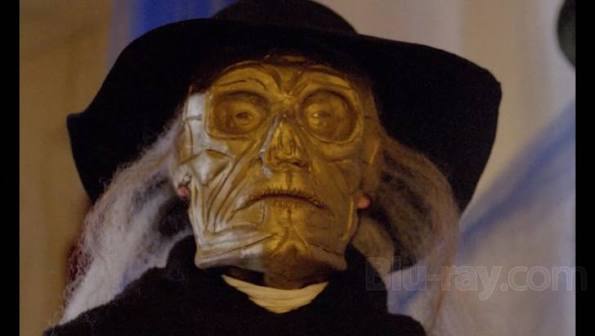
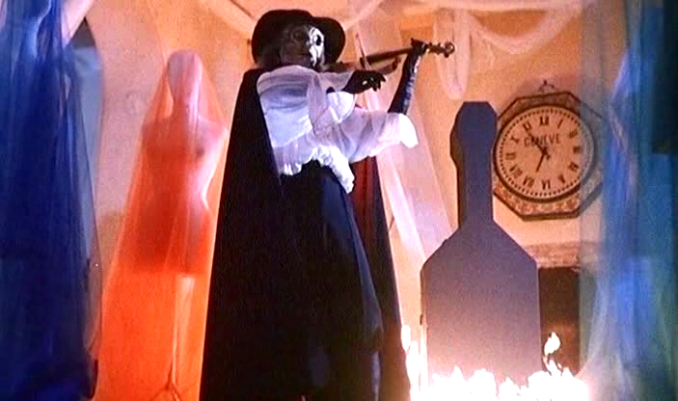
Paganini shows up in a burst of smoke machine—the unofficial sponsor of 80s Italian horror—and stabs poor Rita in the throat. But he doesn’t just use a knife. Oh no. He uses a violin that has a James Bond-style secret blade pop out of the bottom. It is, quite frankly, the best thing I’ve ever seen. It’s the kind of over-the-top, impractical weaponry that makes this genre worth living for. Why carry a dagger when you can carry a musical instrument that doubles as a shiv?
The blood is clearly just strawberry jam masquerading as gore, but it doesn’t matter. The audacity of the violin-knife carries the scene. It’s a moment of pure, unadulterated What the hell am I watching? that justifies the price of admission.
But wait! Rita’s back! Because in a Cozzi film, death is merely a temporary inconvenience. She does that seductive dead lady routine that was mandatory in the late 80s—the zombie-vixen aesthetic. She lures Danny the Drummer Boy into a dark room where he is suddenly distracted by… a glowing egg timer.
I’m not joking. It’s supposed to be an ancient chronometer or hourglass, but it looks exactly like a kitchen appliance from a futuristic 1970s Sears catalog. Danny stares at this thing with the intensity of a scientist discovering a new element, long enough for Paganini to sneak up and kill him. How does he kill him? I have no idea. The movie doesn’t know. It all takes place off-screen. We just see Danny moments later with a nasty looking head wound. It’s lazy, it’s cheap, and it’s beautiful in its sheer lack of effort.
The Technical Triumphs of Luigi Cozzi
As the survivors try to figure out what’s happening, the movie leans into its dodgy 80s special effect lighting phase. Kate falls through a floor in the room where Danny was killed, and when the music video director, Mark, reaches down to grab her, he’s attacked by what looks like blue Christmas lights. It burns most of his hand in the least convincing way possible. It’s not fire; it’s a light show from a discount electronics store.
Then comes the car. Mark and a nameless female bandmate try to escape in the only vehicle. It too is struck by the dodgy 80s special effect lighting. The car explodes, killing Mark but—somehow, against every law of physics and common sense—throwing the woman clear.
Imagine if Wes Craven went on a week-long drinking binge and was asked to direct an episode of Scooby-Doo on the budget equivalent of a packet of crisps and a can of Fanta. That is the raw, terrifying reality of Paganini Horror. It’s a series of spooky events held together by the cinematic equivalent of Scotch tape and hope.

The Gore: Toxic Avenger Meets Robocop
Kate eventually shows up in an empty swimming pool and is reunited with Sylvia and the house’s owner, only to realize that Eleanor—the bandmate who was so forgettable I forgot her name until the script yelled it—is missing.
But don’t worry, a trail of blood and pus leads us upstairs. We find her looking like someone even the Toxic Avenger would struggle to crack one out to. I’m thinking the writer might have watched the melting man scene from Robocop right before coming up with this masterpiece. It’s a mass of prosthetic goop and practical effects that actually looks decent compared to the rest of the film. It’s a moment of genuine, visceral disgust that reminds you that when Italian filmmakers can’t afford a script, they at least know how to buy enough buckets of slime.
The Final Ritual: “I’M BURNING!!”
The remaining three geniuses figure out that the only way to banish old Paganini is to play the music backwards. Because that’s how Satanism works in the movies: it’s just a rewind button away from salvation.
Predictably, it goes about as well as you would expect. The producer gets squished between a pane of not-so-invisible glass and a wall. This is easily the best death in the film. It actually looks like she is being crushed as the old claret pours down her face. It’s a rare moment of effective practical horror in a movie that mostly consists of people looking confused in fog.
She explodes in a torrent of blood, Kate gets knocked out, and Paganini kebabs the owner of the house—all in the space of around 30 seconds. It’s a frantic, messy climax that feels like the production was literally running out of film.
Then we get to the legendary finale. Kate gets shoved inside a giant cello case. Paganini starts twanging his old violin, the case catches on fire, and Kate starts burning.
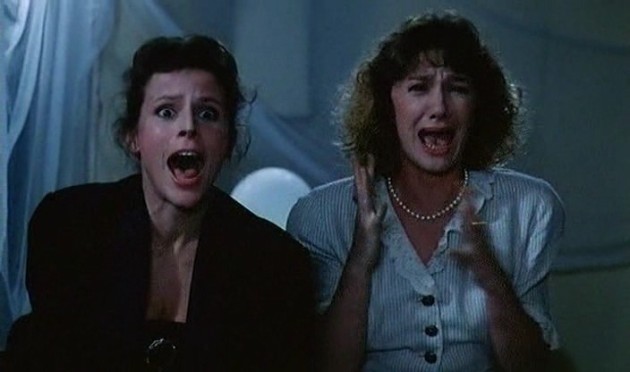
Now, most actors would convey burning through screaming or thrashing or… y’know… acting. Kate decided the best approach was to yell “I’M BURNING!!” at the top of her lungs for a good minute or so. Just in case we didn’t figure it out from the literal flames licking the wood.
“I’M BURNING!””I’M BURNING!”
Yes, Kate. We see. We all see. We’re watching you burn, and we’re watching this movie’s logic burn right along with you. It’s a performance of such singular, loud-mouthed desperation that it becomes high art.

The Twist: Hell is a Real Estate Market
But it’s an Italian horror movie, so a clean escape is forbidden. The sun comes up, Paganini turns into ash (because apparently he’s also a vampire?), and Kate escapes.
Suddenly, Sylvia shows up in a car with Donald Pleasence. But wait! Donald is Satan now. Or he was always Satan. Or he’s just a very dedicated real estate agent for the underworld. He explains how this whole place is Hell. He then knifes Kate—because why not—and tells Sylvia to go greet the new family who has just pulled up for their own personal torment.
The cycle begins anew. Another family, another hairdryer, another suitcase full of American bucks. It’s a cynical, bleak ending that tries to graft a depth onto a movie that just spent 83 minutes showing us a glowing egg timer.

The Verdict: The Spiritual Core of Trash
Paganini Horror is a testament to the cheap bastards creed: sometimes, the spiritual core of a film is just the sheer, unbridled chaos of its creation. It’s a movie that rejects logic, embraces plagiarism, and treats a musical instrument like a murder weapon.
It is the ultimate poser horror movie. It wants to be Argento, it wants to be Craven, it wants to be Bon Jovi. It fails at all of them, and in that failure, it finds a weird, rhythmic beauty. It is the raw reality of a film industry in its death throes, clutching a secret-knife violin and screaming “I’M BURNING” into the void of the late 1980s.
If you love your cinema with a side of What were they thinking?, Paganini Horror is your new gospel. It’s loud, it’s stupid, and it’s glorious. Just keep your hairbrushes away from the bathtub and don’t trust any bald Englishmen carrying briefcases.
Leave a Reply