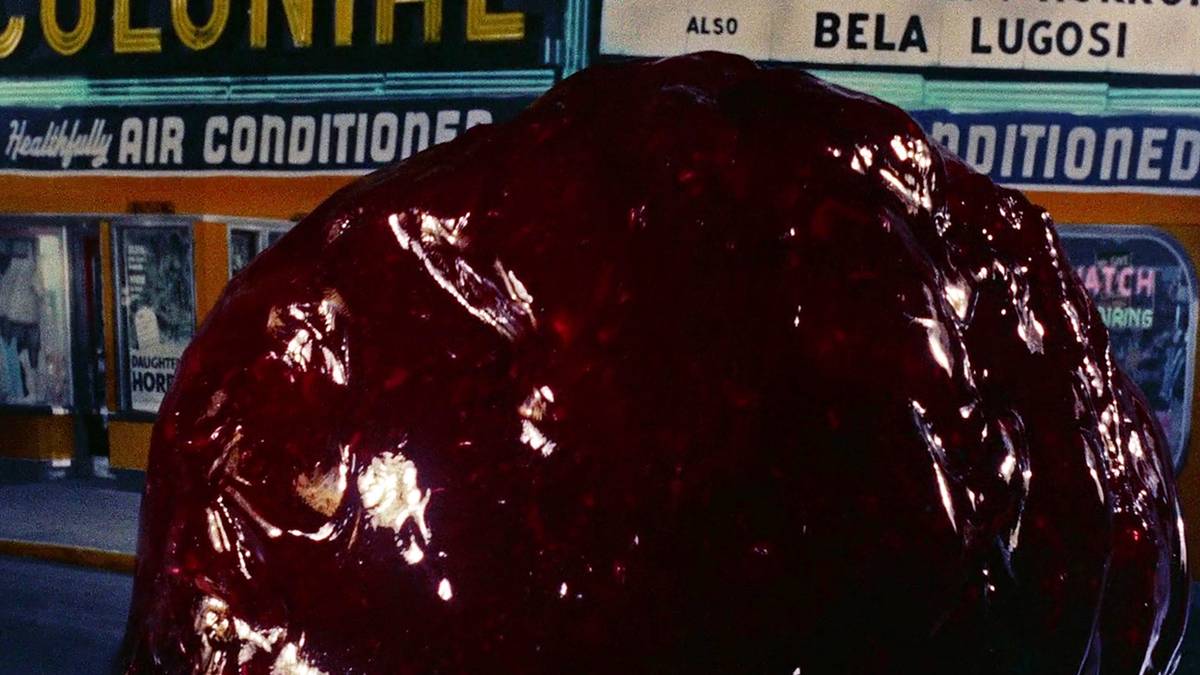
Get your hazmat suits ready and try to ignore the smell of burnt popcorn, because we are heading back to 1958, a year when the biggest threat to national security wasn’t a nuclear warhead, but a giant, sentient bowl of strawberry jam from the vacuum of space. We are dissecting the granddaddy of Goo-Horror, the movie that proved that even the most unassuming household condiment can become a world-ending nightmare: The Blob.
This isn’t just a drive-in classic; it’s the film that put Steve McQueen on the map and gave every teenager in America a legitimate reason to be terrified of the local movie theater. We’re talking horror of meteor-borne slime, 1950s juvenile delinquents, and the sheer, unadulterated joy of watching a silicone-based organism consume an entire diner.
The Setup: The Falling Star of Doom
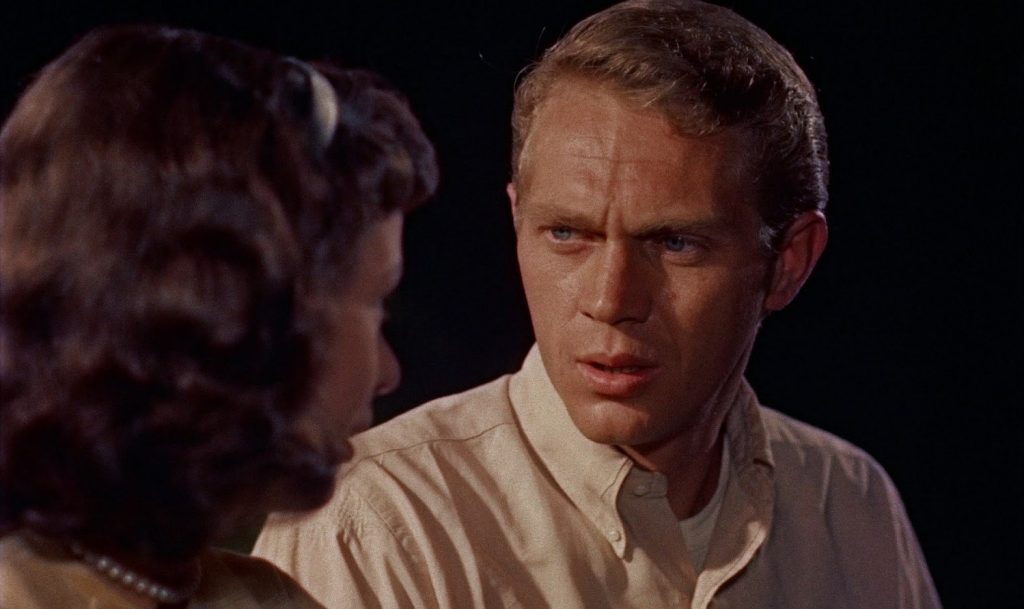
Our story begins with the most 1950s opening imaginable. We meet Steve Andrews (played by a 27-year-old Steve McQueen pretending to be a teenager) and his girlfriend Jane (Aneta Corsaut). They are stargazing in Steve’s convertible, which is code for looking for a place to park that isn’t patrolled by the local sheriff.
Suddenly, a meteor streaks across the sky and crashes in the nearby woods. Now, in a modern horror movie, the characters would call the police or post a TikTok of the crash site. In 1958, an old man (the legendary Old Man trope) finds the meteor first. He pokes it with a stick, because that’s what you do with interstellar debris, and the meteor cracks open to reveal a small, pulsating mass of translucent goo.
The goo hitches a ride on the old man’s hand, and the madness begins. This isn’t a monster that roars or stalks you with a knife. It just… adheres. It starts small, but as we quickly learn, this thing has the metabolic rate of a competitive eater at an all-you-can-eat buffet.
The Steve McQueen Factor: The Birth of a Rebel
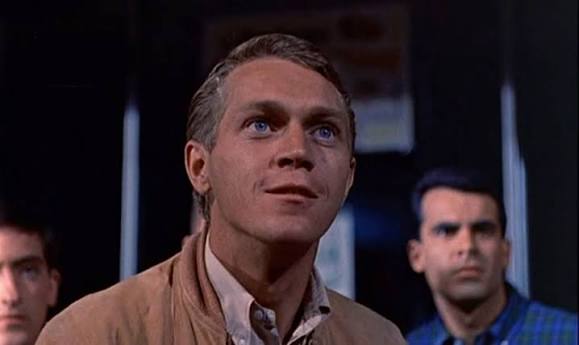
Indulge me for a moment, if you will, while I talk about Steve McQueen. In The Blob, he’s credited as ‘Steven McQueen,’ and you can already see the effortless charisma that would later crown him the King of Cool.
What gives his performance bite is the ‘Youth vs. Authority’ clash at the heart of the film. Steve and Jane find the old man and take him to the local doctor, but once the Blob starts consuming people (starting with the doctor and his nurse), no one believes them. To the adults of Phoenixville, Steve is just a hot-rodder looking for attention. Which in itself is pretty funny because… y’know… 27.
Watching McQueen play a teenager while clearly being a grown man with the gravitas of a combat veteran is one of the movie’s greatest charms. He brings a level of intensity to lines like:
“It was a mass… a shapeless mass!”
that makes you actually believe in the strawberry jelly from space.
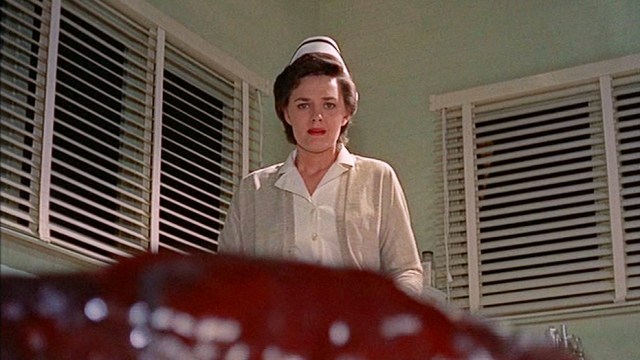
The Practical Effects: The Secret Sauce of the Slime
So, here’s a question for you: How do you create a shapeless, growing monster in 1958 without the benefit of CGI?
Answer: You get creative with kitchen supplies and industrial chemicals.
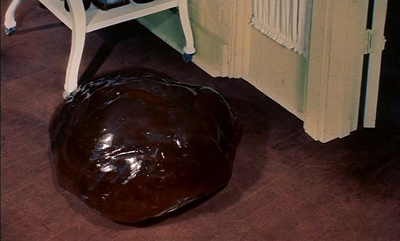
The Silicone: The Blob was primarily made of a silicone-based gel dyed bright red with food coloring. It had to be thick enough to hold its shape but fluid enough to flow over surfaces.
The Miniatures: Most of the famous Blob attacks were filmed using highly detailed miniature sets. The effects team would tilt the sets and let gravity do the work, making the silicone slide over the buildings and people. It’s practical magic at its finest.
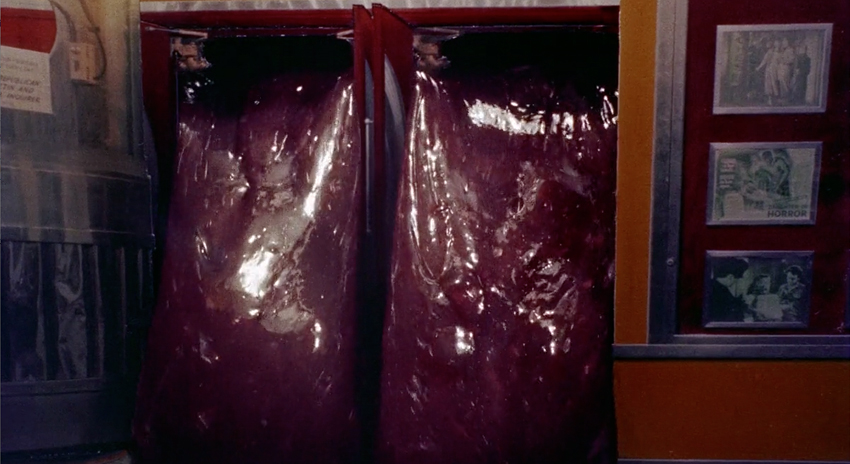
The Growth: As the movie progresses, The Blob gets darker and larger. It moves from a pale pink to a deep, blood-red. This was a conscious choice by the filmmakers to show that the monster was literally becoming what it ate. It’s an abstract, almost surreal kind of horror, rendered in bright, DeLuxe Color. One of the most memorable set pieces is the Projection Room. The Blob enters a movie theater through the projection booth, oozing out of the vents like a slow-motion murder-cloud. The way it moves is hypnotic, it’s both liquid and solid, a pure nightmare made of goo.
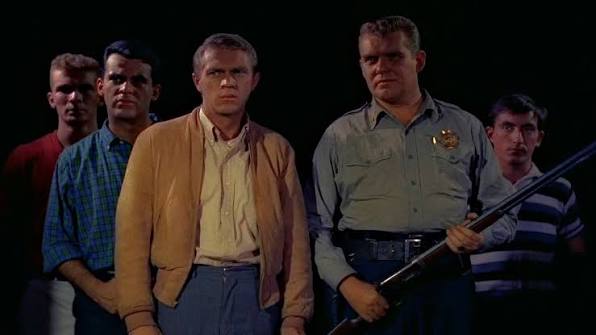
The Support System: Cops, Kids, and Cold War Panic
Every great 50s creature feature needs a balance of good cops and bad cops, and The Blob is no different.
Lt. Dave Barton (Earl Rowe): The sympathetic officer who wants to believe Steve but is held back by procedure.
Sgt. Jim Bert (John Benson): The hard-ass who represents the dismissive adult world.
The movie leans heavily into the paranoia of the era. Much like Invasion of the Body Snatchers, there is an underlying sense that the authorities are ill-equipped to handle an unconventional threat. The Blob doesn’t have a political ideology, but it represents the unstoppable force, something that doesn’t care about your laws, your borders, or your juvenile delinquent status. It just wants to incorporate you into its mass.
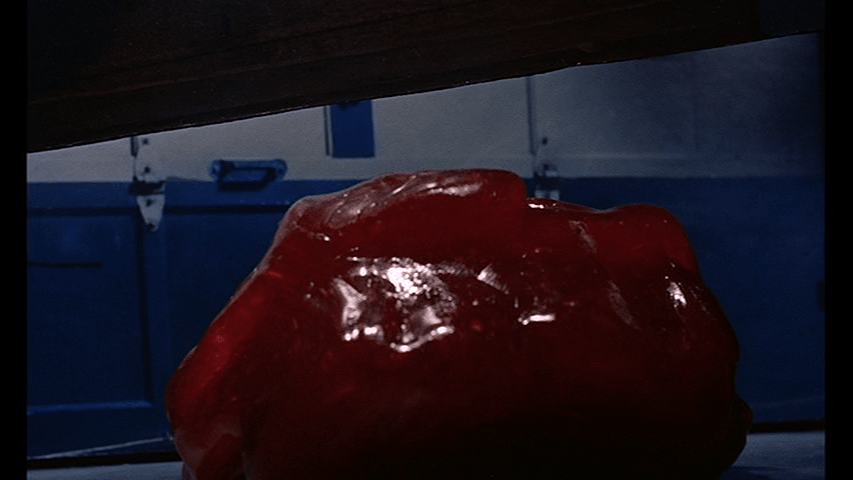
The Slow Ooze of Tension
The Blob unfolds at a deliberately slow pace. It starts with a single hand, then a doctor’s office, then a grocery store, and finally the entire town.The movie does a great job of keeping the monster compelling by showing us the aftermath before revealing the full-scale attack. We see the doctor’s empty clothes. We see the nurse’s shoes. It builds a sense of Goo-Dread that culminates in the legendary Diner Climax.
The pace picks up when the Blob finally traps Steve, Jane, and Jane’s younger brother in the basement of the local diner. The monster literally covers the entire building. It’s a siege movie where the walls are made of sentient jelly.
The Theme Song
We cannot have chat about The Blob without mentioning the Theme Song.
“Beware of The Blob, it creeps/And leaps and glides and slides/Across the floor/Right through the door/And all around the wall/A splotch, a blotch/Be careful of The Blob“
Now, some.might say they could come up with that after four cans of Stella and an hour with a rhyming dictionary, but I say that it’s the work of fucking art!
The song was written by a young Burt Bacharach and Mack David. It is a jaunty, upbeat, finger-snapping pop tune that plays over the opening credits. It is the most whacked out choice in horror music history. You’re about to watch a movie about a man having his arm dissolved by space-acid, and the movie starts with a song that sounds like it should be playing at a high school prom.
It sets a tone that says, “We know this is ridiculous, so let’s have some fun with it.” It’s the mix of camp and craftsmanship that makes the movie endure. It’s absurd and playful, yet it fully commits to being entertaining.
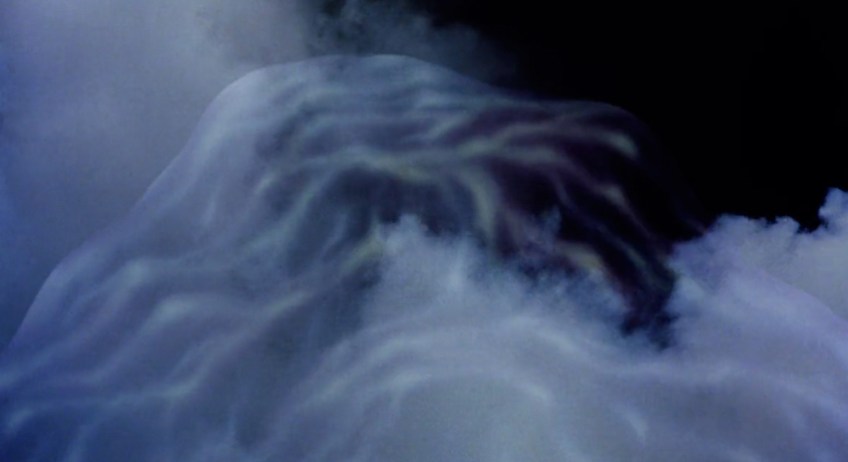
The CO2 Solution
The big reveal in The Blob comes when the heroes discover its weakness. They realize that the monster doesn’t like the cold. Why? Because when Steve hits it with a fire extinguisher, it recoils and hardens.
The finale involves the entire town raiding the school for every fire extinguisher they can find. It’s a community effort horror ending. We get Steve McQueen on the roof of the diner, spray-painting The Blob with CO2 while the townspeople cheer.
The practical effects of the Blob freezing, turning into a dull, crystalline red, is a great visual. And the final solution? They call in the Air Force to airlift the frozen Blob to the Arctic.
Lieutenant Dave: At least we’ve got it stopped. Steve Andrews: Yeah, as long as the Arctic stays cold.
In 1958, that seemed like a solid plan. In 2026, with global warming? That ending is a lot more terrifying than the director ever intended.
The Production Design: Small Town, Big Slime
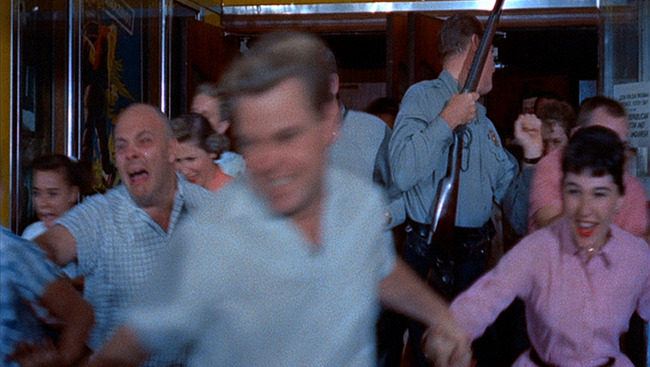
Directed by Irvin Yeaworth, the movie was filmed in and around Phoenixville and Royersford, Pennsylvania. Using real locations gives the movie a grounded feel that sets it apart from the soundstage horrors of the era.The Colonial Theatre in Phoenixville still stands today, and they hold an annual Blobfest where people reenact the scene of everyone running out of the theater in a panic. That is the films ultimate legacy. The movie became a part of the actual geography of the town.
The use of color (DeLuxe Color) is also vital. The 50s were often gray and shadowy, but The Blob is vibrant. The red of the monster pops against the blue of the night and the neon of the diner. It’s eye candy horror that emphasizes the absurdity of the creature.
From Slime to 80s Goo-Gore
The Blob is the Daddy of the Goo subgenre. Without it, we don’t get:
The 1988 Remake: Which took the horror and dialed it up to an 11 with the most some of the most gruesome practical effects of the decade.
The Stuff (1985): Larry Cohen’s satirical take on sentient food.
Society (1989): The shunting scene is essentially The Blob but with more high-society trauma.
For the horror geek, the 1958 original is the pure version. It’s about the simplicity of the threat. It’s an unstoppable, unthinking, unfeeling stomach that just keeps moving. It’s the never ending insatiable hunger of the creature feature.
Why I Love It
I love The Blob because it’s unapologetic. It knows it’s a movie about red silicone, and it plays that hand for all it’s worth. It’s got:
A young Steve McQueen being cool while covered in fake meteor dust.
A catchy-as-hell theme song.
Some of the best miniature-and-matte-painting work of the 50s.
An ending that is both a relief and a subtle screw you to the future.
It’s the kind of movie you watch with a large soda and a box of Red Vines, mostly so you can pretend the candy is a piece of the monster. It’s fast-paced, it’s funny, and it celebrates the ridiculousness of its premise, while still delivering a genuinely iconic monster.
It’s an Atomic Age classic. It’s a movie that reminds us that practical is always better than pixelated, and that you should never, under any circumstances, poke a falling star with a stick.
Leave a Reply