A quiet exploration of the difficult choices that must be made when the doctor has bad news, Lesions—
Wait, no.
That’s not what Lesions is at all, though one might be forgiven for thinking that it was going there for the first chunk of the movie (even with a titillating yet still somehow restrained opening scene).
What Lesions really is, is a movie about collapsing possibilities.
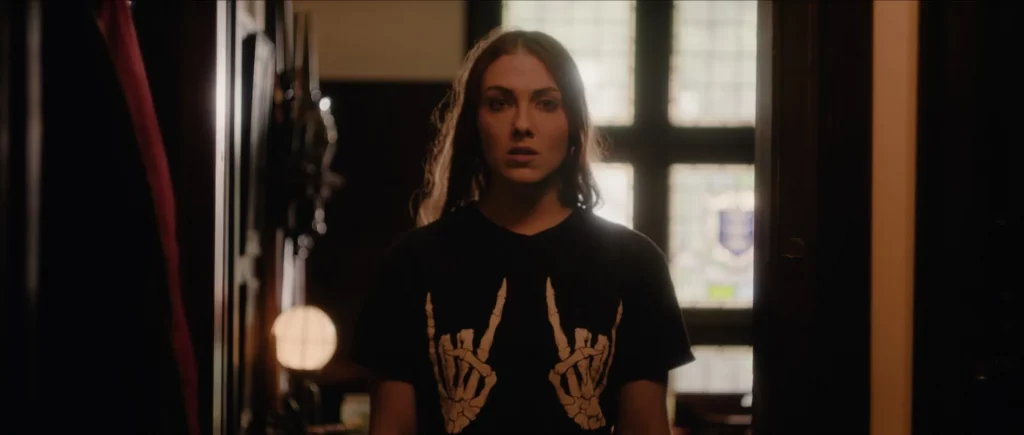
We meet Houston (Alexander McPherson) and Lise (Elsa Ames) mid-divorce, as he is picking up a box of his things from the bar where Lise tends. It isn’t shaping up to be an amicable split—even Lise’s co-workers seem angry at Houston, and Lise has pointedly returned a picture of the couple during happier times in a frame with the epigraph, “You Have My Whole Heart.” When Houston collapses, unable to feel his legs, he learns he has multiple sclerosis (hence, Lesions) and is offered an experimental treatment by neurologist Dr. Nelson. Will this be a nightmare of body horror? Insanity? Medical experimentation at the behest of a shadowy Big Pharma cabal? It could go anywhere from here.
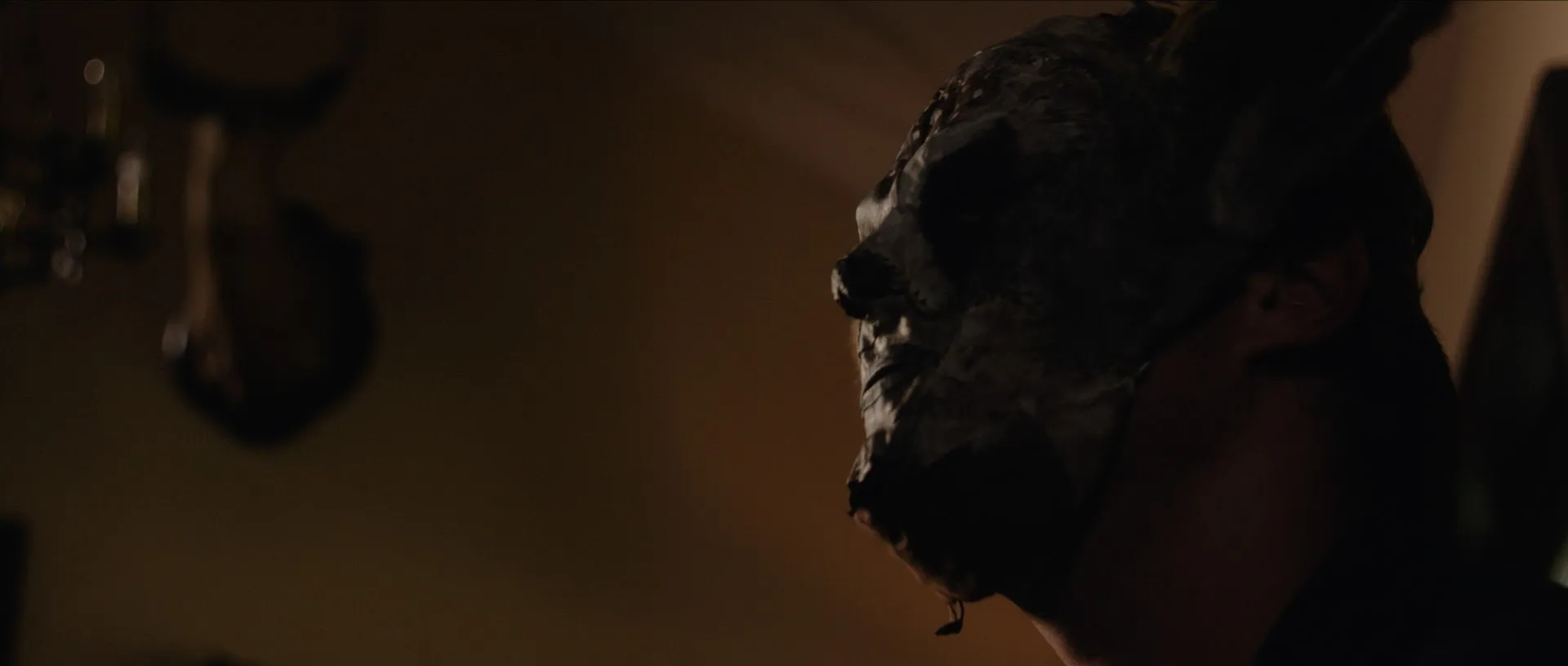
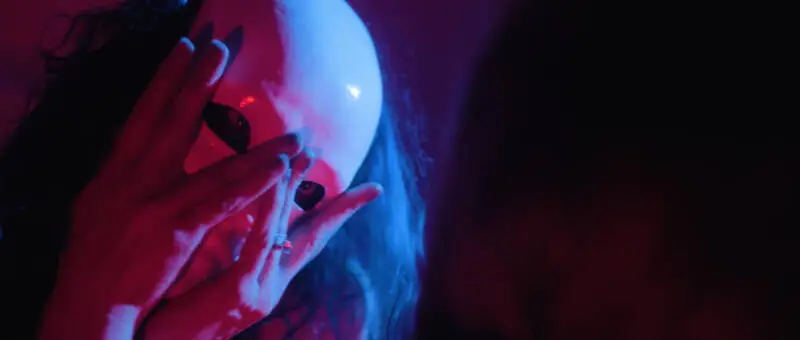
Then slowly, a parallel plot oozes in: this seems straightforwardly a home invasion film in the vein of The Strangers, but with the stop watches, for reasons we will learn later. Are these people minions of Dr. Nelson’s, or whoever he works for? Have they, too, undergone experimental treatment, and mutated into masked and vicious murderers? Almost anything would make sense with what we’ve been given.
Houston decides to accept the experimental treatment, and he and Lise retreat to his grandfather’s isolated cabin so that he can rest and recover. Still, his condition deteriorates into a psychedelic haze to make Panos Cosmatos proud (and it won’t be the last bit of Lesions to do so), even as Lise struggles to both care for Houston and stave off her own boredom. In the meantime, one of her social media accounts has caught the eye of the home invaders.
Some possibilities have dropped away as the real shape of the story becomes clear: a couple in an isolated cabin, a crew of home invaders. Their paths will cross, but why, and what does any of it have to do with Houston’s condition, other than that there needed to be a reason to isolate this couple? There are at least two more branches before all possibilities collapse and the two stories meet. It’s a clever approach, taking what could have functionally been two separate movies and making them work together. Everything, structurally, hangs on the medical story, but having the narrative patience to let all the possibilities breathe before narrowing it down, keeps Lesions interesting.
The home invasion line, which had the greatest potential to be trite, successfully uses misdirection and stylistic choices—including some great musical choices for metal fans—to be something more than a The Strangers retread. (This was a real danger, a very dicey prospect after the perfect recreation of one of the most famous shots in The Strangers, and one pointed paraphrasing of its most famous line). Still, Lesions smacks of love letter, or heartfelt homage, rather than rip off. Visually, there is never a dull moment in Lesions; a highlight is a particularly stunning sequence involving microscopic footage of real red blood cells.
Still, it is in the final collapse of all the possibilities into a cohesive, explosive final act (over which Cosmatos looms again) that makes Lesions. There aren’t any real surprises here, but we are well past that point in cinematic history, and this type of cynicism, however tempting, doesn’t account for catharsis (even when it gets cryptically confounded). There is a comfort there, the memory of being unjaded by buckets of blood, that Lesions taps into. Director Codey S. Wilson admits to hoping that loud music and bright lights might distract viewers from expected beats, and they kind of do, but mostly didn’t need to—because of the set up and pacing in the first part of the film, even once you have a sense of how it might all play out, there is joy to be had here, and this is, for me, what recommends Lesions: that smile I felt when met by the final gloriously gory spectacle.

Leave a Reply