Forget the guy in the spray-painted William Shatner mask. Forget the heavy breathing in the bushes and the repetitive piano tinkling that sounds like a cat walking across a keyboard. In 1982, Tommy Lee Wallace, Debra Hill, and John Carpenter looked at the most successful slasher franchise in history and said, “You know what people really want? Less stabbing, more ancient Stonehenge grit, and a plot involving killer commercial jingles.”
Welcome to Halloween III: Season of the Witch, the movie that didn’t just go off the rails; it crashed the entire train, set the tracks on fire, and then tried to sell you a latex mask filled with snakes and crickets. It is the ultimate in “What the fuck were they snorting?” 80s horror.
The No Michael Gamble
Let me ask you a question, dear reader. Why do you go to see a Halloween movie? Michael Fucking Myers, of course, but Michael Fucking Myers is nowhere to be found. This is because Carpenter and Debra Hill had a vision. They wanted Halloween to be an anthology series, a different spooky story every year.
It was a bold, artistic move that the general public hated with the passion of a thousand burning suns. People showed up to the theater expecting a silent stalker and instead got Dan O’Herlihy playing a toy tycoon with a grudge against children. It’s like ordering a steak and being served a plate of neon-colored circuit boards and a live rattlesnake.
But here’s the truth: Season of the Witch is actually a better, weirder, and more ambitious movie than half the Michael Myers sequels that followed. It’s a cynical, pitch-black corporate satire disguised as a creature feature.
Dr. Dan Challis: The Least Responsible Hero in History
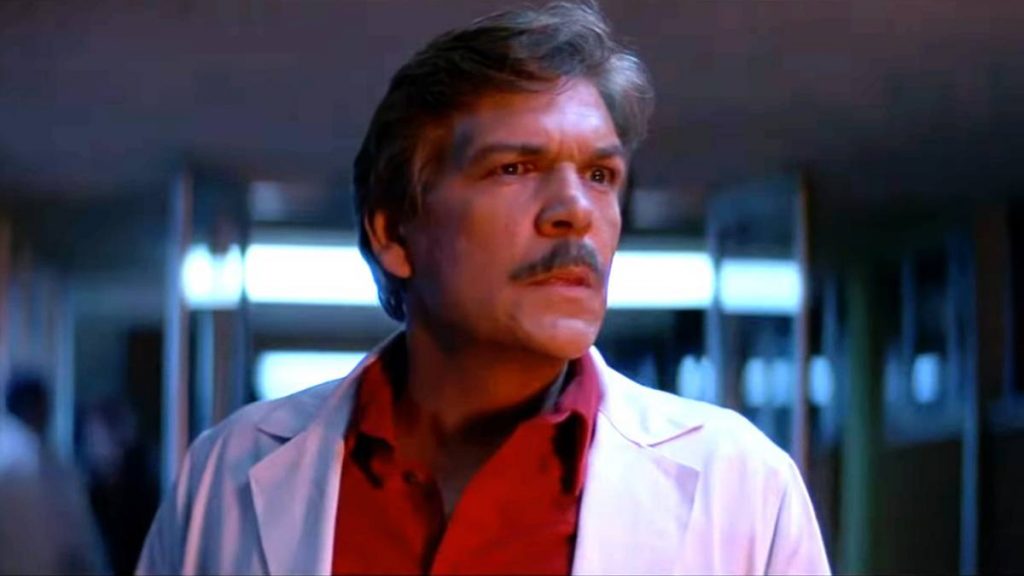
Enter our protagonist, Dr. Dan Challis (Tom Atkins). If there was an award for ‘Most Likely to Be Drunk During an Emergency’, Challis would take the gold, silver, and bronze. He is the quintessential 80s divorced dad hero. He drinks Miller High Life out of a paper bag, hits on every woman within a five-mile radius, and treats his medical practice as a mild inconvenience between bar hops.
Tom Atkins is a legend. He brings a sensational mustache energy to the role that makes the absurdity of the plot feel strangely grounded. When a guy wanders into his hospital clutching a Silver Shamrock mask and then gets his eyes gouged out by a guy in a suit who promptly blows himself up in the parking lot, Challis doesn’t call the FBI. He calls his ex-wife to tell her he’s going on a road trip with a woman half his age (Ellie Grimbridge).
This is peak 80s logic: “My man was murdered by a suicidal robot? Let’s go to the suspicious toy factory town and share a motel room!”
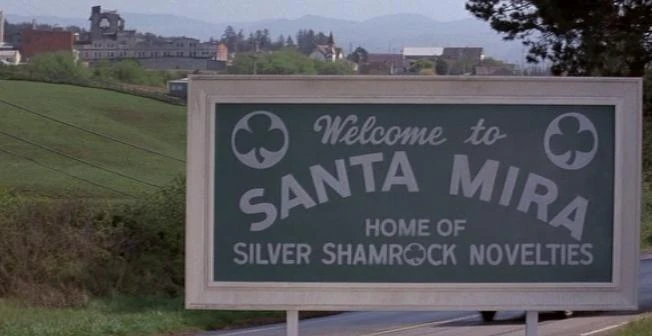
Santa Mira: The Town That Time (and Human Rights) Forgot
The duo arrives in Santa Mira, California, the home of Silver Shamrock Novelties. The town is a panopticon of Orwellian dread. There are cameras on every corner, a curfew that would make a prison warden blush, and a local population that seems to consist entirely of lobotomized extras from a laundry detergent commercial.
This is a place of sterile, plastic malevolence. The town is owned by Conal Cochran, a man who looks like he’s about to offer you a butterscotch candy and then steal your soul. Cochran isn’t a slasher; he’s a CEO. He’s the ultimate ‘The Man’, using the tools of mass production to facilitate an ancient Druidic blood sacrifice.
It’s a bizarre mashup of Invasion of the Body Snatchers and a tech startup gone wrong. The Devil lies in the details: the clean-room labs, the men in grey suits who turn out to be androids filled with yellow goop, and the sheer audacity of a villain whose master plan involves a ‘Big Giveaway’ on Halloween night.
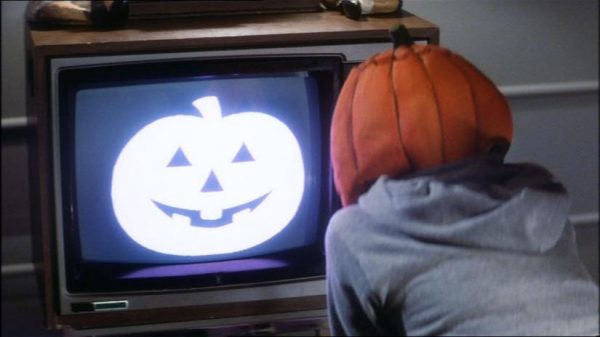
The Jingle That Will Eat Your Brain
“Eight more days ’til Halloween, Halloween, Halloween! Silver Shamrock!”
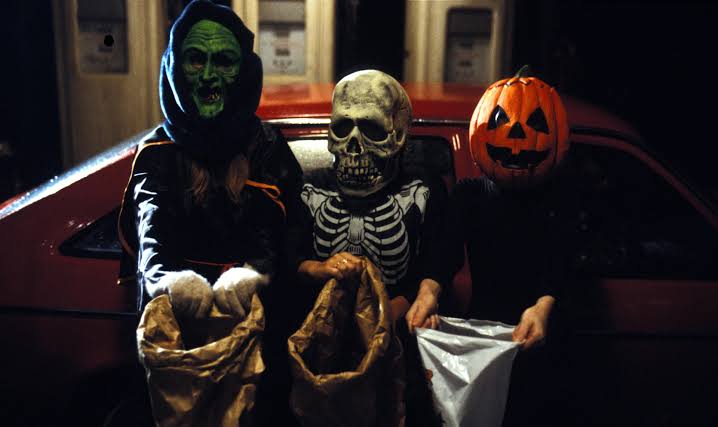
If you’ve seen this movie, that jingle is currently burrowing into your frontal lobe like a parasitic worm. Set to the tune of London Bridge is Falling Down, it is the most effective psychological warfare ever committed to film. It plays constantly, on TVs, on radios, in the background of every scene. It’s a meta-commentary on the commercialization of the holiday, and it’s also a trigger for a Stonehenge-powered microchip hidden in the Magic Pumpkin masks.
Yes, you read that correctly. Stonehenge-powered microchips.
The Plan: Druids, Robots, and Lasers
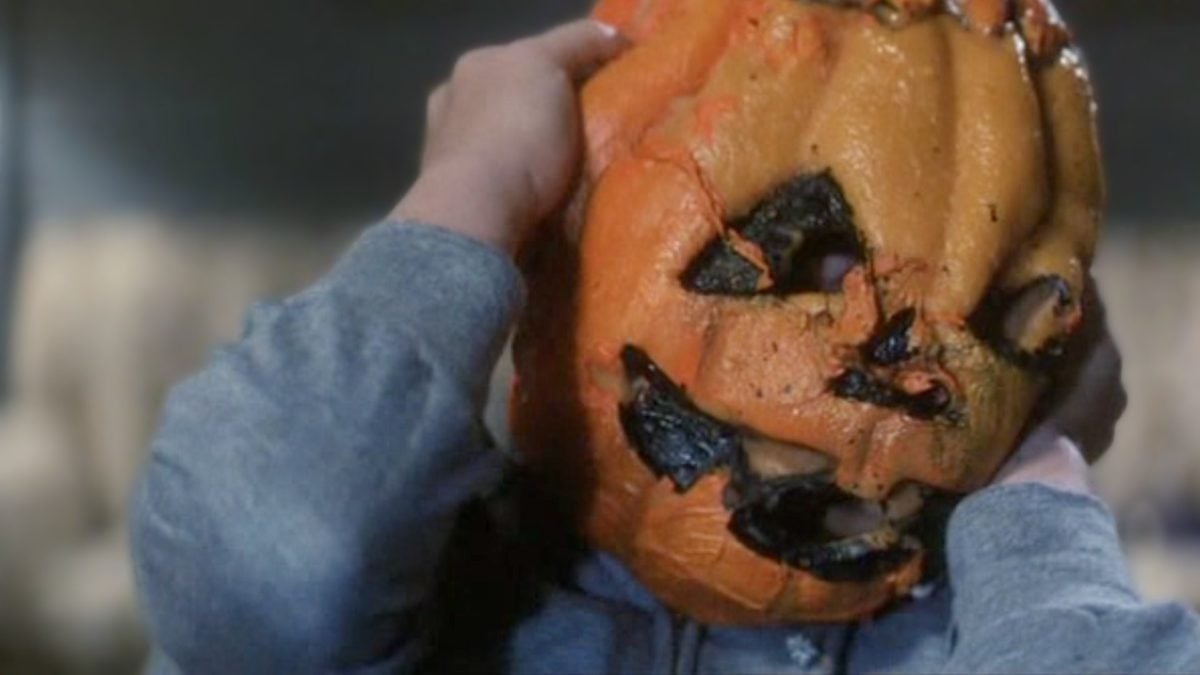
This is where the movie truly exits the atmosphere of sanity. Cochran has stolen one of the stones from Stonehenge (how? why? the movie doesn’t care) and brought it to California. He’s using high-tech lasers to shave off microscopic pieces of the rock and embedding them in the back of latex masks.
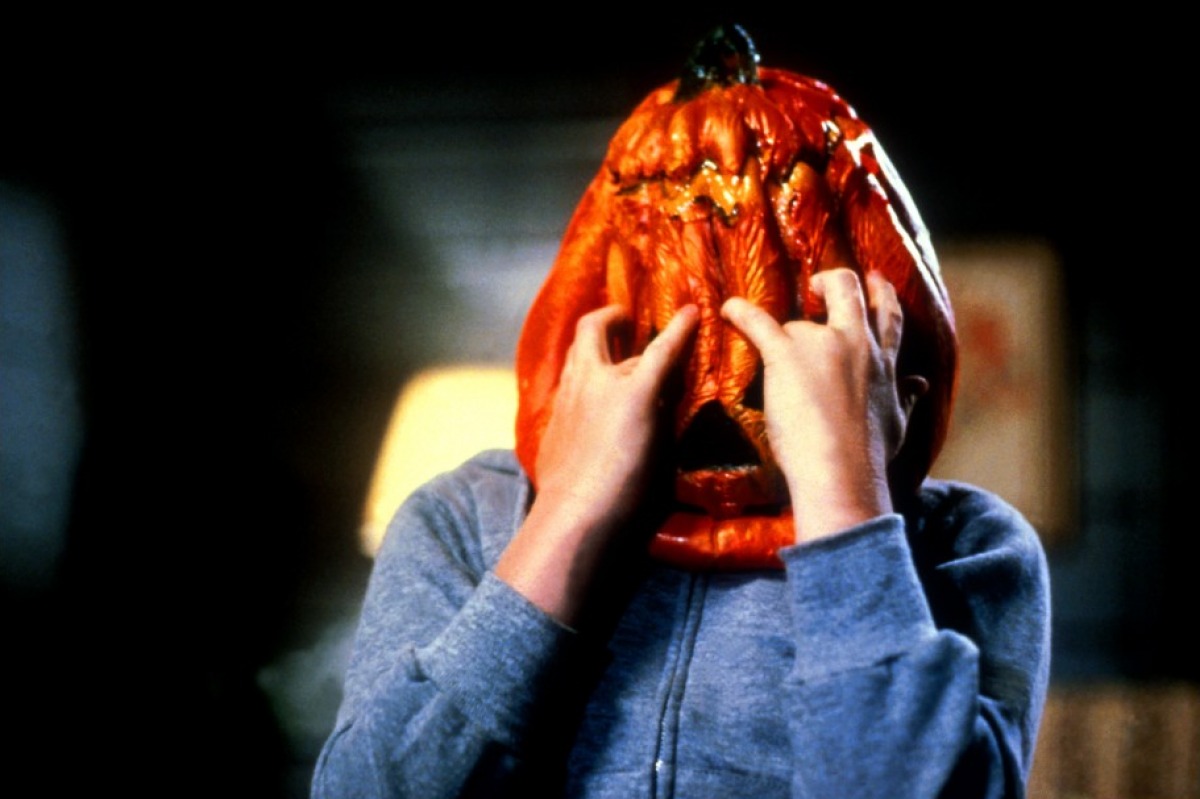
When the Silver Shamrock jingle plays during the ‘Big Giveaway’, the microchip activates, the rock fragment glows, and the child wearing the mask has their head turned into a pile of snakes, spiders, and crickets.
It is the most needlessly complicated way to kill people in the history of cinema. Cochran could have just put poison in the masks. He could have used bombs. But nooooooo, he wanted to use ancient Celtic magic delivered via a TV signal. It is as magnificentas it is fucking stupid. It is the kind of logic that makes no sense on paper but seems quite sensible when you see a test subject’s head melt into a swarm of bugs on a grainy monitor.
The Android Apocalypse
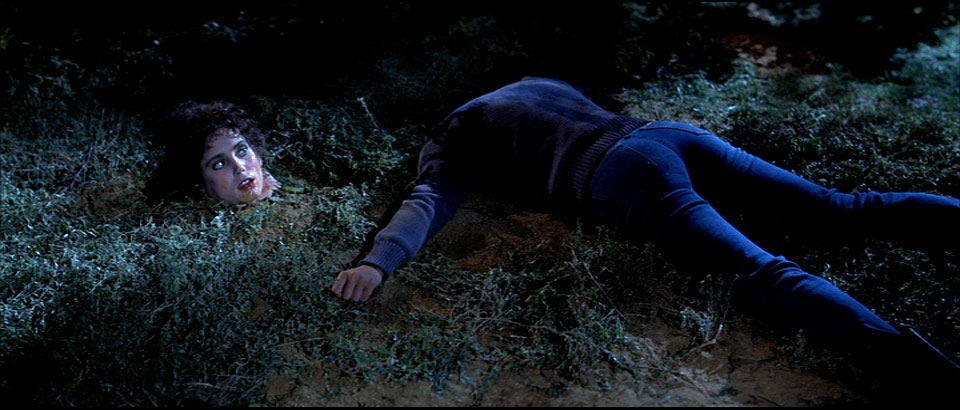
And then there’s the henchmen/women. They aren’t ghosts or demons; they are Androids. These robots are creepy as hell. They don’t talk. They don’t bleed (they leak a yellow, synthetic fluid that looks like lemon curd). They just walk toward you with a blank, corporate stare and rip your head off. The effects here are top-tier 80s gross-out gold. The scene where a robot kills a woman by shoving its hand through her mouth is a reminder that while Michael Myers was classic, these guys were just mean.
The reveal that Ellie has been replaced by an android is meant to be sad, but I find it funny as balls. Challis thinks he’s saved the day, he’s escaped the factory, he’s got the girl, and then she tries to claw his eyes out while he’s driving. It’s one of those sequences I had to oause while rewatching, it for the first time in years, because I was laughing so hard.
The Ending: Stop it! Stop it!
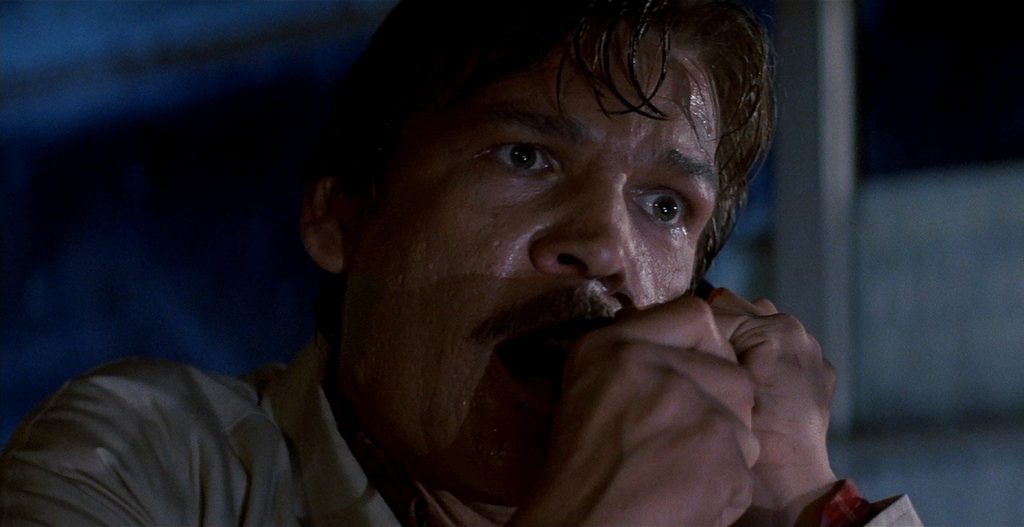
The final scene of Halloween III is a great example of cinematic nihilism. Challis is in a gas station, frantically calling the TV networks, trying to get them to pull the Silver Shamrock commercial before the ‘Big Giveaway’ starts.
He gets two channels to shut down. He’s screaming into the phone at the third one:
”Stop it! Stop it! STOOOOOP IIIIIIIIT!”
The screen goes to black. The jingle cuts off. We never find out if he succeeded. We never see the thousands of children whose heads are about to become insect hotels. It is a bleak, unresolved, and incredibly ballsy ending for a major studio film. It refuses to give the audience the ‘Hero Wins’ satisfaction. It just leaves you sitting in the dark, wondering if you should throw your TV out the window.
Why It Actually Works
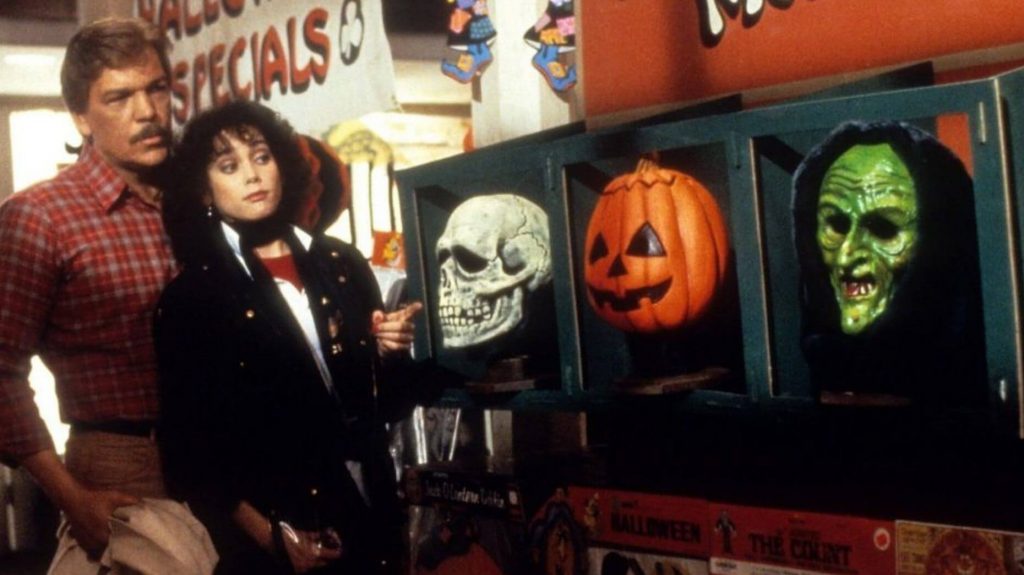
People call this movie ‘off the rails’ because it abandons the formula. But by abandoning the formula, it became its own unique beast. It’s a weird hybrid of sci-fi, folk horror, and corporate thriller.
It captures our obsession with technology and the fear that our screens are rotting our brains. Cochran isn’t just a killer; he’s an influencer. He’s using the most powerful tool in the world, television, to commit mass murder. It’s a precursor to Videodrome or Black Mirror, but with more latex masks and Tom Atkins drinking beer.
The production design is fantastic. The Silver Shamrock factory feels like a real, oppressive workplace. The contrast between the bright, happy masks and the cold, dark rooms where they are programmed is a visual treat.
And, credit where it’s due, the effects team do a bang up job. The ‘Head-to-Bugs’ transformation is a sequence that still holds up. It’s gross and it’s genuinely disturbing. The use of real snakes and crickets crawling out of a child-sized mask is the kind of things that nightmares are made of.
When a robot gets its head knocked off, you see the wires and the goop. When a mask melts into a face, you see the smoke. It feels like something that could actually happen in a basement in 1982 if a druid got a hold of a soldering iron.
Why I Love It
I don’t. I mean, I didn’t used too. In fact, I even tried too fob this article off onto Andrew Grevas, the number one authority on the Halloween franchise and whose book on the subject Horror in Haddonfield you should really go and buy, but after he said he written all he could about Halloween, I bit the bullet and decided I’d suck it up and take one for the team.
And you know, I’m glad I did.
Because Halloween III: Season of the Witch isn’t just a footnote in franchise history, it’s the glorious, neon-lit cocaine fulled middle finger to your expectations. Watching it again is like stepping into a candy-coated funhouse rigged with ancient Stonehenge magic and the subtle menace of a thousand unsmiling accountants. It is ridiculous, unnerving, and absurdly satisfying all at once.
This movie dared to do what few sequels ever could: tell a story that didn’t rely on familiar faces or recycled scares. No Michael Fucking Myers, no endless stalking sequences, just a small-town apocalypse orchestrated by a man who looks like he stole the soul of every toy store in America. It rewards patience, wit, and a dark sense of humor, while punishing anyone who comes looking for a traditional happy ending.
So yeah, I took one for the team. I dove headfirst into the flickering glow of Silver Shamrock TVs, got the jingle lodged in my brain, and had the unnerving thought that somewhere out there, a druid-powered mask might be plotting its next move. And I wouldn’t have it any other way.
Halloween III is a fever dream of the highest order, a movie that’s audacious, absurd, and absolutely unforgettable. If you haven’t watched it, you’re missing the chaotic heart of 80s horror genius, and frankly, your Halloween just isn’t complete.
Leave a Reply