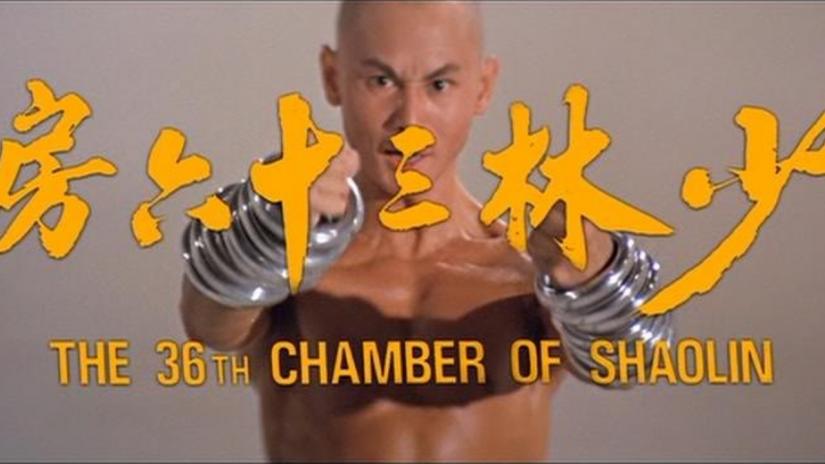
In 1978, Lau Kar-leung and the legendary Gordon Liu looked at the entire concept of the martial arts movie and decided that what people really wanted was an hour-long, granular, deep-dive into the most grueling vocational school in human history. No shortcuts. No inspirational pop song. Just pain, repetition, and the creeping realization that your legs no longer belong to you.
Welcome, my freaks and geeks, to The 36th Chamber of Shaolin (also known as Master Killer to anyone who acquired this via a man who also sold car stereos out of his car). This isn’t just a movie; it’s a document of a human being deciding that resistance is cool, but ‘hitting people with a three-section staff’ is significantly more practical. A film that treats learning kung fu less like an art and more like a long-term punishment you eventually get good at.
Help! Help! I’m Being Repressed!
The 36th Chamber of Shaolin doesn’t waste a second before slapping you in the face with reality. Before Gordon Liu even thinks about buckets or grinding his eyeballs into reflex-enhanced death lasers, we meet the first poor soul to discover what Manchu efficiency really means. A rebel tries to stick it to the Manchu man, but fails. Enter General Tien Ta, a walking execution manual in silk robes who lays a trap for our first attempted hero. The guy doesn’t just fight; he obliterates, turning our wannabe saviour into a human origami project. Blood sprays, limbs flop, and we get a front-row lesson: passion is useless, skill is mandatory, and screaming “Justice!” will not save you from becoming cinematic floor decoration.
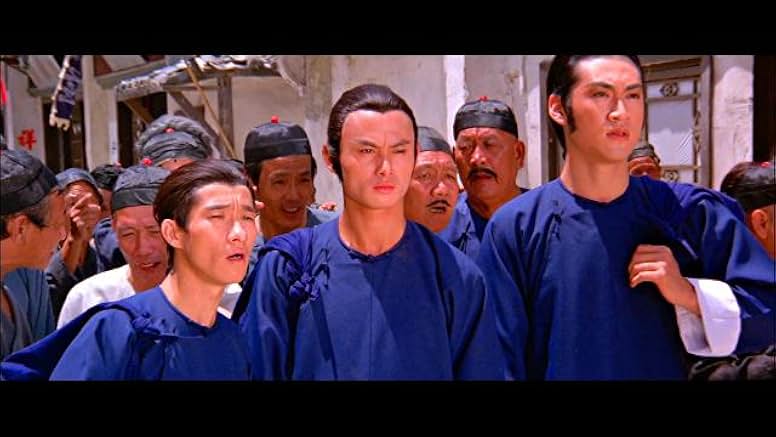
The aftermath of this is where we meet San Te (Gordon Liu), who begins the movie not as a bald-headed bringer of doom, but as a nerdy student with a very questionable haircut and a serious grudge against the government. This is not the look of someone ready to throw down, it’s the look of someone who gets shoved in the hallway and drops his books in slow motion. The Manchus are the bullies, he is the weak. They are brutal, efficient, and possess the kind of facial hair that screams “I kick puppies for a hobby” and probably have a side gig in ruining absolutely everyone’s day.
After his school is dismantled (destroyed beyond all belief) and his friends are turned into very dead martyrs, San Te realizes that being a a loud mouth wanting change doesn’t actually stop a sword from entering your ribcage. Reality hits him like a brick wrapped in barbed wire, and barely alive he manages to flee to the Shaolin Temple, inside a basket of vegetables.
The Grind
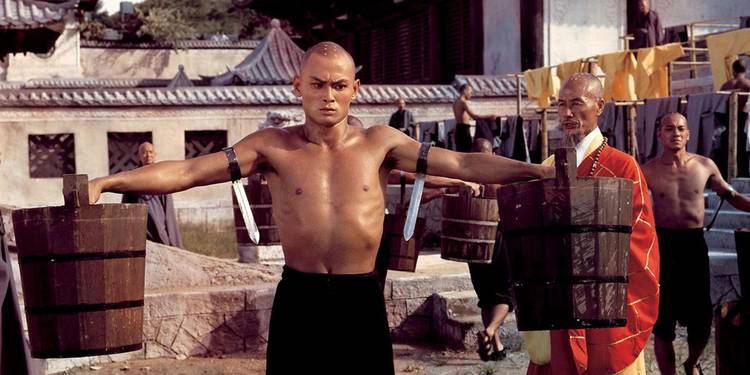
Most movies would show Gordon Liu doing a few push-ups, maybe lifting a rock or two, and then cut to him being amazing. Shaolin says, “Nah, go carry these buckets of water up a massive flight of stairs, while daggers are strapped to you arms to make sure you keep them level, and don’t embarrass yourself.” And just like that, we enter the grind. Not a montage, the grind. Endless, repetitive, soul-sapping effort.
This is where the film’s logic really locks into place. Every Chamber is built to break down one part of the body and rebuild it properly—balance, strength, reflex, endurance—each one isolated, punished, and perfected until there’s nothing left to fix. The Water Chamber isn’t just about strength; it’s about balance and lightness, about understanding your own body like it’s a complicated piece of machinery that keeps breaking in new and exciting ways. If he fails, he gets a blade jammed into his side. If he succeeds, he gets to… carry more water. Congratulations, your reward is more work. It’s the kind of task that grinds a person down and then quietly rebuilds them into something harder.
Gordon Liu’s performance is incredible here because he captures the pure, unadulterated frustration of a beginner. He looks exhausted, he looks annoyed, and he looks like he’s wondering if all this training is gonna be worth it in the long run. You can practically hear his internal monologue screaming, “I could have been a teacher!” But he persists. And with his persistent comes triumph across the board.
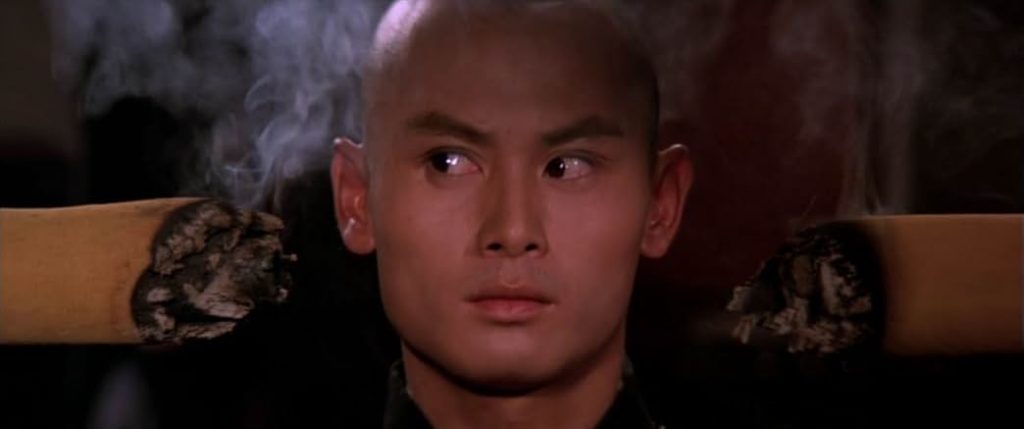
The Eye-Tracker
Here , San Te has to stand between two massive burning incense sticks and follow a light with only his eyes. He can’t move his head. He can’t cheat. If he even so much as flinches, he get a burn on the side of his face that no amount of cream is gonna stop hurting like a bastard.
This is about control. He’s forced to track movement without moving, pushing his focus past the point of comfort until hesitation disappears completely. It’s not flashy, it’s not dramatic, it’s just relentless, until his reactions stop being human and start being exact. It’s silent, it’s intense, and it’s weirdly hypnotic. By the end of the chamber, his eyes don’t wander, they hunt.
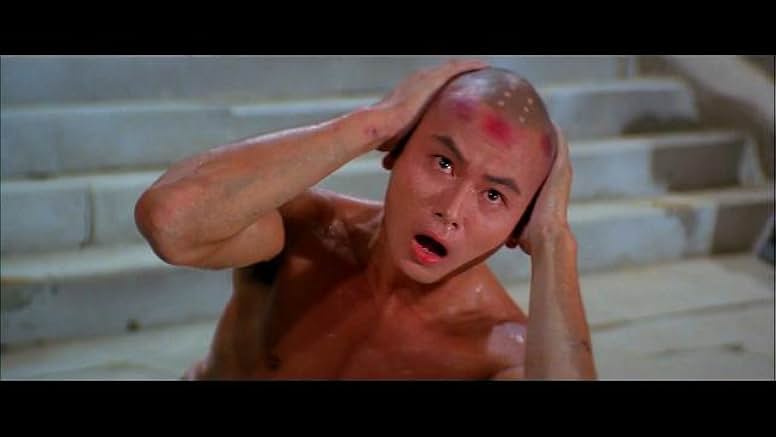
The Head-Butt of Destiny
Most people use their heads for thinking, wearing hats, or occasionally regretting life choices. Shaolin monks use them for structural demolition like they’re auditioning to replace a wrecking ball.
San Te has to strike a massive sandbags with his forehead until his skull becomes harder than a Nokia 3310. The sound design here is tactile and brutal, each thwack echoes through your bones. It’s the kind of noise that makes your chiropractor rub their hands in gless, realising how much money they can fleece out of you for the spinal adjustment you’re gonna need. He isn’t just learning to fight; he’s turning his own body into a blunt-force instrument. An instrument that will eventually find its revenge that he so craves.
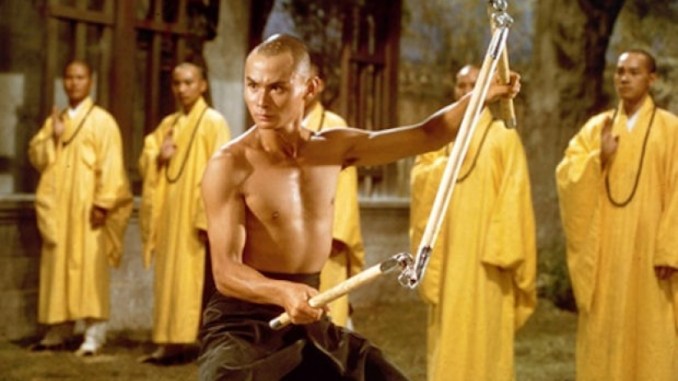
The Creative Weapon: The Three-Section Staff
Eventually, San Te masters the basics and moves on to weapons. But here’s the twist: he is offered the role of leader of any chamber he so desires, if he can beat one of the masters. Problem is, he keeps getting beat by the Abbot’s butterfly swords because his staff is too long to maneuver in close quarters. Instead of pouting, San Te figures out that bamboo is the way forward, no whining, no excuses, just innovation. He goes to the workshop, saws his staff into three pieces, and joins them with chains like some kind of ancient engineering prodigy with a deadline.
Boom. The Three-Section Staff is born. It’s a moment of inspired brilliance. It’s like discovering fire, but instead of roasting marshmallows, you’re hitting people more efficiently. The weapon is unpredictable, dangerous, and looks like a total nightmare to use without immediately concussing yourself. But in San Te’s hands, the choreography becomes a blur of mechanical genius. It folds, it extends, it wraps, it strikes, it’s like watching a weapon think for itself. This is technical combat at its absolute finest, and it turns every scrap into a high-speed puzzle where the solution is always ‘hit harder, but smarter.’
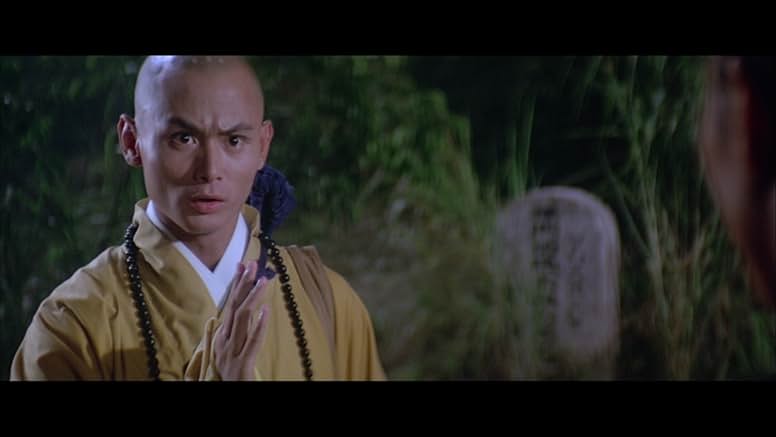
The 36th Chamber
The title of the movie refers to the fact that there were originally 35 chambers. San Te, having conquered them all, proposes a 36th Chamber: a place where laypeople can come to learn the basics of Shaolin arts so they don’t get stepped on by the government like bugs under a very fancy boot.
The monks are all wide-eyed and clutching their robes like San Te just suggested installing a jukebox in the meditation hall. But it’s all a ruse. The head abbot gives San Te a ‘punishment’ assignment: go out into the streets and collect for the temple. Nudge, nudge, wink, wink.
He leaves the temple and goes back to his hometown to start his community outreach program, which mostly involves him kicking the absolute teeth out of the Manchu generals with surgical precision. He’s back where it all began, but now he’s basically a one-man demolition crew. Watching him chew through the guys who made his life miserable is like seeing karma dressed in saffron robes; quick, exacting, and impossible to stop.
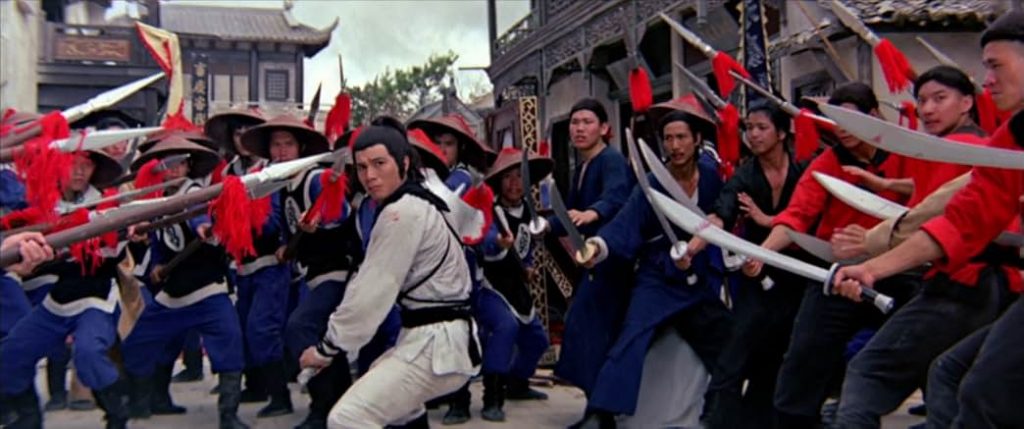
The Choreography: Lau Kar-leung’s Mona Lisa
Lau Kar-leung isn’t just some random guy guessing what kung fu looks like, this is a real-deal martial artist who understands movement like a surgeonu understands human anatomy. The fights in 36th Chamber aren’t flashy in the modern sense. There’s no wire-fu here. Everything feels grounded and realistic.
Well, as realistic as a movie about a guy learning Shaolin Kung-Fu to kick villains to death can be.
They are rhythmic. Every move has a counter. Every strike has a reason. It’s like watching a very high-speed game of chess played with limbs, where every mistake costs you a tooth. Add to it the beauty of the 70s Shaw Brothers sets (the painted backdrops, the slightly-too-red blood, the zooms that hit like a jump scare) and you can almost smell the training halls.
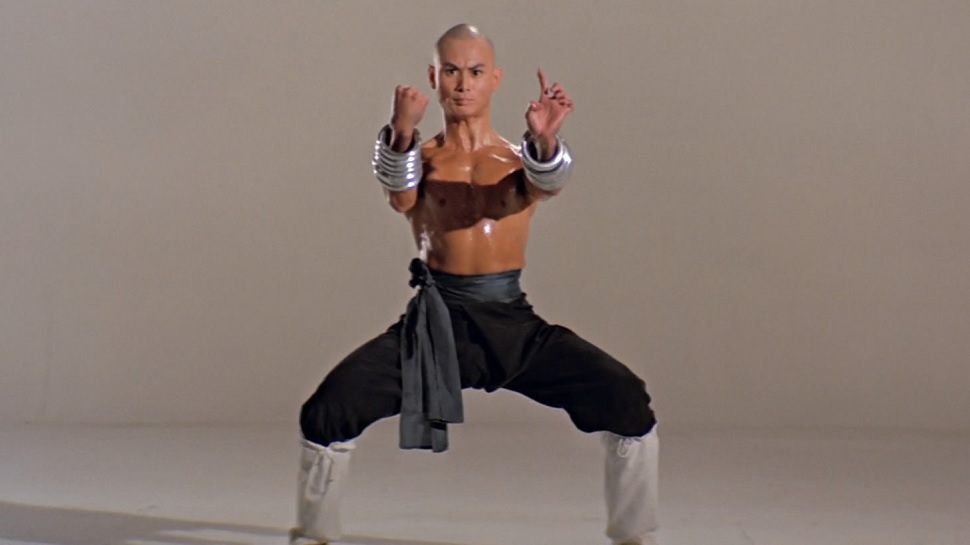
Gordon Liu: A God Amongst Men
Gordon Liu is a God amongst men. He has a physical charisma that is unmatched. Even when he’s just sitting still with a shaved head and a saffron robe, he looks like he could vibrate through a wall if he really committed to it. There’s a coiled energy to him, like a spring that’s been tightened for hours and is just waiting for the moment to snap.
He manages to be both a serene monk and a terrifying engine of destruction. His Master Killer persona is iconic, the stoic, silent warrior who doesn’t need to shout because his three-section staff does all the talking, and when it speaks? Every motherfucker listens. He redefined the monk archetype for a generation, moving away from the old wise man and toward the highly trained special-ops agent for Buddha who can absolutely ruin your day.
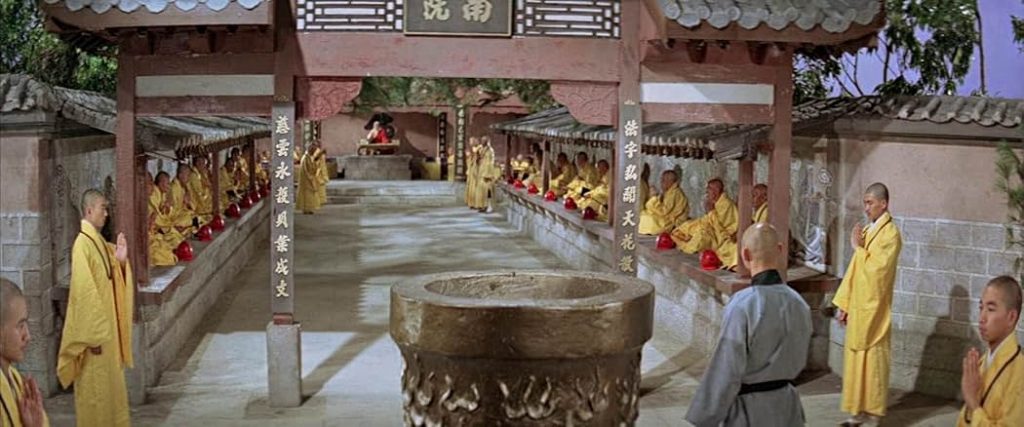
The Humor of Shaolin
Despite the grueling training, the movie has a fantastic sense of humor. The monks aren’t all stoic statues carved from stone; they are competitive, they are petty, and they clearly enjoy watching the new guys suffer through the early chambers like it’s a spectator sport. There’s a quiet, knowing smirk to a lot of the interactions, like everyone’s in on the joke except the poor guy carrying buckets.
The dialogue is direct and punchy. There’s a ‘No Bullshit’ attitude to the whole production. “If you can’t carry the water, how can you carry the weight of the world?” It’s the kind of attitude that would be a cliché if it weren’t being delivered by a man who can break a brick with his index finger and fix your posture at the same time. It’s wisdom that feels earned, not given, like advice carved into stone with someone’s forehead.
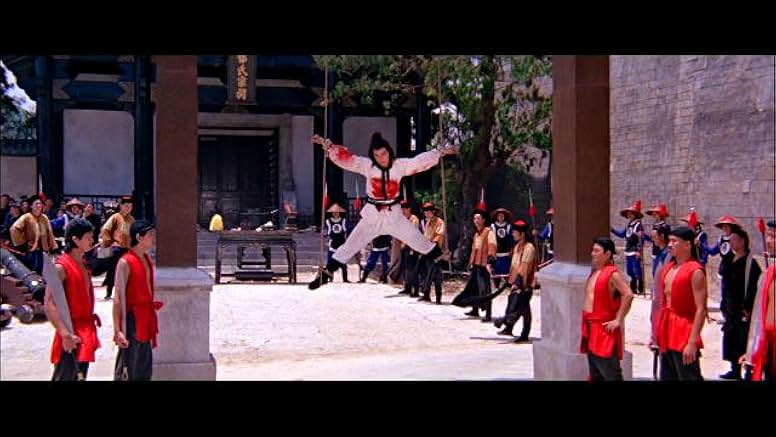
Why I Love It
Because The 36th Chamber of Shaolin doesn’t fuck about. The story is simple. One man wants revenge so trains at a Shaolin temple to gain said revenge, but the road there is hard and doesn’t just happen in the blink of an untrained eye.
It understands that greatness isn’t born; it’s manufactured through thousands of hours of boring, repetitive, and painful practice. It shows that even the most magical martial arts are just a series of physical problems that have been solved through grit, stubbornness, and the refusal to quit even when your skull feels like it’s been used as a drum.
It’s iconic, it’s dazzling, it’s visually unforgettable, and it features a man who can turn a bamboo stick and some chains into both a work of art and a perfectly calibrated instrument of pain. It is pure, 70s, bald-headed intensity. If you haven’t seen it, you’re missing out on a lesson in discipline, and somewhere out there, San Te is glaring at you, handing you two buckets, and pointing you straight up a huge flight of stairs.
Leave a Reply