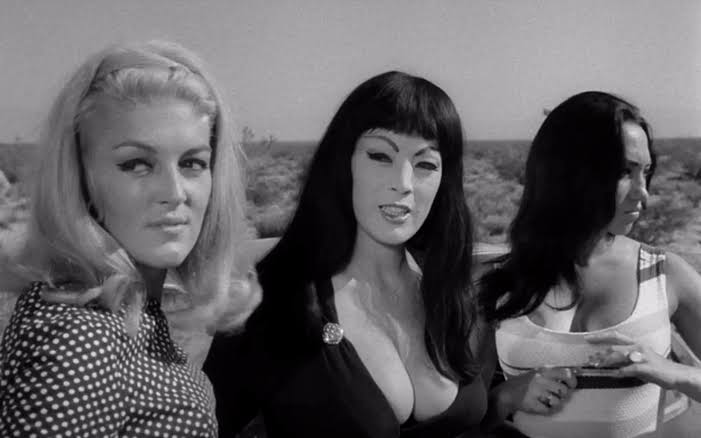
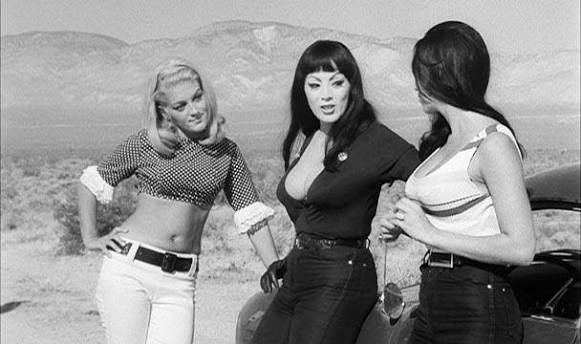
The 1965 monochrome explosion known as Faster, Pussycat! Kill! Kill! is not merely a film; it is a high-octane broadside against the very concept of mid-century morality. To understand the impact of this Russ Meyer masterpiece, we must first strip away the modern lens of ironic appreciation and look at the scorched-earth reality of its 1965 release. In an era where the women’s picture usually involved domestic longing or the pursuit of a husband, Meyer unleashed a trio of leather-clad, go-go dancing predators who treated men like disposable speed bumps. This was not a movie designed to be liked; it was designed to be survived. It stands today as the ultimate artifact of the American Grindhouse, a film that used the tools of exploitation to build a monument to female sovereignty that remains as sharp as a razor and as cold as a desert night.
The architect of this madness, Russ Meyer, was a man of peculiar and highly specific obsessions. Often dismissed by high-minded critics as a mere breast-fixated smut-peddler, Meyer was, in fact, a technical virtuoso with a background that profoundly informed his aesthetic. During World War II, Meyer served as a combat cameraman with the 166th Signal Photo Company. He filmed the front lines of the European theater, witnessing the unedited mechanics of destruction. This experience endowed him with a soldier’s precision and a profound understanding of raw editing. When he returned to the states and eventually turned his lens toward the nudie-cutie genre, he brought that combat-cameraman discipline with him. He didn’t just film scenes; he attacked them. By 1965, he was tired of the playful, naturalist nudity of his early work and wanted to create a legitimate thriller that reflected the cynical, aggressive energy he saw simmering beneath the surface of American culture.
The resulting film is a masterpiece of high-contrast noir. By choosing to shoot in black and white during the height of the Technicolor explosion, Meyer elevated the film from a cheap exploitation flick to a work of graphic art. The desert landscapes of California are transformed into a stark, lunar void where shadows are as solid as the mountains. This monochrome palette serves a dual purpose: it hides the low budget by emphasizing texture and silhouette, and it creates a moral universe where there are no grey areas. You are either the hunter or the prey. The cinematography is fetishistic in its detail, focusing not just on the human form, but on the mechanical anatomy of the cars, the gear shifters, the tachometers, and the roaring engines. It is a world of hard edges and fast movements, edited with a staccato rhythm that makes every scene feel like a ticking time bomb.
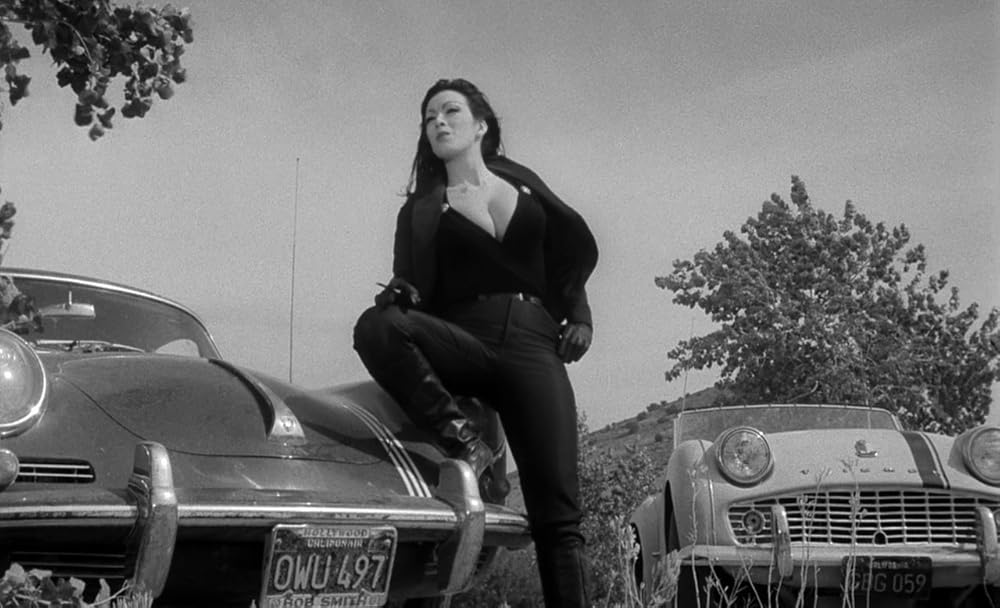
However, all the technical brilliance in the world would have meant nothing without the casting of Tura Satana as Varla. It is a fact that cannot be overstated: Tura Satana is one of the most intimidating presence in the history of cinema. A Japanese-American survivor who had faced more real-world violence than any of her male contemporaries, Satana didn’t just play Varla; she invented her. She reportedly brought her own street fighting style to the production, rewrote her own lines to remove any hint of weakness, and performed her own stunts. Varla is the Alpha in a black jumpsuit, a woman whose pointed eyeliner is as lethal as her neck-snapping bare hands. She represents a total rejection of the Damsel-in-Distress archetype. She does not seek love, she does not seek approval, and she certainly doesn’t seek redemption. She only seeks power.
The narrative engine of the film is deceptively simple, following a Darwinian logic that leaves no room for sentiment. Varla and her companions, the loyal Rosie and the sensitive Billie, are drag racing in the desert when they encounter a young couple. After Varla kills the boyfriend in a fit of cold-blooded boredom and kidnaps the girlfriend, the trio descends upon a remote ranch. They have heard rumours that a wheelchair-bound Old Man is hoarding a fortune in cash. What follows is a psychological siege that pits the Old World patriarchy against the New World anarchy. The Old Man is a bitter, misogynistic relic who is believes he can control women through manipulation and wealth. Varla, however, is a force he cannot quantify. She is a woman who has transcended the need for the systems he represents.
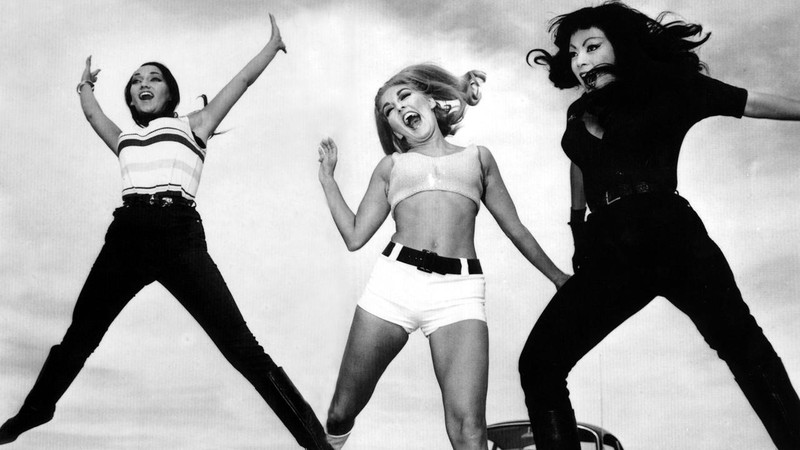
One of the most frequent, and usually hot-headed, debates surrounding the film is its status as a feminist work. On the surface, it is a Russ Meyer production, a genre defined by the male gaze. Yet, if one looks at the actual mechanics of the film, it defies almost every convention of the male-dominated exploitation genre of the 1960s. For one, there is absolutely no nudity in the film. Meyer relies entirely on the presence and agency of his actresses rather than the literal display of their bodies. The women are the sole drivers of the plot; they are physically, intellectually, and emotionally superior to every male character they encounter. The men are either dim-witted brutes like The Vegetable or manipulative cowards like the Old Man. Varla and her crew are predators in a world of prey, and they never apologize for their appetite.
The dialogue, penned by Jack Moran, is a masterpiece of hard-boiled pulp poetry. Every line is delivered with a snarl, stripped of fluff and designed to assert dominance. When Varla tells a man that he is a point of nothing and that it is time he got used to it, she isn’t just insulting him; she is stating a fact of the desert. This verbal aggression matches the physical violence of the film, which was shockingly blunt for 1965. The moment Varla snaps a man’s neck with her bare hands, without a trace of remorse or hesitation, was a cinematic declaration of independence. It told the audience that the era of the safe woman was over.
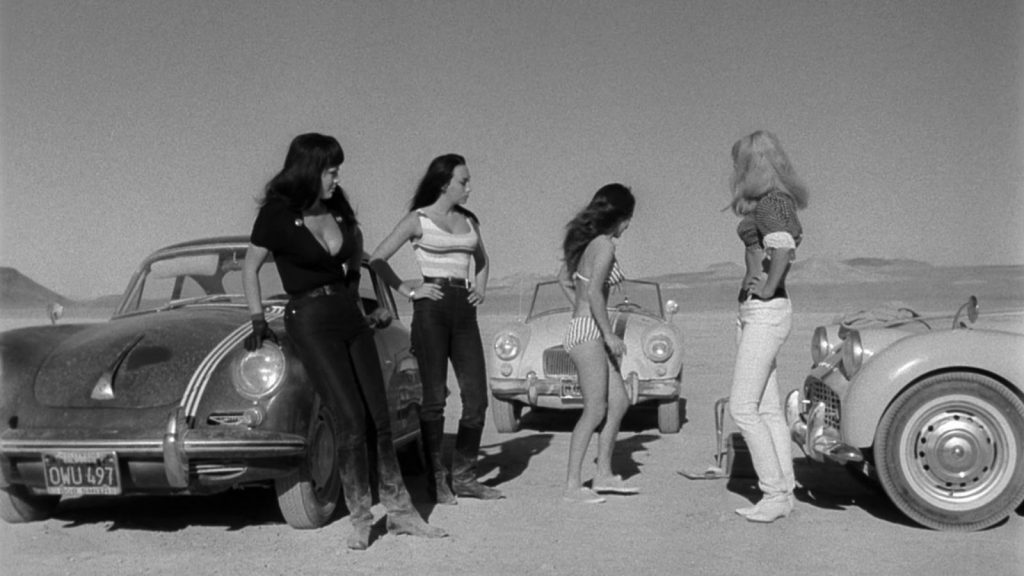
The film’s influence on modern cinema is staggering and well-documented. It was a massive touchstone for the Riot Grrrl movement of the 1990s, which reclaimed Varla as an icon of female rage and independence. I mean, there was even a band called Tura Satana during this point who are very much worth your time. Filmmakers like John Waters and Quentin Tarantino have spent their entire careers trying to replicate the specific vibe of Faster, Pussycat! Kill! Kill. It’s no stretch of the imagination to state that Tarantino’s Death Proof is essentially a high-budget love letter to the visual geometry and aggressive dialogue of Meyer’s film. Musicians from The Cramps to the B-52’s have borrowed the film’s aesthetic, proving that Varla’s black jumpsuit and dagger eyeliner are more than just a costume, they are a uniform for a specific kind of rebellion.
Technically, the film was a marvel of low-budget efficiency. Produced for a mere forty-five thousand dollars, Meyer used his combat-cameraman skills to get the most out of every frame. He often recorded wild sound on set and dubbed the dialogue in post-production, which gives the film its strange, hyper-real, almost dreamlike audio quality. This detachment makes the violence feel more clinical and the backdrop feel more alien. He also utilised real people for his cast, such as the champion wrestler Dennis Busch, to ensure that the physical presence of the characters was as imposing as possible.
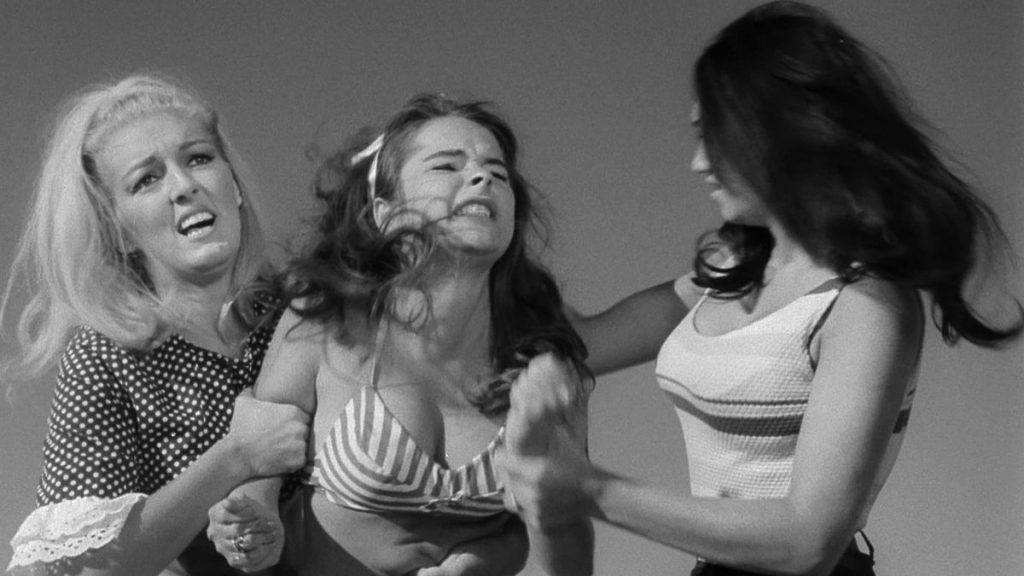
In the end, Faster, Pussycat! Kill! Kill! works so fucking well because it refuses to be categorised . It is a nudie movie with no nudity. It is a thriller where the hero is a murderer. It is a feminist film directed by a man who was the king of male-fixated cinema. It is a contradiction in a leather jumpsuit, a high-octane gospel of liberation that demands you either keep up or get out of the way. It is the purest expression of Russ Meyer’s technical genius and Tura Satana’s unshakeable power, a film that continues to roar across the landscape of cult cinema like a Porsche 356 with the muffler removed.
This is the film that changed the rules of the road forever. It proved that style could be substance, that violence could be freedom, and that a woman in the ass end of nowhere could be the most powerful thing in the universe. If you find yourself in the path of Varla, Rosie, and Billie, you have two choices: you can try to beat them, or you can get used to being a point of nothing. Most people choose the latter, and quite frankly, looking at the wreckage they leave behind, it’s probably the safer bet.
It is the foundational text of the Grindhouse era, not for its sleaze, but for its uncompromising vision of power. It is a film that understands the Darwinian reality of the world: only the fast survive, and only the violent remain free. It is a black-and-white broadside that still rings with the sound of snapping bone and roaring engines, reminding us that in the desert of human experience, there are those who build fences and those who drive right through them. Varla didn’t just drive through the fence; she burned the whole ranch down and didn’t look back at the explosion. That is the essence of the Pussycat philosophy, and it is why we still worship at the altar of Satana today. Every frame of this movie is a testament to the fact that Russ Meyer was more than a filmmaker; he was a choreographer of chaos who understood that sometimes, the only way to find yourself is to get lost in a high-speed chase through the void.
Leave a Reply