There is a moment during the early 1960s where science fiction cinema abandoned all remaining pretenses of middle-class respectability and plunged headfirst into a subterranean pool of pure madness, and that moment is Joseph Green’s The Brain That Wouldn’t Die. Filmed under the significantly more honest title The Head That Wouldn’t Die in 1959 but held back for years because the universe wasn’t quite ready for its specific brand of psychological filth, this movie is an absolute landmark in low-budget dementia. By the early 1960s, mainstream sci-fi was supposed to be about giant radioactive ants, sleek silver flying saucers, or intellectual monologues about the dangers of the atomic age. But Joseph Green looked at the nuclear anxieties of the Cold War and thought ‘Bollocks to this’, before giving us a ninety-minute look at a manic-depressive surgeon driving around New York looking for a woman with a hot enough body to sew onto his fiancée’s severed head. It is a film that exists entirely within its own warped reality, a magnificent, sleazy grease-fire of a movie that manages to be simultaneously horrifying, deeply transgressive, and inadvertently hilarious.
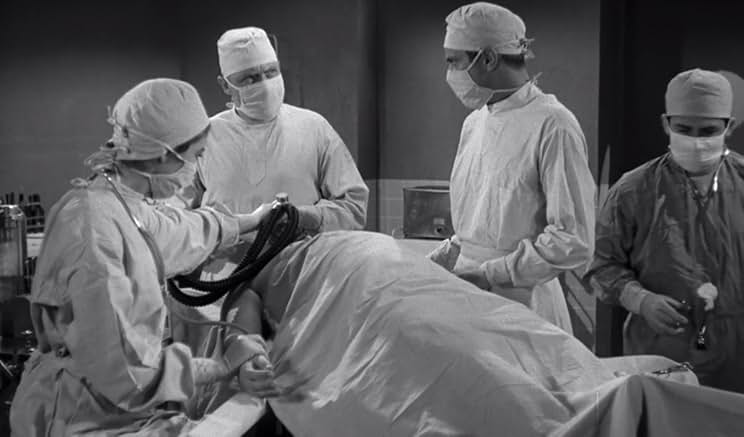
The Brain That Wouldn’t Die introduces us to Dr. Bill Cortner, played by Jason Evers with a level of unblinking, sociopathic arrogance that should have won him an award for services to cinematic delusion. Bill isn’t just a surgeon; he is a medical vanguard who views the human body as a collection of interchangeable car parts that can be held together with enthusiasm and heavy-duty tape. We meet him in a state-of-the-art hospital room where his conservative, old-school father is declaring a patient dead. Bill doesn’t accept this. He steps in, applies a series of experimental procedures he probably learned from a combination of medical journals and reckless optimism, and somehow succeeds in reviving a patient everyone else had already given up on. Instead of being grateful, his father looks completely horrified, establishing the central philosophical conflict of the film: just because you can keep a human being alive doesn’t mean the human being wants to participate in your experiment.
But Bill’s real work isn’t happening in the clean, sterile light of the public hospital. Bill has a secret country estate with a basement laboratory that looks like it was furnished during a liquidation sale at a discarded television repair shop. It is filled with bubbling beakers, random wires taped to the walls, and a massive control panel covered in lights that do absolutely nothing but blink rhythmically to suggest “science.” This is where Bill spends his weekends keeping limbs alive in jars and engineering a massive, unspecified mutant creature that he keeps locked inside a closet. The creature is played by Eddie Carmel, a real-life giant who spent the entire production wrapped in burlap sacks, occasionally sticking a massive, hairy hand through a small slot in the door to announce his displeasure with the catering.
The true majesty of the film erupts during the sports car sequence. Bill is driving his convertible down a winding country road with his beautiful, incredibly patient fiancée Jan Compton, played by Virginia Leith. Bill is driving like an absolute maniac because he is explaining his medical philosophy at maximum volume, completely ignoring the basic physics of the road. Jan is visibly terrified, begging him to slow down, but Bill is too busy monologueing about the future of transplantation to notice the hairpin turn approaching. The car launches off an embankment in a spectacular display of low-budget special effects, flipping over and immediately bursting into a massive ball of fire.
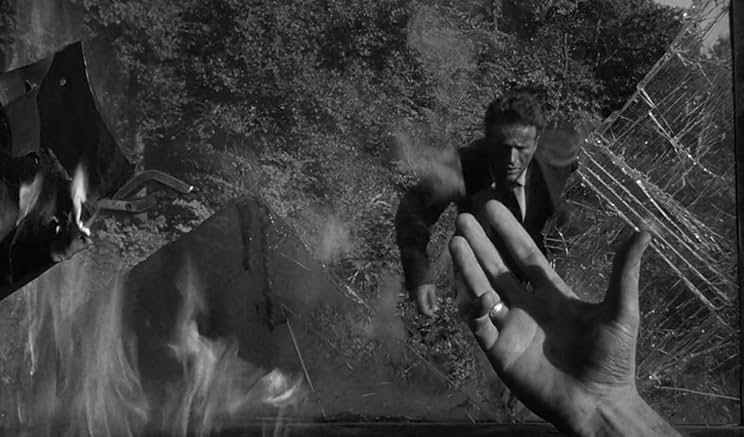
Most people in this situation would call an ambulance, scream for help, or succumb to profound emotional shock. Bill Cortner does none of these things. He is thrown from the wreckage completely unharmed, looks at the burning inferno, notices that Jan’s head has been cleanly severed from her torso by the impact, wraps the head in his suit jacket like a wet bowling ball, and sprints through the woods back to his laboratory. It is a moment of narrative insanity. There is no mourning period. There is no realization of tragedy. There is only a man running through the brush with his girlfriend’s skull under his arm, completely convinced that this is just a minor setback in their relationship.
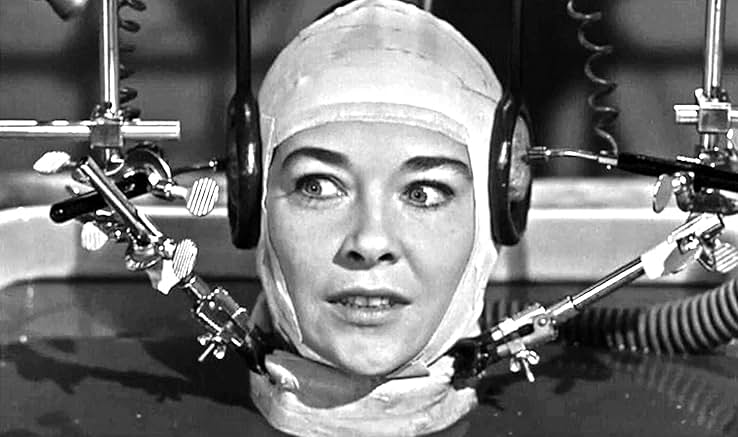
When Bill arrives at the laboratory, he hooks Jan’s head up to a series of rubber hoses, pours an experimental chemical compound known as Serum 11 into his equipment, and attaches two electrodes to her temples. Against every known law of biology, medicine, and common sense, the machine whirs to life, Jan opens her eyes, and she starts talking. This is where Virginia Leith earns her permanent place in the cult cinema hall of fame. For the rest of the movie, she is forced to act using nothing but her face, pinned to a small wooden block surrounded by laboratory equipment, and she decides to play the role with a level of dripping, sarcastic venom that completely redefines the concept of the woman scorned. Jan isn’t sad about being a head on a plate; she is furious. She spends every single scene reminding Bill that he is a lunatic, that her existence is a cosmic joke, and that she wishes he had just left her in the ditch to burn.
Bill, completely oblivious to her emotional distress, tells her to hold tight because he has a plan. He can’t just leave her as a desk ornament; he needs to find her a new body. And because Bill is an absolute perfectionist with an incredibly specific set of standards, he can’t just go to the local morgue and pick up a standard corpse. He needs a body that matches Jan’s facial beauty, which means he has to spend the middle of the film acting like a predatory talent scout for a horror movie. Bill drives into Manhattan, hits up various sleazy strip clubs, beauty pageants, and modeling agencies, staring at targets with a creepy, calculating intensity that the film frames as medical research. He looks at swimsuit contestants not with lust, but with the eye of a butcher trying to estimate the yield on a side of beef.
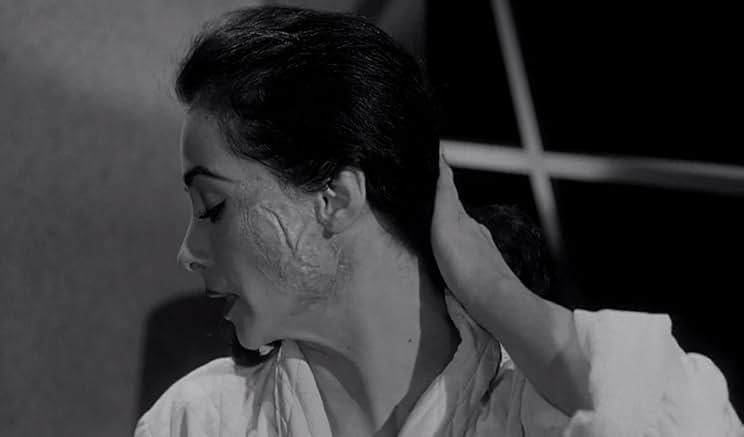
The episodic nature of Bill’s hunt for a torso provides the film with some of its finest, most surreal comedic moments. He meets Doris Powell, who has been physically scarred on her cheek from an accident, and he immediately starts gaslighting her into believing that his experimental surgery can restore her beauty, all while internally calculating if her neck measurements match the wooden block back in his basement. He visits a Greenwich Village artist’s studio where two women are having a full-blown, hair-pulling catfight over a modeling gig, treating the display of raw human desperation like a pre-screen interview for his transplant program. Jason Evers plays these scenes with a flat, wooden, clinical detachment that makes his behavior twice as funny. He is a man who genuinely believes he is doing these women a favor by considering them for his girlfriend’s new chassis.
Meanwhile, back in the basement, Jan is discovering that being a severed head gives her access to a bizarre form of low-budget telepathy. She realizes that the giant mutant locked in the closet isn’t just an angry pile of burlap; he is a kindred spirit who also hates Bill Cortner. The scenes where Jan communicates with the closet monster are the absolute emotional core of the film. She sits there on her little platter, glaring at the door, delivering telepathic monologues about the beauty of hatred. The monster responds by pounding on the walls and groaning like a broken foghorn. It is a beautiful, absurd partnership, a talking head and a hidden giant plotting the downfall of a suburban surgeon using nothing but psychic vibes and structural damage to the drywall.
The horror elements of the film are constantly undermined by the magnificent technical ineptitude of the production. The boom mic makes several prominent guest appearances at the top of the frame, occasionally hovering over Jan’s head like it’s trying to listen in on her telepathic thoughts. The sound design is a chaotic, echoing mess that suggests the entire movie was recorded inside a giant zinc bucket, with every footstep sounding like an explosion and the background music swinging wildly from avant-garde jazz to dramatic orchestral stings that have no relationship to what is happening on screen.
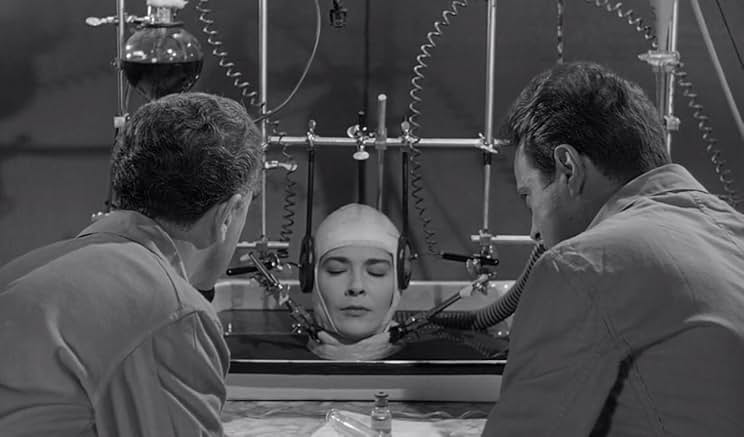
The physical mechanics of keeping Jan alive are also a source of endless joy. The hoses attached to her neck are clearly standard garden equipment purchased from a local hardware store, and the fluid keeping her brain functioning looks remarkably like industrial dish soap. Whenever Bill needs to leave the lab, he has to leave his assistant, Kurt, in charge of monitoring the dials. Kurt spends his entire performance looking like he regrets every life choice that led him to employment under Dr. Cortner, carrying a withered, misshapen arm from one of Bill’s earlier failed experiments as a permanent reminder of his boss’s methods. Kurt hates the head, the head hates Kurt, and the closet monster hates everyone. It is the most dysfunctional workplace environment in the history of science fiction.
The climax of the film is an explosion of low-rent grand guignol that completely rewards the audience for enduring Bill’s extended modeling agency tour. Bill finally settles on a victim, drugges her, and brings her back to the laboratory to begin the operation. He straps her to an operating table right next to Jan’s block, completely ignoring Jan’s frantic, screaming protests. Just as Bill raises the scalpel to begin the decapitation process, Jan unleashes her full psychic potential and commands the closet monster to break free.
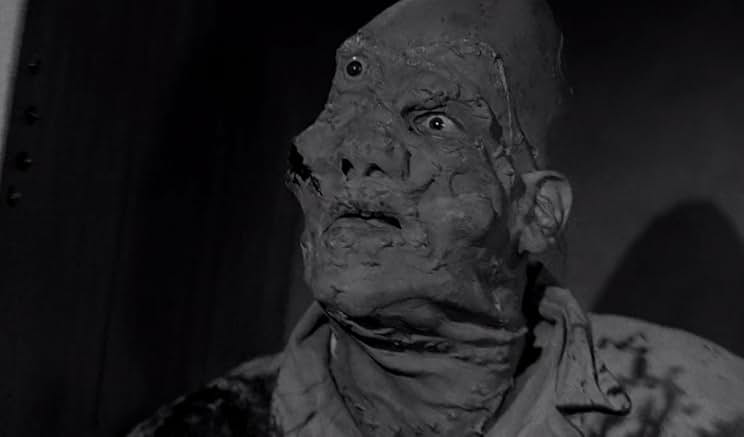
The monster doesn’t just open the door; he completely demolishes the front of the closet, revealing himself to be a towering, misshapen brute with a prosthetic face that looks like it was made out of papier-mâché and old oatmeal. I should also mention that the monster had already attacked Kurt through the cell hatch, before the good doctor returned with Jan’s new body double, violently tearing his good arm completely off in a display of shadow-and-silhouette violence that is shockingly gory for 1962. Kurt stumbles around the lab, smearing blood all over the walls in a sequence that feels like an early 70s exploitation film accidentally inserted into a black-and-white monster movie, before finally falling into a heap of electrical equipment.
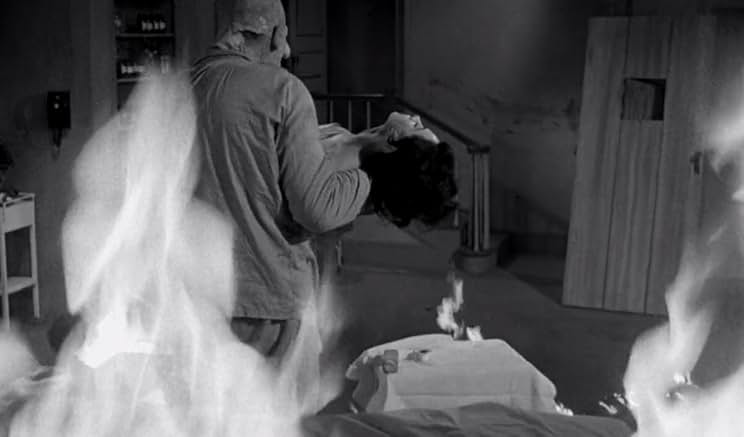
But when he is free, the monster turns his attention to Bill. The final confrontation between the sociopathic surgeon and the burlap giant is an awkward, slow-motion wrestling match that results in the laboratory being completely set on fire. The monster pins Bill to the wall and attacks him with a ferocity that looks less like a man settling a score and more like a natural disaster finally losing its patience. By the time the struggle ends, Bill is mortally wounded and the laboratory is descending into complete chaos. As the flames begin to consume the room, the monster picks up the unconscious figure model and carries her out of the basement like a giant, hairy prince rescuing a princess from a burning garage sale.
The final frame of the movie belongs entirely to Jan Compton, and it is the ultimate punctuation mark for this entire exercise in cinematic madness. With the laboratory burning around her, the hoses melting, and the smoke filling the room, the camera zooms in on her face. She doesn’t scream for help. She doesn’t express regret. She simply unleashes a chilling, hysterical, unhinged laugh that echoes over the crackle of the fire and delivers the immortal final line: “I told you to let me die.” The movie fades to black on her cackling face, leaving the audience with the profound realization that they have just witnessed something truly special.
I adore The Brain That Wouldn’t Die because its independent trash cinema that operates with an absolute lack of self-awareness or restraint. Joseph Green didn’t have the budget for real science fiction, so he substituted it with unfiltered exploitation energy. It takes a premise that is fundamentally grotesque and handles it with a level of deadpan sincerity that transforms the entire experience into a high-speed comedy of medical errors. It shows thaf all you need to make a great piece of cinema is a talking head with an attitude problem, a giant in a closet, and a main character who thinks carrying his girlfriend’s skull through a public park is an acceptable response to a car accident. It is loud, oozing with sleaze, bruised, and completely beautiful.
Leave a Reply