There are films that are important, films that are influential, and then there are films that are so fucking strange that you can watch them more than a century later and still find yourself thinking, What the hell am I watching?
The Cabinet of Dr. Caligari is all three.
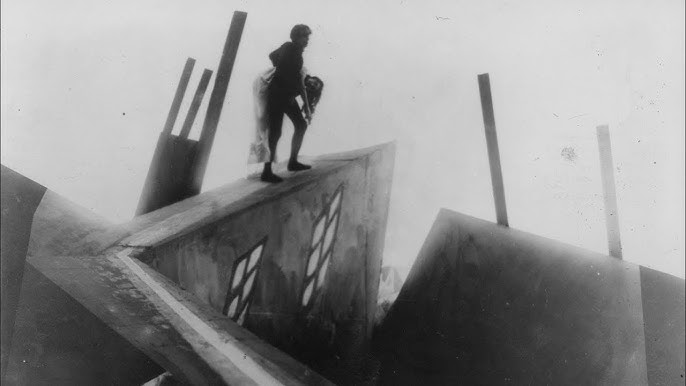
Released in 1920 and directed by Robert Wiene, this German silent horror film is one of the defining works of German Expressionist cinema. Its deliberately distorted sets, painted shadows, impossible architecture and grotesque characters look unlike anything that had come before it. The streets don’t look like streets. The buildings don’t look like buildings. Nothing appears to obey the rules of the real world.
Which is precisely the point.
Caligari doesn’t look like reality because we’re not necessarily seeing reality. It feels like a nightmare given physical form.
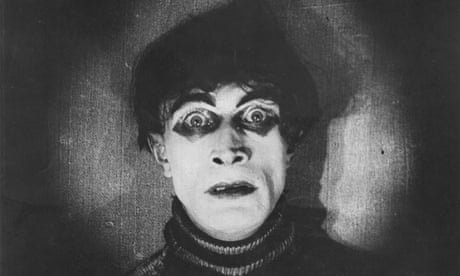
We begin with Franzis, played by Friedrich Fehér, recounting a bizarre series of events involving his friend Alan, the woman they both love, Jane, and a mysterious travelling showman called Dr. Caligari. Caligari arrives at the local fair with Cesare, his somnambulist, a sleepwalker kept inside a coffin-like cabinet and presented to the public as a man capable of seeing the future.
Cesare looks fucking incredible.
Conrad Veidt looks like the world’s most murderous emo ballet dancer. The black clothing, hollow eyes, ridiculous limbs and extraordinary physical performance make him look less like an ordinary human being than something that has crawled out of a particularly unpleasant dream.
He doesn’t simply walk. He glides, bends and unfolds himself through the frame, creating a physical presence that remains genuinely unsettling more than a century later.
Then there’s Caligari himself.
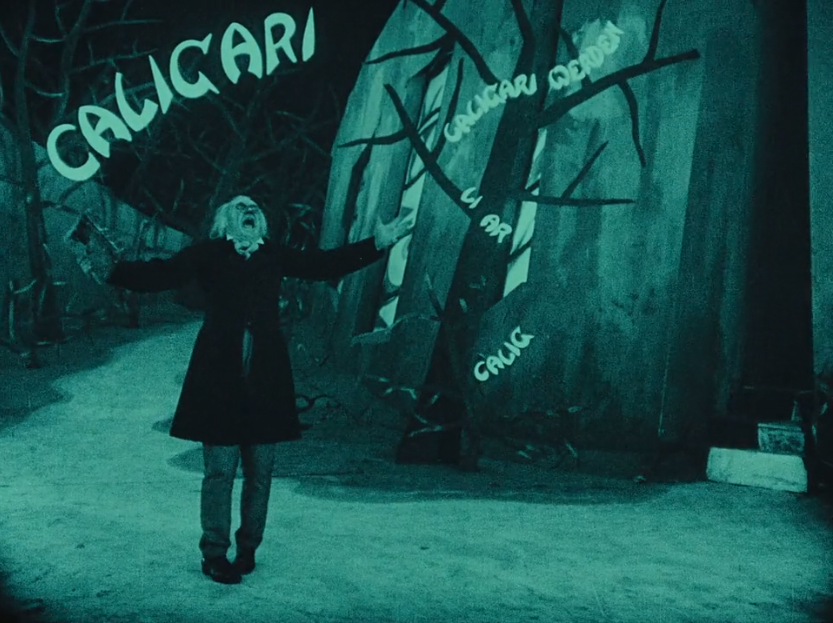
Werner Krauss plays him like a man who has spent his entire life waiting for somebody to piss him off. Somebody does. The local town clerk is rude to Caligari when he attempts to obtain permission to exhibit Cesare. Most people might complain, go home and perhaps write a strongly worded letter. Caligari decides the appropriate response is murder. He sends Cesare out to kill the man.
Yet, no matter how beautiful this film looks and no matter how magnificent some of the performances are, there is a sense that nearly every character has had their common sense game removed
When Franzis’ best-friend Alan meets Cesare and is told this strange sleepwalker can see the future. What is the first thing Alan asks?
“How long will I live?”
Mate.
You’ve just been introduced to a supernatural sleepwalking freak kept in a box, and your first thought is to ask for your own expiry date?
Cesare tells him.
Until dawn.
It turns out to be rather accurate.
Alan is murdered, and Franzis goes to the police to report what happened. There’s a wonderfully theatrical sequence here where Franzis launches into a huge, wild re-enactment of the murder, apparently acting out the stabbing itself, while the intertitle boils the whole thing down to the much calmer statement that he won’t rest until he gets to the bottom of it.
There is no fucking way that’s all this man said.
But fear not, there’s another suspect. A bloke with magnificent eyebrows who gets caught attempting to murder an old woman. His defence? It wasn’t him committing the previous murders. Yes, he tried to kill the old woman, but that was merely an attempt to make everyone think that the mysterious murderer was responsible, so he could get away with it.
So his legal defence is basically: “I didn’t commit those murders. I merely attempted a completely separate murder as part of an elaborate plan to make people think I had nothing to do with shiving the old grandma.”
Right. Off to the gallows with you, then.
There is a wonderfully weird dark humour running through Caligari that gets lost when people talk about it purely as IMPORTANT CINEMA HISTORY™. Yes, it’s hugely influential. Yes, the sets are extraordinary. Yes, the whole thing is a foundational piece of German Expressionism.
But also, Alan is a fucking idiot.
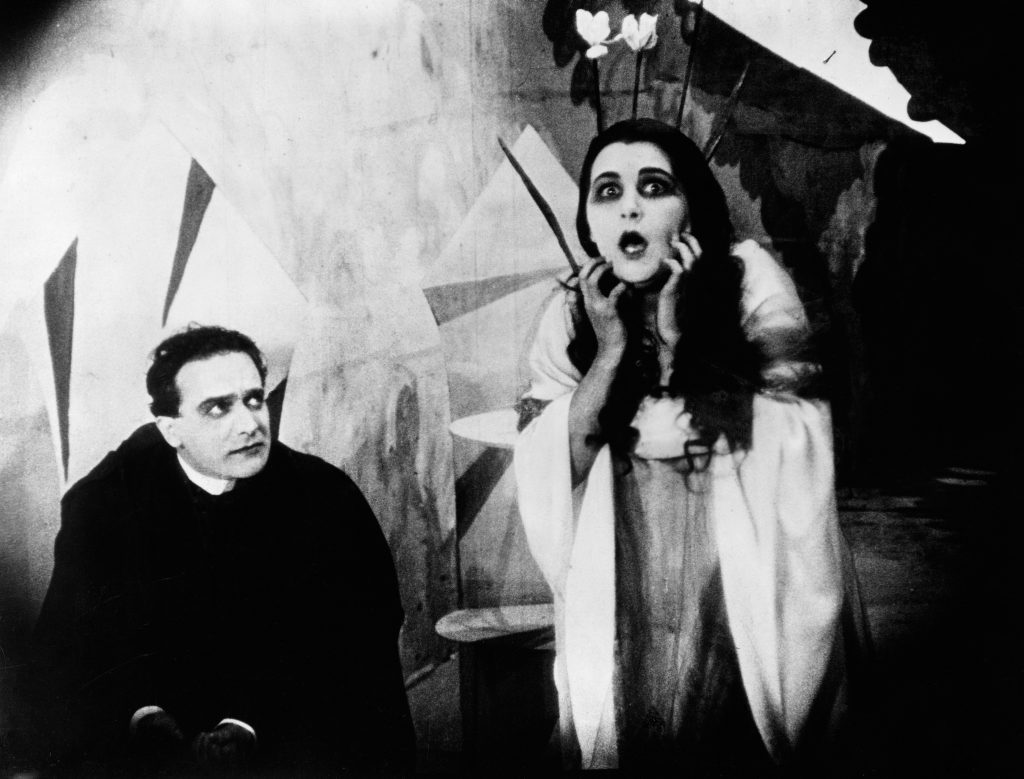
Lil Dagover’s Jane gives the film one of its most striking presences, but poor Jane gets dragged into the nightmare when Cesare is ordered to kill her. Except Cesare sees her and apparently decides that murdering her isn’t such a great idea after all. So he kidnaps her instead. Because apparently even a supernatural murder machine has limits.
The sequence is one of the film’s most famous moments, with Cesare carrying Jane through the night as he is pursued by an angry mob. Veidt’s physical performance is extraordinary throughout. Cesare doesn’t look like a conventional villain; he looks like something that shouldn’t exist, moving through a world that shouldn’t exist either, and here he is at the height of his physical brilliance.
Eventually Cesare collapses. No, he isn’t allergic to daylight, though for a moment, you could be forgiven for thinking somebody had accidentally made a vampire film, he’s just flat out knackered.
Even though Jane tells Franzis that Cesare was the one that had tried to abduct her, Franzis is convinced Cesare couldn’t possibly have been responsible for the abduction because he has been watching him sleep through a window. Except it isn’t Cesare. It’s a fucking dummy.
The police retrieve Caligari’s cabinet from his caravan at the circus, open it up and discover that the sleeping Cesare that Franzis has been looking at is nothing more than a mannequin. Franzis doesn’t exactly conduct a sophisticated forensic examination. He grabs the thing and yanks its arm off.
There you go. Scientific breakthrough. Not Cesare. Dummy.
Caligari legs it.
The investigation eventually takes Franzis to the local psychiatric institution, because reasons and possibly a missing reel, where he asks whether they have a patient called Dr. Caligari. They don’t. Perhaps he should speak to the institute’s director, who has just returned.
And lo and behold… it’s Caligari, because of course it fucking is.
Franzis and the staff discover Caligari’s obsession with a historical figure bearing the same name. Caligari became fascinated by the legend of an 18th-century mystic controlling a somnambulist, and when he gets his own sleepwalker, he basically thinks: Right. Let’s give this murder thing a go.
His diary makes the obsession explicit. It’s mad science stripped down to its most fucked-up essentials.
Hypothesis: A somnambulist can be controlled to commit murder.
Experimental subject: Cesare.
Ethical approval: Absolutely none.
Results: Several dead people.
Conclusion: Apparently it works.
Eventually Caligari is confronted with the evidence and with Cesare, who has been found dead/possibly asleep in a field. For perhaps the first time, we see something resembling genuine remorse from him when he sees what has happened to his sleepwalker. It’s a surprisingly human moment.
Then he tries to strangle another doctor. Apparently the remorse had a very short shelf life.
The authorities finally overpower him, bundle him into a straitjacket and cart him away to a cell. And you might think that’s the end of it. It isn’t.
The final revelation completely turns the story upside down. Franzis, Jane, Cesare and the other characters aren’t ordinary townspeople caught up in a supernatural conspiracy. They are patients in the asylum. Franzis has been telling us the story all along. And the man he has spent the entire film portraying as the insane, manipulative Dr. Caligari is actually the institution’s director.
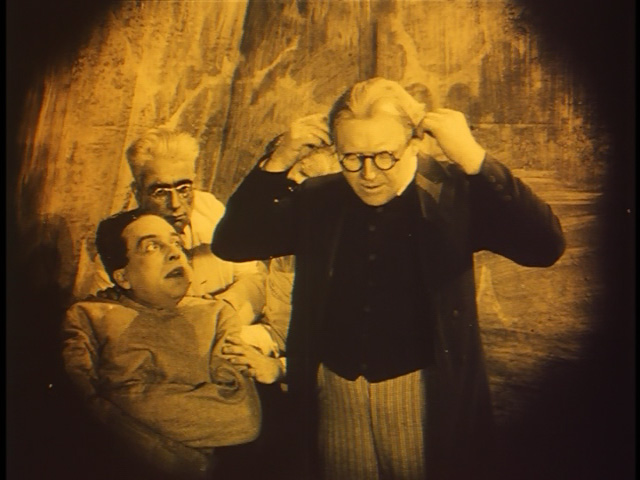
Suddenly the entire film becomes questionable. Was Caligari really controlling Cesare? Did the murders happen? Was the distorted town actually real? Was Franzis constructing an elaborate fantasy around the people and surroundings he knew?
That ambiguity is one of the film’s great strengths. The framing device turns what appeared to be an objective horror story into something filtered through Franzis’s broken perspective, leaving us to question how much of what we’ve witnessed can actually be trusted.
Those crooked streets, painted shadows, warped buildings and impossible angles aren’t merely there because somebody thought they looked cool. They create a world that feels psychologically wrong. The environment itself seems diseased, as though the landscape has been dragged directly out of somebody’s fever dream. The production design by Hermann Warm, Walter Reimann and Walter Röhrig creates a visual language that became the blueprint for German Expressionism.
Its distorted reality, unreliable perspective and visual style have echoed through horror, film noir, and gothic cinema for generations.
But none of that is the main reason to watch it again. It’s worth watching because it’s fucking weird.
There’s an angry little monkey hanging around with an organ grinder that seems to hate every single person who comes anywhere near it. There’s Cesare, looking like the world’s most dangerous Goth. There’s Alan, presented with a supernatural opportunity to learn anything about the future and immediately asking when he’s going to die. There’s a bloke who tries to murder someone as a means of proving he isn’t a murderer. There’s Franzis recreating a stabbing for the police with such theatrical enthusiasm that the intertitle gives up trying to translate it. And there’s a dummy Cesare whose limbs can be removed with approximately the same effort required to pull a sausage out of a bun.
That combination is what keeps The Cabinet of Dr. Caligari from feeling like a museum piece.
It is historically important, absolutely. But it is also an extraordinarily entertaining little nightmare. Robert Wiene and his collaborators created a world where nothing looks right, the rules of reality keep shifting, and even the narrator can’t be trusted.
The fact that it was made in 1920 makes it even more astonishing. We’re talking about a film experimenting with visual storytelling, psychological horror and narrative ambiguity at a time when cinema itself was still figuring out what the fuck it could actually do.
More than a century later, Caligari still looks like a nightmare.
And thankfully, it still feels like one too.
Leave a Reply