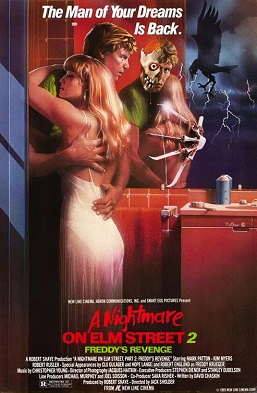
It had to happen; Halloween had done it; the Universal and Hammer studios had delivered a string of films based around characters such as Dracula, Frankenstein and The Mummy; and now it was Freddy Krueger’s turn to have a sequel and build a franchise with A Nightmare on Elm Street 2: Freddy’s Revenge.
Directed by Jack Sholder (Alone in the Dark, Wishmaster 2: Evil Never Dies), A Nightmare on Elm Street 2: Freddy’s Revenge was another success for New Line Cinema, grossing $30 million against a budget of $3 million, although this time the audience and critical response were much more mixed.
Now seen as a cult classic due to its perceived gay subtext (or overt theme, depending on who you ask), at the time, the film unintentionally functions as a definition of what Freddy Krueger and the Elm Street films are and how they should work, by being the exception that proves the rule.
Nightmares & Cash-Grabs
The surprise success of A Nightmare on Elm Street caught New Line Cinema by surprise, being its first major success as a company. As such, although Wes Craven, writer and director of the original film, had intended the original film to be a stand-alone picture, the studio saw an opportunity to build on their success, recognising the film as a potential cash cow that could be milked.
Wes Craven, despite misgivings, was initially on board until he read the script. In his eyes, exploding birds and Freddy Krueger entering the waking world were not part of his original conception. This tension between New Line Cinema—the moneymen—and Wes Craven—the auteur and creative visionary of the Elm Street world—is emblematic of the problem of creating a sequel to A Nightmare on Elm Street. Craven’s film was the result of an intense, personal vision, and as such, any sequel, to be as artistically successful as the first film, would need to buy in completely to that version. New Line Cinema, on the other hand, wanted to capitalise on their first major success, and they weren’t going to let Wes Craven get in the way of it.
The director they eventually landed on, Jack Sholder, was a capable enough director, but the difference in approaches between him and Craven to Elm Street are telling. In Never Sleep Again: The Elm Street Legacy, Sholder put his interest in the original film thus: “I was never a huge fan of the original. I mean, I understood why it was good, and I understood why it was successful, but I felt no compunction to follow the template of the first film.” Sholder was even quoted as saying that he was originally going to turn the film down, but was then convinced that if he directed this, it could really establish him as a director and set him on the path to ‘better’ films.
With that being Sholder’s attitude to making the film, it’s little surprise that A Nightmare on Elm Street 2: Freddy’s Revenge, in comparison with Craven’s personal attachment to the original film, feels like the cash-in it was intended to be. But that could be bearable at least, if the film had remembered what made the original film so unique and popular.
A Nightmare Like No Other
The original plan for A Nightmare on Elm Street 2: Freddy’s Revenge was not the film we ended up with. Leslie Bohem had pitched an idea that would be very familiar to fans of the Elm Street franchise: a pregnant mother would find her unborn baby controlled by Freddy for his own nefarious ends. Nixed by New Line due to the idea having upset a pregnant executive at the company (a sign they had an actually effective, horrifying idea), this plot kernel would find itself the basis of the sequel A Nightmare on Elm Street 5: The Dream Child, itself scripted by Bohem.
If written well, this idea could have actually made for a solid sequel. Freddy, having found that teenagers can fight back in the last film, would this time use the dreams of an unborn child, someone who wouldn’t fight back, to wreak his revenge on the parents and children of Elm Street. Assuming, similar to Nightmare 5, that Freddy would use the unborn child’s dreams (Bohem has used the word “possession”, which suggests not too much differentiation with this film), this would at least link to the concept of Freddy using the dreams of others to kill. This use of dream-murder was one of the major reasons the first film was such a success: audiences responded to such an imaginative, creative and philosophical concept.
This should have been the starting point for any writer of the sequel, but not for eventual writer David Chaskin. To his credit, he didn’t take the easier option of writing a soulless carbon copy of the original film, but he did make the mistake of not finding variety in the framework (the dream concept) of what made the original a success.
As such, there would be no other film in the franchise like A Nightmare on Elm Street 2, for better or worse.
The Story of a Possession
The basic plot is simple: Jesse Walsh (Mark Patton) and his family move into the former house of Nancy Thompson on Elm Street. Upon discovering Nancy’s secret diary in the house, Jesse and his girlfriend Lisa (Kim Myers) learn about the terrifying history of Elm Street and Freddy Krueger. After this, Jesse experiences encounters with Freddy, who threatens Jesse into doing his bidding and killing people on his behalf. Jesse becomes more and more possessed by Freddy, and eventually Freddy takes over the full appearance and control of Jesse.
Lisa tracks Freddy down to his boiler room (revealed in this film to be in a now-abandoned power plant Freddy used to be the janitor at), and, by kissing Freddy, forces the Jesse consciousness now inside Freddy to fight back, with Freddy falling to ashes, and Jesse emerging from the debris. Freddy appears to have been defeated, only for the gloved one to be revealed to be driving the school bus, taking all the kids into the desert (and one imagines to their demises).
It’s not a bad story by any means, and to be clear, I don’t think this is a bad movie. It’s not even the worst in the Elm Street franchise. What I think this film is, however, is ultimately a bad Elm Street film, if we judge it by the criteria that an Elm Street film has to have dreaming and dreams as the core around which the rest of the film is built, no matter how broadly it treats that core. On that basis, A Nightmare on Elm Street 2 is the confused child of the series. It aims for possession, but it runs into a few problems on the way.
What’s My Motivation?
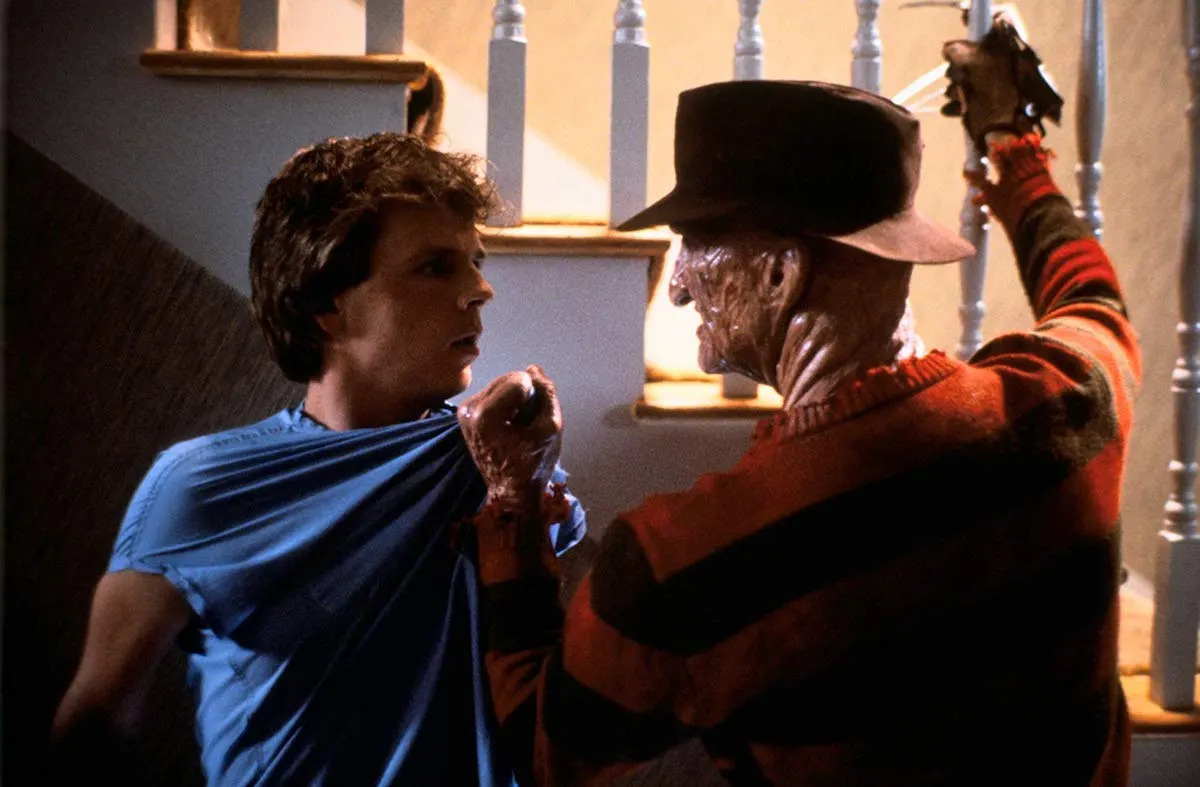
Firstly, it’s never really clear what Freddy’s motivation for possessing Jesse is. Sure, Jesse makes for an easy target, as he is presented as weaker and softer than someone like his friend, Grady, which would make it easy for Freddy to take him over with little resistance (at the risk of an unintentional innuendo, Jesse is the passive partner in the relationship. It’s also a nice little plot device that Jesse is living in Nancy’s old house. Freddy could have theoretically possessed any teenager in the Elm Street area, but that he would infiltrate the next teenage occupant of the house of his arch-rival is a nice touch to link things with the previous film.
But what does Freddy actually need to possess anybody for? What is his endgame? In the original film, Freddy’s goal is take revenge against the parents of Elm Street who burned him to death by killing their children. Yes, he was defeated, but that was only by one teenager, and even then, he was able to come back. Not all teenagers are going to be a Nancy. Why not continue to invade their dreams, where these teenagers will be at their most vulnerable? What does Freddy gain by coming into the waking world? Surely he would lose the power he has in dreams to manipulate the environment to his ends?
The film never really explains, nor does it explore. Freddy almost appears less important in this film, as the focus is mainly on Jesse and how he reacts to his possession by Freddy. While that is interesting, and Mark Patton does a great job of portraying Jesse’s struggle with himself and Freddy, it is certainly a bold choice to reduce your monster, the biggest draw for your audience, to a semi-background note. There was a balance that could have been had here, where Jesse’s struggles could have had a counterpoint in giving Freddy a bit more attention, a bit more focus on Freddy’s character and motivations. It didn’t have to be a Shakespearean-style character study, but a sequel seems a good place to bring out a bit more from your central character.
Ultimately, the film never really answers the question of why Freddy wants to return to the waking world, nor does it leave the answer as intentionally ambiguous either. The film just doesn’t appear to care, and to me as a viewer, it leaves me dissatisfied. The most we can surmise is that Freddy wants to expand his scope beyond Elm Street. As he tells the teenage guests at Lisa’s pool party, “You are all my children now”.
It’s not really fair to criticise a film for what it’s not, but it does strike me that even just a few lines of motivation as to why Freddy wants to possess Jesse and return to the waking world would have benefitted the film and possibly linked things back to the dream core, even if it was just an overt rejection of it.
Speaking of dreams…
The Problem of Possession
The second major problem A Nightmare on Elm Street 2: Freddy’s Revenge has with its possession theme is that quite often it is confusing as to what perspective we’re seeing certain scenes from: the waking world or the dream world.
See, Freddy’s Revenge (and who is that revenge against? Nancy has gone, and Freddy seems to be widening his scope beyond the children of the Elm Street parents) couldn’t completely cut ties with the dreaming concept. Freddy was never presented as a ghost, and as such, it wouldn’t make sense for Freddy to have possessed Jesse in the traditional ghostly way.
The obvious answer, then, was to have Freddy access Jesse through his dreams and take possession that way. It does raise the question, if Freddy can access someone’s dreams without invitation, then why would he need to persuade and win over Jesse when it appears Freddy could have just taken Jesse over without consent (which Jesse never really gives; he just doesn’t know how to fight back)? It could be that invading the mind and possessing both mind and body are two different things, and that some kind of consent, however partial, is needed for a full possession. It’s only a theory, but it’s more than the film gives us.
What’s less explainable is the confusion provided by the film during scenes where Jesse is at the service of Freddy. For these to work, I would argue that Jesse needs to be asleep first, so that Freddy can possess him, and then Jesse needs to be awake to act out the killings. And while it sort of appears to work that way on-screen, A Nightmare on Elm Street 2 portrays this in such a confusing way that it dilutes the impact these moments have on the overall story.
There are several instances of these confusing possession scenes in the film, but one will suffice as a textbook example of why they don’t make logical sense, even in the realms of the fantastical: the Schneider Shower Scenario.
The Shower of Death and Confusion
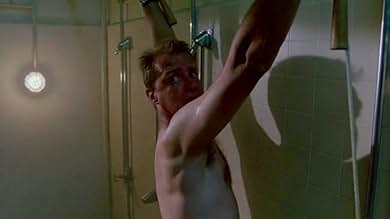
This section of the film begins with Jesse in bed, eyes closed, tossing and turning, until he finally decides to get dressed and go downstairs. We can assume from this start that Jesse was asleep (the closed eyes) and that this ‘waking’ part is actually a dream. Right? This seems to be confirmed by a peculiarly localised bolt of lightning striking the dishes in the kitchen. How this set Jesse off walking in the rain away from his house, I don’t know, maybe he thought he’d be safer outside if the lightning was now moving into indoor shocks…
The real implication is that Jesse is sleepwalking, and that would explain how he kills in the waking world while he’s asleep, but when he enters the leather bar, Jesse seems pretty awake and compis mentis. He takes in his surroundings, and he asks for a beer. Surely the other patrons, and certainly creepy Schneider, who catches Jesse at the bar, would notice if Jesse was sleepwalking? Assuming, then, that what we see on-screen is still the point of view of Jesse’s dream, is Jesse subconsciously transferring the stimuli of what is around him into his dream?
Schneider takes Jesse back to the High School for some, what I presume is erotic, running around the sports hall, and sends Jesse for a shower. The sports equipment starts to attack Schneider (who is pulling the most glorious, gum-chewing, gormless face I’ve ever seen—it’s a work of art), and it appears clear at this point we are still in a dream—Freddy is clearly causing the equipment to turn into weapons. Invisible Freddy then drags Schneider to the showers, strips and then whips him as Jesse watches.
This plays out very much like how a nightmare in the original film would play out, but if Schneider is in the dream, and he can be killed, wouldn’t it have to be Schneider’s dream? We’ve not yet gotten to the point in the franchise where dreamers can pull other people into their dreams, and also, Schneider is found dead at the school, so this would suggest that at least some of what we’re seeing here takes place in the waking world: how does that work? Did Jesse wake up at some point? If Freddy can attack people from Jesse in the waking world, then why does Jesse appear to need to sleep to set things off? It’s messy and contradictory, diluting the impact of what we’re seeing.
The shower then steams up around Jesse, and at last the man himself, Freddy Krueger in the (dream?) flesh emerges from the steam to slash Schneider to death. As Schneider dies, however, we turn back to see Jesse again, this time with Freddy’s razor glove on his hand. He screams, suggesting Jesse has now, or is about to, wake up. But, to reiterate a point, if Jesse had been asleep, how would Schneider not have noticed? His murder, for all intents and purposes, seems to have taken place in the waking world, not a dream. How would he not have noticed that big, heavy razor glove that Jesse would have had to have been carrying around all that time to have it in the shower? Unless it was part of the dream that got pulled into the waking world—but then why put emphasis on Jesse finding the glove in the boiler room of his house (a nice tie-in to the first film)?
And on and on the argument goes in circles, with no clear answer in sight. The same applies to the death of Grady: how can Jesse, who had just been asleep, kill Grady in a dream without it being Grady’s dream? Ok, if New Line had gone with the baby dreaming idea for this first sequel, and this was a later sequel made after the introduction of characters pulling others into their dreams had been made, then it would have been a neat idea. Freddy, having exhausted his dream options, possesses someone else and pulls victims into that person’s dreams, getting stronger and taking over the possessed more and more with each kill. But no such argument can be made for this film. The possession angle here just doesn’t stand up to the scrutiny.
Again, it’s not really fair to criticise a film for not being something it’s not trying to be, and yes, you can argue that I’m taking the workings of the possession concept far too seriously. That’s fine; I completely get the argument to turn off the mind and just enjoy the blood flow. But when a concept has this many holes that can be picked at, it is so obviously flawed that it can’t help but distract you from the full effect of what you’re watching.
It’s a good job, then, that this film at least makes up for it in other ways.
Celebrating Burnt Flesh & Big Kills
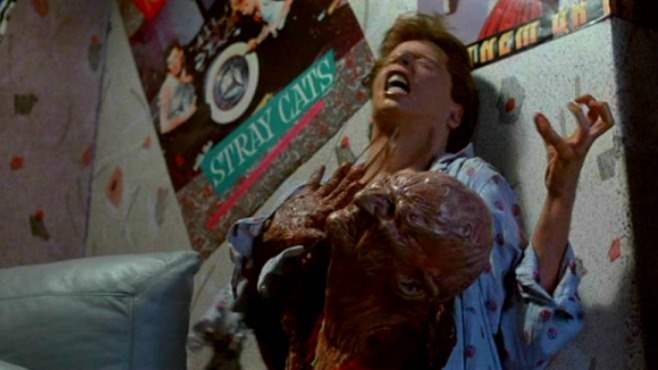
I said this was perhaps a bad Elm Street film, but I did also say that A Nightmare on Elm Street 2 wasn’t the worst in the franchise either, and that’s because it’s not. In fact, while the concept of the film lets it down, there’s actually a lot to enjoy here.
Firstly, Freddy Krueger, despite reservations about his motivations, or lack of, is on excellent sinister form here. The make-up this time is wonderfully grotesque, really playing up the texture of the burnt flesh. It looks like it would bubble and burst if you touched it. Robert Englund plays Freddy again as someone amused by his own bad inclinations and the terror they cause, as opposed to a desire to be the world’s first and best serial killer-cum-stand-up comedian. His big pun here—“you’ve got the brawns, and I’ve got the brains”—is coupled with a nasty shot of Freddy peeling his skin back to reveal his own grey matter—we’re a long way away from wicked witch impressions at this stage.
It’s that sly, conspiratorial amusement as he stalks and surprises his victims that brings the fear. But Robert Englund shows great range here, giving Freddy a shocked vulnerability in the moments where Lisa tries to reach Jesse through Freddy, and Krueger is stunned in the realisation that it’s working. This surprise, mixed with fear at his own weakness, is played beautifully by Englund, with just enough pathos that you take a fresh look at the monster, without losing sight that Krueger is still a monster.
Talking of Freddy’s monstrous quality, there are some great, grotesque kills here. The Schneider shower scene, despite my comments above, works excellently as a kill, with the sight of Freddy emerging out of the steam to slash Schneider up being particularly winning. Freddy bursting and being ‘birthed’ out of Jesse as a desperate Grady bangs on his locked bedroom door and screams for help is tense and nailbiting—you know Grady’s going to get it, but the slow birth of Freddy, in full sight of a terrified Grady, is a delicious moment and deserves to be better remembered.
Both Lisa and Grady are great additions to the pantheon of Elm Street teenagers. Grady takes Rod’s asshole qualities and adds some empathy and good humour to them, while Lisa is a strong, likeable and determined heroine who could perhaps have equalled Nancy with a better script. Schneider is memorable as the creepy, pervy gym teacher (with the best gormless expression ever), while Jesse, who has his fans and his detractors, has got a fan in me. He’s just refreshingly dorky, but in a good way. Touch Me (All Night Long) is a bop—of course Jesse should fucking dance to it like a twat! I mean, I would! And he’s vulnerable in an endearing way—a legit scream queen. It’s such a shame that this role caused Mark Patton such damage, because he deserved bigger and better things after this.
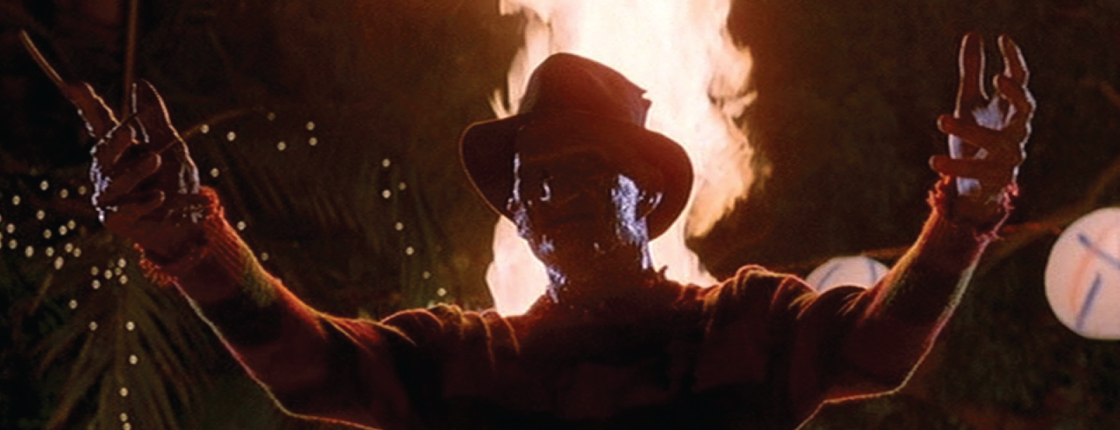
Lastly, while I think the visual quality of this film generally looks cheaper than the original (did they use cheaper-quality film stock?), it does have a strong, attractive look of its own. The use of steam and strong red and green lighting throughout lends an eerie quality to the proceedings, while the school bus, balanced on four pillars at the start of the film, stands in front of a gorgeous matte painting of a doomy, dark-blue sky. There’s fire throughout, with the classic image of Freddy gesturing at the teenagers at the pool party, while a tongue of fire erupts behind him, being one of the most iconic in the franchise for my money, so gorgeously sinister does it look.
So no, A Nightmare on Elm Street 2: Freddy’s Revenge is not the best film in the franchise, but it could be a damn sight worse. I mean, I actually paid money to see the remake of the original…
Final Thoughts
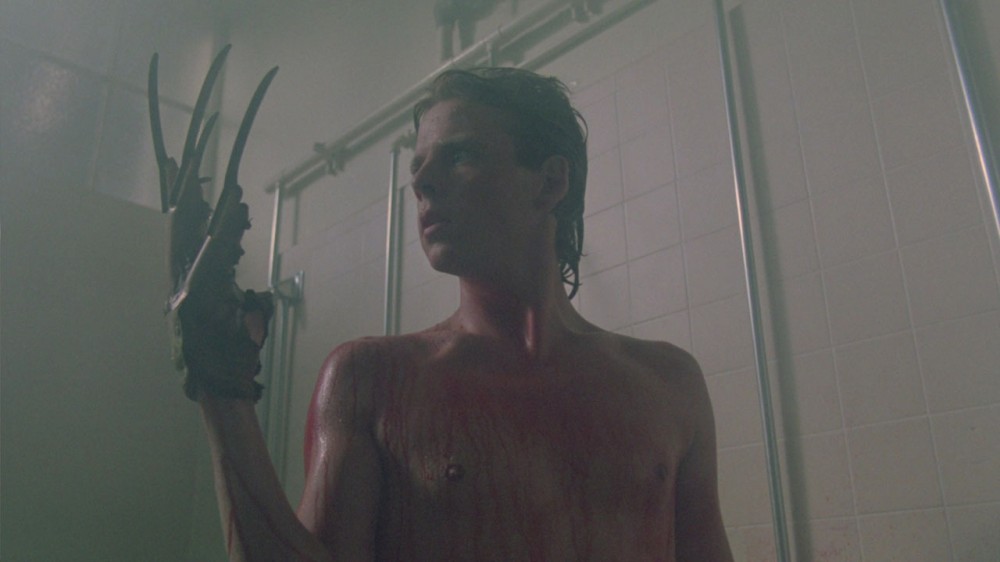
A Nightmare on Elm Street 2: Freddy’s Revenge holds a strange place in the franchise’s legacy. Commercially successful but receiving critically mixed reviews, with the massive success of the third instalment, The Dream Warriors, this second film saw its standing fall with fans as the franchise grew.
In more recent times, though, the film has seen a rehabilitation, with horror and Elm Street fans acknowledging the film’s strong points, while the film has also been reclaimed by the gay community as a gay film (something I haven’t discussed here because, as a heterosexual, I didn’t really feel qualified to comment on its theme of sexual awakening from a gay point of view, but am very supportive of).
For me, though, the legacy of A Nightmare on Elm Street 2: Freddy’s Revenge is that it cements what is successful about why Elm Street works by doing something that is not that. As such, it is the exception that proves the rule, and an entertaining film in its own right. Freddy’s Revenge was commercially successful enough to warrant a third film, but the establishment of a larger franchise would depend entirely on that film’s success—would it be a third film too many? By the time Freddy returned for The Dream Warriors, New Line Cinema had learned its lessons from A Nightmare on Elm Street 2, and there would be no turning back from here.
Leave a Reply