Right. Let’s get this out in the open before we go any further. I love Ed Wood. Not ironically. Not as a cult in-joke. I love him the way other people love immaculate framing and directors who treat film sets like sacred temples. To me, Wood isn’t a punchline, he’s a wildfire. While Stanley Kubrick demanded absolute control, while Steven Spielberg orchestrated wonder with military precision, while Francis Ford Coppola conducted operas of shadow and power, Wood charged into battle with borrowed props and unshakable belief.
They had polish. He had nerve. They built cathedrals. He built lightning rods out of scrap metal and sheer optimism. And sometimes, not always, but sometimes, that lightning struck.
Which brings us to 1955 and a swamp that looks like it’s been stitched together from leftover fog and ambition. Because if you want proof of why I’ll always defend him, why I’ll plant my flag in radioactive mud and declare him a genius of pure intent, you don’t start with the myths. You start with Bride of the Monster.
Who Needs Plot When You Have Belief?
Let’s be real: Bride of the Monster is a miracle. It’s not a miracle in the prestige cinema sense where everything is polished to a mirror finish; it’s a miracle because it was made at all. Released in 1955, it was Ed Wood’s attempt to stake his claim in the radioactive boom of atomic-age monster cinema. While the major studios were playing with massive budgets and actual working machinery, Wood was operating on a diet of sheer willpower and whatever he could scavenge from the back alleys of Hollywood.
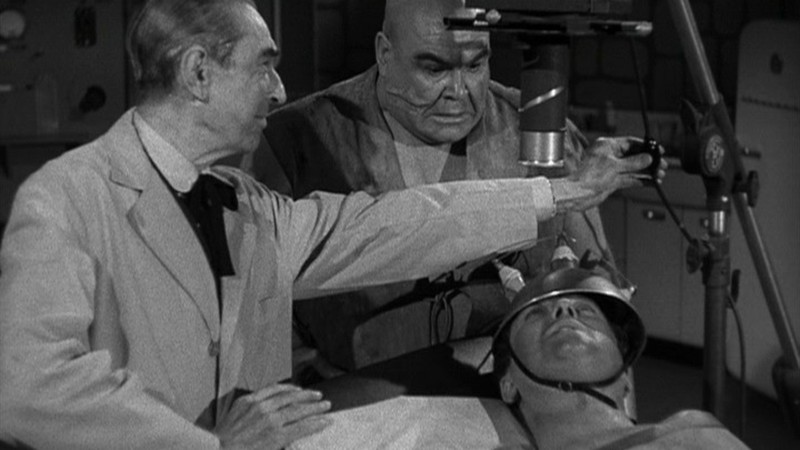
The plot is a glorious, rhythmic chaos. We have Dr. Eric Vornoff, a scientist who was exiled from his homeland for conducting forbidden experiments, which, in 1950s cinema language, usually means he was doing things with radiation that made the local authorities nervous. He’s set up shop in a crumbling mansion in the middle of a swamp, determined to prove his detractors wrong by creating an army of atomic supermen. It’s a premise that feels like it was ripped straight from the pulpiest pages of a 10-cent magazine, and the execution is just as frantic. This is the kind of filmmaking that vibrates with energy because everyone involved feels like they’re making the greatest movie ever told, despite the fact that the set is literally held together with tape and hope.
Bela Lugosi: The Operatic Twilight of a Legend
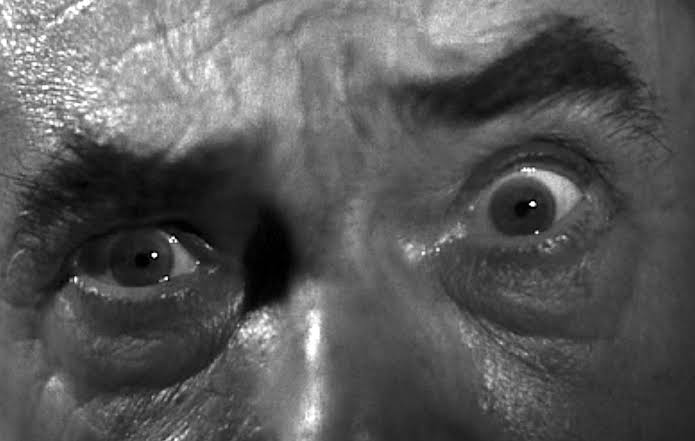
We cannot talk about why this is a wonderful piece of filmmaking without starting with the man himself: Bela Lugosi. By 1955, Lugosi was a man fighting a losing battle with his own health and an industry that had largely moved on from the gothic horrors that made him a star. But when he stepped onto the set as Dr. Vornoff, he didn’t bring the energy of a man who was defeated. He brought the energy of a titan.
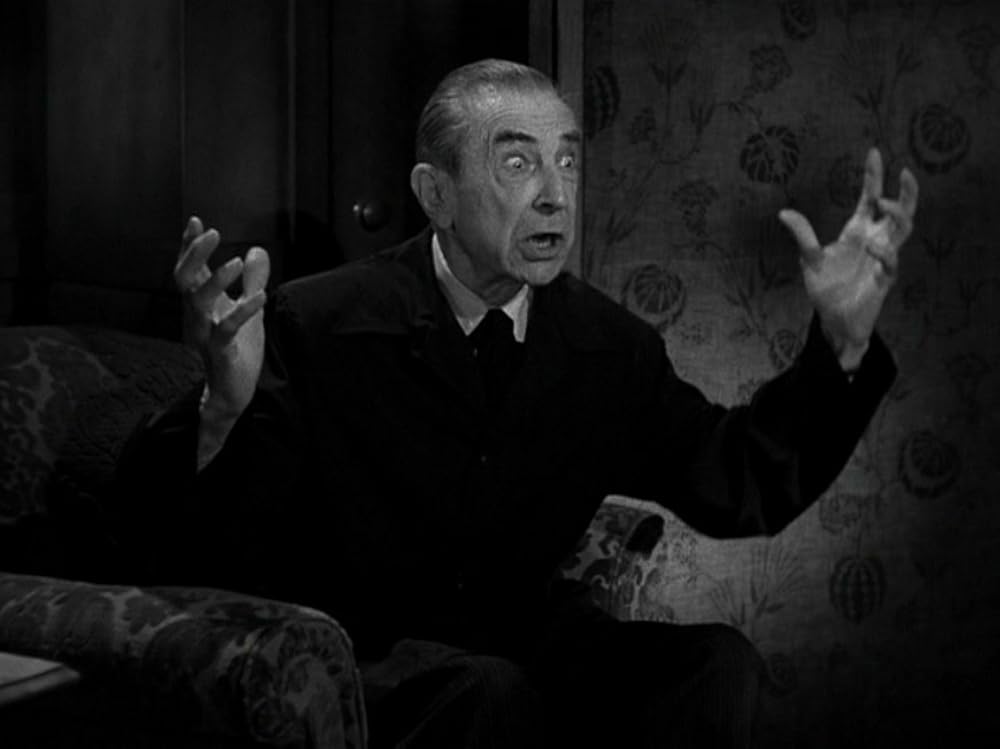
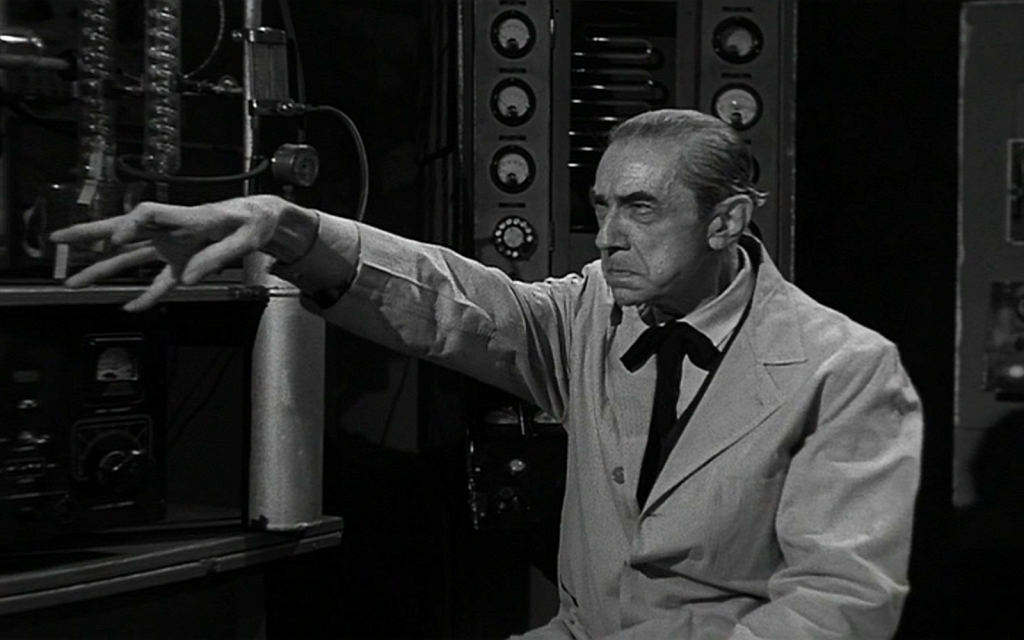
Lugosi’s performance is nothing short of operatic. He treats every line, no matter how absurd, as if it were a soliloquy from the world’s greatest tragedy. When he stands in his laboratory, which, let’s be honest, looks like a collection of radio parts and kitchen appliances, and delivers his “Home? I have no home!” speech, he isn’t just acting. He is baring his soul. He bellows about being hunted, despised, living like an animal, and for a few minutes, the cheap lab equipment disappears and you’re watching a master actor refuse to go quietly.
The rhythm of his delivery is jagged and intense. He pauses in strange, jagged beats that feel less like hesitation and more like a mind splintering under obsession, but in the context of Vornoff’s world, it makes perfect sense. He is a man on another level of everything, and his commitment to the role is what anchors the entire production. It’s the wonderful part of the filmmaking, the ability of a single performance to elevate the mundane into the macabre.
Lobo: Muscle, Silence, and Slow Thunder
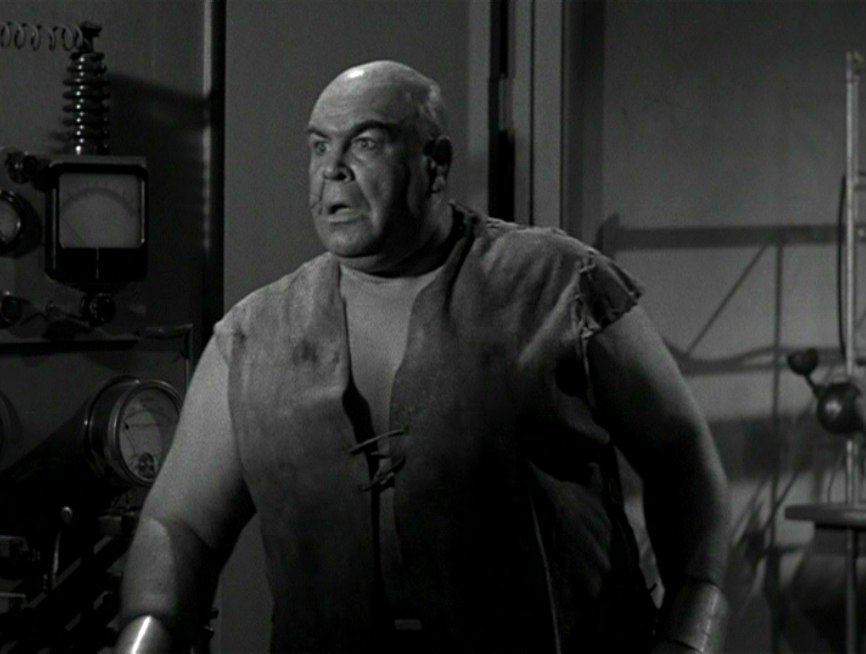
Every mad scientist needs a henchman, and in the world of cult horror, they don’t get more iconic than Tor Johnson as Lobo. Tor was a mountain of a man, a former wrestler who looked like he had been carved out of a single piece of granite. In Bride of the Monster, he provides the perfect physical counterpoint to Lugosi’s high-strung, nervous energy.
Watching Lobo carry out Vornoff’s orders is a lesson in the beauty of horror. Tor doesn’t have much in the way of dialogue, mostly just grunts and pained expressions, but his physical presence is undeniable. He’s a slow, thudding sound that grounds the frantic pacing of the lab scenes. There’s a specific kind of wit in seeing this giant of a man gently tending to a mummified experiment or kidnapping victims with the awkwardness of someone trying to move a sofa through a narrow doorway.
The dynamic between the two is legendary. Lugosi provides the sharp, intellectual stings, while Tor provides the heavy, brute force. Together, they create a visual language that defines the Ed Wood aesthetic: sincere, slightly disorganized, but utterly captivating.
The Octopus: A Masterclass in Manual Labor
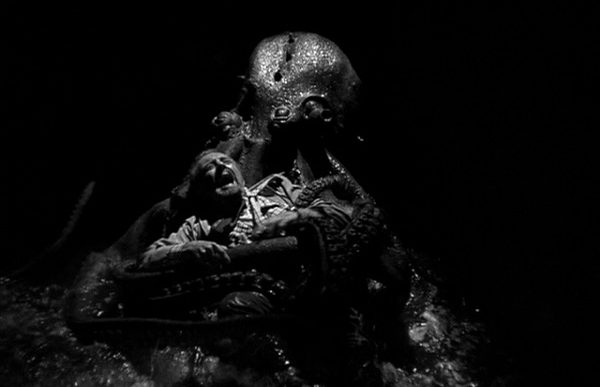
Now, there have been a lot of classic monsters in the history of cinema, but for me, none come close to The Octopus. If there is a single image that defines the laugh out loud brilliance of practical effects in trash cinema, it’s this big, beefy bastard from Bride of the Monster. The story of its origin is almost as famous as the movie itself. According to long-repeated production lore, Wood acquired the prop without its motor, leaving the tentacles completely inert.
In a normal production, this would be a show-stopper. In an Ed Wood production, it’s a creative opportunity. Since the octopus couldn’t move, the burden of the horror fell entirely on the victims. Watching Lugosi thrash in shallow water, wrestling rubber tentacles that refuse to move or the incredibly stiff Tony McCoy rolling around like a meatball that has just fallen off a plate, manually wrapping the lifeless rubber arms around their own necks while screaming in simulated agony, is a sight that every film fan needs to witness.
It is filmmaking in its purest form, the refusal to let a lack of resources stop the story. The actors are working harder than any hydraulic system ever could. They are the ones providing the movement, the tension, and the life to a prop that is essentially a giant bath toy. It’s gritty, it’s honest, and it captures the high-energy do or die spirit of independent cinema. It’s the kind of moment that makes you geek out because you can see the effort in every frame.
Swamp-Born Cinema
The style of Bride of the Monster is a frantic, majestic mess. Ed Wood was a director who believed in the power of the first take, mostly because he couldn’t afford a second one. This gives the movie a sense of urgency that you just don’t find in big-budget productions. The scenes are edited with an utter disregard for continuity that is actually quite refreshing.
One of the hallmarks of the film is the use of stock footage. One minute, you’re in a tense scene in Vornoff’s lab, and the next, there’s a sudden cut to a grainy shot of a crocodile or a snake. These animals were clearly filmed in a completely different part of the world, probably years before this movie was even conceived, but Wood drops them into the narrative without hesitation, as if sheer momentum will make them belong. The movie doesn’t care if the lighting changes between shots or if a character’s hat suddenly disappears. It’s too busy moving toward the next atomic revelation. It embraces the absurdity of the genre and invites the audience to do the same. It’s witty in its lack of polish, and it’s fast-paced because it has to be, after all, the clock was always ticking on Ed Wood’s budget.
A Supporting Cast of Zealous Amateurs
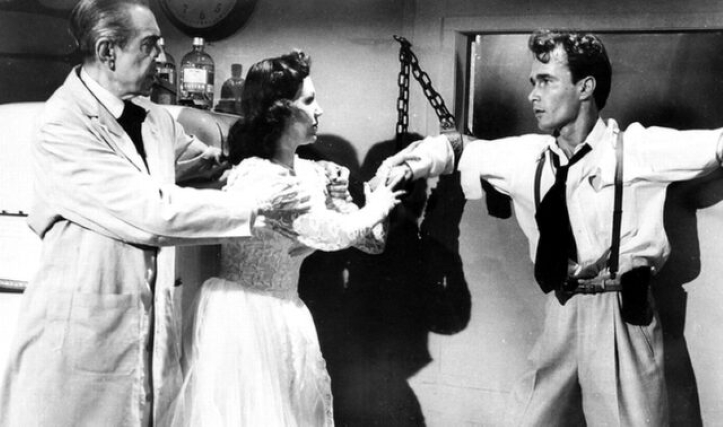
The supporting players in Bride of the Monster add a layer of unintentional comedy that only enhances the film’s charm. Tony McCoy, the son of the film’s financier, plays our hero, Lieutenant Dick Craig. McCoy delivers his lines with a rigidity that feels almost architectural. He uses an unwavering monotone that makes him look and sound like he’s reading off a teleprompter located three miles away. It’s the perfect foil to Lugosi’s operatic intensity.
Then we have Loretta King as Janet Lawton, the intrepid reporter. King brings a frantic, wide-eyed energy to the damsel in distress role. She’s there to investigate the disappearances in the marsh, but she ends up being the catalyst for Vornoff’s final breakdown. And who could forget Harvey B. Dunn as the police captain who spends his scenes interacting with a parakeet? These are the strange visitors that populate Wood’s world, performers who seem less directed than simply placed in front of the camera and trusted to survive the take, while a giant rubber octopus was being prepared in the next room.
The Final Atomic Blast
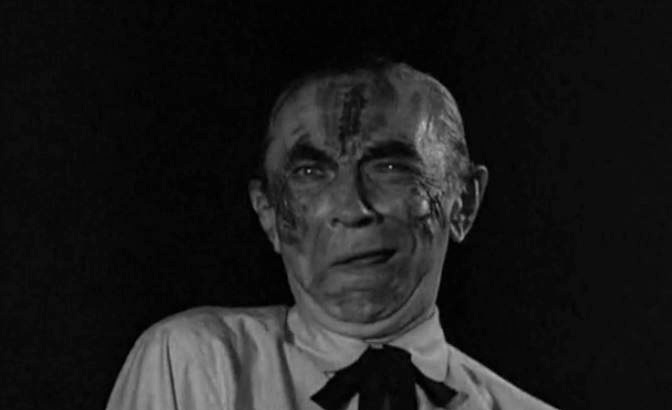
The climax of the film, the atomic blast that eventually takes out Vornoff’s lab, is the perfect ending to this disorganized, sloppy, wonderful journey. It blends stock nuclear test footage with miniature effects that barely conceal their construction. It’s a direct hit to the nervous system of anyone who loves the out there nature of 1950s sci-fi.
Ultimately, Bride of the Monster is a triumph because it is so unapologetically itself. It’s a movie that celebrates the grit of the filmmaking process. It proves that conviction can outmuscle polish and create something that people will still be talking about seventy years later. For that to happen, you just need a legend like Lugosi, a mountain like Tor Johnson, and a director who is brave enough to believe that a rubber octopus is the scariest thing on earth.
It’s the kind of film that makes you want to go out and make your own backyard masterpiece. Whether you love it because it’s a classic or because it’s a gloriously messy, chaotic ride, there’s no denying that Bride of the Monster delivers exactly 69 minutes of pure, unfiltered weirdness you won’t forget.
Leave a Reply