Hellraiser doesn’t so much ease you in as it does drag you by your collar straight into a house where pleasure and pain have the same zip code, and the rent is overdue. Clive Barker’s vision is loud, wet, and unapologetically tactile: skin stretches, chains scrape, and every moment hints at something that will absolutely ruin your night. There’s no polite buildup, no friendly ‘here’s a story’ wink; just a house full of secrets, a box that demands to be solved, and the kind of horror that makes you simultaneously squirm, cringe, and marvel at how someone thought this was a good idea.
This isn’t just a movie. It’s a 90-minute descent into the industrial Gothic basement of Clive Barker’s brain, and trying to summarize it quickly is like trying to explain the concept of pain to a guy who’s currently being dismantled by meat hooks. It takes time. It takes patience. It takes a disturbing amount of corn syrup.
So, grab your puzzle box, ignore the whispering in the walls, and let’s settle in. We’re going deep into the wet, squelchy heart of the Cotton family residence.
The Box, The Bazaar, and the Boredom of Frank Cotton
It always starts with the box. The Lemarchand Configuration.
If you’re a horror geek, you know the aesthetic: lacquered wood, etched brass, and a mechanical internal logic that would make a Swiss watchmaker weep. It’s beautiful. It’s tactile. And it’s the ultimate “Do Not Press This Button” in cinematic history.
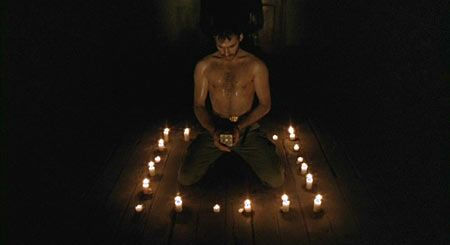
We open on Frank Cotton in a sweaty, dimly lit room in some far-flung, sunbaked locale. Frank is played by Sean Chapman, and he radiates the kind of greasy, 80s bad boy energy that suggests he’s been kicked out of every decent club from London to Marrakech. Frank is a man who has exhausted the world. He’s tasted every drug, slept with everyone willing (and some who weren’t), and found the entire experience underwhelming.
Frank is the personification of the ultimate edge-lord. He doesn’t just want a thrill; he wants the limit. He wants the kind of pleasure that requires a specialized medical team and a waiver signed in blood. He seeks out the box after hearing the rumors: solve the puzzle, and you unlock a doorway to a dimension of sensory transcendence.
The Big Mistake: Frank thinks he’s a player. He thinks he’s going to be the guest of honor at an interdimensional orgy. Instead, he solves the box in the attic of his family’s ancestral home (which, let’s be honest, is already a red flag for real estate value), and the universe responds by sending a fleet of invisible chains to turn him into a human jigsaw puzzle.
The brilliance of Barker’s direction here is the lack of monsters in the first five minutes. It’s just chains. It’s mechanical. It’s the sound of metal on meat. Frank isn’t being haunted; he’s being processed. He walked into the DMV of Hell, and his number finally came up.
Larry Cotton: The World’s Most Oblivious Human
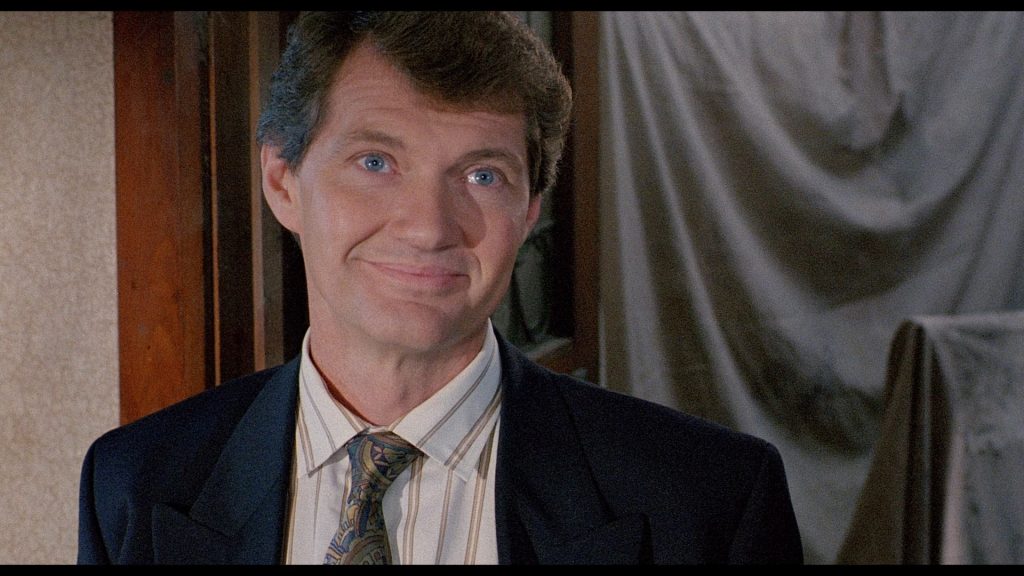
Enter Larry Cotton (Andrew Robinson). If Frank is the dark, greasy underbelly of humanity, Larry is the beige, lint-covered surface.
Larry is moving back into the house where Frank disappeared (most people assume he just went on another bender). Larry is the kind of guy who wears a sweater vest to a home renovation. He’s polite, he’s kind, and he has the situational awareness of a goldfish in a blender.
He’s moved in with his second wife, Julia (Clare Higgins). Now, Julia is the real MVP of this movie. While Larry is worrying about leaky pipes and moving boxes, Julia is simmering in a stew of regret. She had a torrid affair with Frank years ago, and she’s never quite gotten over the fact that her current husband is as exciting as a bowl of unseasoned oatmeal.
The Inciting Incident: Larry, being the lovable klutz he is, tries to move a sideboard up the stairs. He cuts his hand on a stray nail. Now, in any other movie, this is a minor inconvenience. In a Clive Barker movie, a drop of blood on the floorboards is basically a starter motor for a necromantic ritual.
Larry’s blood drips through the cracks of the attic floor, landing on the spot where Frank was dismantled. And that’s when the movie truly begins to ooze.
The Rebirth
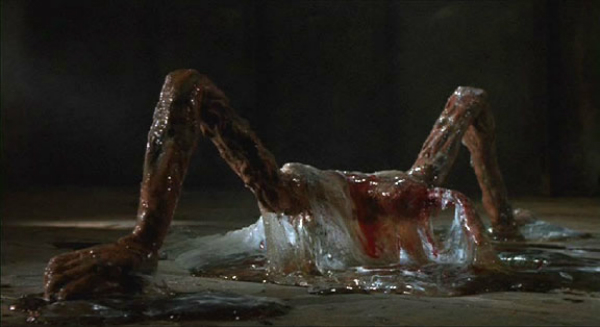
Frank’s rebirth is so well done that you can almost feel the slime dripping onto you. If you’re a fan of practical effects, this scene is your North Star.
Frank doesn’t just pop back into existence. He has to pull himself out of the floorboards like a piece of chewed bubble gum being stretched back into shape. We see the floorboards literally breathing. We see the skeletal structure form, then the layers of muscle, then the weeping, wet veins.
This is the genius of Bob Keen’s effects team. In 1987, they didn’t have the luxury of fixing things in post with a computer. They had to use latex, KY Jelly, and probably several gallons of industrial-grade mucus. The result is something horrific yet alive. You can almost smell the rot through the screen.
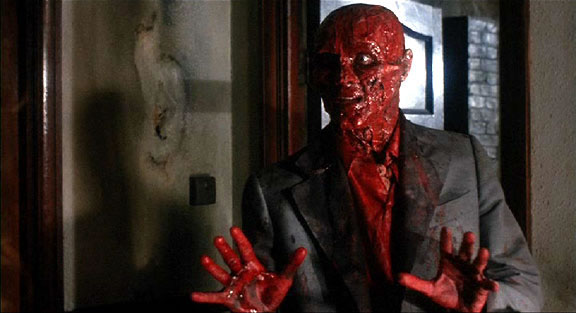
When Julia finds the partially reformed Frank, he doesn’t have skin. He’s just a Meat-Frank. He looks like a biology textbook illustration that’s been left out in the rain. And yet, because Julia is so profoundly bored with her life, she doesn’t scream and run. She looks at this shivering, skinless freak and thinks, “Finally, someone with a personality.”
The Meat Economics of Julia Cotton
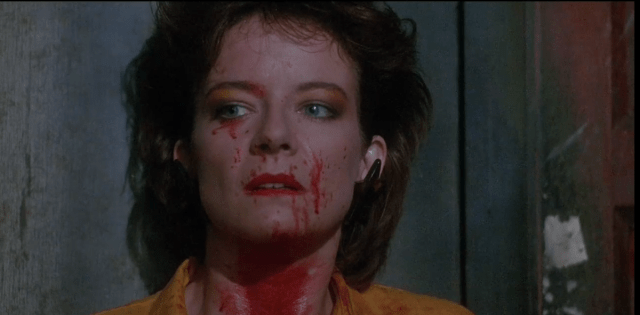
This is where the domestic drama turns into a full-blown body horror slasher. Frank needs more than just a drop of Larry’s blood; he needs galoons of claret to rebuild himself. He’s essentially a leaky vampire.
Julia becomes the more than a willing participant in securing back idiots for Frank to drain dry. She goes to local bars, finds men who are looking for a good time, and lures them back to the attic. It’s a brilliant subversion of the 80s slasher tropes. Instead of a masked killer stalking teenagers, we have a middle-aged housewife in a silk dress hitting men over the head with a hammer.
Clare Higgins plays this with a chilling, pragmatic brilliance. She isn’t evil in a cackling, cartoonish way. She’s doing it because she’s desperate. She wants Frank back because Frank represents the only time she ever felt alive, even if alive in this context means “covered in someone else’s blood in a dusty attic.”
Every time she brings a victim back, Frank gets a little more human. He starts to grow a face. He starts to grow hair. But he’s still missing the final piece: the skin. And he knows exactly whose skin he wants. (Sorry, Larry.)
The Cenobites: The High Priests of ‘Just Doing My Job’
Now, let’s talk about the icons. The Cenobites.
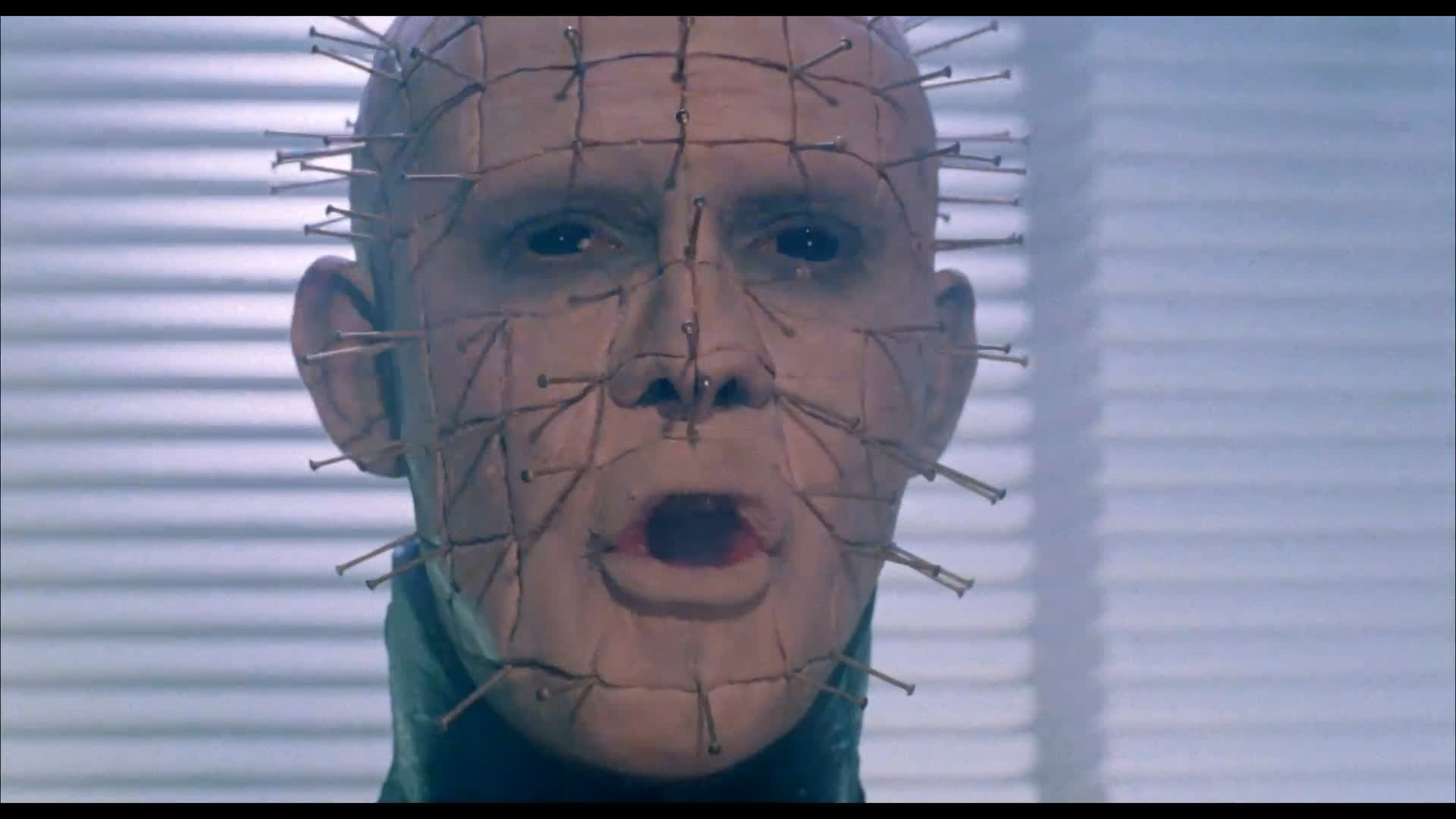
In the late 80s, the ‘Big Three’ of horror were Freddy, Jason, and Michael. They were monsters of the shadows. Then came Pinhead (originally credited simply as Lead Cenobite).
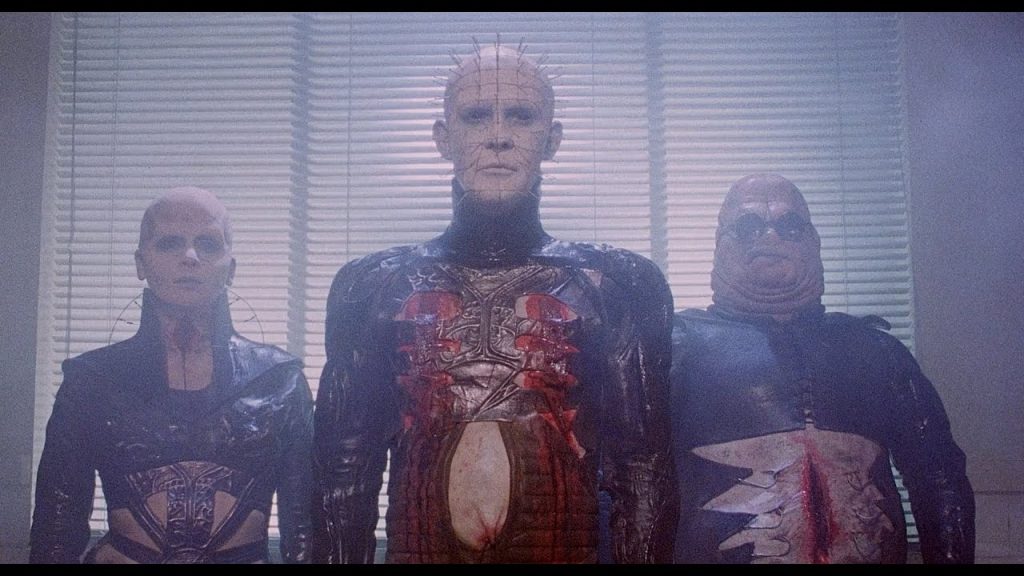
When Pinhead (Doug Bradley) enters a room, the atmosphere doesn’t just get scary; it gets clinical. The Cenobites don’t run. They don’t hide. They walk into the frame with the quiet authority of a team of forensic accountants who have found a $10 million discrepancy in your soul’s ledger.
Pinhead: The philosopher. He speaks in a deep, melodic baritone that makes every threat sound like a graduation speech.
The Chatterer: A masterpiece of design. His face isn’tone even a mother could love, and his teeth are constantly clicking in a rhythmic, mechanical stutter.
The Female Cenobite: Stoic, pale, and possessing a wire through her throat that suggests she hasn’t had a glass of water since the Renaissance.
Butterball: The heavy-hitter who looks like he’s been stapled together after a very long weekend at a butcher shop.
The brilliance of Barker’s design is that they don’t look like demons from a Sunday school pamphlet. They look like they belong to a culture. They have their own tailors, their own rules, and their own aesthetic. They are the ultimate other. They represent the end-point of Frank’s curiosity: a state where pain and pleasure have merged into a single, agonizing gray area.
Kirsty Cotton and the Great Interdimensional Negotiation
Enter Kirsty (Ashley Laurence). She’s Larry’s daughter, and she is the only person in this movie with a functioning bullshit meter.
Kirsty is our anchor. She’s the one who stumbles upon the box, the one who witnesses the horror of the attic, and the one who eventually has to clean up the mess her family made.
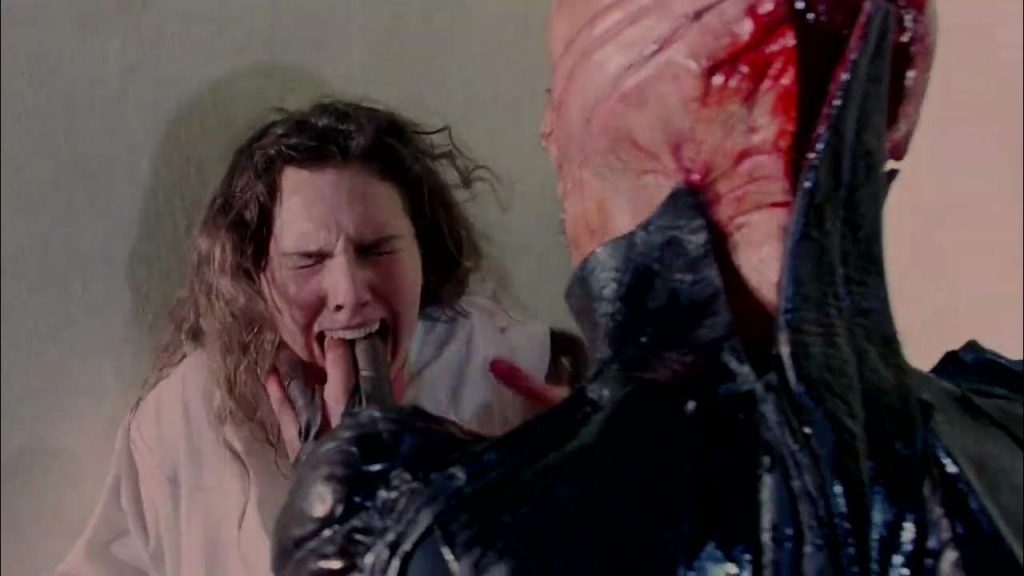
The hospital scene is one of the best non-action sequences in horror. Kirsty accidentally opens the box while recovering from the shock of seeing Frank. The walls of the hospital room literally fold away, revealing the blue-tinted void of the Cenobite realm.
When Pinhead appears, Kirsty doesn’t try to outrun him (because you can’t outrun a guy who controls the dimensions). Instead, she negotiates. She realizes that the Cenobites are essentially bounty hunters. They don’t care about good or evil. They just care about the contract.
It’s a legalistic nightmare. Kirsty isn’t fighting a monster; she’s fighting a cosmic lawsuit. And the only way to win is to turn in the fugitive who skipped bail on his eternal torture session.
The Climax: Skin Suits and Sharp Hooks
The final act of Hellraiser is a chaotic, wet, and deeply unsettling explosion of practical effects.Frank has finally done it. He’s killed Larry, stolen his skin, and is now masquerading as Julia’s husband. It’s the ultimate identity theft. But the skin doesn’t quite fit. He looks off. His eyes are too deep in his head. He’s sweating, he’s shaking, a2nd he’s one step away from falling apart.
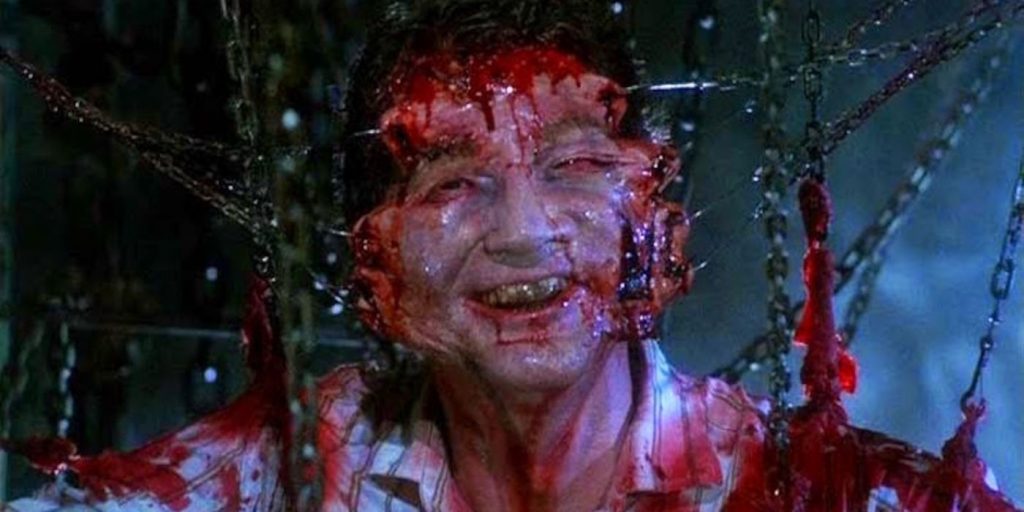
When the Cenobites arrive to collect, the horror reaches a new peak, transforming the film into an industrial gothic slaughterhouse. The chains return, those beautiful, rusted, hooked chains. They fly through the air like heat-seeking missiles, latching onto Frank’s flesh and pulling him in four different directions.
The Iconic Line: As Frank is literally being dismantled, he looks at Kirsty and smiles:
“Jesus wept.”
It’s a perfect Barker moment. It’s sacrilegious, it’s dramatic, and it’s completely fucking brilliant. Frank isn’t repenting; he’s acknowledging the sheer, overwhelming scale of the experience he finally achieved. He got what he wanted. He just didn’t realize that getting what you want involves being turned into a human kite.
The Philosophy of Barker’s Meat-Verse
Why does Hellraiser still work? Why does it feel so much heavier than other 80s horror movies?It’s because Clive Barker understands that meat is vulnerable.
Most horror movies focus on the spirit or the ghost or the slasher. Barker focuses on the plumbing. He focuses on the nerves, the skin, the blood, and the bone. In the world of Hellraiser, the body is just a fragile container for a soul that wants to be elsewhere.
The Cenobites aren’t evil because they enjoy pain. They are evil (from our perspective) because they have transcended the need for comfort. They see the human body as an instrument to be played. If you’re a virtuoso like Frank, they’ll play you until the strings snap.
The film is a bleak, cynical commentary on the 1980s obsession with ‘more’. More sex, more drugs, more money, more sensation. Frank is the ultimate consumer, and the Cenobites are the ultimate debt collectors.
The Practical Magic of 1987
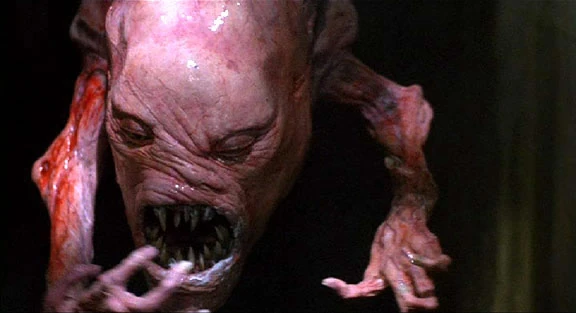
I have to give one final shout-out to the effects crew. Before the world was flattened by digital pixels, movies like Hellraiser felt dangerous because the stuff on screen looked like it had mass and was alive. When the Engineer (that weird, multi-legged monster in the hallway) chases Kirsty, it’s a big, clunky, rubber puppet. And yet, because of the lighting and the sound design, it’s terrifying. It feels like something that shouldn’t exist in our world, but does.
The entire aesthetic, the steam, the flickering lights, the peeling wallpaper, creates a sense of urban decay that makes the supernatural elements feel grounded. It’s not a haunted castle in Transylvania; it’s a shitty house in a London suburb. That makes the horror feel much more personal. It could be the house next door. It could be your attic.

Why I Love It
Hellraiser remains an almost unsurmountable peak of the genre. It’s a movie that balances high-concept fantasy with low-brow gore in a way that hasn’t really been matched since.
It’s terrifying, it’s gross, it’s poetic, and it’s genuinely unique. It gave us one of the most iconic villains in history, but more importantly, it gave us a world where the monsters have a code of conduct.
Don’t talk to me about the 10+ sequels. Don’t talk to me about ‘Pinhead in Space.’ The 1987 original is a self-contained, perfect nightmare. It’s a reminder that some puzzles are better left unsolved, and some boxes are better left in the bazaar.
Leave a Reply