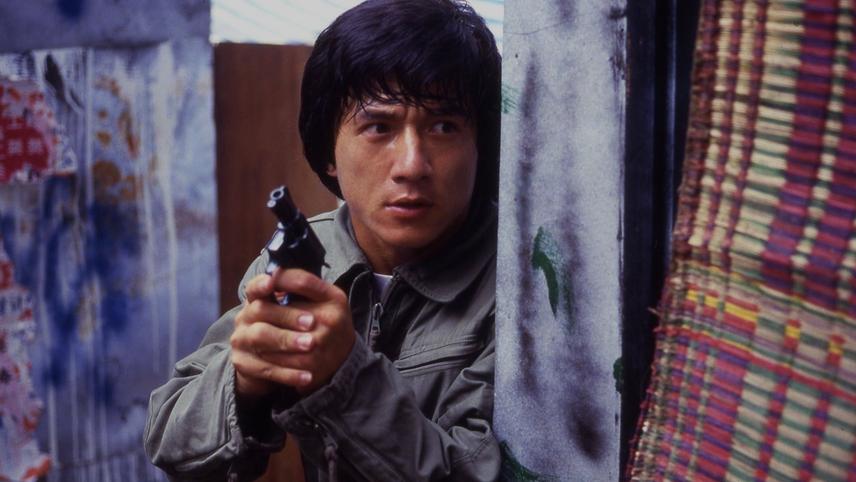
Listen up: if you want to understand what action cinema looked like before safety nets, digital doubles, and lawyers, watch Police Story. In 1985, Jackie Chan turned a Hong Kong shopping mall into a demolition zone and treated his own body like a crash-test dummy. What follows isn’t just action choreography, it’s controlled chaos performed by people who clearly decided that gravity was more of a serving suggestion than a rule. Police Story is the film that didn’t just move the bar for action cinema; it took the damn thing, bent it over its knee, and used it to vault a moving vehicle.
This isn’t just a martial arts movie. It is a symphony of destruction, a showcase for Chan’s bone-rattling physical comedy, and a document of several dozen human beings (led by the madman himself) attempting to bypass the laws of physics and workplace safety. Police Story is about how much punishment a human body can take before it finally refuses to cooperate. It doesn’t feel staged; it feels documented, like someone pointed a camera at chaos and hoped everyone survived.
The Birth of Super Cop
By 1985, Jackie Chan was already a star in Asia, but he was looking for something to set him apart from the shadow of Bruce Lee. Lee was the stoic philosopher-warrior, a god walking among men. Jackie wanted to be the everyman who gets hurt, makes mistakes, and yet somehow wins through sheer, frantic desperation.
Enter Chan Ka-Kui. He isn’t a chosen one. He’s a cop who wants to do a good job, keep his girlfriend May happy, and not get fired. The brilliance of Police Story starts with this relatability. When he gets hit, he sells it. When he falls, it looks like it hurts. Usually because it bloody does. This vulnerability is the secret sauce that makes the high-stakes stunts feel like life-or-death situations rather than choreographed dances. He made the superhero feel like your next-door neighbor, bruised, battered, and surprisingly unstoppable. He wasn’t just fighting criminals; he was fighting the laws of Newton, fatigue, and the sheer weight of a world that wanted to crush him.
The Shanty Town Slalom
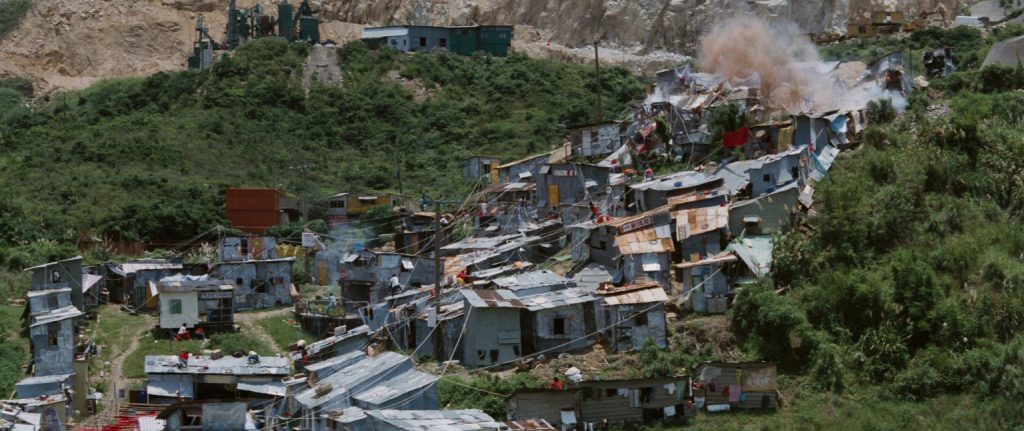
The movie opens with a sting operation in a shanty town that goes sideways faster than a greased pig on ice. Now, most directors would be content with a foot chase through the alleys, but then, most directors aren’t Jackie Chan. He decides to drive several cars straight through the village, literally over the roofs and through the walls of the hillside settlement.
These aren’t flimsy stunt props either; the production team built an entire hillside shanty town from corrugated metal and timber so the vehicles could smash straight through it. The cars plow into them, sending splinters and terrified stuntmen flying in every direction. Every exploding building, every stumble, every skid is impossible to look away from. You can see the dust clogging the actors’ lungs.
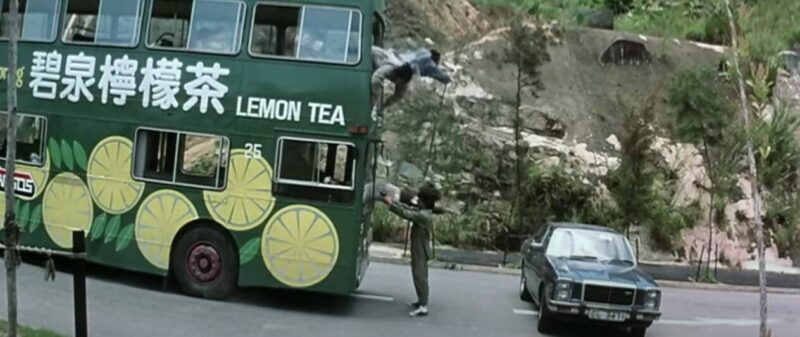
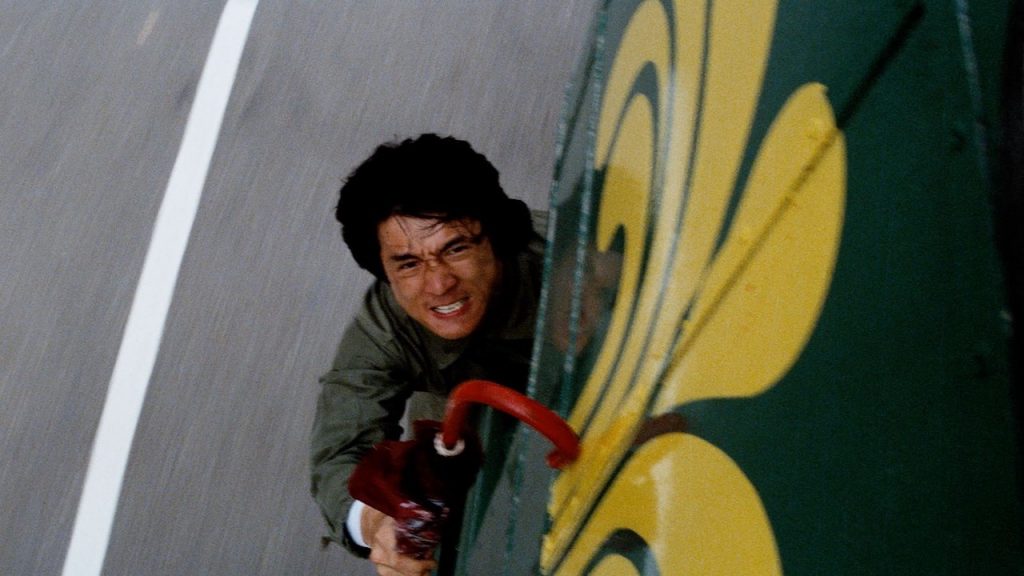
The climax of this scene involves Jackie chasing a bus, not by running alongside it, but by using an umbrella to hook onto the window and drag himself along the pavement, after running and rolling down a hillside that would make Edmund Hillary think twice. It’s absurd and genuinely dangerous. When the bus stops suddenly, two stuntmen are launched from the top-deck windows toward a car meant to break their fall, but the bus comes up short, and they slam straight onto the pavement. The shot stayed in the movie, signalling that everyone on set would pay in flesh for the audience’s adrenaline.
Mayhem and Misfires
Between the spine-snapping stunts, Police Story is pure Keatonesque Slapstick. Jackie Chan is arguably the greatest physical comedian since Buster Keaton, and this film proves it. He understands that action and comedy are built on the same foundation: timing.
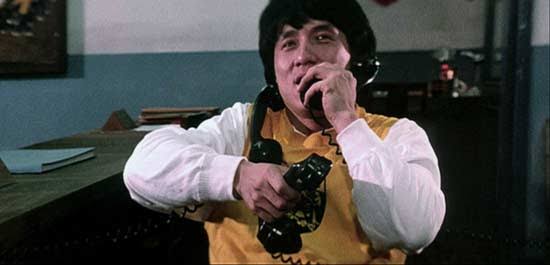
The sequence in the police station where Ka-Kui is trying to juggle five different phone lines while tangled in cords is pure comedic gold. It’s witty, hurried, and relies entirely on Jackie’s coordination. He uses his environment as a prop, turning a mundane office into a playground of frustration.
Then there’s his relationship with May, played by the incomparable Maggie Cheung. She is the unsung hero of this film. Her timing and instincts keep up with his wild improvisations. Whether she’s getting a birthday cake in the face or accidentally riding a motorcycle into a pile of boxes, she is the perfect foil. Their chemistry adds a layer of heart to the carnage, making us actually care if Ka-Kui survives the next twenty minutes. It gives the ‘Super Cop’ a reason to come home, providing a grounded emotional anchor in a movie that otherwise threatens to fly off the rails.
Glass Story
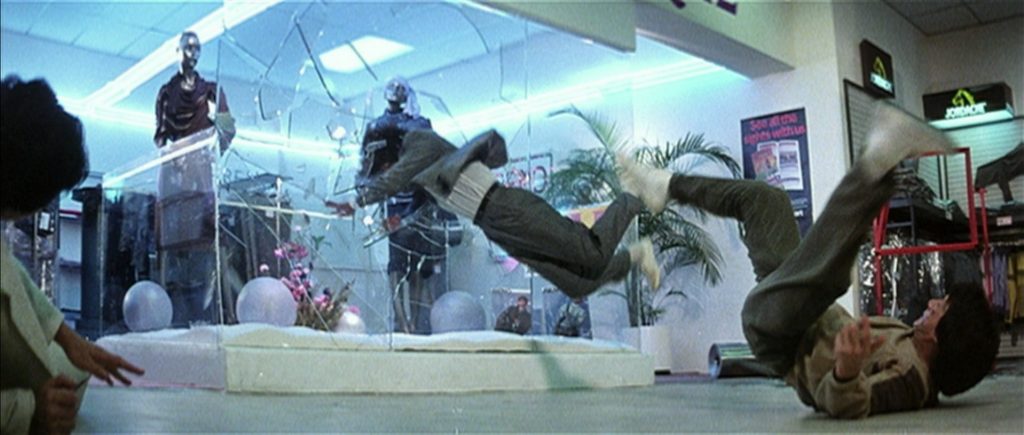
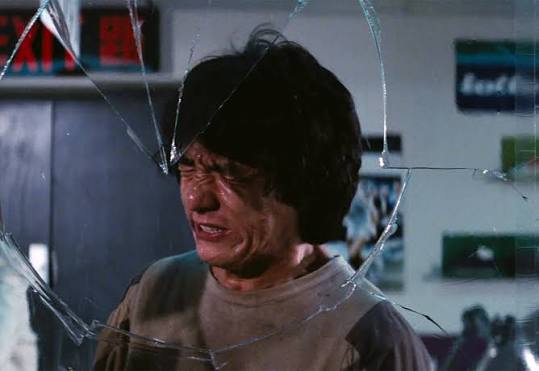
The crew famously nicknamed this movie ‘Glass Story’ because of the sheer volume of sugar glass (and unfortunately, real glass) shattered during production. In the 80s, Hong Kong action cinema didn’t have the luxury of safety officers or digital composition. If you wanted a guy to fall through a glass table, you put a guy over a glass table and pushed him.
The cinematography reflects this ‘No Safety Net’ philosophy. The camera stays wide. There are no rapid-fire cuts to hide a stunt double’s face, because for the most part, there are no stunt doubles. This wide-angle approach is a stroke of brilliance. It allows the audience to track the physics of the movement. You see the leap, you see the flight, and you see the impact. It creates a connection that modern films can never replicate. When you see Jackie’s head bounce off a marble floor, your brain knows it happened. There’s no polish hiding the danger; every action speaks for itself. The stunts land hard because they’re lived in, not faked.
The Shopping Mall: The Sistine Chapel of Action
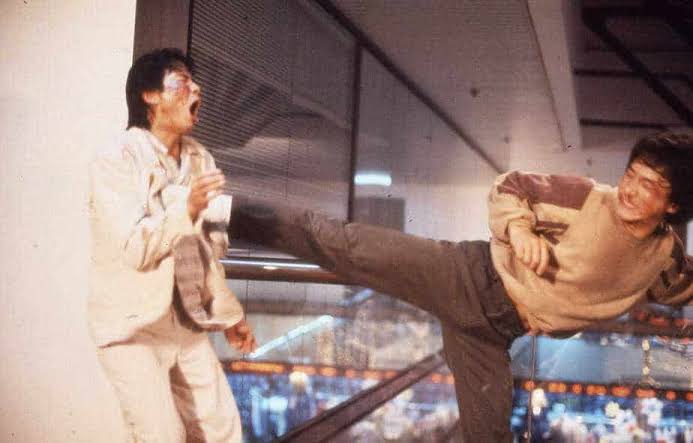
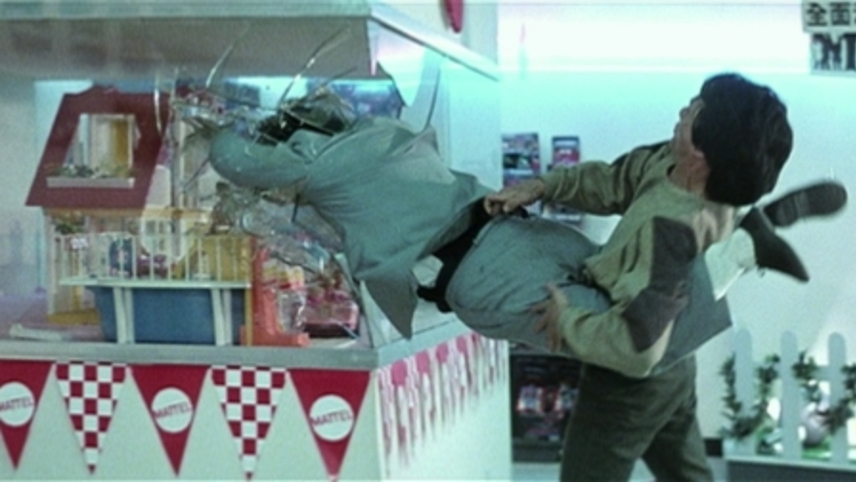
The shopping mall showdown is, quite simply, the greatest sustained action sequence ever captured on film. It is a heady combination of split-second choreography, sheer unadulterated chutzpah, and “How the fuck did he not die?” moments. The setup: Ka-Kui is cornered in a multi-story mall. The villains have the numbers. The environment is 90% glass. What follows is a nonstop gauntlet of flying bodies and daredevil feats that still boggle the mind.
The Clothes Rack Warfare: Jackie uses everything. He’s swinging around racks, using hangers as hooks, and turning a department store into a tactical arena. Every move is functional. It’s not flowery kung-fu; it’s martial arts as survival.
The Escalator Slide: Only Jackie Chan would look at a moving escalator and think, “I should slide down the middle of that while being shot at.”
The Shattering Landscape: People are thrown through windows, display cases, and mirrors at a rate of roughly one per second. The sugar glass used was thicker than usual to ensure it looked cinematic on camera, which meant it actually hurt more to break. By the end of the shoot, the stunt team was reportedly covered in hundreds of tiny lacerations, a testament to the film’s death or glory production.
And then there’s The Stunt…
The Pole Slide: The Stunt That Changed Everything
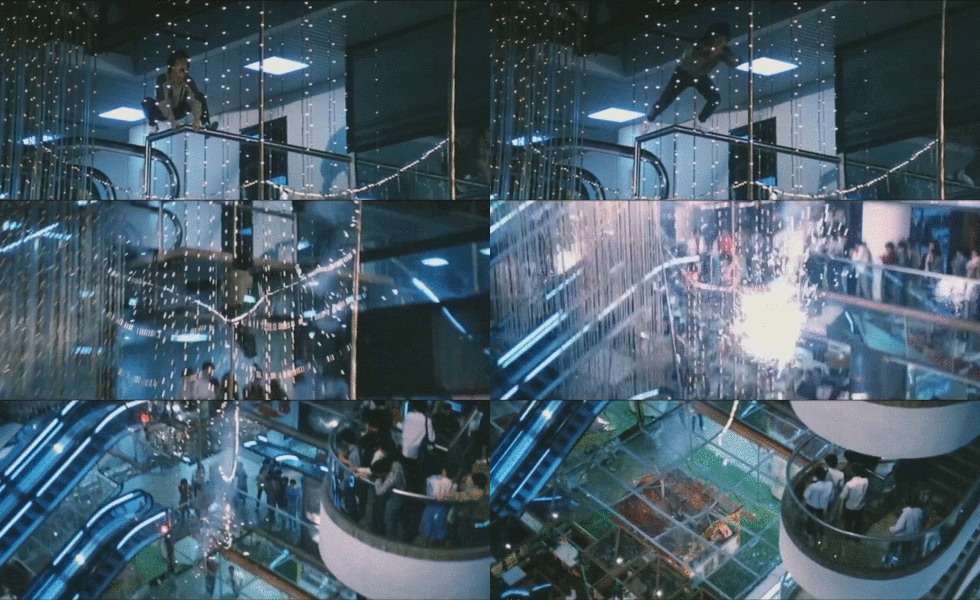
We have to talk about The Stunt. The one that defines the movie, the franchise, and Jackie’s entire career. Ka-Kui is on the top floor. The villains are escaping on the ground floor. The only way down is a metal pole wrapped in decorative Christmas lights. Jackie jumps. He grabs the pole. He slides down through a literal waterfall of electrical sparks and exploding lightbulbs, crashing through a glass canopy at the bottom.
The reality behind this is terrifying. Those lights were plugged into a real power source; they weren’t low-voltage props. As Jackie slid down, the heat from the bulbs and the electrical discharge gave him second-degree burns on his palms. The landing was so violent it should’ve killed him, and definitely left him shaken but still able to finish the scene. Rumour has it that Jackie, in a fit of pure shock and adrenaline, grabbed the actor playing the villain and started screaming at him, staying in character despite the agonizing pain. It’s the moment where the line between entertainment and emergency room ceases to exist, but goddamn it, he not only managed to survive, he did it with style.
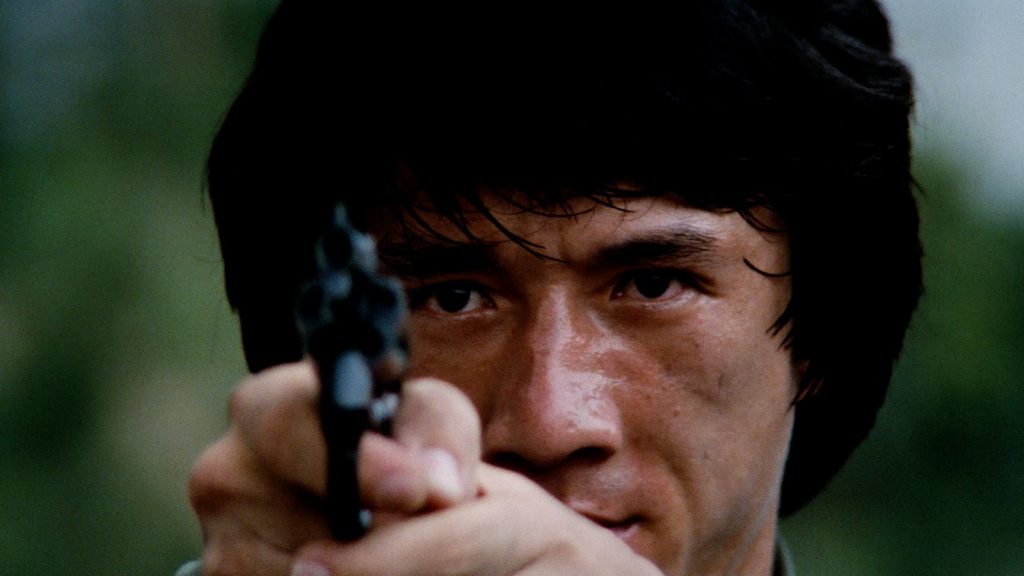
The Theme Song and the Cult of Personality
You can’t talk about Police Story without mentioning the theme song, Hero Story, sung by Jackie himself. It’s an upbeat, 80s synth-pop anthem that perfectly encapsulates the tone of the film. It tells you that despite the broken bones and the electrical burns, our hero is still smiling. It is the anthem of the underdog.
In a decade dominated by invincible one-man armies like Rambo or Commando, Ka-Kui was the hero who actually felt the pain. He was the cop who still had to answer to his boss and apologize to his girlfriend. This humanity is what built the Jackie Chan cult of personality. He wasn’t a distant icon; he was the guy putting his life on the line for our amusement, and he invited us to enjoy the ride with him.
The Jackie Chan Stunt Team
Police Story helped cement the reputation of the Jackie Chan Stunt Team as one of the most fearless groups in action cinema. These guys were a brotherhood who signed on to do the things no one else would. In the credits (which are mandatory viewing), we see the outtakes. We see the missed jumps, the accidental head-kicks, and the hospital stretchers.
This isn’t just behind the scenes fluff; it’s a badge of honor. It shows the audience that the entertainment they just consumed was paid for in claret and bruises. It validates the experience, proving that the magic is real. These men weren’t just background actors; they were athletes and daredevils participating in a new kind of physical theater. Their sacrifice created a standard of excellence that still sets the bar for the stunt industry today.
The Brutal Reality of Stunts and Sets
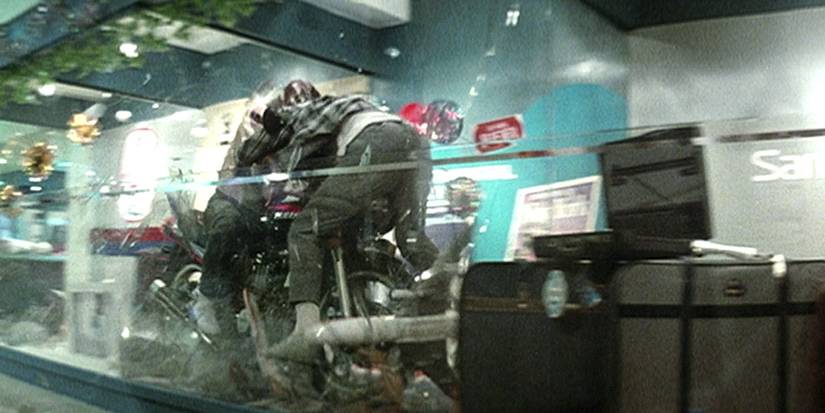
Even in 2026, Police Story proves what practical effects can do. Every fall, every collision, every stunt hits with real force. When a motorcycle crashes into a pile of crates, the crash is genuine. When a man is kicked through a real glass window, the way the shards fly is chaotic and unpredictable.
This commitment to the tangible is why the film still hits harder than most blockbusters from the last 40 years. There is no artificial gloss in Police Story. Everything on screen has mass, momentum, and consequence. The hustle and bustle of the Hong Kong streets and the sterile, soon-to-be-destroyed mall provide a texture that is almost impossible to replicate.
The Cinematography of Movement
Director of Photography Cheung Yiu‑Tsou deserves immense credit for how Police Story is framed. The camera isn’t just a passive observer; it moves with the action. However, unlike modern shaky cam, the movement here is precise.The camera knows exactly where Jackie is going to be. It anticipates the leaps and the falls, ensuring the audience never loses their sense of space.
This clarity is essential for high-level of action in Police Story. If you can’t see the move, the move doesn’t matter. The film uses long takes to emphasize the reality of the choreography, letting the performers’ skill shine without the need for aggressive editing tricks.
The Evolution of the Hong Kong Action Star
Police Story marked a pivot point in Hong Kong cinema. It moved away from the period piece wuxia films and into the modern, urban gun-fu and stunt-fu era. It proved that you could have the complexity of traditional martial arts in a contemporary setting.
Jackie took the discipline of the Peking Opera and applied it to a world of cars, malls, and guns. This evolution helped pave the way for directors like John Woo and shaped the direction of Hong Kong and global action cinema. Without Police Story, the style of modern action would look very different. Jackie showed that the entire world is a weapon if you are creative, and crazy, enough to use it.
The Legacy
The film spawned several sequels and later reboots, but the 1985 original remains the lightning in a bottle. It captured a specific moment in Hong Kong history, a time of immense creativity, reckless ambition, and a local film industry that was punching far above its weight class on the global stage.
It remains the absolute standard for how to blend tonally disparate elements. It moves from broad comedy to gritty police drama to death-defying action without ever feeling disjointed. It is a testament to Jackie Chan’s vision as a director and his unparalleled skill as a performer. He knew exactly what the audience wanted: to see a hero who was human enough to fail, but brave enough to keep jumping.
Why I Love It
Police Story isn’t just a movie, it’s a study in pushing the human limits. Every sequence is measured, precise, and brutal. Jackie Chan doesn’t act; he drives the stunt itself, vaulting, sliding, and crashing through spaces that would stop most people in their tracks. You feel everything; every scrape, every near and not so near miss, not because of camera trickery, but because it actually happened. No CGI, no padding, no illusions, just a man, a lack of self preservation, and a team pushing the physical boundaries of filmmaking.
It’s funny as hell, too. Amid all the carnage, Jackie’s complete understanding of timing and physical comedy keeps the film brimming with levity. Every fall, every collision, every accidental tumble becomes a beat in a symphony of pain and laughter. Even the smallest stunts are infused with a kind of manic precision that few filmmakers dare attempt.
This film is more than action. It’s a celebration of human capability: ingenuity, risk, resilience, and the pure joy of seeing a master at work. It’s why, decades later, the film doesn’t just entertain; it inspires.
Police Story is a religious experience for anyone who loves cinema unafraid to hurt itself for the sake of awe. It is reckless, joyous, bone-crunching, hilarious, and devastating all at once. Jackie Chan didn’t just make a movie; he made a temple to action and comedy, and every sequence is an altar on which sweat, pain, and genius have been offered up. To experience it at full volume, in full view of every pane of glass and every wire of tension, is to remember what cinema can do when humans, not pixels, are in charge.
Leave a Reply