
I’ll be honest here. I have no idea what the fuck I just watched. This was one of the most out there movies it’s ever been my pleasure to sit through, and I loved every second of it.
Gunfighter Paradise isn’t just a movie; it’s a full-on psychological ambush. Written and directed by Jethro Waters, this thing is a Southern Gothic fever dream that manages to be both deeply unsettling and undeniably hilarious, often in the same breath. It’s the kind of cinema that makes you want to grab the person sitting next to you by the shoulders and ask if they saw that mummified cat too, or if your own brain is starting to splinter alongside the protagonist’s.
The story centers on Stoner, a man who is, quite frankly, on another level of everything. When we first meet him, he’s returning to his family home in North Carolina following the death of his mother. But Stoner isn’t exactly grieving in the traditional sense. He’s navigating a landscape of divine voices and unholy visions, all while carrying a mysterious green case that he treats with a reverence usually reserved for holy relics.
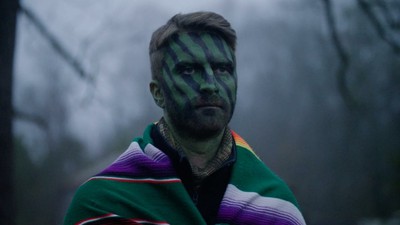
And then there’s the makeup. Stoner spends the entire film in full camouflage face paint. The movie never stops to really explain why, and honestly, it doesn’t need to. It’s just part of the character’s internal logic—a man perpetually ready for a war that might only exist in his own head, or perhaps in the rising tide of Christo-Fascism swirling around his neighborhood. It’s a bold choice that adds a layer of absurdist tension to every scene. You’re watching a man try to have normal interactions while looking like he’s about to invade a swamp, and the sheer commitment to that visual is part of what makes the film so captivating.
But don’t let the camo and the mystery case fool you; this is a stunningly beautiful piece of filmmaking. Waters treats the landscape not just as a setting, but as another character entirely. The cinematography is breathtaking, capturing the lush, heavy atmosphere of the South with a clarity that feels almost hyper-real. The fields, the trees, and the light all seem to be whispering to Stoner just as loudly as the voices in his head. It’s a visual feast that grounds the more out there elements of the plot, making the surrealism feel organic rather than forced.
The film finds its balance in the character of Joel, an old friend of Stoner’s who shows up in the most mundane capacity possible: he’s the cable man sent to sort out the internet. Joel is the perfect foil to Stoner’s religious mania. While Stoner is deciphering his mother’s handwritten riddles and listening to the commands of God, Joel is just trying to get the Wi-Fi to work. Their reunion is a masterclass in awkward, funny, and strangely touching character work. Joel represents the world we know, the world of bills, cables, and basic logic, while Stoner is drifting further into a visionary void.
The southern gumbo of the plot is seasoned with some truly bizarre ingredients. You’ve got zealous neighbors, Confederate reenactors, and that aforementioned mummified cat, all swirling through a narrative that explores the cultural Frankenstein of modern America. The film takes aim at the rising tide of Christian Fundamentalism and the way neighbors can suddenly become the other, but it does so through a lens of dark satire that feels incredibly fresh. It’s not a lecture; it’s a funhouse mirror held up to a very specific, very unfortunate here and now.
Without giving away any spoilers regarding the green case, the mystery of it acts as the movie’s pulse. It’s the MacGuffin that keeps you leaning in, but the real meat of the film is Stoner’s mental disintegration. You’re right there with him as his world splinters, guided by disquiet and the strangeness that keeps knocking on his door. It’s a wild ride that manages to be witty and irreverent while still respecting the gravity of the themes it’s playing with.
The humor in Gunfighter Paradise is sharp and dry. It’s the kind of humor that comes from the absurdity of extreme conviction. Stoner is so deeply entrenched in his own reality that his interactions with the normal world become inherently comedic, yet the film never mocks him. Instead, it invites us into his splintering mind and lets us find the beauty in the chaos. The dialogue is snappy, yet the pacing is never rushed, and the performances, especially Braz Cubas as Stoner, are top-tier.
It’s rare to find a movie that feels this uncompromising. Gunfighter Paradise knows exactly what it is, and it doesn’t care if you’re keeping up. It demands your attention and rewards it with a sensory experience that lingers long after the credits roll. Whether it’s the high-fidelity rendering of the Southern woods or the sight of a man in camo makeup firing high powered weaponary and passing out at divine visions, every frame feels intentional and expertly crafted.
In the end, Gunfighter Paradise is a triumph of independent cinema. It’s a bold, weird, and gorgeous exploration of faith, madness, and the irreconcilable ideologies that define the American South today. It takes the Southern Gothic label and gives it a much-needed shot of adrenaline, mixing comedy and surrealism into something that feels entirely new.
If you’re looking for a safe, predictable night at the movies, this isn’t it. But if you want to see a filmmaker at the top of his game taking huge risks and nailing every single one of them, then you need to see this. It’s a movie that celebrates the ridiculousness of the world while remaining a truly wonderful piece of filmmaking. I still might not have a full grasp on what I watched, but I know one thing for sure: I’m ready to watch it again.
Gunfighters Paradise will hit cinemas on February 27th.
Leave a Reply