
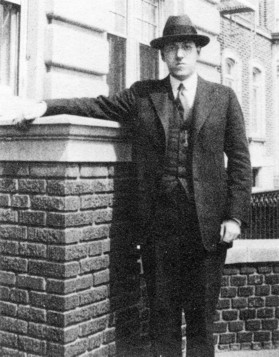
In October 1919, H. P. Lovecraft stood upon the precipice of a radical stylistic transformation. Inspired by the rhythmic, antique beauty of Lord Dunsany, he penned The White Ship—a story that ostensibly reads like a fairy tale but functions as a brutal, existential autopsy. If Beyond the Wall of Sleep was a rupture of the mind, The White Ship is a shipwreck of the spirit.
Here, Lovecraft’s eye falls on Hope.
The Cartography of the Impossible
The narrative is a first-person account by Basil Elton, a keeper of the North Point lighthouse. Elton’s life is defined by the monotony of the shore and the relentless, rhythmic calling of the sea. His grandfather and father before him were keepers of the light, men who stood at the edge of the world and watched the gray waste. But Elton is different; he is a man whose soul is attuned to the blue vapors and the unfathomable secrets of the deep.
Every month, when the moon is full, a mystical White Ship appears from the South, gliding silently over the waves. One night, Elton yields to the beckoning of the bearded, robed man at the helm and steps onto the deck. Thus begins a voyage through the geography of the Dream-lands—a sequence of islands that represent the various stages of human desire and the limitations of the human soul.
They pass Zar, a land of green meadows and golden domes where great ideas dwell, but which no man can enter or ever return. They pass Thalarion, the City of a Thousand Wonders, where the secrets of the universe are carved in stone, but which is inhabited only by remnants and madmen. They find temporary respite in Xura, the Land of Pleasures Attained, which smells of lilies but hides the stench of the grave.
Finally, against the warnings of his celestial guide, Elton demands to be taken to Cathuria, the Land of Hope, the final destination where all desires are fulfilled. The ship sails into the mists, only to find that Cathuria is not a land, but a literal edge—the end of the world. The ship is pulled over a titanic cataract into a lightless abyss. Elton wakes back at his lighthouse, the White Ship gone forever, and the light extinguished. The voyager is left with nothing but the gray waste and the realization that he has traded his station for a phantom.
The Gentleman and the Destruction of Hope
Let’s get real about Basil Elton. He isn’t a seeker of beauty. He’s a bored lighthouse keeper with a god complex.
There isn’t a tragic hero here; I see a guy who had one job—keep the light burning—and he ditched it because he wanted a vacation in a golden dome. Lovecraft is giving us the ultimate lesson in Grass is Greener Syndrome. Elton thinks he’s too good for the gray North Point. He thinks he deserves the thousand wonders of Thalarion.
But look at what Lovecraft does to him. He takes this seeker and shows him that every single one of his ideals is a trap. Zar is a mental breakdown. Thalarion is a charnel house. Xura is a perfumed corpse. Lovecraft isn’t writing a travelogue; he’s writing a Warning Label for the Soul.
The warning here is for the people who think enlightenment or utopia is waiting just over the horizon. Lovecraft is mocking the very idea of progress. He’s saying that if you leave your post to go chasing the White Ship of your own ego, you’re going to end up in the drink. The bearded man on the ship isn’t a guide; he’s a predator of the restless. He feeds on guys like Elton who can’t handle the reality of the gray waste. If you can’t find meaning in the lighthouse, you won’t find it in Cathuria. Because Cathuria doesn’t exist. It’s just the place where the map ends and the falling starts.
The Allegory of Disillusionment
In The White Ship, Lovecraft utilizes the Allegorical Voyage to dismantle the Victorian optimism that still clung to the early 20th century.
The Geography of Failure:
Each island in the story represents a different failure of the human intellect.
Zar is the failure of Pure Reason. It is beautiful from a distance, but to inhabit it is to lose the human element that makes thought possible.Thalarion is the failure of Knowledge. It is a city where everything is known, and therefore nothing is alive. It is a necropolis of facts.
Xura is the failure of Hedonism. It is the Land of Pleasures, but its sweetness is the sweetness of rot. It is the realization that desire, once satisfied, becomes a corpse.
By the time Elton reaches for Cathuria, he has rejected the mind, the intellect, and the senses. He is reaching for Hope itself—the meta-desire. Lovecraft’s response is the Cataract. He posits that Hope is not a destination, but a linguistic error. It is the name we give to the momentum that carries us over the edge of the abyss.
The Return of the Gray:
The most devastating philosophical move is the ending. Elton doesn’t die in the abyss; he returns to the gray waste. This is the horror of stasis. Lovecraft is suggesting that the White Ship of the imagination is a temporary reprieve that only makes the subsequent reality more unbearable. The lighthouse is out. The ships are crashing. By seeking the ideal,” Elton has destroyed his utility. This is a profoundly anti-Romantic sentiment: the imagination is not a gift; it is a distraction that leads to dereliction of duty.
The Amateur’s Lament
To understand The White Ship, we must look at Lovecraft’s relationship with his own Lighthouse—the city of Providence and the 18th-century values he idolized. In 1919, Lovecraft was deeply immersed in the world of Amateur Journalism. He was a man who lived in a world of words, often preferring the dream of the past to the gray waste of his poverty-stricken present.
Basil Elton is Lovecraft’s self-critique. Lovecraft knew that he was a man standing on the edge, watching the White Ships of literary greatness pass him by. He was tempted by the Zars and Thalarions of professional success and cosmopolitan life, yet he feared the cataract of failure.
The story is a manifestation of Imposter Syndrome. Lovecraft fears that if he ever truly leaves his North Point—his sheltered, amateur existence—he will find that the Cathuria of the literary world is a void. The bearded man is Lord Dunsany himself, or perhaps the ghost of Edgar Allan Poe, beckoning Lovecraft to sail into dangerous waters. Lovecraft writes the story as a way of telling himself: “Stay at the light. The sea is a lie.”
The Dunsanian Mask
The prose in The White Ship is Lovecraft’s most successful impersonation. He adopts a cadence that is biblical, archaic, and lush.
The Languid Rhythm:
“Out of the South it was that the White Ship used to come when the moon was full and high in the heavens. Out of the South it would glide very smoothly and silently over the sea.”
The repetition of Out of the South… and the use of the word glide creates a sense of effortless, supernatural motion. It is the prose of a man who is being seduced. Lovecraft is using Sibilance (the ‘s’ sounds) to mimic the sound of water against a hull. He is trying to hypnotize the reader just as Elton is hypnotized.
The Vocabulary of the Forbidden:
Lovecraft uses words like unfathomable, iridescent, porphyry, and basalt. These are “hard” words used to describe soft dreams. It gives the Dream-lands a sense of physical weight, which makes the eventual reveal of their phantasmal nature more jarring. He describes Thalarion as having gardens of enchanted flowers and streets of onyx. This is the language of the high ideal, used specifically so that it can be shattered by the grayness of the final paragraph.
The End of the Map
The Cataract at the end of the world is one of Lovecraft’s most powerful early images. It is the literalization of the Cosmic Limit.
In the medieval mind, the edge of the world was where monsters lived (“Here be Dragons”). In the Lovecraftian mind, the edge of the world is simply Nothingness. The cataract is a silent fall. There is no roar of water, no scream of the wind—only the transition from being to non-being.
This is the Lovecraft’s work in its purest form. It tells the reader that the universe does not end in a climax; it ends in a drop. Your narrative, your journey, your White Ship doesn’t have an ending; it just stops being. The fact that Elton survives is the ultimate cruelty—he is forced to witness the extinction of his own fantasy.
The Extinguished Light
Look at the final image of the story: the lighthouse is dark. Because Elton left his post, the very thing that defined him is gone. He didn’t just lose the dream; he lost the real.
This is the ultimate fuck you to the New Age seeker. You think you can go on a spiritual journey and come back to your old life? No. The moment you step on that ship, you’ve abandoned your post. You’ve let the light go out. And when the dream inevitably fails, you’ll find that you’ve crashed your real life into the rocks.
Lovecraft is telling us: Hold your fucking position. Don’t go chasing the white ships or the ideals of fools. If you’re a lighthouse keeper, be a lighthouse keeper. The moment you start looking for Cathuria, you’re already a corpse in the water.
Final Thought:
The White Ship is the anthem of The Grey Reality. It is a rejection of the light (the White Ship) in favor of the void (the Gray Waste).
To accept this is to accept that there is no Cathuria. It is to find the terrible beauty in the lighthouse and the gray sea, rather than the domes of Zar. Lovecraft is teaching us that the ideal is a form of spiritual slavery—a siren song that leads to the cataract. The true soul doesn’t need the White Ship. The true soul is the one who can stand at North Point, look at the gray waste, and say: “This is enough.”
Basil Elton’s sin wasn’t that he dreamed; it was that he believed the dream was better than the duty. He wanted a world without shadows, and he ended up in a world without light. The White Ship moves the series from the psychological to the philosophical. It establishes that the weird is found in the gap between what we want and what the universe provides. It proves that hope is the most dangerous emotion in the Lovecraftian lexicon.
Leave a Reply