By 1968, Hammer Films was standing on unstable ground. The Gothic cathedral they had spent a decade building—brick by blood-soaked brick—was beginning to crack. The world was changing faster than the studio could repaint its castle walls. Youth culture had turned feral. Authority was suspect. Faith was eroding. Horror itself was mutating into something colder, crueler, and more intimate.
Night of the Living Dead would land like a grenade that same year, stripping horror of its aristocratic pretensions and replacing them with the cannibalistic rot of the American heartland. Rosemary’s Baby had already poisoned the domestic space, suggesting that the Devil wasn’t in a castle in Transylvania, but in the apartment next door. The monster was no longer safely foreign; it lived inside belief systems themselves.
And then Hammer released The Devil Rides Out—a film that, on paper, should not exist. It is a film that plants its boots firmly in the soil and declares—without irony, without apology—that evil is real, structured, organized, and must be fought with discipline, knowledge, and absolute faith. In a decade that was rapidly unlearning how to believe in anything, Hammer delivered its most reactionary, most sincere, and most philosophically rigid film.
The Knight of the High Altar: Christopher Lee’s Transfiguration
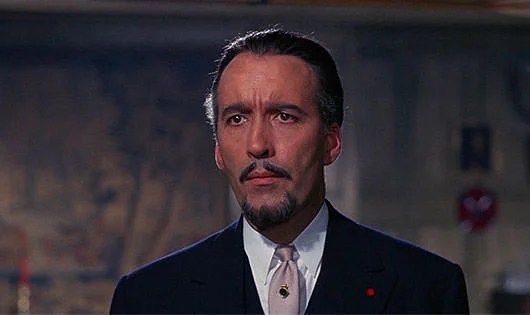
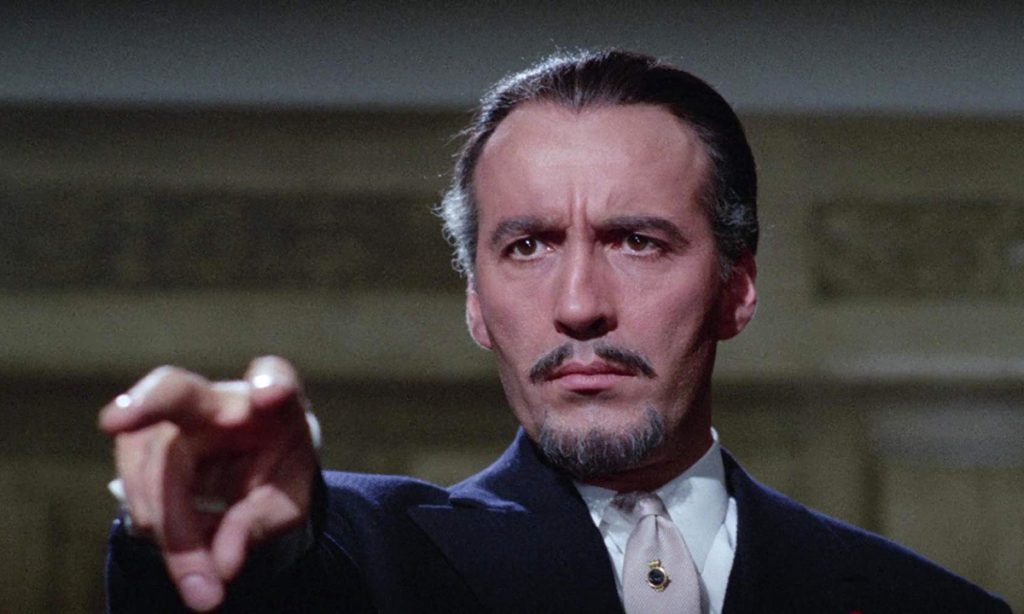
At the center of The Devil Rides Out stands Christopher Lee’s Duc de Richleau—arguably the most important character Hammer ever produced who was not a monster. Finally, the predator becomes the protector. After a decade of playing the “Other”—the silent Count, the lumbering Mummy, the tragic Creature—Lee is allowed to wield the cross rather than cower before it.
Richleau is not tormented. He is not conflicted. He does not arc. He already knows. This alone makes the film anomalous. Most horror thrives on the protagonist’s ignorance, but Richleau enters the story fully armed. He is a moral engineer who understands evil as a system rather than a temptation. When he enters the room and smells the odor of sanctity or detects the influence of the Left-Hand Path, he is not guessing; he is observing data.
This is charisma as authority. In a cultural moment increasingly hostile to certainty, Hammer casts Lee as a man whose confidence is necessity. The Devil exists. Cultists exist. Ritual magic works. And if you hesitate, you die. There is no room for irony here. The film demands belief as participation. Lee’s performance is anchored by a sense of urgency that drives the entire film. He knows that his friends, Simon and Tanith, aren’t just in danger of dying; they are in danger of being erased from the spiritual register.
Matheson and the Mechanics of the Miraculous
While the soul of the film belongs to Dennis Wheatley, its skeleton was built by the legendary Richard Matheson. Matheson, the author of I Am Legend, brought a sense of Scientific Occultism to the script. He stripped away Wheatley’s dense, often bloated prose and replaced it with a procedural urgency.
In the world of The Devil Rides Out, magic has laws. It is not a vague, spooky force; it is a metaphysical technology. Matheson establishes three critical rules that govern the film’s tension:
The Law of Consent: You cannot be taken by the Devil against your will; you must be seduced or tricked into the first step.
The Law of the Circle: A protective barrier is absolute unless breached from the inside by fear or doubt.
The Law of the Substitute: Once a power like the Angel of Death is summoned, it must take a soul. It is a cosmic debt that will be paid.
By establishing these rules, Matheson turns the horror into a high-stakes game of chess. This makes the film feel like an action movie. Every spell has a counter-spell. Every incantation is met with a specific preparation. It replaces the scream and run trope with stay and pray, turning the act of standing still into an act of supreme heroism.
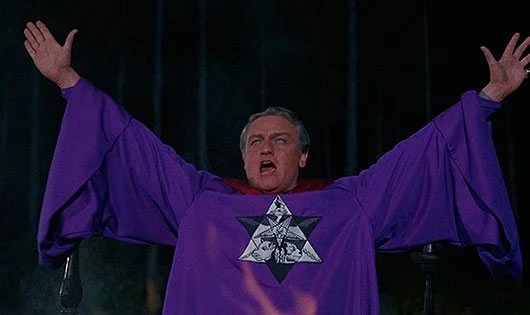
Charles Gray and the Domesticity of Damnation
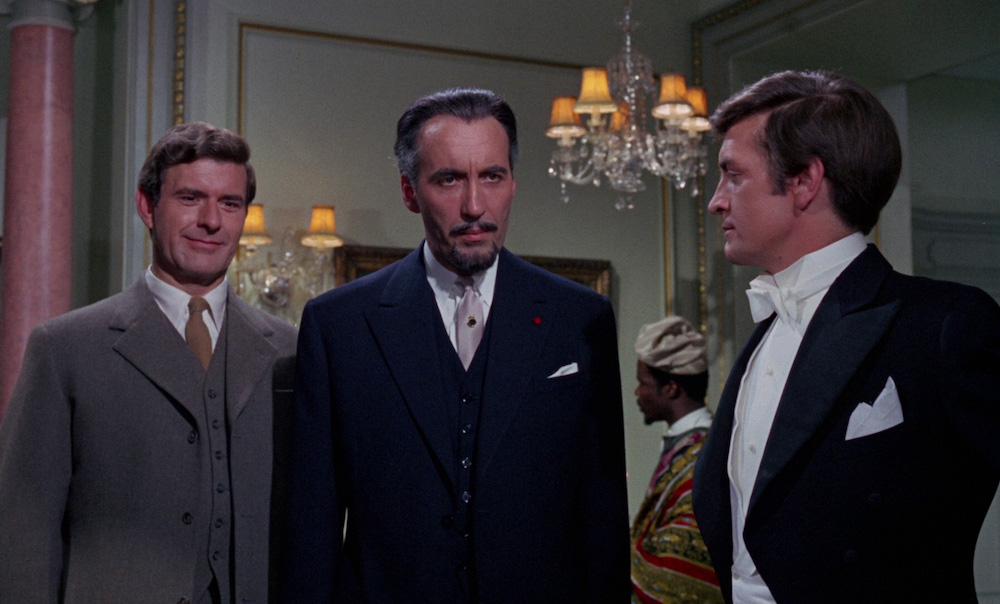
If Richleau is the High Priest of Order, then Charles Gray’s Mocata is the CEO of Chaos. Mocata as a far more dangerous villain than Dracula, The Monster, or any other creature or villain Hammer had put on the silver screen, and the reason behind this is because he is so domestic. He doesn’t live in a crumbling ruin; he lives in a well-appointed London townhouse. He doesn’t snarl; he speaks in soft, cultured tones. He is the Devil as a gentleman caller.
Gray’s performance is a masterclass in stillness. His power is purely psychological and telepathic. The scene where he visits Marie Eaton (Sarah Lawson) and attempts to hypnotize her while sipping tea is one of the most tense sequences in the Hammer canon. There is no blood, no chanting—just the sheer force of a predatory will.
Mocata represents the raw, terrifying reality of the cult leader: the man who can walk into your home and convince you that your children belong to him. He and Richleau are mirror figures—two men who believe completely, standing on opposite sides of a metaphysical line. The film’s horror emerges from the uncomfortable proposition: What if belief itself is the battlefield?
The Sabbat: The Devil on Salisbury Plain
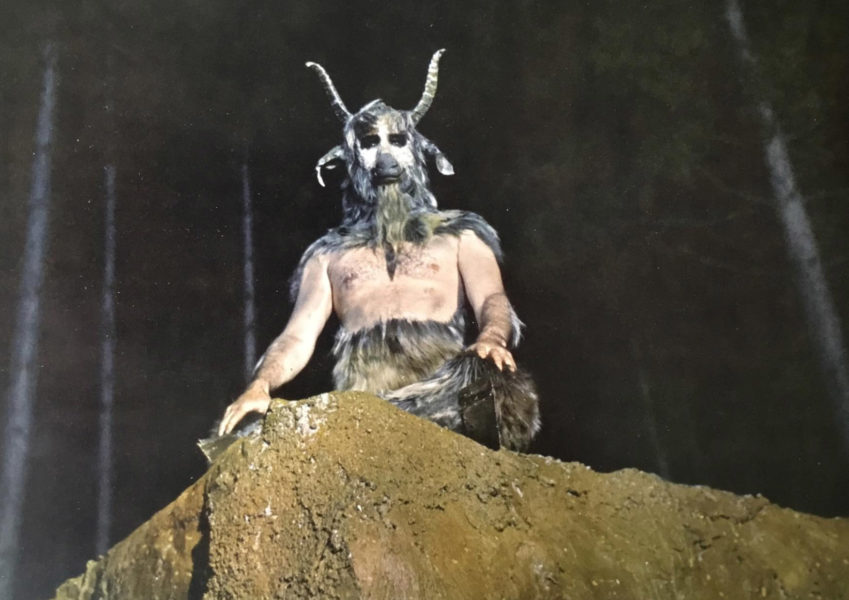
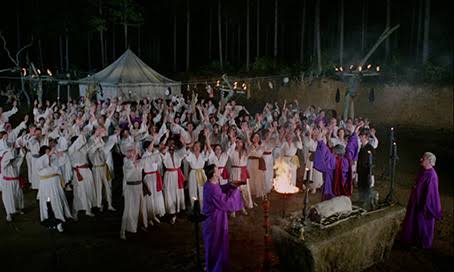
The center of the film—and its most visually audacious sequence—is the Sabbat on Salisbury Plain. Here, Terence Fisher captures the unholy energy of the gathering through rapid editing and a discordant score. These are not witches in the traditional sense; these are the elite of society—lawyers, doctors, politicians—shedding their masks to worship a primal force.
The Sabbat is a perversion of the social contract. Where the era saw magic as transgression and liberation, Hammer frames it as submission to a darker, more exacting master. The appearance of the Goat of Mendes is the moment the this magic takes physical form.
While you might find the 1968 special effects for the Goat a bit dated, the theological weight of the scene remains heavy. De Richleau’s interruption of the ritual—throwing a silver cross at the beast—is a moment of pure, righteous violence. It is the rejection of the abyss by the hand of the faithful. It is Hammer’s way of saying that some things should not just be tolerated; they must be banished.
The Pentacle: Horror as Obedience
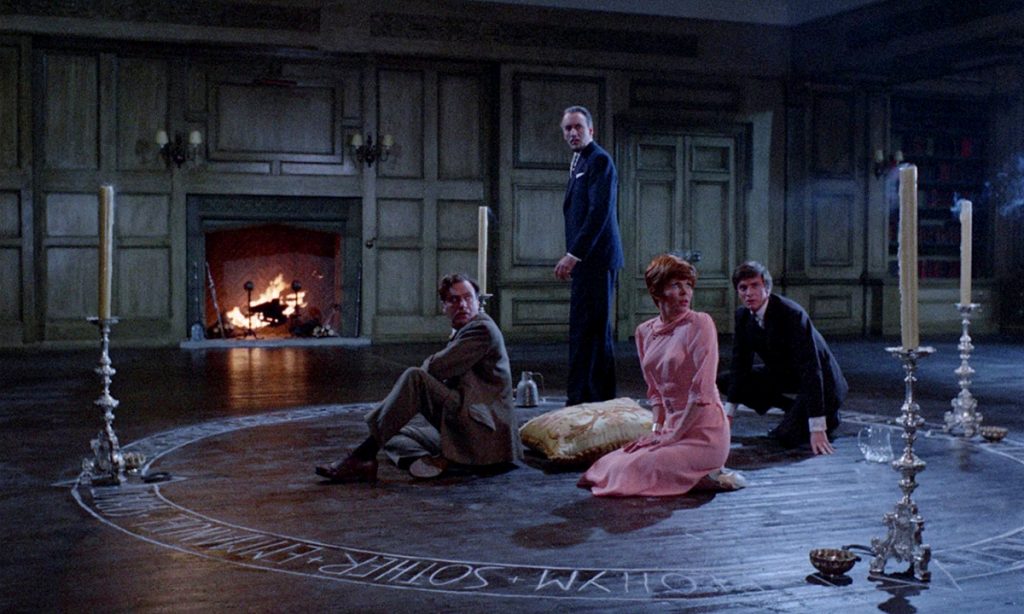
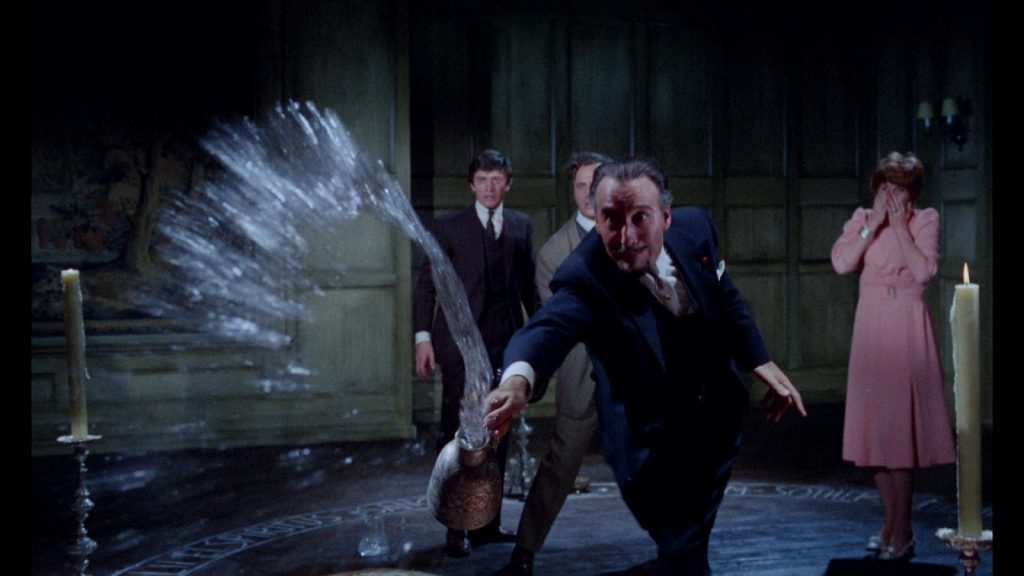
The film’s greatest achievement is the night spent inside the chalk circle. This is Hammer redefining heroism. Bravery here is not physical dominance; it is mental discipline.
The characters are trapped in a circle on the floor of a library, and for one night, that circle is the only thing standing between them and the void. The attacks on the circle are not physical; they are hallucinatory and psychic.
The arrival of the Angel of Death on horseback.
The appearance of a giant spider (a manifestation of the target’s specific phobia).
The voice of a lost child crying from the darkness.
These are glamours—tricks of the mind designed to make the defenders break the circle. Fisher uses the tight framing of the circle to create an unbearable sense of claustrophobia. The horror is in the wait. The Angel of Death is terrifying because it is inevitable. It cannot be fought with a sword; it can only be resisted through absolute adherence to the rules of the ritual.
There is something profoundly unmodern about this. In 1968, the world was being told to break the rules and expand your mind. Hammer told its audience to stay in the circle and close your mind to the lies of the shadow. It is horror as obedience.
The Ultimate Reset
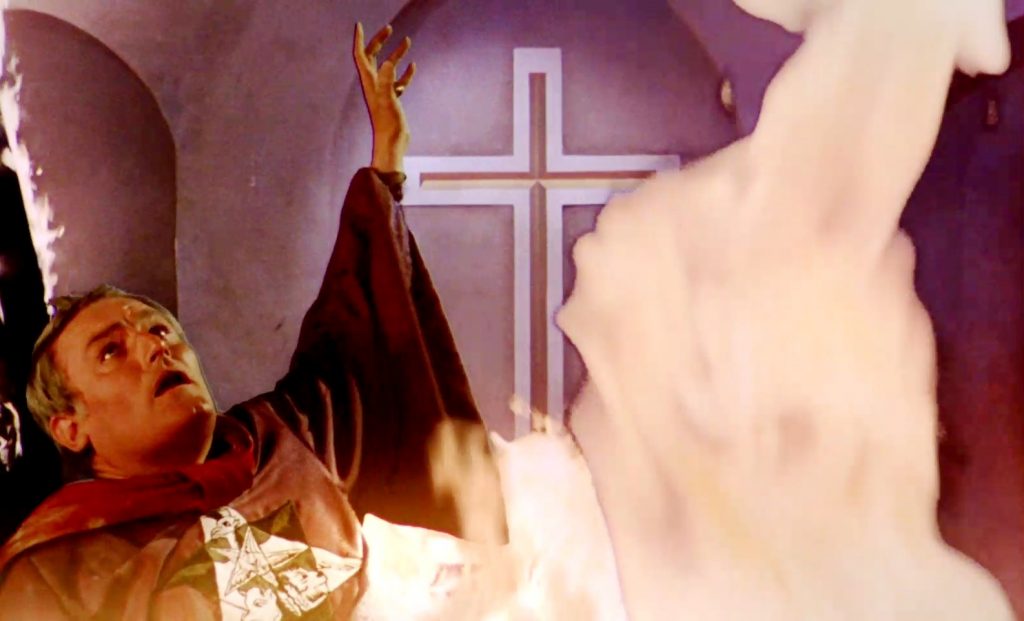
The climax of the film involves a time-slip and a divine intervention that many critics find confusing, but the fact is, it is the ultimate reset of the soul. When all seems lost, and the cult has kidnapped the child Peggy for sacrifice, the group performs the Suspiria de Profundis—the prayer from the depths.
This is where the film’s theological artillery is most apparent. The prayer triggers a reversal of time, a divine undoing that restores the lives of the victims and destroys the cult. It is a pyrrhic victory. The ending of The Devil Rides Out is one of the few Hammer films that offers a truly “happy” ending, but one earned through immense psychic trauma. The final image of the group standing in the light of the morning sun is a powerful testament to the theme of Restoration. Order has been returned, the intruders have been banished, and the flame of evil has been extinguished—for now.
Hammer vs. the World of 1968
To understand The Devil Rides Out, you have to place it against what horror was becoming. By 1968, American horror was turning inward. Romero stripped away mythology and replaced it with social collapse. Polanski turned pregnancy into paranoia. The old rules—priests, experts, saviours—were either useless or complicit.
Hammer goes the other way. This is a film where the expert is the hero. Where knowledge saves lives. Where faith is not oppressive, but protective. Where the universe is ordered—even if that order is hostile.
This is why the film feels so strange today. It is not ambiguous. It does not hedge its bets. It does not flirt with doubt. It insists that moral structure is real, external, and binding. In a sense, The Devil Rides Out is Hammer refusing to surrender. Rather than chase modern horror’s cynicism, the studio doubles down on metaphysical certainty. If the world is falling apart, the film argues, then belief must become firmer, not softer.
After this, Hammer would never again be this certain. They would spend the 70s chasing the modern and the sexual, but they would never again achieve this level of theological purity.
Final Thought: The Last Line of Defense
The Devil Rides Out is Hammer horror stripped of romance, stripped of decadence, stripped of ambiguity. What remains is belief as weapon, knowledge as armor, and evil as an organized force rather than a poetic tragedy. It is a film that refuses to flirt with doubt. It asks the audience not to question, but to choose sides.
In doing so, it becomes one of Hammer’s most intellectually provocative works—not because it reflects the chaos of its era, but because it rejects it entirely. This is not the sound of a studio adapting. It is the sound of a studio drawing a line.
And for one last, strange, defiant moment, Hammer stands its ground—salt circle intact—against the dark. It is the history of the human shadow written in chalk and blood, a reminder that the ride is never truly over—the Devil is always just one ritual away from the front door.
Leave a Reply