
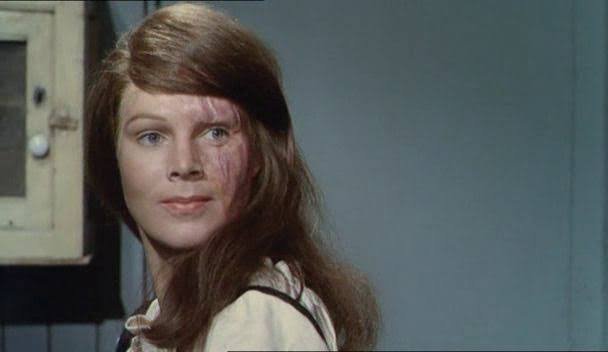
By 1967, the Hammer Frankenstein cycle stood at its most philosophical precipice. Following the commercial necessities of The Evil of Frankenstein (1964), the studio and, crucially, Terence Fisher and Peter Cushing, needed to return the series to its roots: not in the spectacle of electricity and muscle, but in the harrowing inquiry into the nature of life itself.
Frankenstein Created Woman is the sublime result. This film is a profound and melancholy meditation, trading the literal resurrection of corpses for the far more complex theological challenge of soul transference and psychic identity. It is widely considered Fisher’s most mature and arguably his most compassionate work for the studio, moving the focus away from the Baron’s hubris and toward the devastating consequences of his moral trespass. The monster here is not a shambling brute, but a beautiful, tormented being consumed by a soul that does not belong to her—a terrifying union of two separate, damaged identities.
The film is a stunning inversion of the Gothic form, using the familiar horror machinery to ask agonizing questions about redemption, justice, and whether the essence of a person can ever truly be manufactured.
The Unmaking of Identity: A New Creation
The film establishes its philosophical terrain not in the laboratory, but in the village tavern—the site of community, gossip, and judgment. We are introduced to the protagonists who will become the raw material for the Baron’s latest blasphemy:
Baron Victor Frankenstein (Peter Cushing): The genius, returned to a lower, quieter level of exile, obsessed not with brute power, but with the esoteric mysteries of the soul.
Dr. Hertz (Thorley Walters): The Baron’s new, essential collaborator, a physician working on the borderline of metaphysics, focusing on the moment of death.
Christina (Susan Denberg): A beautiful but painfully shy girl, emotionally fragile and physically scarred (due to a childhood injury). She is the village outcast, the victim of cruel mockery, but a figure of pure innocence and vulnerability.
Hans (Robert Morris): Christina’s fiercely protective, gentle lover, a waiter at the tavern who embodies loyalty and simple human goodness.
The central conflict is immediately and brutally established: Hans is framed for the murder of the abusive, bullying tavern owner, Klaus (Duncan Lamont). Despite the lack of evidence, Hans is swiftly executed by guillotine, a horrific sight witnessed by the distraught Christina. In her grief and madness, Christina drowns herself.
This tragic cascade sets the stage for the Baron’s most audacious experiment: using the new, intact, female body of Christina and the dying consciousness captured by Dr. Hertz, Frankenstein intends to house the executed soul of Hans in Christina’s resurrected form. The monster, for the first time in the series, is a perfect, anatomically complete woman, the horror residing entirely within her consciousness.
Fisher’s Philosophical Thesis: The Soul is Real
In the Fisher lexicon, science is never atheistic; it is always blasphemous. Fisher treats the soul not as an abstract concept, but as a real, measurable force—the last piece of divine creation that the Baron must steal. Dr. Hertz’s device, designed to capture the soul in the instant of death, is the sacred technology that allows the Baron to cross the final, untouchable barrier.
The transformation is instantaneous and complete. Christina is physically resurrected, stunningly beautiful, but mentally blank. The horror begins when the soul of Hans slowly asserts itself. This is the heart of the film’s moral question: If life is the product of science, and the essence is the product of divine theft, what entity has the Baron actually created?
The answer is devastating: He has created a creature of pure, fractured vengeance.
The new Christina is a terrifying duality:
Physical Form: Christina’s stunning, desirable femininity (the body of the victim).
Psychic Core: Hans’s executed, vengeful spirit (the soul of the innocent condemned).
The tragedy is twofold. She cannot be Hans, yet she is driven by his righteous rage. She is compelled by his soul to seek justice, but she possesses Christina’s social identity, making her a weapon aimed at the very people who tormented both her forms. The Baron’s creation is not a failure of biology, but a failure of psychic ethics.
The Wounded God: Peter Cushing’s Melancholy
Peter Cushing’s performance here, in what was Fisher’s final Frankenstein film, is his most subtle and arguably his most affecting. Gone is the cold, aristocratic arrogance that defined his earlier work. This is the Wounded God—a Baron weighed down by failure, exile, and a profound, quiet melancholy.
His motivation is no longer simple hubris. He is trying to resurrect his ambition, yes, but he is also attempting a complex act of intellectual salvation for Hans. He sees the unjust execution and believes science can provide the ethical correction that the flawed human justice system could not.
Cushing plays the Baron with an intense, paternal frustration. When the resurrected Christina/Hans begins her inevitable, vengeful rampage, the Baron is genuinely distressed, not by the scientific setback, but by the moral complexity of his failure.
His famous, definitive line from the film is not about life, but about essence:
Bodies are easy to come by, souls are not.”
This is the Baron’s ultimate confession: he accepts the supremacy of the non-material soul, even as he attempts to manipulate it. He proves that the spirit, even in a scientifically engineered vessel, demands its own justice.
Justice and Damnation: The Vengeance Ritual
The film cleverly uses the new creature’s duality to launch a terrifying, methodical vengeance plot. The men who tormented Christina (Klaus’s cohorts at the tavern) and the men who condemned Hans (the judges and tavern bullies) become the targets.
The killing spree is framed less as slasher violence and more as a ritualized, psychic execution. The creature, driven by Hans’s righteous anger, uses Christina’s sensual, beautiful form as a mask to lure her tormentors to their doom. The horror lies in the fact that the victims are punished by the very image of the vulnerability they once mocked.
Fisher brilliantly contrasts the creature’s elegant appearance (Susan Denberg’s stunning, silent beauty) with the brutal force of Hans’s fury. The true horror isn’t the knife, but the knowledge that the dead man’s soul is demanding justice through the living, resurrected body of his victimized lover. The murders are not random; they are moral scores settled.
This thematic focus transforms the film from a horror piece into a theological tragedy. The creature cannot find peace because its existence is an ethical paradox: the soul of a man cannot be happy trapped in the body of a woman, and a condemned spirit cannot be absolved until it has completed its vengeance.
The Silence of the Condemned: Christina and Fisher’s Compassion
Susan Denberg’s performance is central to the film’s success. It is a performance that suggests profound, confused suffering.
Fisher, often labelled as a master of terror, shows immense compassion for the creature in Frankenstein Created Woman. This creature is a victim twice over: first of the village’s cruelty, and second of the Baron’s scientific trespass. She is not evil; she is merely an instrument of tragic, historical justice.
The film’s visual poetry often lingers on Christina’s bewildered gaze, showing her struggling against the internal, masculine rage that guides her hands. This struggle—the battle between the soft, feminine body and the hard, masculine soul—is the most poignant element of the film. Fisher uses this psychological struggle to criticize the failure of society to protect its most vulnerable members. The true villain is not the Baron, who acted out of misguided principle, but the cruel, judgmental society that drove both Hans and Christina to their deaths.
The End of the Line: Theological Finality
Frankenstein Created Woman is the last Frankenstein film Terence Fisher would direct for Hammer. Fittingly, he ends his tenure with a climax defined not by explosions, but by profound, irrevocable resignation.
The Baron, realizing the catastrophic spiritual error he has committed, tries to stop the creature’s vengeance, but is powerless against the force of a justified, righteous soul. The Baron cannot kill his creation because, for the first time, he respects the soul contained within it.
The film’s ending is pure, shattering nihilism wrapped in elegant resignation. The creature, having fulfilled Hans’s vengeful destiny, chooses her own final act. She approaches the guillotine where Hans died, not to seek revenge, but to achieve peace. She leaps into the river, allowing the weight of the water and the philosophical contradiction of her being to end her agony.
The final scene provides no easy answer. The Baron is left alive, his work destroyed, but his moral lesson complete. He proved his scientific thesis—the soul can be transferred—but at the cost of ultimate tragedy. He is left alone with his genius and the devastating knowledge of the soul’s terrible power.
Final Thought: The Triumph of the Spirit
Frankenstein Created Woman is the pinnacle of the Hammer Gothic’s philosophical ambitions. It is a work of dark, profound existentialism that asks whether salvation is possible through science, and answers with a definitive, mournful no.
The film strips away the sensationalism to focus entirely on the sanctity of identity. It proves that the essence of a human being—the soul—cannot be manipulated, contained, or repurposed without catastrophic spiritual consequence. The creature is defined by its grief and its demand for justice, showing that the fire of the spirit, even after the body has been rebuilt, remains the final, unassailable truth.
It is a masterpiece of melancholy and high tragedy—Fisher’s final, devastating sermon on the impossibility of defying God, not through simple biological failure, but through the fatal, complex intrusion into the private world of the human soul. The experiment failed, but the film succeeded, leaving behind an indelible mark on the landscape of cinematic horror.
Leave a Reply