If you grew up in the UK during a certain era, your education didn’t happen in a classroom with a dusty chalkboard and a teacher who smelled like cabbage. No, your real education happened on Channel 4, late at night, while your parents were out doing their level best to support the local brewery industry. For me, the curriculum was set one fateful night: a double-bill of Blood from the Mummy’s Tomb and the urban firestorm of Coffy.
I was eleven-ish. I was impressionable. And within four hours, my type was set in stone for the rest of my natural life. We’re talking Amazonian goddesses, towering figures of power who could either kiss you or snap your neck like a dry twig, and frankly, at eleven, I wasn’t picky about which one came first. But while Coffy was a revolution in street justice, Blood from the Mummy’s Tomb was something weirder, sexier, and far more gothic. It took the tired, dusty trope of the shuffling mummy and threw it into a blender with 70s occultism and the sheer, gravitational pull of Valerie Leon.
Curse of the Production
Before we even touch the plot, it’s worth saying this upfront: the movie existing at all is a minor miracle. Most Hammer flicks were shot on a shoestring with a “let’s just get it done” attitude, but Blood was haunted from day one. Original director Seth Holt, the director of the Bette Davis thriller The Nanny, dropped dead of a heart attack with a week of filming left. While Peter Cushing, the king of classic horror, had to withdraw early in the shoot because his wife was gravely ill.
Most movies would have folded. But Blood is like its titular Queen Tera: it refuses to stay buried.
Hammer producer Michael Carreras stepped in to complete the film after Holt’s death, and the result is this jagged, hallucogenic masterpiece that feels like it’s actually decaying while you watch it. It has a rawness most Hammer sequels lack because it feels genuinely dangerous. This isn’t disposable pulp; it’s a high-wire act of desperation and brilliance.
The Goddess Manifest: Valerie Leon
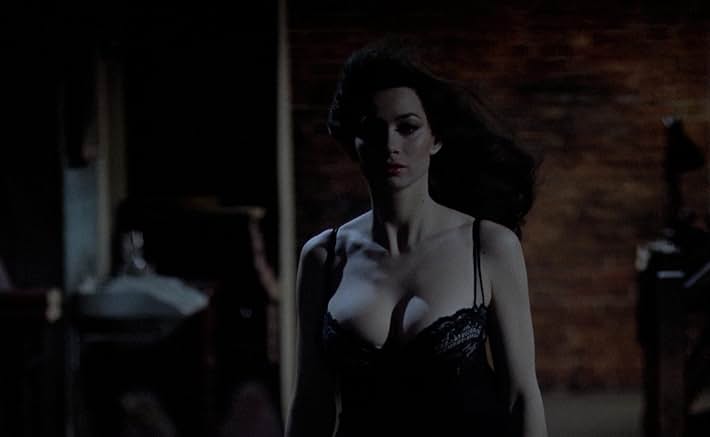
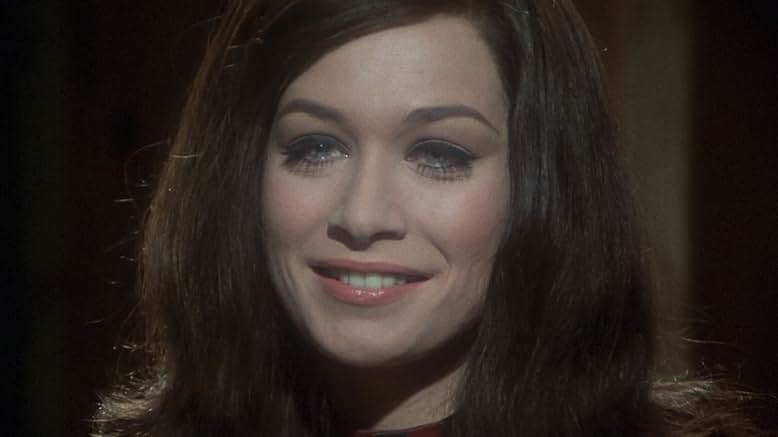
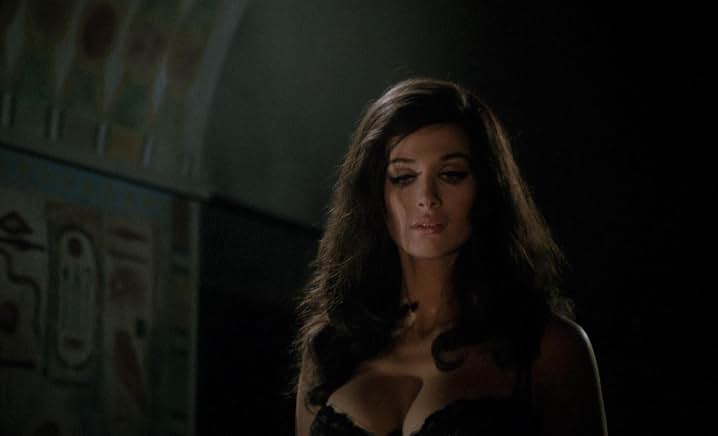
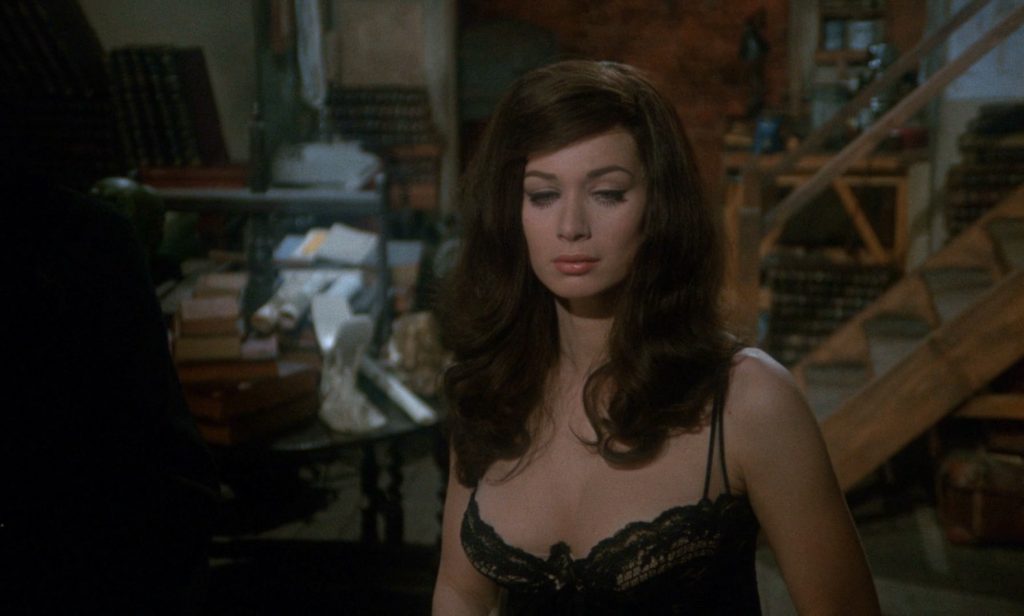
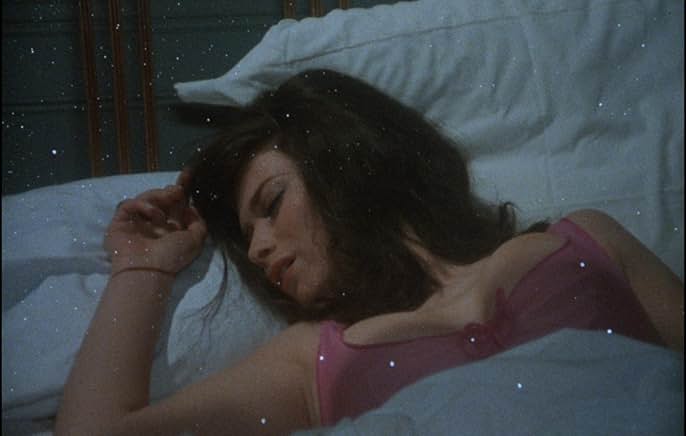
Let’s stop pretending we’re here for the archaeology. We are here for Valerie Leon. In 1971, Valerie didn’t just walk onto a film set; she occupied it like a sovereign nation. Standing a head taller than most of her male co-stars and possessing a screen presence that can only be described as sublime amazonian authority, she plays two roles here: the modern, wide-eyed Margaret Fuchs and the ancient, blood-thirsty Queen Tera.
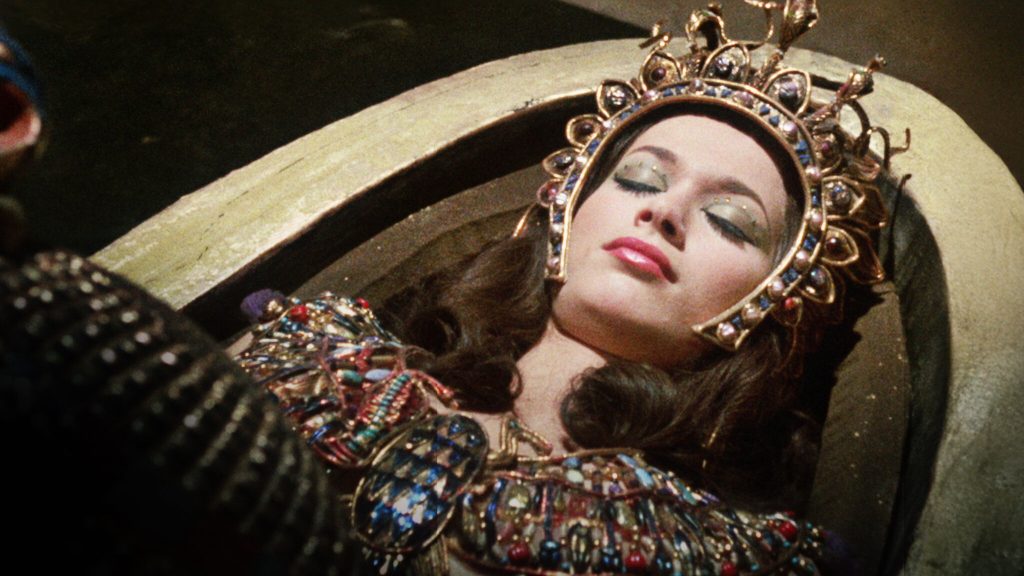
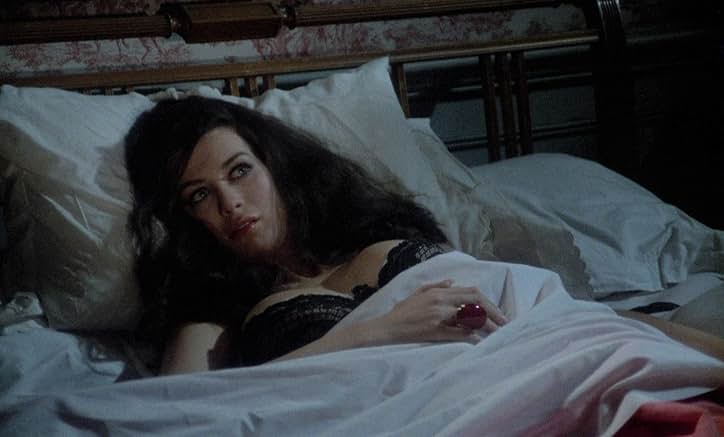
This was the defining moment of my youth. Watching her as Tera, lying perfectly preserved in a sarcophagus for thousands of years, not wrapped in stinking bandages like a commoner, but looking like she just stepped out of a high-end spa, was a total brain-scrambler. When she speaks as the Queen, her real power isn’t in the words, it’s in her stare. She has The Look. It’s a look that says, “I have outlasted empires, and I will outlast you.”
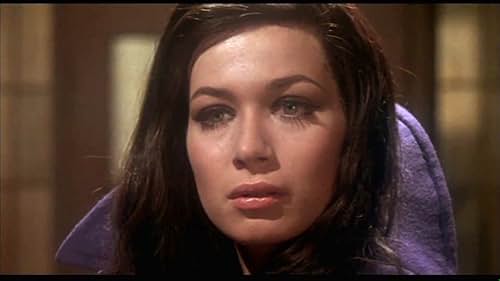
For a kid watching this while the house was empty and the streetlights were buzzing outside, Valerie Leon set the standard from that night on. She wasn’t a scream queen waiting for a man to save her. She was raw power. Even as Margaret, she’s the one holding all the cards, the one the ancient world is reaching out to claim. She holds the movie together with her sheer presence.
The Plot: Jewelry, Severed Limbs, and Bad Parenting
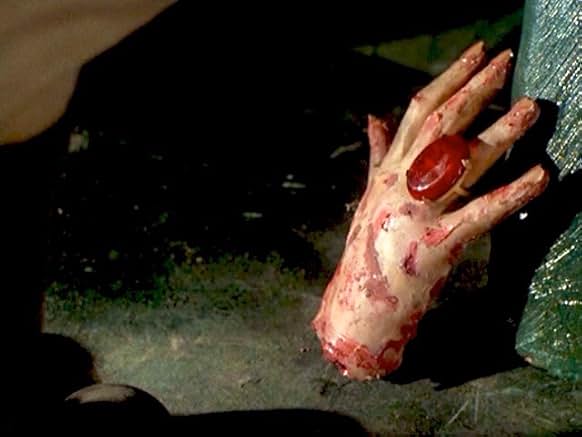
The story is loosely inspired by Bram Stoker’s novel The Jewel of Seven Stars, which is basically Victorian speak for “Don’t Touch My Stuff.” We start with an expedition to the tomb of Queen Tera. The explorers find her looking suspiciously fresh, and because they are British colonial idiots, they remove the severed hand of Queen Tera to claim the ruby ring on it.
The Blood-Red Shock: Here’s where things get gloriously messy. The hand doesn’t just fall off; it bleeds. Bright, Technicolor Hammer Red. Thousands of years in a dry-as-dust tomb, and she’s still got the circulation of a marathon runner. It’s glorious, pure, over-the-top absurdity that proves Hammer was still the reigning monarch of gothic horror.
Fast forward to 20th-century London. Margaret (Valerie Leon) is having nightmares. Her dad, Professor Fuchs (played by the wonderfully gravel-voiced Andrew Keir), has basically turned their basement into an Egyptian hoarders’ paradise. He gives Margaret the stolen ruby ring for her birthday. Great gift, Dad. Really tops a bike or a chemistry set. Suddenly, the old explorers start dying in ways that involve a lot of screaming and even more of that signature Kensington Gore.
Rituals and Rubies
This is where Hammer shows its teeth. As I’ve stated elsewhere on this site, by 1971, Hammer knew they had to compete with the grittier, nastier horror coming out of the US and Europe.
Blood from the Mummy’s Tomb doesn’t shy away.
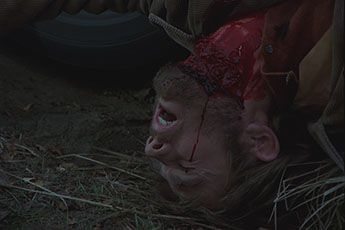
One by one, the men who desecrated Queen Tera’s resting place are picked off. It’s a whirlwind of vengeance. One guy gets his throat ripped out by an invisible force. Another loses his mind. The violence isn’t exploitative for the sake of it; it feels like the universe is correcting a mistake. Every time someone dies, we get a shot of Tera’s severed hand, still bleeding, still waiting to be reunited with its owner. It’s horror with pedigree, bloody, bizarre, and brilliant.
The Aesthetics of the 70s Occult
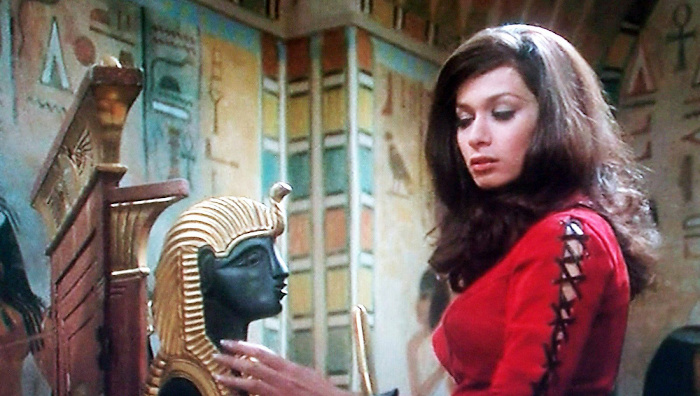
The movie is a visual feast for the soul. The Fuchs house is a masterpiece of production design. It’s all heavy velvet and stolen artifacts that look like they’re humming with cursed energy. It creates an atmosphere that contrasts perfectly with the tomb-bound, shadowy flashbacks to Egypt.
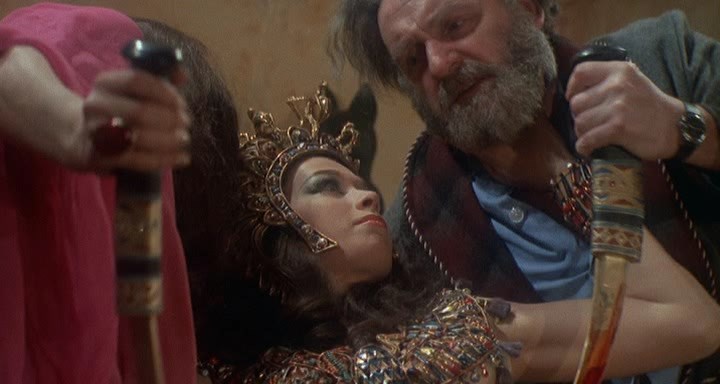
And can we talk about the makeup? The heavy 70s eyeliner and stylized features on Valerie Leon as Tera give her a cosmic, otherworldly presence, practical, tactile, and far more immediate than any modern CGI could achieve. You can see the texture of the skin, the sparkle in the eye, the physical weight of the jewelry. It’s a tactile movie. You can almost feel the desert sand and the cold London skies.
The Amazonian Template: Leon vs. Grier
I have to go back to that double-bill. If you’re an eleven-year-old kid watching Blood from the Mummy’s Tomb and then Coffy immediately after, you aren’t just watching movies; you’re undergoing a psychological recalibration.
Valerie Leon represented the classic Amazon; regal, mystical, and seemingly carved from marble. Pam Grier represented the modern Amazon; gritty, fierce, and packing a shotgun. Both were women of incredible physical stature and unshakeable will. They didn’t fit into the damsel or villainess box, Valerie Leon was imperious and untouchable, while Pam Grier was a streetwise antihero, taking justice into her own hands. They were just… more.
That night set the template for everything I ever wanted from a woman. I wanted someone who could lead an army or handle a curse without breaking a sweat. Someone who looked like they belonged on a throne or at the head of a revolution. Blood from the Mummy’s Tomb didn’t just give me a horror movie; it gave me a standard.
The Basement of Never-Ending Chaos
The finale tears the basement apart in a riot of ritual and madness. Professor Fuchs decides the only way to save Margaret is to fully resurrect Tera. It’s a science experiment mixed with ancient sorcery. The walls are crumbling, the wind is howling inside the house, and everything is going to hell in a handbasket.
The ending doesn’t pull any punches. Hammer was done with all the tidy ‘hero saves the day’ nonsense and went full-on nightmare ballet. Without giving the punchline away, it leaves you staring at something both gorgeous and utterly wrong. It’s the universe shrugging and saying ‘Some things just can’t be buried.’
The Nuts, Bolts, and Blood of Hammer
The Severed Hand: A recurring visual that’s equal parts grotesque and mesmerizing. The way it’s filmed, lying on a velvet cushion like a piece of jewelry, is pure Hammer.
The Score: Tristram Cary’s music is a rhythmic, percussive nightmare. It doesn’t rely on cheap stings; it builds a sense of inevitable doom that fits the vibe perfectly.
The Reincarnation: The movie plays with the idea of identity in a way that’s actually pretty sophisticated for a creature feature. Is Margaret becoming Tera, or was she always Tera? Valerie Leon plays that ambiguity perfectly.
The Channel 4 Legacy
Hats off to the genius behind that Channel 4 lineup. They weren’t just showing movies; they were orchestrating an experience. They knew that the energy of Coffy and the dread of Hammer belonged together.
For a kid whose parents were out drinking, that television was a window into a world where women were powerful, the past was dangerous, and blood was always bright red. It’s a memory that has stayed with me for decades. Every time I see a movie with a statuesque leading lady, I’m eleven years old again, sitting in the dark, watching Valerie Leon breathe life into a five-thousand-year-old corpse.
Why It Outshines the Rest of the Mummy Pack
Let’s be honest: most Mummy movies are boring. Once you’ve seen one guy in bandages walk slowly toward a screaming girl, you’ve seen them all. But Blood from the Mummy’s Tomb is the razor-sharp tip of the Hammer horror spear. It throws out the bandages. It throws out the slow walking. It gives us a Mummy who looks like a supermodel and acts like a god.
It’s cinema that dares to break every rule in the Mummy rule book. It’s Hammer shaking off the old cobwebs for a new decade, and while the fancy critics sneer, for me it’s pure, untamed classic horror. It’s a movie that understands that the most frightening thing isn’t a monster in the closet; it’s the realization that you are being replaced by a version of yourself from a billion years ago.
Why I Love It
Valerie Leon is the 12th Wonder of the World. Her performance in this movie, and specifically the way she commands the screen, is the reason I’m still talking about it. She is the core of the film. Without her, it’s a weird, disjointed horror flick. With her, it’s a pagan ritual that demands your attention.
She and Pam Grier are the twin pillars of my cinematic upbringing. They taught me that Amazonian isn’t just a physical trait; it’s an aura. It’s the ability to hold the gaze of the audience and never let go.
It’s the movie that turned an eleven-year-old kid into a lifelong fan of screen goddesses who bend worlds to their will. It’s the reason I’ll always have a soft spot for bright red fake blood and heavy eyeliner. It’s a reminder that sometimes, when your parents are out pissing the mortgage payments up the wall, the best thing you can do is turn on the TV and let a five-thousand-year-old Queen tell you how the world really works.
Long Live the Queen.
Valerie Leon, if you’re out there, thank you for the education. And to the programmer at Channel 4 in 1980-whatever? You’re a goddamn hero.
Leave a Reply