By 1965, the Gothic machinery of Hammer Films, which had once felt like a bold revolutionary engine, now risked becoming a repetitive ritual. Audiences, glutted on blood and capes, were demanding a different kind of terror—one closer to home, stripped of historical distance and supernatural alibis. The genre had been redefined by Alfred Hitchcock’s Psycho (1960), which proved the most disturbing monsters wore ordinary clothes and lived in ordinary houses.
Hammer responded by shedding the musty velvet of Bray Studios and embracing the sterile, linoleum dread of contemporary London with The Nanny. This film, directed by the tense, focused hand of Seth Holt (who had previously delivered the brilliant Scream of Fear for the studio), arrived not as another costume drama, but as a chilling, black-and-white exercise in domestic paranoia. It was Hammer’s deliberate, if temporary, rejection of the castle for the contemporary council flat, trading in the philosophical dread of damnation for the immediate, sickening terror of the dysfunctional family.
The result is a masterpiece of psychological confinement and ambiguity—a film where the monster is not a creature from the crypt, but the very source of comfort and security. It is Hammer confronting the fact that the true horror of the 1960s was not ancient evil, but the failure of the domestic ideal.
The Unmaking of Home
The film begins with a jarring, uncomfortable premise: the return of Joey Fane (William Dix), a disturbed ten-year-old boy, from a reform school for “maladjusted children.” He has been committed there for two years, following the death of his younger sister, Susy.
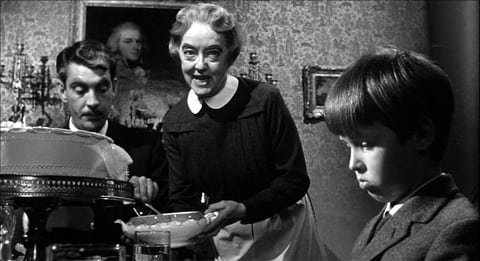
From the moment Joey steps into the beautiful, yet suffocating, London home, he embodies pure, articulate resentment. He refuses to eat the Nanny’s food, he sabotages his room, and he declares loudly to anyone who will listen that the live-in Nanny (Bette Davis) is a murderess who killed Susy and is now plotting to kill him.
The setting is crucial. This is not the misty, dangerous foreign landscape of Transylvania; this is a tidy, middle-class London home, impeccably maintained. The horror is sourced not from external, supernatural forces, but from the poisoned atmosphere of the family unit. The house, usually a sanctuary, becomes a prison, meticulously controlled by the very figure meant to provide unconditional love.
The architecture of the Fane home, with its dark stairwells, heavy furniture, and claustrophobic corridors, becomes a physical manifestation of Joey’s emotional confinement. Every polished surface hides a deep, psychic wound. Hammer, long masters of the Gothic castle, proves adept at rendering the modern home as a place of equally pervasive dread. The monster has traded the subterranean crypt for the quiet privacy of the locked bedroom door.
The Queen of Denial: Bette Davis’s Calculation
The casting of Bette Davis was a profound, calculated coup for Hammer. A genuine, undisputed American screen legend, Davis brought instant transatlantic credibility and, more importantly, a pre-existing persona defined by psychological intensity and sharp-edged vanity. Her presence in a Hammer film signalled that this was serious, prestige terror, a deliberate nod to the “Psycho-Biddy” subgenre she had helped define with What Ever Happened to Baby Jane? (1962).
Davis’s performance as the Nanny is a clinical study in controlled performance and devastating menace. She plays the perfect, gentle, selfless caregiver—the visual epitome of stability and maternal devotion. But beneath the starched uniform and the gentle, humming singing, there is a steel rod of calculation. She is immaculate, precise, and subtly terrifying.
The film hinges entirely on the ambiguity she projects. Is Joey a genuine, violent psychopath, manipulating his parents to get rid of the woman he blames for his sister’s death? Or is the Nanny a monstrous hypocrite, hiding a dark secret behind her façade of benevolence?
Davis masters this duality. Her eyes, often magnified and softened by her glasses, convey deep, convincing sorrow, only to snap shut with terrifying efficiency when faced with Joey’s rebellion. She embodies the classic Hammer villain stripped of the Gothic disguise: the moral corruption is no longer hidden beneath a velvet cloak, but beneath a respectable, domestic uniform. The true horror is watching someone capable of immense cruelty perform perfect, tireless virtue.
Seth Holt’s Clinical Eye: Horror Without Blood
Director Seth Holt approaches the material not with the lurid colors of a Hammer Gothic, but with the cold, clinical distance of a documentarian. Shot in stark black-and-white, The Nanny benefits from the lack of Technicolor distraction, forcing the audience to focus solely on the psychological terrain. The horror is intellectual, built entirely through pacing, shadow, and the mounting suspicion of the viewer.
Holt uses tight framing, close-ups on hands, and deliberately claustrophobic shots to mirror the boy’s increasing paranoia. The camera becomes Joey’s frantic, unreliable eye. The pacing is slow, deliberate, and agonizing—a marked departure from the rapid violence of a traditional slasher film. Holt understands that true dread is sustained, not instantaneous.
The film’s atmosphere is defined by domestic displacement. The most terrifying set pieces occur in banal locations: the bathtub, the hallway, the kitchen table.
The scene where Joey throws an actual rat into the bathtub to frame the Nanny is not shocking because of the rat, but because of the sheer malice of the boy, forcing the viewer to constantly question his sanity.
The sequence where the Nanny forces a crying Joey to eat the food he has been hiding and hoarding becomes an unbearable display of passive-aggressive cruelty. It is a moment of control and humiliation far more chilling than any overt knife attack.
Holt’s direction makes the film feel less like a manufactured horror film and more like a tragedy unfolding in real-time, the tension drawn taut until the final, shocking revelation.
The Collapse of the Family Unit: The Real Monster
The film’s true power lies in its unforgiving critique of the post-war nuclear family. Joey’s mother, Virginia Fane (Wendy Craig), and his father, Bill Fane (James Villiers), are not monsters, but they are catastrophically absent. They are too self-absorbed, too emotionally fragile, and too reliant on the Nanny to function as true parents.
Virginia is an hysteric, consumed by her own grief over Susy and incapable of connecting with her surviving son. Her belief in the Nanny’s competence is absolute, bordering on self-neglect.
Bill is weak and emotionally distant, unable to confront either his son’s accusations or his wife’s fragility. He relies on money and external services (the reform school, the Nanny) to solve deep-seated emotional problems.
The Fane parents are the modern equivalent of the absent, ineffectual authority figures in the Gothic castle, but here, their failure is ordinary and therefore more damming. They have hired their morality and their maternal instincts out to a third party, and that third party is quietly destroying their child.
The film argues that the “evil” is not solely the Nanny’s crime, but the environment of denial and emotional abandonment that created the conditions for the crime to be committed and then hidden. The terror is rooted in the utter lack of authentic love and attention.
The Unmasking: Ambiguity and Inversion
For the first two acts, The Nanny sustains its tension through ambiguity: Is Joey mad, or is the Nanny murderous? This central question keeps the audience tethered to Joey’s viewpoint, experiencing his panic and isolation.
The final act provides the devastating answer, confirmed through a series of flashbacks that reveal the Nanny’s true history and the events surrounding Susy’s death. The reality is shocking not just for its violence, but for its banality and tragedy.
The Nanny suffers from an unbearable, deeply buried emotional trauma linked to the death of her own illegitimate daughter years before. Susy’s accidental death in the Nanny’s care—when the Nanny’s fractured psyche briefly snapped under the weight of her past—is a moment of horrifying, impulsive cruelty rooted in a lifetime of repressed guilt and shame.
This twist is a crucial inversion of the Hammer Gothic formula:
The Villain is Tragic: The Nanny is not a devil-worshipper or a vampire; she is a deeply wounded woman whose sanity has failed under psychological pressure. Her evil is not theological; it is psychological and historical.
The Child is Right: Joey’s paranoid claims are entirely accurate. The film validates the child’s perspective, proving that the world of adult stability is a terrifying lie.
The final confrontation, culminating in the Nanny’s emotional breakdown and eventual institutionalization, lacks the spectacular, fiery climax of a Dracula or Frankenstein film. It is quiet, contained, and desperately sad—a chilling comment on the inevitable fate of the monster in the modern age. The horror is over, but the emotional scars remain permanent.
Hammer’s Shifting Identity: Trading Blood for Doubt
The Nanny is not Hammer Gothic; it is Hammer Clinical. It demonstrates the studio’s savvy attempt to remain relevant in the mid-1960s, a period dominated by American realism and psychological tension. By bringing in a star of Bette Davis’s caliber and embracing the domestic thriller structure, Hammer managed to:
Diversify its Brand: Proving it wasn’t chained solely to period pieces, allowing it to appeal to a wider, more contemporary audience.
Deepen its Themes: Shifting the focus from the sins of the past (Frankenstein) to the sins of the contemporary family (abandonment, denial, psychological trauma).
Final Thought:
The Nanny is not the film Hammer wanted to make, but the film the 1960s demanded. It is a necessary, clinical amputation of the studio’s reliance on the Gothic crutch.
Its power rests not in the lurid spectacle of ancient evil, but in the sickening clarity of modern failure. The film exposes the terrifying truth that the most destructive monsters are not found in the crypts of Transylvania, but in the emotional void of the contemporary, middle-class home. Bette Davis’s immaculate white uniform is far more chilling than any velvet cape because it hides a recognizable, systemic betrayal—the corruption of trust.
The film may lack the theological grandeur of a Fisher epic, but it gains something darker: a profound, inescapable sense of domestic damnation. It proves that when the bedrock of the family unit collapses through denial and neglect, the resultant evil is far more insidious and much harder to exorcise than any vampire.
The Nanny is Hammer’s cold, sharp verdict on the modern age: when the parents abdicate their duty, the true horror always comes home.
Leave a Reply