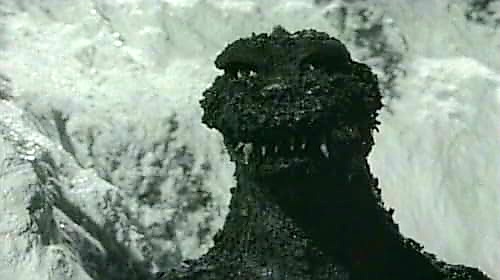
Forget the neon-drenched, hollow-earth acrobatics of the 2020s for a second. To truly understand the transformation of the King of the Monsters from political warning to arse whupping badass, we have to travel back to 1955. Just one year after the original dropped like an atomic bomb on global cinema, Toho gave us Godzilla Raids Again (or Gigantis the Fire Monster, if you grew up with the butchered American dub).
This isn’t just a sequel; it’s a parade of firsts. It’s the first time Godzilla fought another monster. It’s the first time we saw the city-leveling destruction rendered in a gritty, documentary-style black and white that feels more like a war film than a creature feature. In the cold light of 2026, Godzilla Raids Again is a raw, unpolished look at a franchise finding its teeth.
So let’s head straight into the trenches of the Showa era, as we examine every smashed miniature, every gallon of sweat inside those monster suits, and every wild decision that made this sequel such a beautifully chaotic beast.
The Day Two Monsters Met
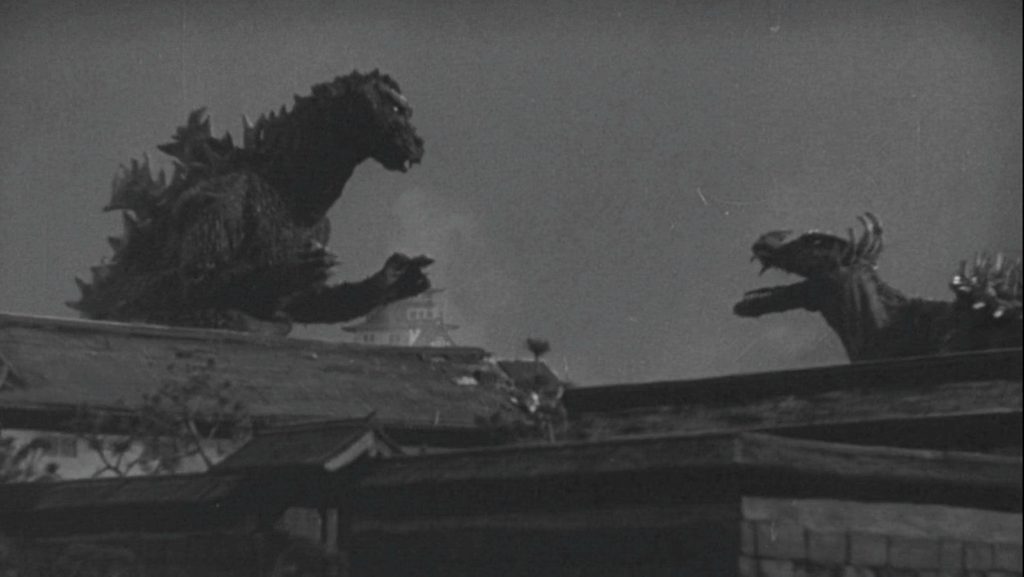
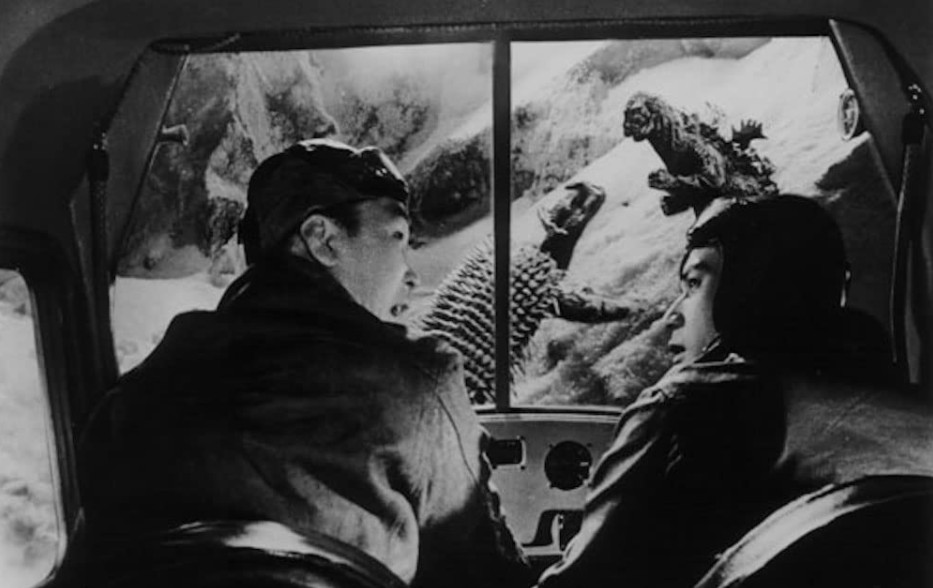
The movie starts with a total lack of preamble. We don’t get twenty minutes of scientists arguing in a boardroom or a slow buildup of mysterious footprints. Instead, we follow two scout pilots for a tuna cannery, Tsukioka and Kobayashi, who are just trying to do their jobs in the post-war Japanese economy. The film opens with a bird’s-eye view of the ocean, establishing a sense of scale, which is pretty important when you are trying to convince your audience that what they’re watching are two titans in the middle of an epic smackdown and not just two fellas trying their best not to fall over the scenery in heavy rubber suits. When Kobayashi gets stranded on a remote, jagged rock called Iwato Island, his partner makes a landing to save him.
However, while they nose around their new surroundings they don’t find a lost tribe or a mysterious temple; they find two nightmares locked in a death match. This is the moment that changed everything: the introduction of Anguirus. Anguirus isn’t a god or a space alien; he’s an ankylosaurus on steroids. Watching these two behemoths tumble into the ocean while the pilots look on in horror sets the tone for the entire film. There’s no explanation needed, this is nature red in tooth and claw, and humans are just the caught in the middle. The shock on the pilots’ faces mirrors the audience’s: the world just got a lot more crowded, and the rules of the first film have been shredded.
The Birth of the ‘Vs.’ Formula
In the original ’54 film, Godzilla was a walking metaphor for the ‘A’ bomb, a shadow of doom. In Raids Again, he becomes a brawler. The suit acting in this film is legendary among the Godzilla community because the battle scenes were filmed at altered speeds, giving the monsters a jittery, high-speed aggression that feels genuinely dangerous.
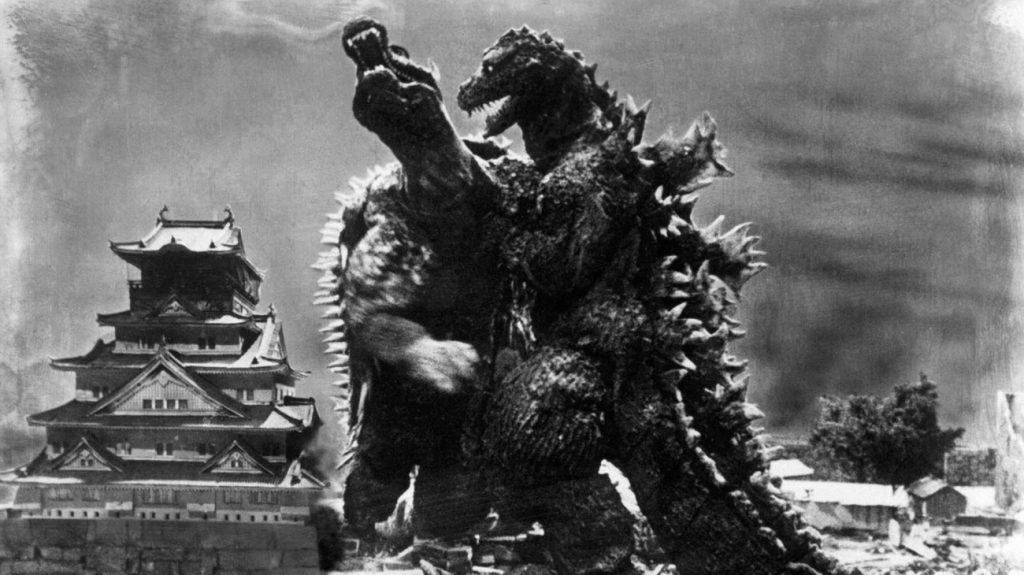
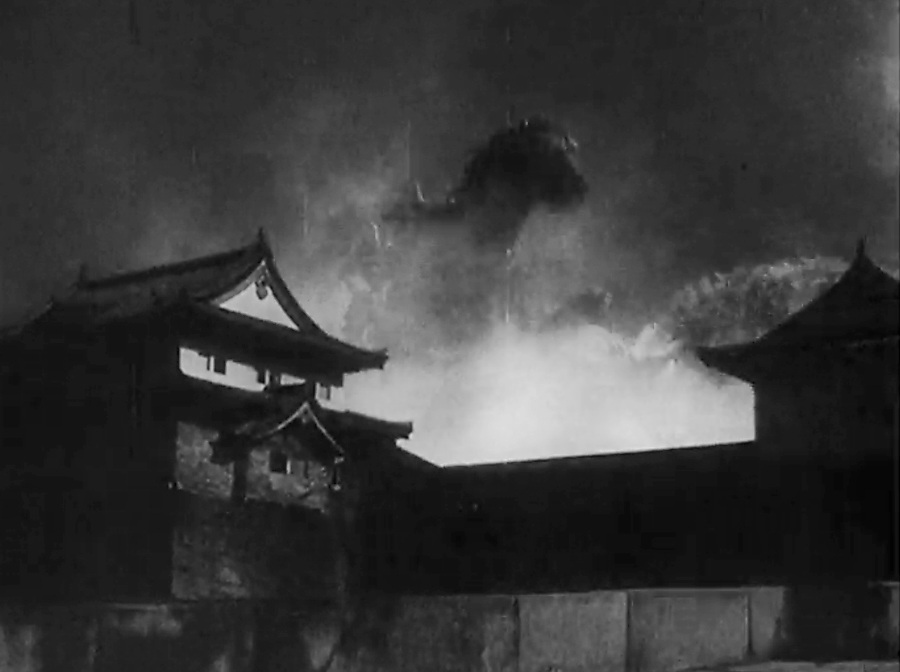
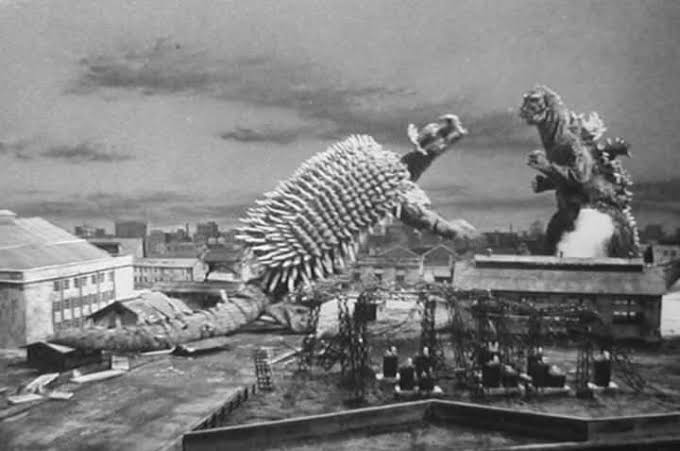
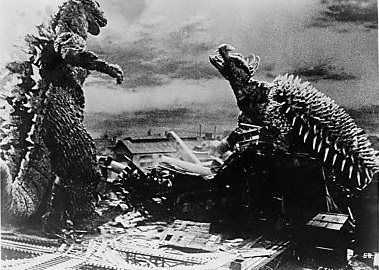
When Godzilla and Anguirus finally bring their beef to the streets of Osaka, it isn’t the choreographed wrestling of the 70s Godzilla movies. It’s a fucking street fight. They bite necks. They slam into landmarks. They behave like animals. There is a nastiness to the way Anguirus lunges at Godzilla. When Osaka Castle collapses, it’s one of the film’s signature effects moments, an elegant miniature reduced to wreckage in seconds. Scenes like this quietly set the template the genre would follow for decades. This is the when Toho realised that one monster is scary, but two monsters fighting in your backyard is a riot. The way Godzilla eventually overcomes Anguirus, mauling his throat before torching the body with atomic breath, is a level of brutality the series would gradually leave behind as the films shifted toward younger audiences.
The Beauty of Osaka in Flames
Director Motoyoshi Oda might not have the prestige of Ishirō Honda, but he brings a realism to the destruction. Because the film is in black and white, the night scenes in Osaka feel like something out of a film noir. The shadows are deep, the fire is bright, and the intensity of the city’s evacuation feels terrifyingly real.
Oda treats the monster attack like a blackout air-raid. The city goes dark to avoid attracting the beast, but human error (in the form of a massive fire started by criminals) acts as a flare. The visual of Godzilla’s silhouette illuminated by a burning industrial district is pure poetry. It creates a sense of dread that the later color films struggled to replicate. You can almost smell the smoke and the salt water. The black-and-white photography hides the seams of the suits and the wires of the miniatures, making the whole experience feel like authentic documentary footage of an impossible catastrophe.
The Escaped Convicts: Japan’s Three Stooges
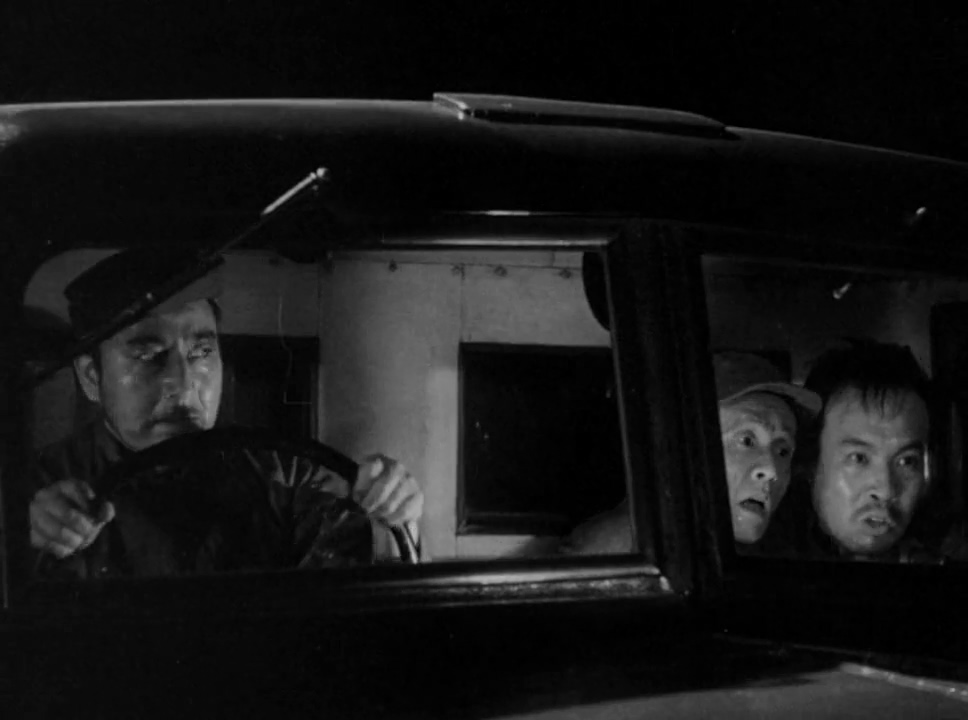
There is a bizarre, yet brilliant, subplot involving a group of escaped convicts who hijack a truck during the monster alert. Their involvement is a reminder that in a Godzilla movie, human stupidity is often just as dangerous as a massive beast stomping on the local church. As they flee the police, they crash into an oil refinery, inadvertently starting the massive blaze that draws Godzilla into the heart of Osaka.
Some might call this subplot filler, but for me, the convicts’ bumbling chaos turns Osaka into a perfect storm. The convicts represent the turmoil of the post-war era, men who don’t care about giant lizards, only about their own survival. Their accidental sabotage is a classic narrative trope that gives the monster a reason to stop lurking and start smashing. It’s filmmaking that straddles crime thriller and kaiju epic, giving the human characters just enough to do while the monsters gear up for Round 2.
The Tragedy of Kobayashi: A Hero’s End
While the classic Godzilla movies often focus on scientists in lab coats or generals in bunkers, Raids Again is about the working class. Kobayashi, the pilot who just wanted to find a wife and eat some good food, becomes the heart of the film. He’s the everyman, the comic relief who turns into a martyr.
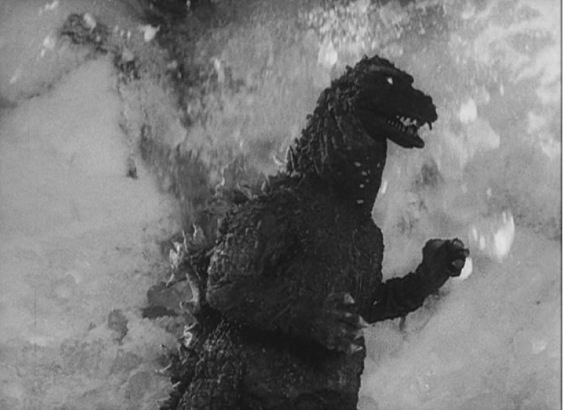
His sacrifice at the end, diving his plane into an icy mountain to trigger an avalanche, is a moment of kaiju cinema pathos. It isn’t grand or symbolic; it’s a desperate, hands-on attempt to trap the monster in ice. The pilot who kept us laughing throughout meets his doom in the snow, leaving behind only a grim, quiet victory. The silence of the snowy landscape afterward provides a stark, contrast to the blazing pandemonium of Osaka. The storytelling pulses with purpose, showing that even in a monster movie, the human stakes are real and worth feeling. Kobayashi isn’t a hero by choice; he’s a hero by necessity, and his loss is felt by the audience.
The Controversy of Gigantis the Fire Monster
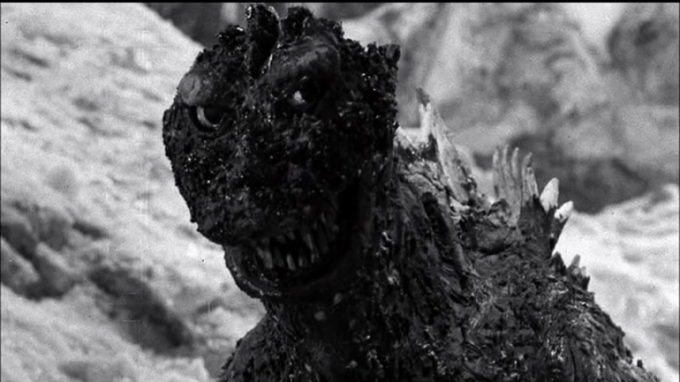
The American release of Raids Again has its own notorious legacy. Toho sold the rights to U.S. producers, who decided Godzilla wasn’t flashy enough and rebranded him as Gigantis. They swapped in a lumbering, elephant-like roar, actually just Anguirus’ swapped around, and slapped on a narration that spelled out every plot beat you could already see. For fans today, the Gigantis cut is pure, baffling comedy: a masterclass in how to turn a perfectly menacing monster into a slightly confused, dubbed spectacle. They even tried to claim Godzilla and Anguirus were fire monsters from the dawn of time.
Yet it’s also a fascinating glimpse into how Western audiences wrestled with the raw energy of Japanese kaiju cinema. American producers tacked on stock footage, swapped the score, and reshaped the pacing to make it familiar. Thankfully, the original Japanese cut has been restored, letting us enjoy the monsters exactly as Toho intended; wild, chaotic, and unapologetically gigantic.
Miniature Mastery: The Joy of Destruction
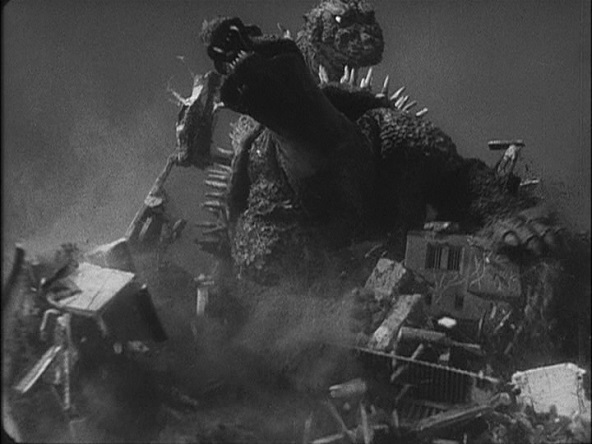
One of the most respected aspects of Raids Again is the miniature work by Eiji Tsuburaya. In this film, the miniatures feel particularly fragile and detailed. When Anguirus crashes into a building, it’s not just a model shattering, you get a spectacular cascade of plaster and timber, every splinter flying like tiny fireworks.
The fun of seeing a perfectly constructed 1/25th scale city get pulverized is what makes the 50s era so special. The practical effects have a tangible heft and unpredictability that no studio polish could replicate. You can feel the weight of the suits and the heat of the pyrotechnics. For a me, the scene where Godzilla kills Anguirus and then burns his corpse in the middle of Osaka is a highlight. It’s brutal, it’s final, and it’s beautifully executed. The use of real fire in proximity to the suits adds a layer of danger to the production that shines through on screen.
The Ice Grave
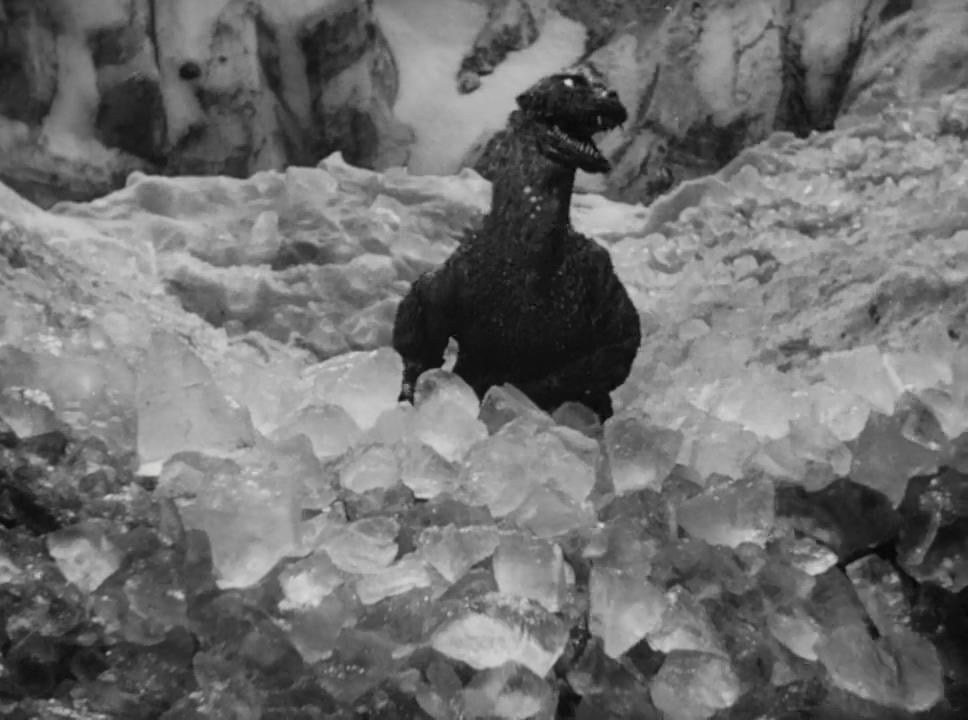
The ending of Raids Again is one of the best in the series. Godzilla isn’t defeated by a super-weapon or another monster; he is simply buried. The image of the King of the Monsters trapped in a tomb of ice on a desolate island is a visual that sticks in the mind.
It also helps creates a pause in the franchise. It wasn’t until seven years later that the chamber of frost would finally give way, unleashing him to fight King Kong, but it’s the cold imprisonment that makes this sequel so memorable.
It’s a conclusion that feels both final and ominous. It suggests that you can’t kill the atomic nightmare; you can only put it on ice. The final shot of the frozen sea is a cold, quiet reminder that the monsters are still out there, waiting for the thaw.
Suit Acting and the Infamous Jittery Frame Rate
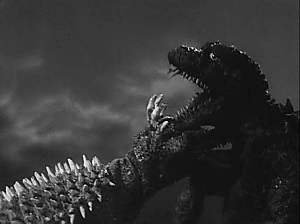
The suit acting in Raids Again deserves a closer look. Haruo Nakajima (Godzilla) and Katsumi Tezuka (Anguirus) were essentially inventing a new language of performance. In Raids Again, they were encouraged to be fast. Because the battles were filmed at altered speeds, their movements come across as sharp, sudden, and surprisingly aggressive.
This makes the fights feel more like a animal attack than a wrestling match. When you see Godzilla shake his head or Anguirus snap his jaws, it has a ferocity that disappeared in the later, more kid-friendly entries of the 60s and 70s. For someone who loves this era of suit-mation, this is the gold standard of monster combat. It’s ugly, it’s fast, and it’s visceral. Nakajima has noted in interviews that this was one of the most physically demanding shoots because of the physicality required.
The Music of Masaru Sato
While Akira Ifukube’s themes are the heartbeat of the franchise, Masaru Sato brings a different kind of feeling to Raids Again. His score is more experimental, leaning into jazz and brassy compositions that match the urgency of the black-and-white visuals.
Sato’s music makes the Osaka attack feel like a newsreel. It doesn’t have the funeral-dirge quality of the first film; instead, it moves with a sharper, more restless energy. This soundtrack is a must-listen, as it shows how versatile the kaiju genre can be. It’s men in rubber suits cinema elevated by professional arrangement, proving that Toho took their monster sequels seriously even when they were moving at light speed.
The Cinematography and the Documentary Style
The choice of Motoyoshi Oda as director brought a certain documentary flair to the proceedings. Oda wasn’t interested in the soul searching of Ishiro Honda; he wanted the reality of the moment. The camera work in Raids Again often feels hand-held or positioned from a human-eye level, looking up at the titans.
This creates a sense of ‘you are there’ terror. When the power goes out in Osaka, the screen becomes a void where only the monster’s eyes and the fires reflect. It’s a noir technique applied to a giant lizard movie. For me, this is the peak of 1950s atmospheric horror. It makes the ridiculous elements, like the visible zipper on a suit or a wobbling building, disappear into the blackness of a very real, very dark night.
The Human Element: More Than Just Filler
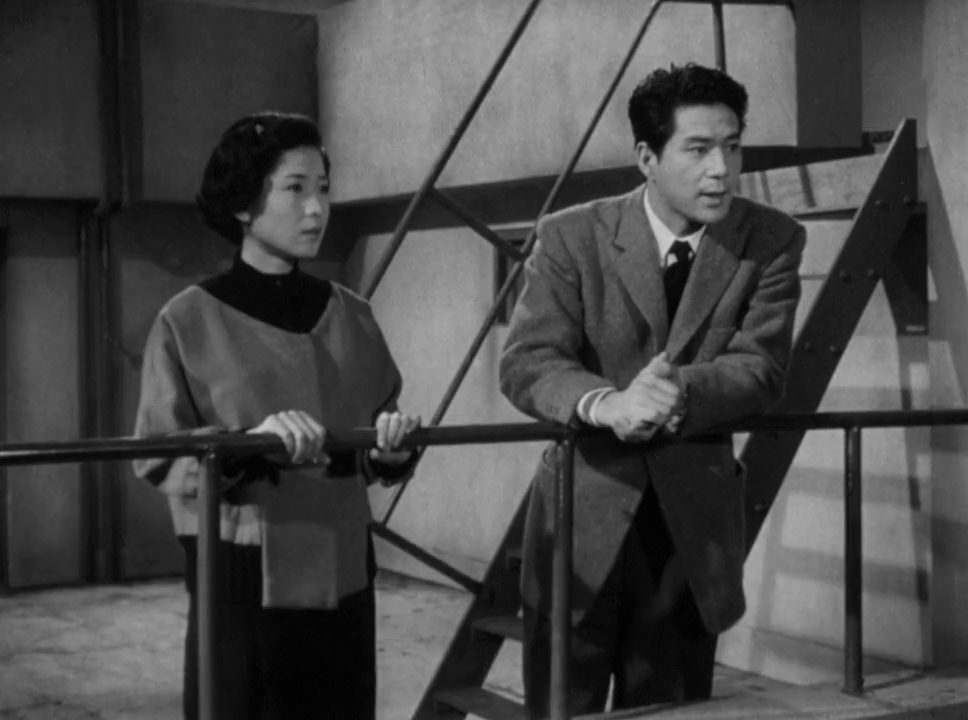
While many fans come for the thrills and the city smashing, the human drama in Raids Again is surprisingly effective. The look into the pilots’ lives, their friendships, their modest dreams of marriage, their exhaustion, makes the monster attack feel like a violation of their mundane reality.
There is a scene in a bar where the pilots talk about the future, completely unaware that Godzilla is currently swimming toward their city. It’s the kind of small, human moment that makes the chaos that follows feel real. It reminds the audience that every building destroyed in a kaiju movie is someone’s home or workplace. This grounding is what makes the spectacles of the Showa era endure into 2026.
Why I Love It
Godzilla Raids Again sits at a strange crossroads in the series. The first film was a grim atomic nightmare; the later sequels would become colourful monster spectacles. This one stands in the middle, experimenting with what a Godzilla movie could be.
It introduces Anguirus, stages the franchise’s first full monster battle, and turns Osaka into a proving ground for the kind of city-shattering mayhem that would define kaiju cinema for decades.
The film is rough around the edges, rushed into production, and occasionally chaotic, but that roughness is part of its charm. You can see the series discovering its future in real time.
Godzilla is no longer just a symbol looming over humanity. Now he has rivals. Now the cities become arenas. Now the monsters fight.
And once that door opened, the kaiju genre would never close it again.
Leave a Reply