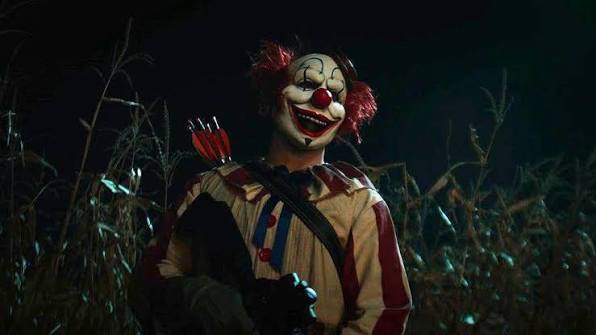
Watch out, David Howard Thornton, there’s a new killer clown on the block…errr… cornfield. Frendo the Clown steps off the pages of Adam Cesare’s book and onto the silver screen for a gory little slice of Mayberry terror. Clown in a Cornfield is now terrorizing moviegoers all over the country, claiming the fifth spot at the box office last week with a $3.6 million opening. While Terrifier’s Art the Clown still has the edge on Frendo there, Clown in a Cornfield is still a lot of fun and is an enjoyable teen slasher throwback that crams a lot of movie references and tropes into one boisterous romp of a movie that has a whole lot to say.

Now, Clown in a Cornfield didn’t just come out of nowhere, as if this were a whimsically slick B-movie vision from its screenwriters, Eli Craig (Tucker and Dale Vs. Evil), who also directs, and Independence Day: Resurgence writer Carter Blanchard. No, Adam Cesare’s book series has been around for five years, the first of which won the Bram Stoker Award for Best YA Novel. The film is pretty faithful to its source material and concerns rising star Katie Douglas (Ginny & Georgia) as Quinn, who’s been uprooted by her doctor father, Glenn (Levels Aaron Abrams), and dragged to the midwest from her northeast home to settle down in a stagnant and dying small town. The two pull up to the scariest-looking house you’ve ever seen, the kind of place that should be crawling with teenagers who think it’s haunted.
Quinn joins the new school, gets detention on the first day, and falls in with the wrong crowd pretty quickly. Her new friends, Cole (Carson MacCormac), Janet (Cassandra Potenza), Ronnie (Verity Marks), and Tucker (Ayo Solanke) love pulling pranks and making gory horror videos where the town’s beloved mascot, Frendo the Clown, is a serial killer. Recently, the teens have become the target of the small town’s Sheriff (Will Sasso) after falsely being blamed for burning down the corn syrup factory during the filming of one of their videos. The whole town looks down on these ne’er-do-wells since the majority of them were employed there, and now someone is getting tips from the group’s YouTube channel, and though they’re dressed like Frendo, they’re not clowning around.

Subtlety isn’t the film’s strong suit regarding the horror material. I mean, the film is called Clown in a Cornfield after all, and I think we all expected the blood and terror to be right in our faces. That notwithstanding, everything here does feel awfully familiar, from the film’s Jaws-inspired opening scene to all of the supremely tropey teen moments that stick out. Craig leans into all of it; any horror movie lover will easily begin pointing out the many scary movie references Clown in a Cornfield makes, and unless you want a list of at least twenty-five that I caught, I’ll leave it at that. While some will wonder why they’re so glaringly obvious, the reason becomes apparent as the film comes to an end.
However, thematically speaking, Clown in a Cornfield has a lot of subtext that becomes more blisteringly apparent as the film reaches its conclusion. Much of it intertwines the stagnation of Kettle Springs, the fictional town where the movie is set, and the undeserved pride that its residents dote on. To call it a one-horse town might imply they have a horse; that’s how broke Kettle Springs is. Still, nostalgia and tradition have much to do with the way Kettle Springs operates, and their Mayor (Kevin Durand) definitely enjoys pacifying the town with a haughty parade down Main St, even though there’s not a lot to celebrate given the financial distress the town finds itself in.

That “everything is fine” approach is exceptionally well-crafted, drawing a parallel to modern era politics of staying the course (Making America Great Again) and looking out for one’s self (Qatar gave him a plane this week), while asserting that you wouldn’t want to live anywhere else (nationalism), and cutting down it’s youth’s aspersions to make their community better (Dept of Education cuts, anti-DEI agenda) by taking them out of the picture entirely (deportations for people they don’t like).
The main takeaway from Clown in a Cornfield is about generational control, specifically as America’s youth are stymied and disregarded when discussing the issues that matter to them. Quinn is dismissed by her father a few times, just trying to explain her side of the story to him. The saying “We didn’t have that when I was a kid…” is a somewhat reductive phrase that suggests the youth should suffer because the previous generation did. But that’s not how progress works. With the town out of work and a factory sitting empty, it could be a great time to implement changes. Regardless, since the town’s adults have been fed misinformation to believe Quinn’s new friends started the fire, the odds of the group implementing any new approaches remain low at best.

I think we’re seeing signs of this all over the place. In Massachusetts, in an effort to combat housing shortages, a zoning law was implemented to increase housing for towns with transit stations. The measure has been met with a mix of outrage and support. Some towns are even suing the state over the measure. While I agree that there are some good points on both sides of this argument, towns that do not change often don’t survive. There are even multiple towns for sale all over the world that have fallen into that type of stagnation for various reasons. The implication of Clown in a Cornfield is for us to remember the glory days fondly without getting stuck in them, allowing the next generation to create their memories while preserving the town for their children to make it better than they had it.
My biggest gripe with Clown in a Cornfield is that it takes a little bit to rev up. The first half hour contains a lot of dry exposition, but once Quinn sees a second Frendo in one of the group’s videos, the fun is turned up to eleven, and it’s nothing but chainsaws, gore, and clowns hunting teens in the corn stalks. The film’s near-constant location changes are impressive (well-designed and decorated, too), helping the film maintain a fast pace. The cast is fantastic, embodying the same hip and fresh attitude as a reviewer may have had written on the cover of Scream in the ’90s. If you’re looking for a killer clown movie to hold you over until Welcome to Derry this fall, Terrifier 4 in 2026, or Killer Klowns from Outer Space 2 (if it ever happens), Clown in a Cornfield may well satisfy your killer coulrophilia.
Leave a Reply