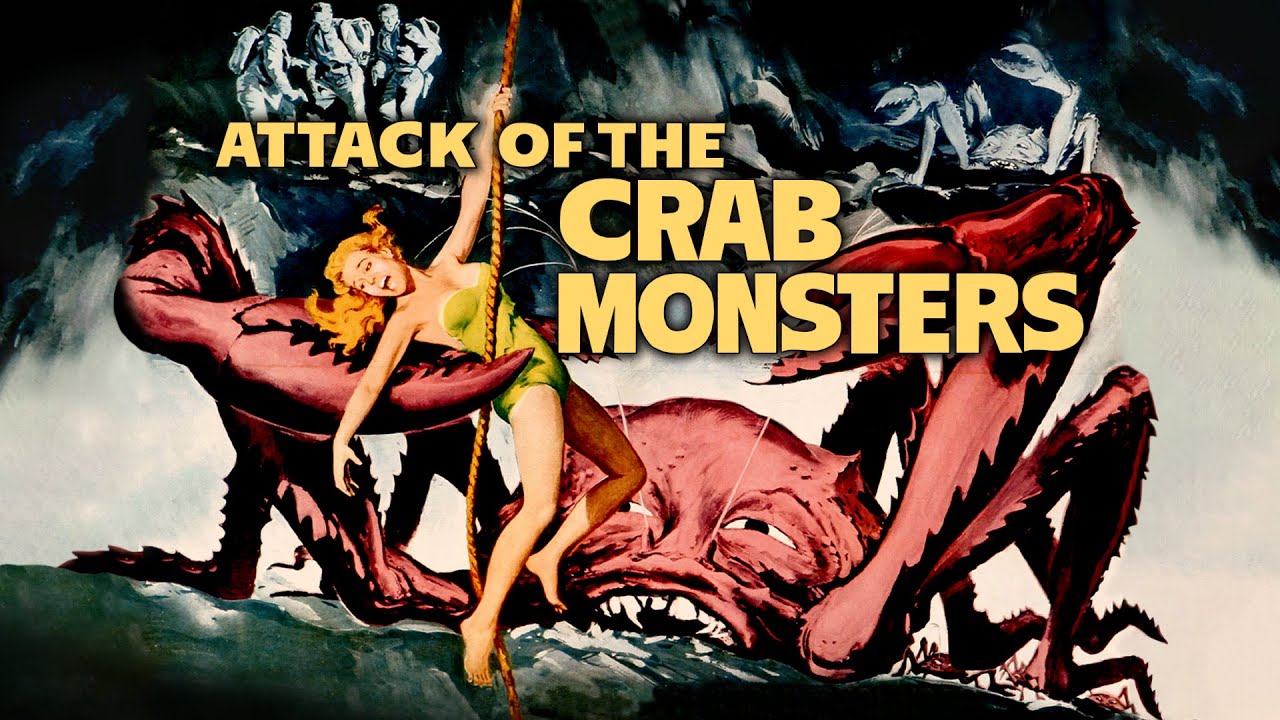
There are bad movies, there are good movies, and then there are movies that exist in that glorious little radioactive swamp somewhere between the two. Movies that were never going to win awards, never intended to change the course of cinema and probably had absolutely no business being as much fun as they are. Attack of the Crab Monsters is one of those films.
Released in 1957 and directed by the legendary Roger Corman, this is a 63-minute black-and-white science-fiction horror movie about giant, mutated, telepathic crabs eating scientists on a rapidly disappearing island. And honestly, if that sentence doesn’t immediately make you want to put the kettle on, turn the lights down and spend an hour watching crustacean-based carnage, I’m not entirely sure why we’re friends.

The premise is pure 1950s atomic-age cinema. A scientific expedition arrives on a remote Pacific island to investigate what happened to an earlier group of researchers following nuclear testing in the area. It isn’t long before the survivors discover that something has gone very, very wrong.
The island is shrinking.
People are disappearing.
And somewhere in the surrounding landscape are enormous crabs with a rather alarming appetite for human flesh.
So far, so wonderfully stupid.
Except Corman and screenwriter Charles B. Griffith throw a genuinely clever idea into the middle of all this radioactive nonsense. These aren’t simply oversized crustaceans with anger management issues. The creatures have developed intelligence and telepathic abilities, and when they consume a human being, they absorb that person’s knowledge.
Think about that for a moment.
Every time one of these bastards eats somebody, it gets smarter.
It’s a fantastic monster concept, particularly for a film operating on what was clearly a budget held together by string, chewing gum and the personal determination of Roger Corman. The crabs don’t need to be elaborate cinematic creations because the real threat isn’t simply that they can bite you in half. It’s that they learn from you.
And that gives the film an unexpectedly nasty little edge.
The expedition members begin hearing the voices of people who are already dead. At first, there’s something almost supernatural about it. Someone appears to be communicating with them from beyond the grave, and the film gets a surprising amount of mileage from this idea.
Then the penny drops. It isn’t a ghost. It’s the bloody crabs.
That is actually rather brilliant.
The film understands that what you don’t see can sometimes be considerably more effective than what you do. Rather than constantly having the monsters stomp around in front of the camera, Corman uses voices, disappearances and increasingly desperate discoveries to keep the tension moving. Considering how little money was available, it’s an excellent way of creating a monster that feels considerably more dangerous than the effects budget should allow.

This is where Attack of the Crab Monsters becomes more interesting than its title suggests, and make no mistake, the title is fucking magnificent.
It sounds like something a twelve-year-old would come up with after discovering the words “attack”, “crab” and “monsters” in the same afternoon. There is no mystery here. No subtlety. No ambiguity. You’re not going into this wondering whether the film might eventually reveal that the monsters are actually metaphorical representations of post-war anxiety.
No.
There are crabs.
They attack.
They are monsters.
Thank you, cinema.
But underneath that gloriously blunt exterior is a surprisingly efficient little thriller. Corman reportedly wanted suspense or action in virtually every scene, and you can feel that philosophy all over the finished film. At barely over an hour, there is very little opportunity for the story to wander off into the bushes and start explaining itself. The film gets the scientists onto the island, starts killing people and then keeps pushing them towards the inevitable conclusion.
That pace is one of its greatest strengths. Modern horror filmmakers could learn something from this.
There is no forty-minute prologue explaining everybody’s childhood trauma. There isn’t a beautifully photographed sequence of someone staring meaningfully through a window while a piano quietly murders itself in the background. There is certainly no need for three separate scenes establishing that the protagonist is emotionally complicated.
Someone gets eaten and away we go.
The other major threat is the island itself. The radiation hasn’t merely turned ordinary crabs into giant psychic nightmares; the entire landscape is becoming unstable. Sections of the island are collapsing into the ocean, meaning the characters are trapped somewhere that is quite literally disappearing beneath their feet.
This is another clever piece of low-budget filmmaking because the movie doesn’t need to show us an entire island being swallowed by the Pacific. It simply has characters discover that another piece has vanished. Suddenly somewhere they were standing earlier is gone.
It’s cheap. It’s simple. And it works.
The shrinking island provides the film with a ticking clock without requiring Corman to spend half the budget blowing things up. The characters aren’t merely trying to survive the monsters. They’re trying to survive long enough to escape a location that is slowly being removed from existence.
That’s the sort of practical problem-solving that makes 1950s exploitation cinema so much fun.
Of course, we need to talk about the crabs.
Oh, the crabs.

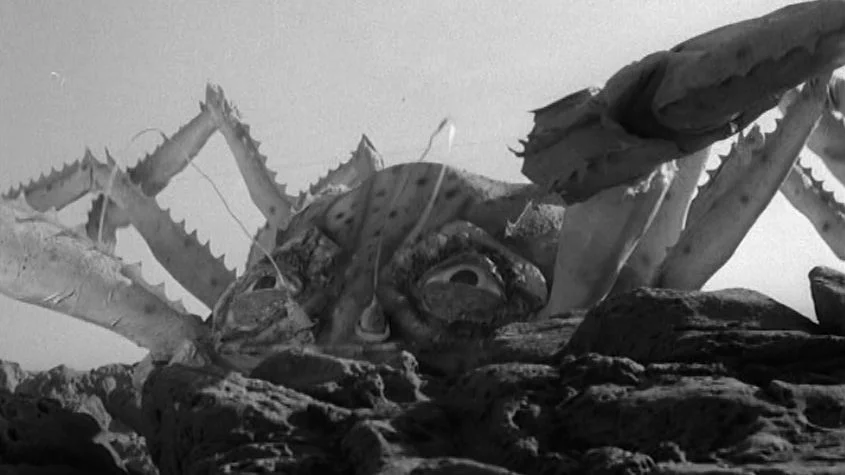
Look, nobody is going to mistake the effects in Attack of the Crab Monsters for anything produced by Ray Harryhausen. These things are not majestic creations that make you stare at the screen in awe. They look like what they are: enormous creatures created within the very specific financial limitations of a Roger Corman production.
And yet I wouldn’t want them any other way.
There is something genuinely charming about watching these ridiculous monsters clambering around while everyone behaves as though the arrival of a giant telepathic crab is an entirely reasonable scientific development. The creature design has that wonderfully primitive 1950s quality where you can almost see the machinery behind the illusion.
This is not a movie that asks you to believe the monster exists. It asks you to play along and that’s a very different thing.
The cast do their part admirably. Richard Garland plays expedition leader Dale Drewer, Pamela Duncan is Martha Hunter and Russell Johnson appears as Hank Chapman. Johnson is particularly amusing for anyone familiar with his later career as the Professor on Gilligan’s Island. Here he is doing serious 1950s science-fiction business, surrounded by disappearing land, dead colleagues and psychic crabs, which gives the whole thing an additional layer of accidental comedy for modern viewers.
The performances are generally functional rather than spectacular, but that actually suits the film. Nobody needs to deliver an Oscar-worthy monologue when the next scene might involve discovering that their recently deceased colleague is now communicating through a crustacean.
And there is something else I really like about the movie: it doesn’t apologise for being ridiculous.
This is a film from the great age of atomic monster movies, when nuclear testing could mutate virtually anything. Ants? Absolutely. Lizards? Naturally. Spiders? Obviously. Crabs? Fuck it. Make them enormous—and give them telepathic powers so they can taunt the survivors using the voices of the people they’ve already eaten.
The atomic-age monster movie was often built around genuine anxieties about nuclear weapons and radiation, but Attack of the Crab Monsters isn’t interested in delivering a lecture. It takes those fears, throws them into a blender and serves them with claws.
That’s what makes the film work as pure stupid entertainment.

It is also a perfect example of why Roger Corman became such an important figure in low-budget cinema. He understood that limitations could become advantages. If you don’t have the money to show everything, don’t show everything. If your monster looks better when partially hidden, keep it partially hidden. If you only have an hour, don’t waste twenty minutes getting to the fucking point.
Corman was prolific to an almost absurd degree, and Attack of the Crab Monsters was one of a number of films he directed in 1957, originally hitting drive-ins as part of a double bill with Not of This Earth.
And that double-bill mentality is important because this is exactly the sort of movie that benefits from being approached as a piece of drive-in entertainment rather than some lost cinematic masterpiece.
Is it sophisticated?
No.
Is the dialogue occasionally wooden?
Absolutely.
Are the effects cheap?
You could probably see the fucking invoice.
But does it move?
Yes.
Does it have ideas?
More than you might expect.
Does it have atmosphere?
Damn straight.
And is there something inherently wonderful about a film in which the central existential threat is a gigantic psychic crab that becomes more intelligent every time it eats somebody?
Fuck yes.
There is a tendency to look back at films like this and judge them purely on their effects. If the monster looks cheap, the film must therefore be bad. But that’s missing the point entirely. The real joy of these movies lies in seeing what filmmakers could accomplish when they didn’t have enough money to make the movie they wanted.
Corman couldn’t give us a horde of terrifying, photo-realistic monsters, so he gave us the idea of them. He gave us voices in the darkness. He gave us an island slowly being swallowed by the sea.
He gave us a ticking clock, a relentless pace, and the unsettling idea that every person the creatures consume makes them smarter.
And then, eventually, he gives us the crab. Bloody hell, does he give us the crab.
It’s ridiculous. It’s glorious. It’s exactly what you signed up for.
Attack of the Crab Monsters isn’t a forgotten masterpiece, and pretending otherwise would be doing the film a disservice. It is something much more enjoyable: a fast, inventive, wonderfully cheap slice of 1950s creature-feature madness that understands exactly what it is and wastes absolutely no time getting there.
It’s the sort of film that reminds you why terrible cinema can be so much fun. Because sometimes you don’t need prestige. Sometimes you don’t need nuance. Sometimes you just need Roger Corman, a disappearing island, some radioactive crustaceans and the complete absence of adult supervision.
The crabs are coming.
Bring snacks.
Leave a Reply