Just before entering the Chattanooga Film Festival for what was to be my last in-person film of the festival, the foyer of the Chattanooga Theatre Center was boisterous. People were just exiting Tina Romero’s excellent Drag Queens v Zombies comedy, Queens of the Dead, and the final party of the weekend loomed. Delaying the “Pizza Pity Party” for eighty-five minutes, I really wanted to check out Erik Bloomquist’s Self-Help. I’ve been following this director since I first saw A Night at the Eagle Inn at a festival a few years ago.
Since then, I’ve watched just about every horror project Erik and his co-writer brother Carson Bloomquist have created. While not every review has been positive, The Bloomquists have a knack for making movies that horror fans can get excited to see. Whether it’s a witchy camp slasher mashup in She Came from the Woods or exposing small-town politics with Scream-like referentialism in Founder’s Day, The Bloomquists know how to excite their horror base through screams, scares, and story, and Self-Help may be the brothers’ best offering to date.

I was handed a nametag with the name “Mary” on it, attached it to my shirt, and went to sit. On the stage, two of the festival’s volunteers stood sentry at either end of the silver screen, ominously wearing rubber masks and saying nothing. As people filtered into the theater, another two stood at the rear doors. The Bloomquists were about to unleash some aggressive therapy upon the audience, ready for us to purge our inner demons… one way or another.
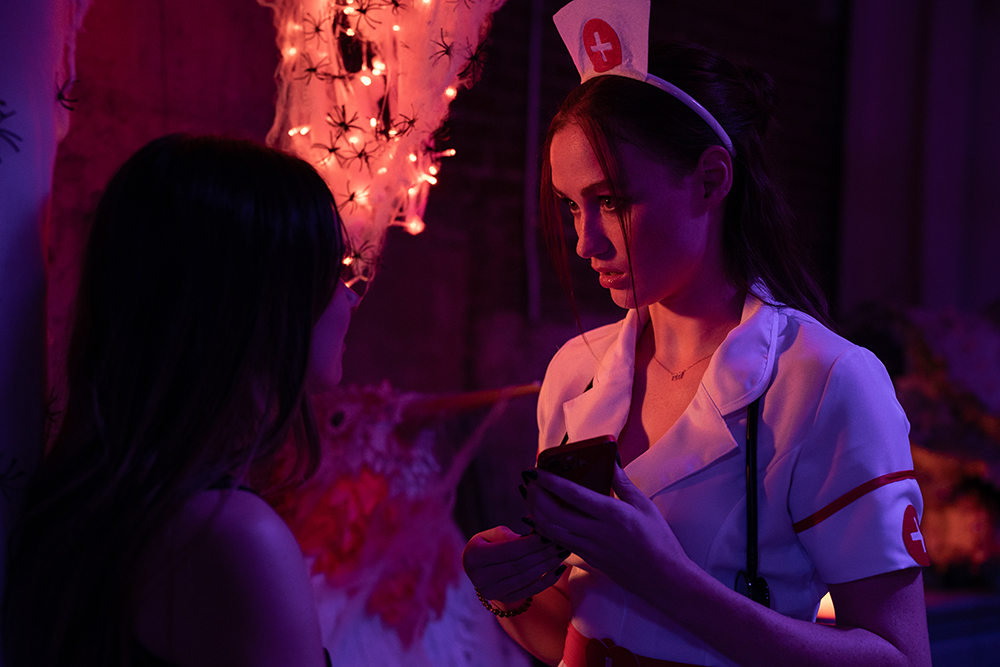
Beginning with a cold open, the audience witnesses the indiscretions of young Olivia’s (Marlee Eaton) mother at Olivia’s Halloween/Birthday party inside an arcade resembling a Chuck E Cheese. The remarkably traumatic moment is heightened with a deathly secret between the mother and the daughter, and the beginning of Olivia’s resentment toward her mom. Self-Help fast forwards to Olivia’s college years, where a now older Olivia (Landry Bender) and her friend Sophie (Madison Lintz) are preparing to see Olivia’s estranged mother for the first time since her father’s death.
Arriving at the location where they should be meeting, Olivia’s mother, Rebecca (Amy Hargreaves), Olivia, and Sophie find themselves seated in a small church where a confluence of rubber-masked individuals have already amassed in the pews. A TV is rolled in, and a presentation about Curtis Clark’s unorthodox therapeutic methods leads to Clark (Dawn of the Dead 2004’s Jake Weber) revealing himself, along with Olivia’s mother, who says that she’s now married to the charismatic cult leader, prompting defiant criticism from Olivia.
As Olivia attempts to discuss the impulsiveness of her mother’s decisions, she’s met with a lot of “give him a chance” attitudes. It also doesn’t help that they’re all staying in Clark’s home, where he’s also working with a trio of new patients. Joanne (Carol Cadby), Andy (Blaque Fowler), and Owen (Erik Bloomquist) have paid a small fortune to find their inner strength through Clark’s method, which becomes easily identifiable as anything but what a trained professional would do, promoting extremely violent acts and self-mutilations that Clark puts creative spins on to simultaneously take credit for while distancing himself from the gruesomeness of their inflictions.
There’s a lot baked into Self-Help’s subtext, from the abhorrence of scam artists to the need to blindly follow (somewhat literally in one case) those we put our faith in to fix things. Olivia may be the audience’s protagonist, but in a den of believers, her antagonistic voice is silenced or at least muffled, especially since she’s the one person speaking to the f*cked up nature of Clark’s so-called therapy. The subtle dissent here is the point of the film. While everyone else is clearly witnessing a messed-up situation unfold, Olivia is the only one shouting wolf, which also says a lot about the desensitization pervading our own realities.
Self-Help takes on the sterilized, clinical lingo we hear from both doctors and politicians in our daily lives, while also putting some of the internet noise on blast as well. There are a lot of voices vying for our attention, causing self-hatred or familial division, and we’re all pretty susceptible to these easy cure-alls instead of doing the work to empower ourselves above our self-embattled positions.
The Bloomquists recognize the allure and pitfalls of cultish behavior and do an excellent job of addressing concepts of isolation, identity, rejection, and herd mentality in Self-Help, presenting the susceptibility of lonely people and the charms of snake oil salesmen. Cadby and Fowler have a few heartfelt scenes within the film, as they try to overcome their pasts, resulting in one moment of the two huddled together in a car, brought together by shared trauma that’s captured beautifully through Bloomquist’s lens. Similar themes pervade other recent cult films, such as Abigail Before Beatrice and So Fades the Light, which lean far more towards the dramatic side, whereas the Bloomquists’ concept is more aligned with that of the slasher subgenre, even if I think it’s somewhat reductive to Self-Help to say that.

In the last few years, I’ve seen the Bloomquists’ films grow through new writing techniques and deeper character exploration while maintaining super-cool plotlines. They continue to approach their stories through knife-wielding killers and supernatural concepts, but they’re constantly learning, becoming smarter in their storytelling. Self-help has a lot of psychology embedded in it, and the actors infuse that into their characters, adding incredible depth. Weber turns in an exceptional performance, though the young Landry Bender goes toe-to-toe with him extraordinarily. There are moments of grace and beauty, like the scene I mentioned above between Cadby and Fowler, as well as heart-wrenching sadness. One character faces their fate in another exemplary scene, where visuals and Haim Mazar’s score come together to enchant the audience with shockingly memorable imagery.
Self-Help is a step in an incredibly great direction for the Bloomquists, whose movies are getting continually better with every new entry in their filmography. My main gripe with the film is that the entire retreat at Clark’s house takes place over a considerably short period, which seems slightly fast for these events to escalate the way they do. The film also doesn’t host much of a body count either, but it doesn’t have to. The paranoia and fear seen through Olivia’s eyes is enough to captivate any moviegoer, ending in an ultra-satisfying way that ties up loose ends and sticks to its established themes.
Regardless of nitpicks, Self-Help is a surprising treat from a remarkable duo who are teetering on the edge of becoming established household horror names. Self-Help never treads the easy path, crafting an outstanding realm for the film’s originality and its characters’ motivations to shine. Like another film from Chattanooga Film Festival, the indie comedy I Really Love My Husband, there was a lot here about loving yourself and letting people go, providing catharsis, and making Self-Help mandatory therapy for horror lovers.
Leave a Reply