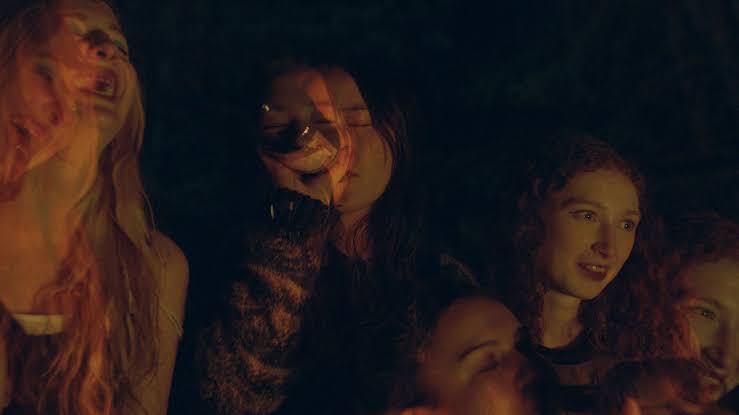
It may have only been three years ago when I was first introduced to the world as Avalon Fast sees it. The budding auteur’s debut film, Honeycomb, about a group of young women who venture out into the woods where they start an independent commune free from the pressures of societal norms only to find themselves viciously punishing each other for superficial offences, is everything you want an independent film to be: daring, surreal, and with a twist that the audience never sees coming. I fell head over heels for Fast’s first film, and have been waiting for her follow-up, CAMP, since.
Fast heads back into the forest for CAMP, telling the story of a traumatized young woman named Emily (Zola Grimmer) whose life has unraveled in the wake of watching her best friend overdose before her very eyes. Still processing an earlier accident where Emily struck a child with her car, the new incident leaves her unsettled, and a job at a Christian summer camp could prove to be the reset she needs to heal. One detail that Emily fears may ruin her plan is the fact that she isn’t religious, but soon finds that neither are most of the councilors. In fact, she begins to grow increasingly suspicious that they may actually be witches.
From the moment Emily jumps on the train to the campgrounds, Fast moves into surreal territory, swapping out reality for kinetic details. The background seems to become cartoonish, and the northern lights briefly emit a green haze through the window behind her. The first face she wakes up to is Eden’s, staring daggers at her, replacing the two men who stared at her previously, but continuing to make Emily feel derisively uncomfortable. From here, CAMP moves ethereally, like a dream, with Emily awakening in a field outside the campground as if brought directly to this place by magic. It’s little things like this in the connective tissue of the film that enrapture the audience, allowing them to drift along with Emily through Max Robin’s atmospheric score and Fast’s brilliant sense of mysticism.
From here, Fast makes the audience a part of the ride, and how much they’re willing to pay attention is going to pay dividends in the story. After checking in with Dan (Austyn Van de Kamp), she meets Jo (Sophie Bawks-Smith), and there’s an immediate chill up their spines as the first thing she says to Emily is, “I’m so glad you’re here.” A saying that is echoed again by Clara (Alice Wordsworth) later in the film. The odd use of this phrase by each person signifies two distinct cliques, with Jo representing the Christian side of healing and Clara representing a darker path. Even their councilor shirts denote a separation, aka two camps Emily will ultimately have to choose from: seeking guidance or walking the path toward becoming a “Leader.”
Doting on the idea of CAMP, Fast is able to make intrinsic connections to the spirits of the types of introvert/extrovert behavior that people might exhibit while at summer camp. The director blends many ideas, but it’s Rosie’s (Cherry Moore) confession that really creates poignancy. Her bombshell of a backstory is very revealing in a way that could damage her reputation among some, but like Emily’s, she doesn’t have uncomfortable reservations about telling it. There’s a lesson of acceptance in all of this. Yet, it’s the level of openness and honesty that goes a long way toward making Emily feel like she belongs —a non-judgmental kinship we watch her search for at parties she had previously attended.
Beneath a celestial event, Fast melds ideas of female support with the ability to make things happen. And you can’t argue with the results… even if it eviscerates their victims’ identities or worse. The scene strikes a particular chord of familiarity, a nod really, to the film The Craft in tone and feeling.
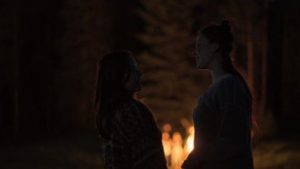
Still, there’s abject cruelty in getting what you want at another’s expense, and Fast falls into similar themes from Honeycomb, while conveying these notions of clique-based morality and martyrdom motifs, this time set against a contrasting backdrop of a religion that often perpetuates a powerful, parallel sentiment. Though CAMP creates a world where a coven develops inside a Christian camp, like wolves in sheep’s clothing on the surface, it uses a lot of the same tools from Christianity to indoctrinate Emily, highlighting the more cultish reasons people find themselves attracted to these communities. That beguiling of instant friendship and sisterhood leads Emily to some extreme decisions, with CAMP going to some wild places by the end of the film.
Fast again incorporates animation into the film, continuing to provide fantastic enchantment through the medium, telling stories through mixed media, and furthering the film’s surreal qualities. CAMP feels like a dizzying dream at times, a beautiful, buoyant, and intoxicating drug propelling the audience and Emily toward a part of ourselves that silently coerces us to “live deliciously.”
Ultimately, CAMP is a punk-rock masterpiece. There’s no sophomore slump here for the multihyphenate filmmaker as Avalon Fast expands on many of the ideas swirling around in Honeycomb’s subtext, here on a much more profound cinematic scale. Fast elicits the type of fearlessness few directors ever possess, shocking us with contrasting imagery of witchy vengeance through pitch-perfect irony that is sure to cause a divisive reaction between “camps.”
Leave a Reply