If you want to understand the moment that the Shaw Brothers, the absolute kings of the Hong Kong studio system, finally decided to lean into pure, unadulterated madness, you have to look at Five Elements Ninjas. Also known as Chinese Super Ninjas, this movie is a blood-drenched love letter to the ‘Gimmick’. By 1982, the traditional Wuxia film was starting to feel a bit dusty, and the fist and foot Kung Fu of the 70s was being replaced by the high-wire acrobatics of the 80s. Enter Chang Cheh, The Godfather of Hong Kong Cinema. He didn’t just want to make a Martial Arts movie; he wanted to create a live-action comic book where the periodic table itself is trying to kill you. This is the ultimate style over substance movie, but when the style is this aggressive and the substance is literally five different flavours of death, who cares about the plot?
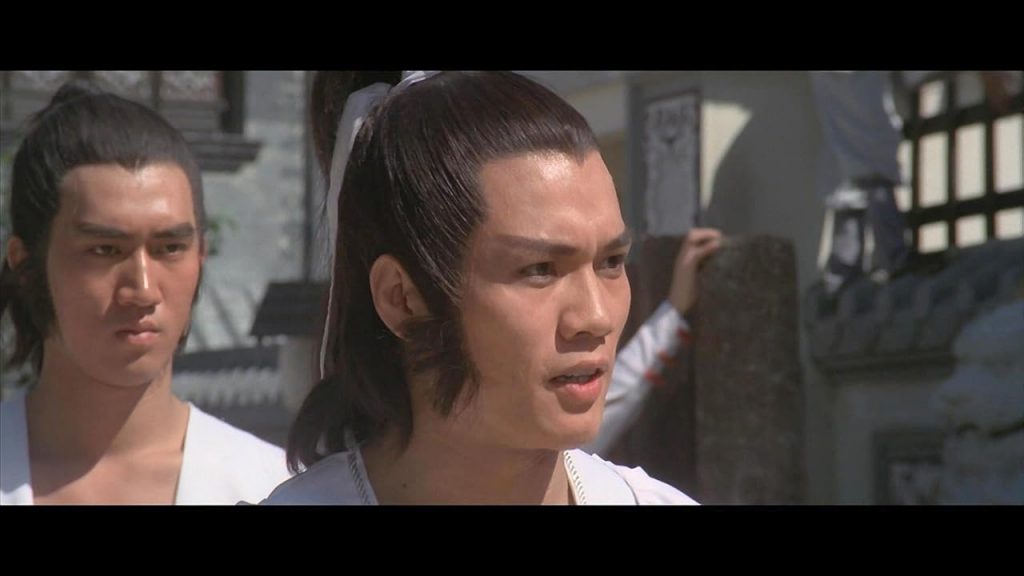
To get the full picture, you have to look at the state of the Shaw Brothers studio in the early 80s. They were being squeezed by the rise of Golden Harvest and the star power of Jackie Chan. Their response was to hand the keys to the kingdom to Chang Cheh and let him go wild with his Venom Mob style of storytelling. The result is a film that feels like it was directed by a beautiful maniac who was obsessed with color-coding and inventive slaughter. The plot is a classic revenge setup: a Chinese Martial Arts school humbles a Japanese samurai, who then calls in a Ninja King to take them out. This King doesn’t just bring ninjas; he brings the Five Elements Ninjas, a group of specialists who use the environment as a weapon. This is where the movie moves from a standard brawler into something truly elemental.
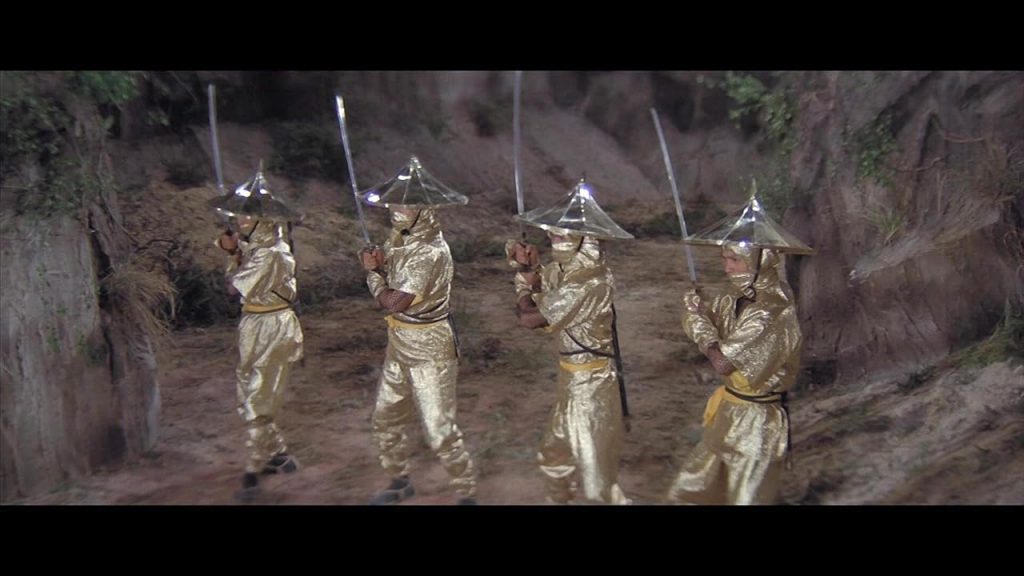
The first group we meet are the Gold Ninjas. These guys are essentially human disco balls. They wear shimmering gold suits and use mirrored shields to blind their opponents. It’s a brilliant piece of visual storytelling. In the bright sunlight of the Shaw Brothers backlot, these shields are practically nuclear. They don’t just fight you; they erase your ability to see the sword coming for your throat. It’s a clever lesson in how to use gimmickry as art. It’s not just a costume choice; it’s a tactical advantage that forces the heroic Martial Artists to fight a battle they aren’t prepared for. When the Gold Ninjas start hacking away at the blinded students, you realize that Chang Cheh isn’t here to show you a fair fight. He’s here to show you an execution.
Then we move into the Wood Ninjas. If the Gold Ninjas were about the flash, the Wood Ninjas are about the environment. They disguise themselves as trees.
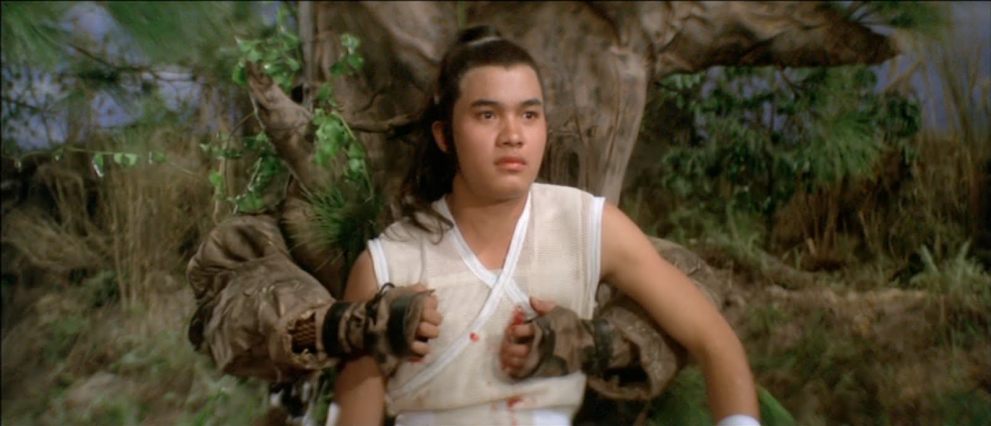
No, really.
It sounds ridiculous on paper, but on screen, it’s a nightmare. Imagine walking through a forest and the very trees start bleeding or, worse, swinging axes at your head. These ninjas use a claws and camouflage approach that turns the scenery into a predator. They represent the hidden nature of the ninja, a contrast to the honourable, stand-up fighting style of the Chinese students. The Wood Ninjas don’t want a duel; they want to ambush you from the shadows of a willow tree. It’s a perfect example of how the film uses nature to subvert the traditional arena of the Kung Fu film.
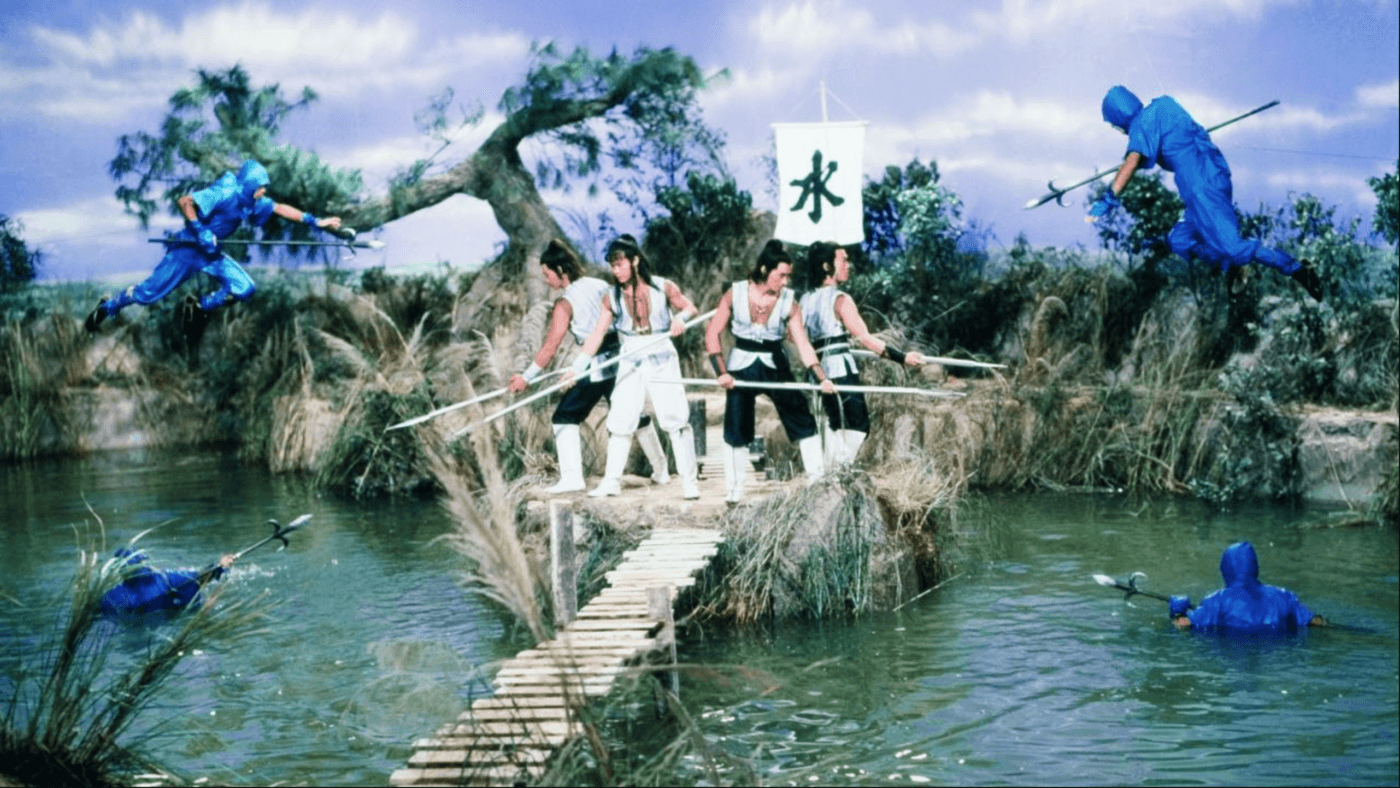
But the movie really hits its stride with the Water Ninjas. This is where the technical wizardry of the Shaw Brothers’ tank work comes into play. The ninjas wear blue suits and oxygen backpacks that allow them to pull their enemies underwater and drown them in about six inches of pond water. It’s brutal, it’s inventive, and it features some of the most hilarious yet effective underwater fight choreography ever filmed. They use harpoons and nets to drag the land-dwelling Martial Artists into a void where their fancy footwork doesn’t mean a damn thing. It reinforces the theme of the movie: the invincible heroes are only invincible if you play by their rules. The ninjas don’t play by the rules; they will quite happily cheat.
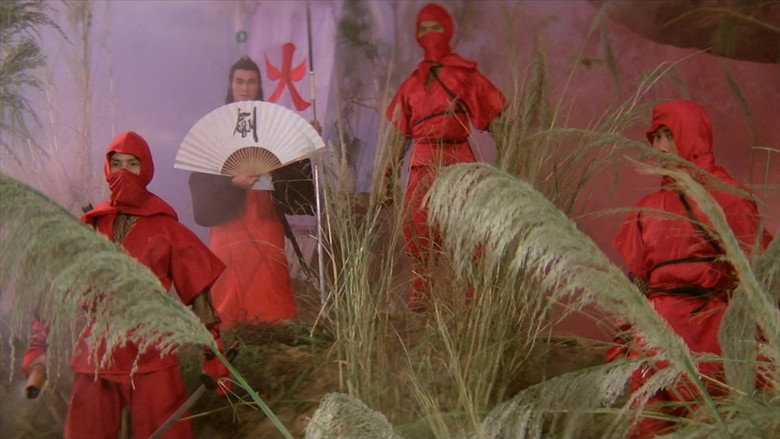
Then come the Fire Ninjas. These guys use smoke screens and explosions to create a literal fog of war. Clad in bright red, they move through the smoke like demons. They use fire-breathing techniques and explosive darts to turn the battlefield into a kiln. It’s loud, it’s chaotic, and it’s visually stunning. The red of their suits against the grey smoke is a prime example of Chang Cheh’s obsession with color theory. He wants every frame to pop, and the Fire Ninjas are the most explosive manifestation of that desire. By the time the Fire Ninjas are done, the Chinese school is in ruins, and the few survivors are left wondering how honour is supposed to beat a guy who can disappear in a puff of sulfur.
Finally, we have the Earth Ninjas. These guys are the underground specialists. They tunnel through the dirt and grab your ankles, dragging you into the soil like a scene out of a horror movie. They use spears that pop out of the ground, turning the very earth beneath your feet into a minefield. This is perhaps the most grindhouse of all the elements, featuring some truly grotesque moments of limb-trapping and stabbing. It rounds out the quintet of destruction perfectly. The message is clear: whether you look up, down, left, or right, the elements are coming for you. It’s an all-encompassing siege that wipes out the old guard and sets the stage for the second half of the film, where the hero has to go through his own training montage to learn how to beat these elemental freaks.
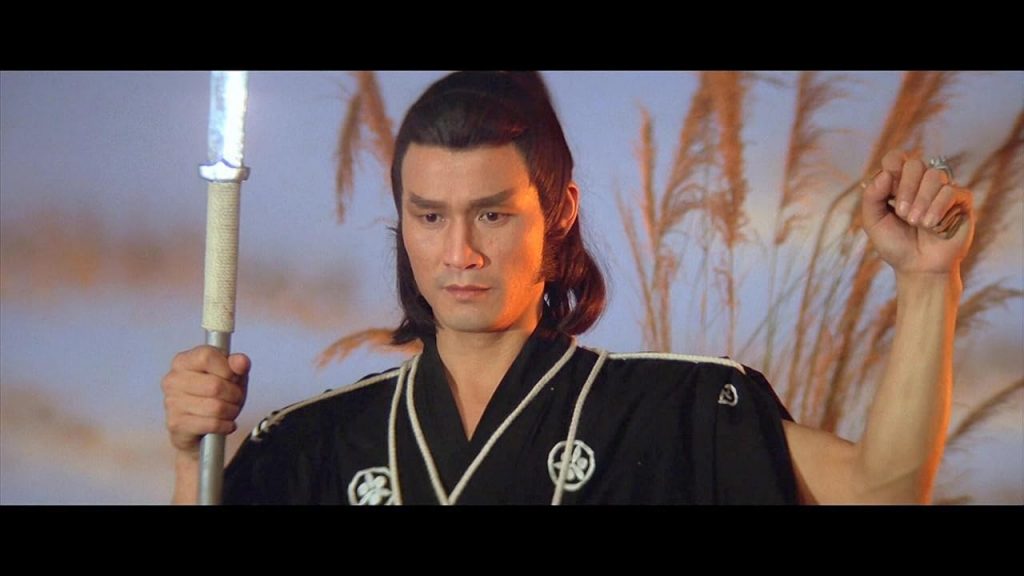
The training half of the film is where we get into the nitty-gritty of the counter-ninjutsu. Our lone survivor meets an old master who knows the secrets of the elements. This isn’t just about punching harder; it’s about Tactical Physics. To beat the Gold Ninjas, you need to use their reflections against them. To beat the Wood Ninjas, you need to see the fake trees. To beat the Water Ninjas, you need to bring the fight to the shore. It’s shows how to structure a Martial Arts film around problem-solving. The final battle is a twenty-minute symphony of revenge where our heroes systematically dismantle each of the five squads. It’s cathartic, it’s incredibly gory, and it features some of the most imaginative weapon designs in the history of the genre, including a hooked beast designed specifically to rip ninja suits apart.
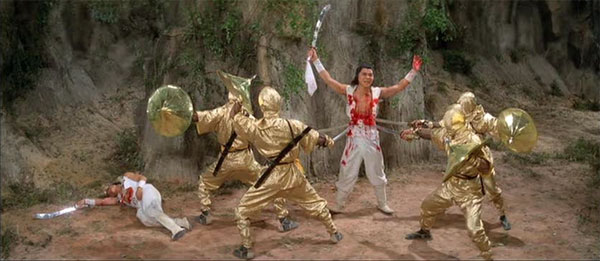
And then there’s the blood. Chang Cheh was famous for his Red Paint philosophy. In his world, blood doesn’t just trickle; it sprays. It coats the walls, it stains the costumes, and it becomes a character in its own right. Five Elements Ninjas features some of the most iconic Heroic Bloodshed moments ever filmed, including a guy who continues to fight while his own intestines are literally trailing behind him. It’s gruesome, yes, but it’s done with such a stylised, operatic flair that it transcends exploitation and becomes something closer to a Greek tragedy. The gore isn’t there just to shock; it’s there to emphasize the sheer, physical cost of the conflict. It makes the final victory feel earned, rather than just choreographed.
Technically, the film is a marvel of the Shaw Brothers’ industrial efficiency. They used every inch of their Movietown backlot, transforming it into forests, ponds, and fortresses with a speed that would make a modern production’s head spin. The action direction, handled by Cheng Tin-chi and Chu Ke, is a pinnacle of Wire-Fu before it became too floaty and CGI-reliant. It is a testament to the studio’s ability to coordinate mass chaos. The costumes are iconic, the music is a pulse-pounding mix of traditional and synthesized sounds, and the pacing is absolutely relentless. There is zero filler in this movie. It starts at a sprint and ends in a full-blown roar.
In the end, Five Elements Ninjas works because it embraces its own absurdity. It doesn’t try to be a deep philosophical tract on the nature of the soul; it tries to be the most exciting, colorful, and violent ninety minutes of your life. It succeeds on every level. It is the definitive Ninja movie of the 80s, a film that understands that the audience wants to see things they’ve never seen before. It treats the elements not just as background dressing, but as the core of the drama. It’s the sound of a studio at the height of its power, throwing everything at the screen to see what sticks, and what sticks is a shimmering, bloody, grandiose spectacle that still leaves modern action films in the dust. It’s the ultimate gimmick flick that proved, once and for all, that if you’ve got a good idea and enough red paint, you can conquer the world.
Leave a Reply