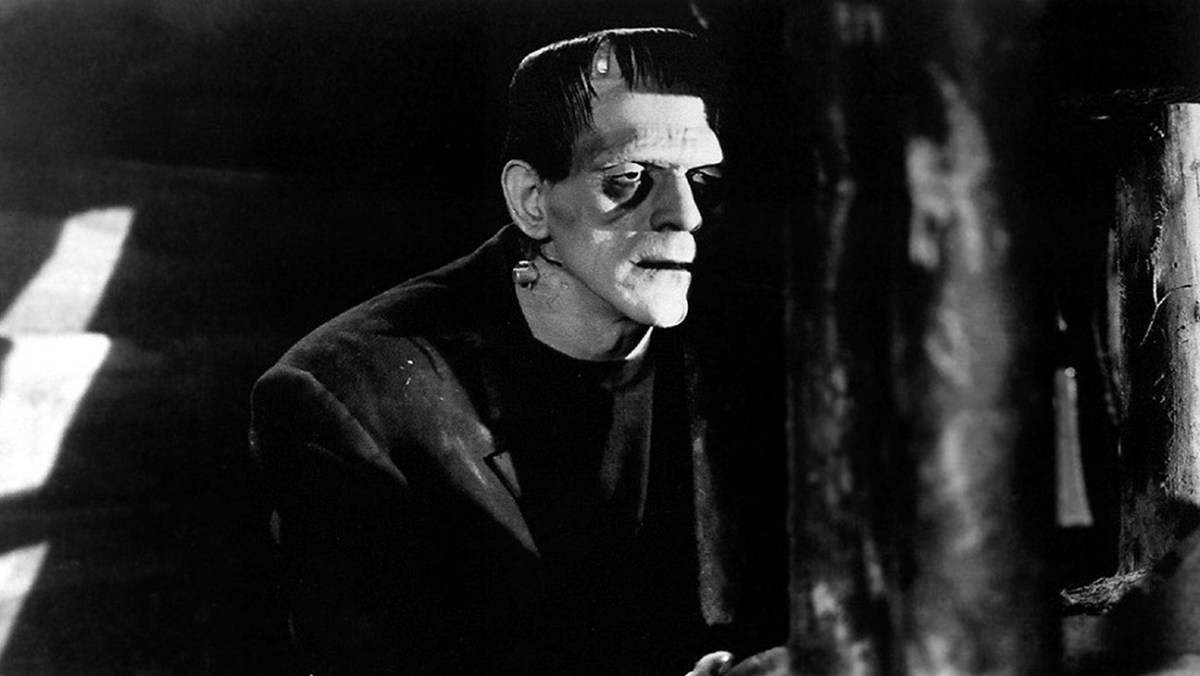
James Whale’s 1931 Frankenstein isn’t just a cornerstone of horror cinema; it’s the moment the genre stepped out of the theatre and became a proper movie. Everything before it feels like a rehearsal. Everything after it feels like consequences. This is the film that taught audiences that shadows could have teeth, that science could sweat, and that ambition could rot from the inside out while still smiling for the camera. To talk about this movie in 2026 is to talk about the literal DNA of the modern blockbuster, but with a soul that most modern films are too terrified to even acknowledge. It’s less a movie and more a controlled explosion of gothic anxiety, a sprawling, jagged masterpiece that hasn’t lost an ounce of its voltage.
What makes it endure isn’t just its status as important, but the way it still feels like it was carved out of something fundamentally unstable. The story, adapted from Mary Shelley’s novel, becomes in Whale’s hands something more unstable and more confrontational: not just a warning about playing God, but a full-on psychological collapse dressed up as a lab experiment gone wrong. Whale brings a distinctly European sense of unease into the heart of early Hollywood. A veteran of World War I, he had seen enough real-world machinery of death to treat horror not as fantasy, but as aesthetic memory. That sensibility bleeds into every frame. The influence of German Expressionism is everywhere, angled sets, warped perspectives, and deep, swallowing shadows that seem to lean in closer than they should. The world doesn’t feel built; it feels infected.
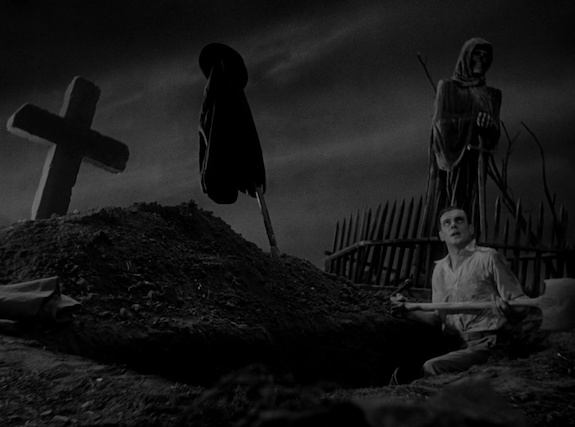
Even the opening graveyard sequence carries that feeling. It isn’t atmospheric window dressing. It’s a moral vacuum with headstones. The fog doesn’t drift so much as it lingers like regret. Henry Frankenstein and Fritz move through it like trespassers in something ancient and uninterested in their experiments. The dead aren’t resting, they’re being used. It’s a moment of flesh and hubris. Henry himself, played by Colin Clive, is one of early cinema’s great beautiful disasters. Clive doesn’t perform so much as combust in increments. There’s nothing sleek or controlled about him. He is all frayed nerves, trembling obsession, and eyes that look like they’ve stopped believing in sleep. Modern viewers sometimes mistake his intensity for theatrical excess, but it plays more like a man actively losing his grip on reality while insisting he’s absolutely fine, thank you very much.
His relationship with creation is less scientific curiosity and more an addiction spiral. Every gesture suggests urgency, like he’s trying to outrun doubt before it catches him. When the experiment finally works and the creature animates under stolen lightning, his triumph isn’t clean or heroic. It’s feral. That famous declaration
“It’s alive!”
doesn’t land like discovery. It lands like possession. Like something inside him has finally broken loose and is speaking through his mouth. He isn’t happy he’s helped humanity; he’s high on the fact that he’s cheated death. It’s a moment of total ego that sets the stage for everything that burns later.
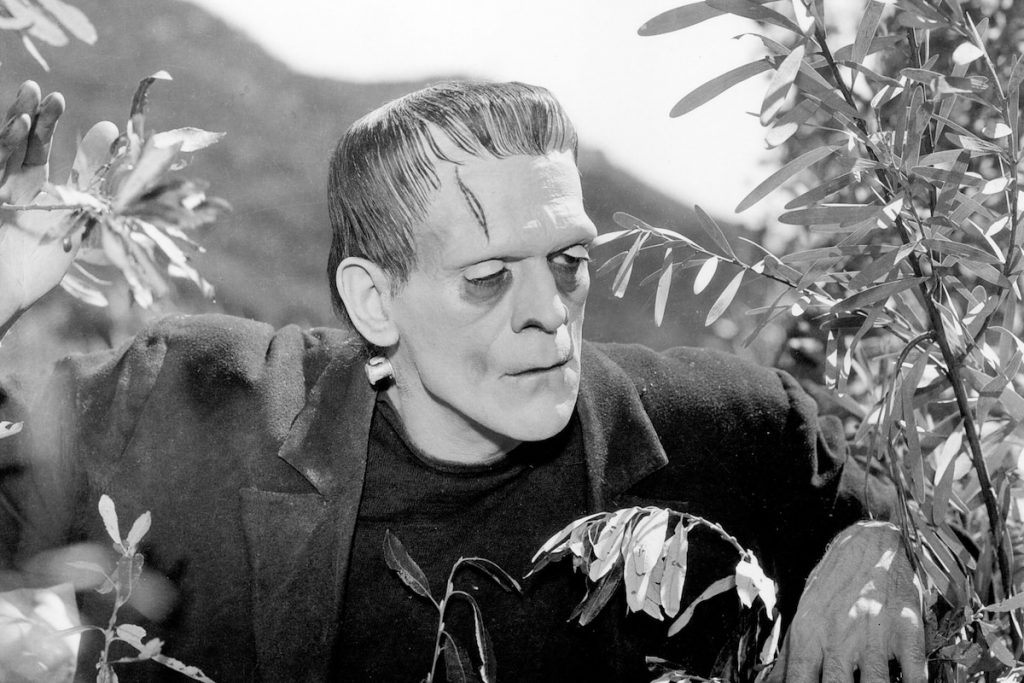
Boris Karloff’s performance, built under Jack Pierce’s painstaking makeup design, is one of those rare cinematic miracles where limitation becomes mythology. The flat head, the heavy eyelids, the bolts and stitches, none of it works as spectacle without Karloff’s physical presence and control. What he brings is something profoundly delicate. The Monster isn’t evil. He isn’t even fully formed in the moral sense. He is awareness arriving too suddenly in a world that already decided what he is. His movements are heavy but uncertain, like a body still negotiating its own existence. The way he tilts his head, the way his hands hover instead of grasp, it all reads like an intelligence booting up in real time. When he first steps into the light of the laboratory, there’s no menace. Just confusion. A kind of stunned curiosity, like being born inside a thunderstorm and immediately blamed for the weather.
The real horror of Frankenstein isn’t the resurrection itself. It’s what happens immediately after. Henry’s dream collapses into disgust the second the creature stops being an idea and becomes real. Responsibility evaporates. The experiment is suddenly something to hide, not nurture. The Monster is thrown into confinement, poked at, contained, and effectively abandoned by the only being who ever claimed ownership of him. Fritz, the sadistic assistant, adds a layer of cruelty that feels almost petty in its casualness. The torch scenes, the torment, the deliberate provocation, it’s all small-scale evil, the kind that doesn’t announce itself with screams but with laughter. And it matters, because it reinforces the film’s central truth: the Monster isn’t born violent. He is shaped by every reaction he receives. He is a mirror reflecting the ugliness of his creators.
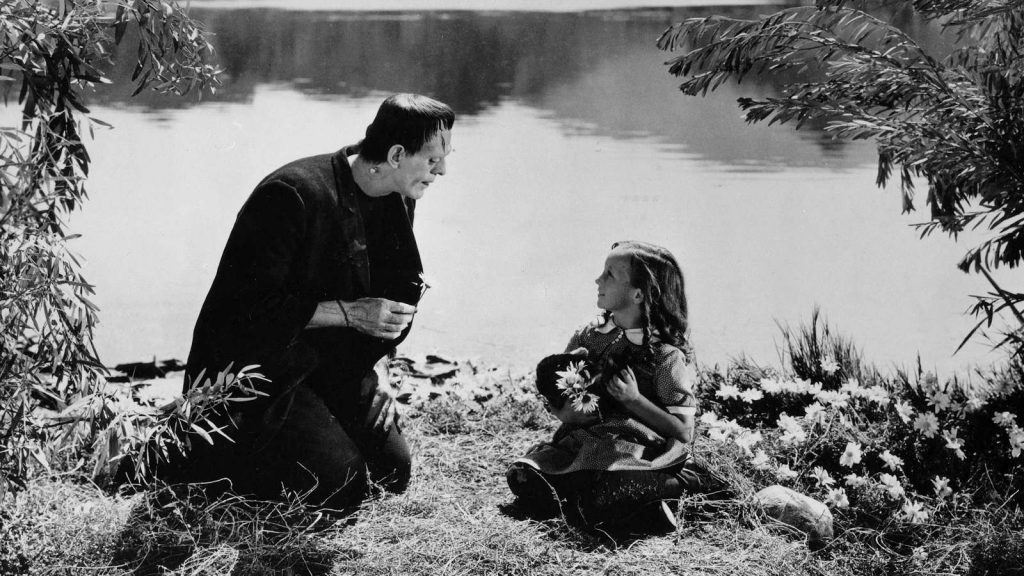
That theme crystallizes in the lakeside sequence with the little girl, Maria. It remains one of the most quietly devastating moments in early horror cinema. Hell, in all horror cinema. Stripped of context, it could be mistaken for innocence itself: a lonely creature and a child sharing a moment of play. She is unafraid. She accepts him. There is no instinctive rejection, no inherited panic. Just curiosity meeting curiosity. The flower game is almost absurdly gentle. Tossing petals into water as if testing how fragile joy can be before it sinks or floats. The Monster, operating on incomplete understanding, participates with something like happiness. Not the human version of happiness, but its rough silhouette. When the flowers run out, logic misfires. In his world, objects behave consistently. If flowers float, then so should Maria. The act that follows isn’t malice, it’s a catastrophic misunderstanding of physics by a being that was never taught how to live.
The censorship history around this scene only reinforces its impact. For years, it was softened, cut, or avoided entirely because it refused to sit comfortably within the general public’s boundaries. But its presence in the film is essential. It’s the moment everything tilts. The Monster stops being a threat and becomes something far more unsettling: a victim of interpretation. A being whose actions are horrifying precisely because his intentions are not. From there, the film stops asking whether he is dangerous and starts asking why anyone would expect him not to be. He has learned that the world is a place where things break, where things drown, and where people scream. He is just reflecting the lesson.
The mob that forms afterward is where Frankenstein sharpens into full allegory. Torches in the night, bodies moving as one angry organism, voices dissolving into collective certainty. It’s less a group of individuals and more a system of judgment that has decided it already understands the truth. The irony is unavoidable: the Monster is being hunted for a crime that only exists because of how the world taught him to behave. He is the scapegoat for Henry’s scientific vanity and the village’s collective fear of the unknown. Whale orchestrates this with brutal clarity, using the mob as a visual representation of a society that would rather burn its problems than understand them.
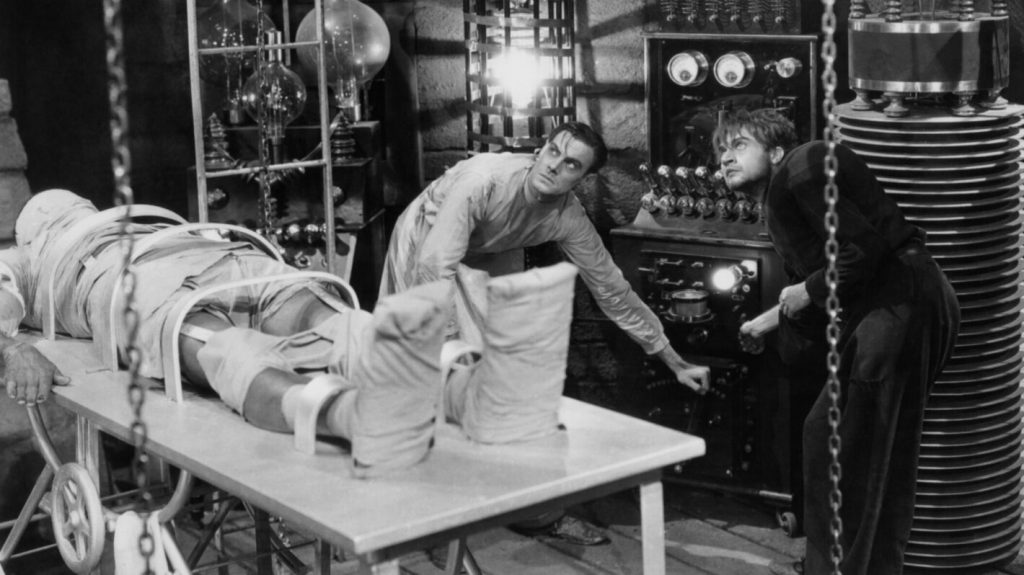
Visually, Charles D. Hall’s production design turns the laboratory into a cathedral of forbidden engineering. Towering stone walls, sparking machinery, and the iconic electrical apparatus designed by Kenneth Strickfaden give the entire space a ritualistic quality. This is not just science, it’s a ceremony with better wiring. The sheer scale of the set makes Henry and Fritz look like ants crawling over the machinery of the gods. It reinforces the theme that they are out of their depth. Sound design, limited as it was in early talkies, becomes strangely powerful because of its restraint. The absence of music in key sequences forces attention onto the mechanical heartbeat of the lab: crackling electricity, humming currents, the sudden violence of activation. Silence becomes part of the atmosphere rather than a gap in it. Everything feels exposed.
Whale’s camera work is surprisingly mobile for its era. At a time when sound recording often anchored productions in static framing, he pushes angles, depth, and perspective. Low shots turn the Monster into a looming landscape. High shots reduce human figures into fragile geometry. The result is a visual language where scale constantly shifts depending on who holds power in the moment. When Karloff is on screen, he owns the space. When the mob arrives, the world shrinks around him.
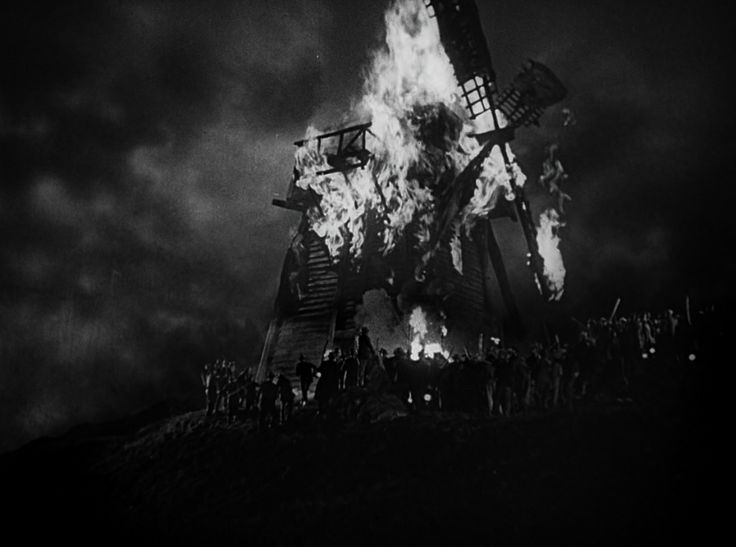
The climax is pure elemental chaos, but it’s also strangely symbolic in its simplicity. Fire versus creation. Old world superstition versus new world ambition. The Monster trapped inside the burning structure doesn’t die with triumph or resolution. He dies afraid. Not monstrous, not triumphant, just afraid. The image is almost unbearable in its honesty. A life that never asked to exist being erased inside the very symbol of human progress. The wooden gears of the mill, churning away while the fire consumes the creature, serve as a cold reminder that the world keeps turning whether we survive our experiments or not.
What lingers isn’t just tragedy, but a profound exhaustion. The sense that something irreversible has happened and nobody really knows how to process it. Frankenstein’s legacy only deepens that unease. It became the foundation for Universal’s entire horror universe, shaping everything from sequels to spin-offs, most notably The Bride of Frankenstein, which would push Whale’s thematic obsession even further into questions of companionship and rejection. But the original film remains the purest expression of the idea: that making life without responsibility is not innovation, but negligence with better branding.
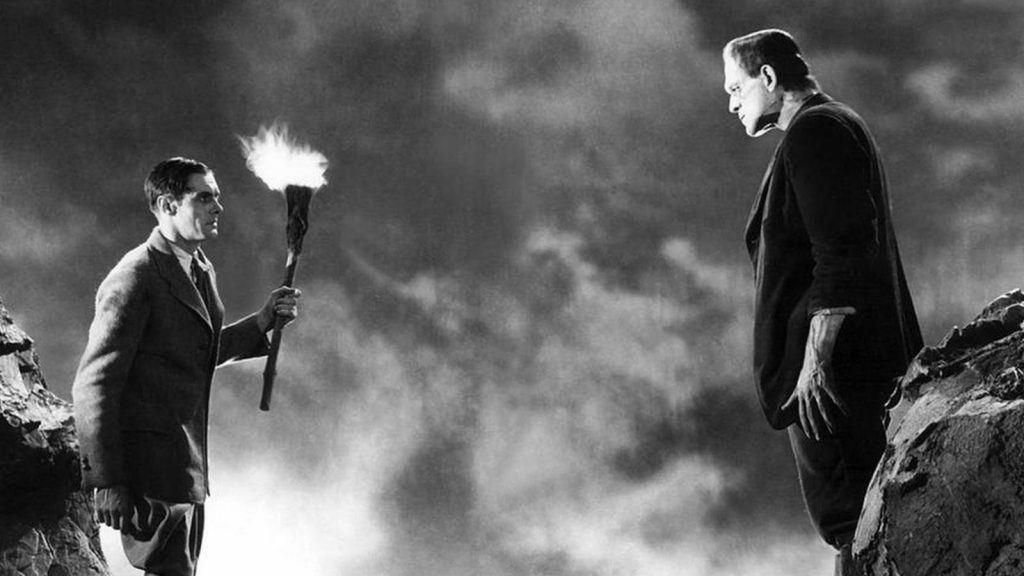
The cultural footprint is unavoidable. Every mad scientist trope, every lightning-struck laboratory, every stitched-together creature struggling to understand its place in the world, it all loops back here. But imitation misses the point. The film isn’t memorable because of its imagery alone. It’s memorable because it refuses to simplify its own morality. There is no clean villain. There is no clean hero. There is only action and aftermath, cause and consequence, stitched together like something that was never meant to hold. At its core, Frankenstein is less about science than ego. It asks what happens when intelligence outpaces empathy and when creation outruns care. Nearly a century later, it still feels alive in the worst possible way. Not because it scares you, but because it understands you. And once it understands you, you have nowhere left to hide.
Leave a Reply