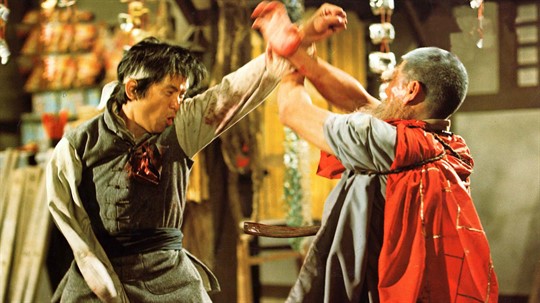
Some films aim for polish. Some films aim for awards. The Master of the Flying Guillotine aims for straight for your fucking head. Directed by and starring the one and only Jimmy Wang Yu, this follow-up to One-Armed Boxer takes a straightforward premise, revenge, and builds it into a series of encounters that feel increasingly unrestrained, as if each scene is trying to outdo the last. It is a feral, grindhouse-bred spectacle that makes modern action cinema look overly rehearsed.
This isn’t a continuation of the One-Armed Boxer story, it’s escalation, pushing the original’s ideas past their limits and into something far more volatile and incredibly violent.
And I am all for that.
The Villain: A Man, A Mission, A Hat That Ends Careers
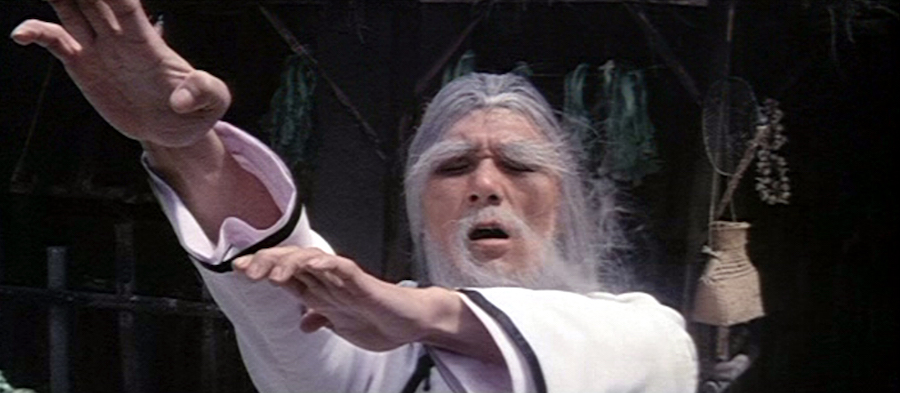
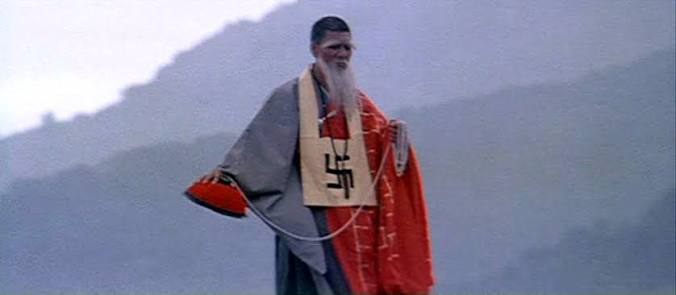
Feng Sheng Wu Chi is a blind monk, an assassin, and an all around walking vendetta. When we meet him, he’s living in isolation, training, listening, bothering birds by slicing them up, and existing entirely in a world built out of sound and rage. He discovers thar his two students were killed by the One-Armed Boxer in the previous film and that’s all the motivation he needs.
What follows is a roaming campaign of violence driven by one very specific goal: find the man responsible and remove him from existence. The catch? He’s blind, and he’s relying entirely on the slightest noise, his instinct, and a weapon that turns every encounter into a guessing game of who’s noggin is going in the bag.
He doesn’t posture. He doesn’t monologue. He moves and murders. There’s something deeply unsettling about how matter-of-fact he is.
And then there’s the weapon.
The Weapon
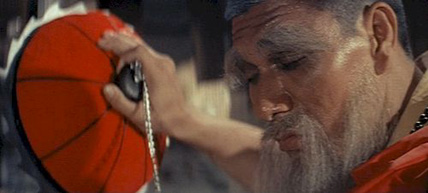
The flying guillotine is one of those ideas that sounds like a joke until you see it in motion. It’s a hat-like device on a chain with very sharp fucking blades inside it, that gets thrown, lands, and removes the head from the shoulders, leaving behind a bloody, spurting neck stump.
There’s no attempt to explain it beyond ‘This is what it does, ain’t it fucking cool?’ And that, quite frankly, is enough. The film embraces the idea fully, which is why it works. It doesn’t need logic, it needs consistency. Once you understand what it does, every scene becomes about distance, timing, and if the guy being hunted is about to get one hell of a haircut.
From a filmmaking perspective, it’s exactly the kind of ingenuity that defines this era. You can see how it’s done if you look closely, but that doesn’t matter. What matters is that it feels physical. When it lands, it lands. You also hear it before you see it, a whoosing sound that signals your doom, and it fits perfectly with a villain who might be as blind as a bat, but can fuck you up seven ways from Sunday before you’ve even had the chance to think ‘Huh? What was that noise?’
The Fighting
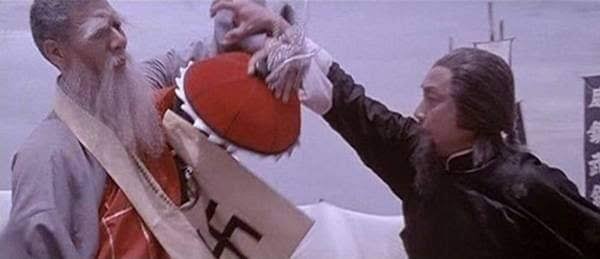
There’s a lot of fighting in the Master of the Flying Guillotine. As you would expect there to be, otherwise it’d just be a movie about a guy, wandering around, with the weirdest looking headwear since Isambard Kingdom Brunel realised he was a short ass and decided to add about a foot via his hat choice.
The One-Armed Boxer himself is now a teacher, running a school and passing on what he knows. He’s not trying to prove anything anymore, and that’s important. He’s already survived his origin story. So now he’s just chilling out and dropping his knowledge. Yet fate, as always, has other ideas and sends a very angry blind dude after him, as well as a cast of characters who are either after him for pay, or because he’d be a hell of a notch on their legacy.
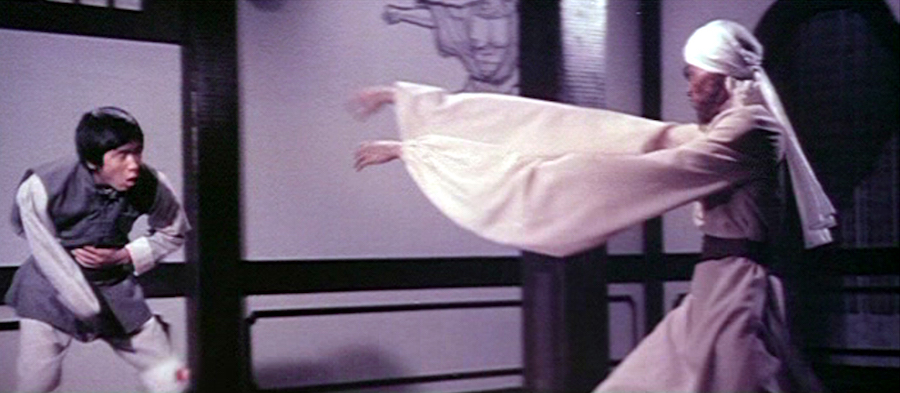
The Yoga Master: A fighter whose arms extend far beyond normal human limits, striking from distances that shouldn’t be possible.The effect is simple, but that simplicity is part of the appeal. It’s not trying to fool you completely. It’s showing you something strange and committing to it.
Honestly, this guy is one fireball away from being Dhalsim.
Muay Thai Man: This brother is all about the impact. No tricks, no illusions, no arms that could strangle you from another room. He’s all knees, elbows, and forward pressure. Every strike is deliberate. He’s there to represent force. Direct, efficient, and hard to stop once it gets going.
The Japanese Fighter: Armed with a segmented weapon, he is precise in his movements, controlled in his approach. He fights with the confidence of someone who knows exactly what his abilities are and how to use them.
These three men show that there are other ways to fight, that styles that meld together well, make for entertaining scraps. And, also, that it doesn’t matter who you are, Jimmy Wang Yu can still kick your arse, even with one arm tied behind his back.
Jimmy Wang Yu
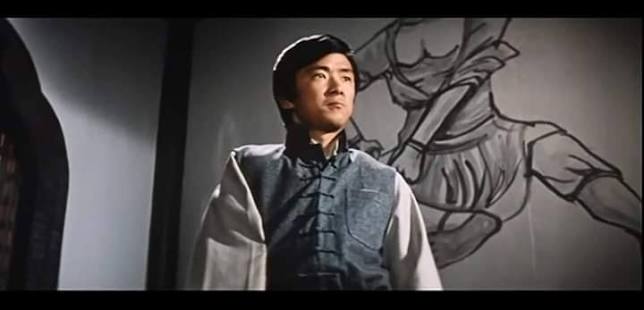
Jimmy Wang Yu’s performance keeps Master of the Flying Guillotine steady. The film leans into escalation and excess, but he plays it with restraint rather than theatrics. He doesn’t rely on spectacle. What he has is awareness of space, of timing, of limitation. One arm isn’t framed as a weakness or a badge of honor. It’s just a condition he’s adapted to.
That’s what defines him. Adaptation.
When faced with something like the flying guillotine, he doesn’t try to overpower it. He studies it, he learns its movements and the movements of the man wielding it, and then he figures out where both fail.
He’s not the loudest presence in the film, but he’s the one holding it together.
The Rumble In The Undertakers
The last act boils everything down to a single problem: how do you defeat someone who can kill at any range, who doesn’t need sight, and who has already proven that hesitation is lethal?
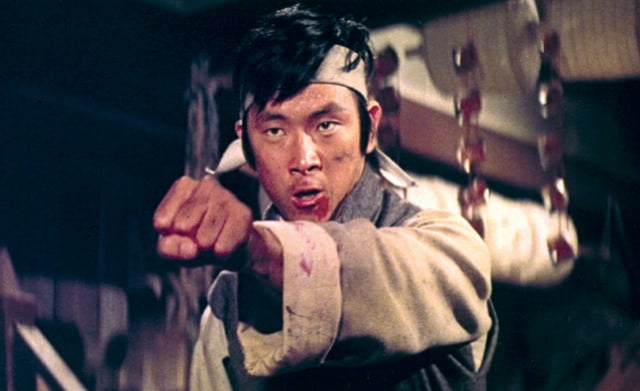
Yu Tien Lung doesn’t meet him in an open field, as he isn’t an idiot who is eager to lose his head. Instead he brings him somewhere controlled, a coffin shop. A place with tight spaces, hard surfaces, and limited movement.
From there, it becomes a matter of him using the environment to his benefit. Every decision he make is about reducing the advantage of the guillotine and forcing the fight into a spot where it’s far less effective.
It’s not flashy. It’s methodical, even when be is running up a wall, and when the fight finally ends with The Master as dead as the dodo, you realise that it all happend from his understanding of the situation, not luck.
Commitment To The Bit
This is a film that commits fully to what it is. It doesn’t step back to explain itself or smooth out its rough edges. If something works, it pushes it further. If something is strange, it lets it stay strange.
The violence is excellently done. The pacing shifts when it needs to, then accelerates again without warning. The dubbing, the sets, the effects, they all carry that slightly uneven texture that mark a lot of films from this period, and instead of sanding that down, it leans into it.
There’s a sense of unwavering belief in what the film is doing. It introduces a concept, builds rules around it, and then explores those rules through movement and conflict. It doesn’t rely on complexity. It relies on execution. The flying guillotine is a simple idea, it’s a weapon with a clear function. So, everything else builds outward from that.
Yu Tien Lung’s approach is just as simple: observe, adapt, respond. That balance is what keeps the film from collapsing under its own hubris.
Why I Love It
Outside of the fact that it’s about a blind geezer with anger issues and his flying hat that chops peoples heads off, you mean?
Because Master of the Flying Guillotine isn’t interested in refinement. It’s interested in telling a story. It also throws its ideas forward and trusts them to land.
Some of those ideas are weird beyond comprehension. Some are as rough as a ball shave with sandpaper. But all of them are delivered with complete confidence.
It’s a film where a blind assassin hunts his target with a weapon that shouldn’t exist, where fighters bend the rules of the body, and where the final victory comes from understanding the place you’re in better than the person trying to kill you.
If you’re even slightly interested in martial arts cinema that pushes past the expected and into something more unpredictable, this is essential viewing.
And if you hear the chain ring out, don’t bother looking around to find out where it’s coming from or you’re already dead.
Leave a Reply