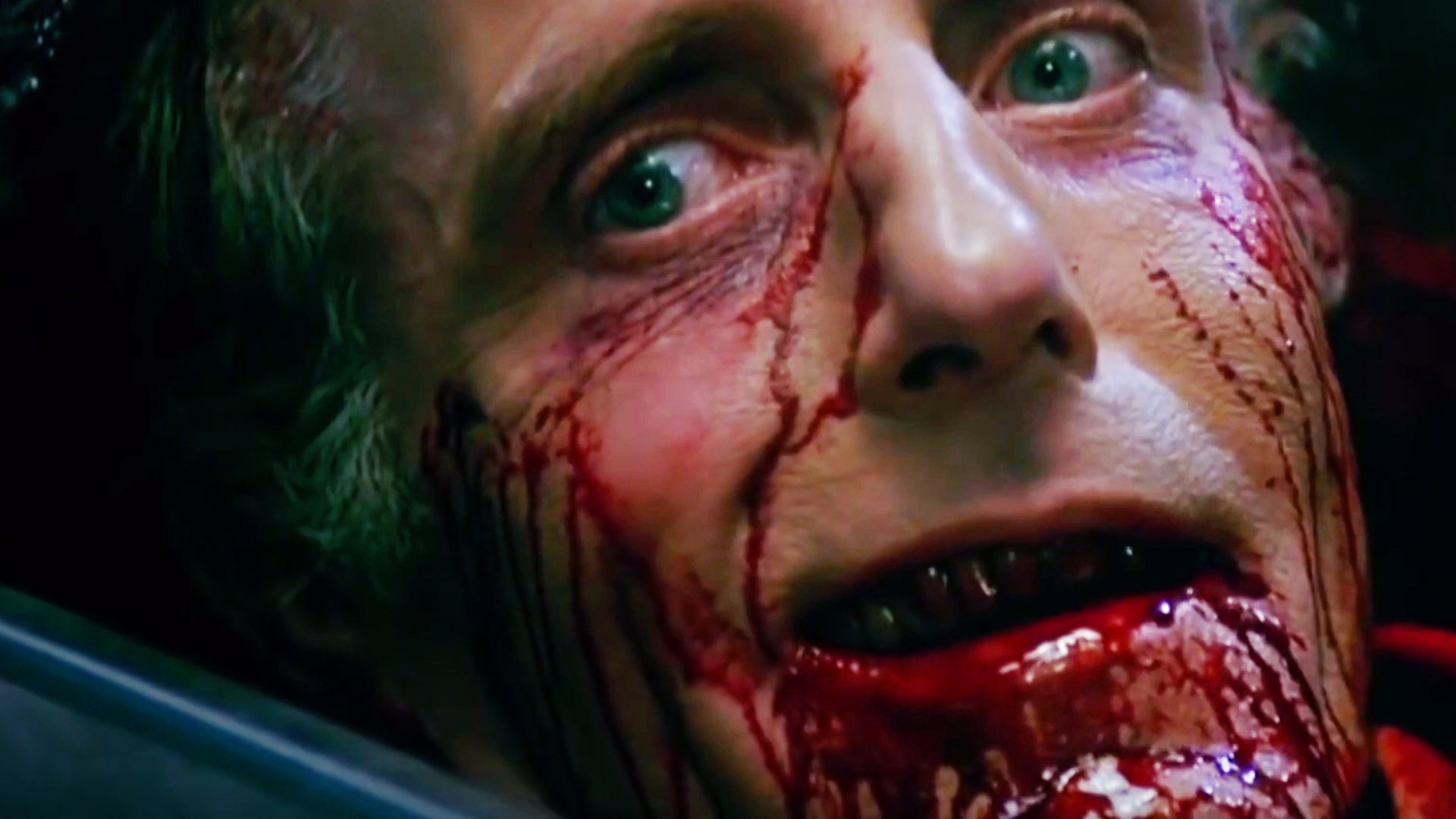
There are horror films, and then there are movies that feel like they escaped from heavy security. Re-Animator is one of those films. It does not unfold so much as detonate. Watching it for the first time feels less like sitting through a traditional narrative and more like accidentally injecting fluorescent chemicals directly into your nervous system while a screaming madman performs surgery in the next room. Nearly forty years after its release, it still carries the power to shock, disgust, and completely overwhelm audiences in ways most modern horror films can only dream about.
And the truly miraculous thing is that it somehow gets funnier every single year.
Directed by Stuart Gordon and loosely inspired by H.P. Lovecraft’s serialized story, the film arrived in 1985 like a severed head crashing through a stained-glass window. Horror was in a healthy place during the mid-80s. Slashers ruled the video stores and practical effects artists were becoming underground celebrities, but Re-Animator felt different immediately. This was not just another horror movie trying to outdo its competitors with body counts or cheap shocks. It was meaner, smarter, and more specific. It managed to be both sophisticated and juvenile at exactly the same time. It is an honest-to-God horror high-point made by people who clearly thought the phrase too far was a personal insult.
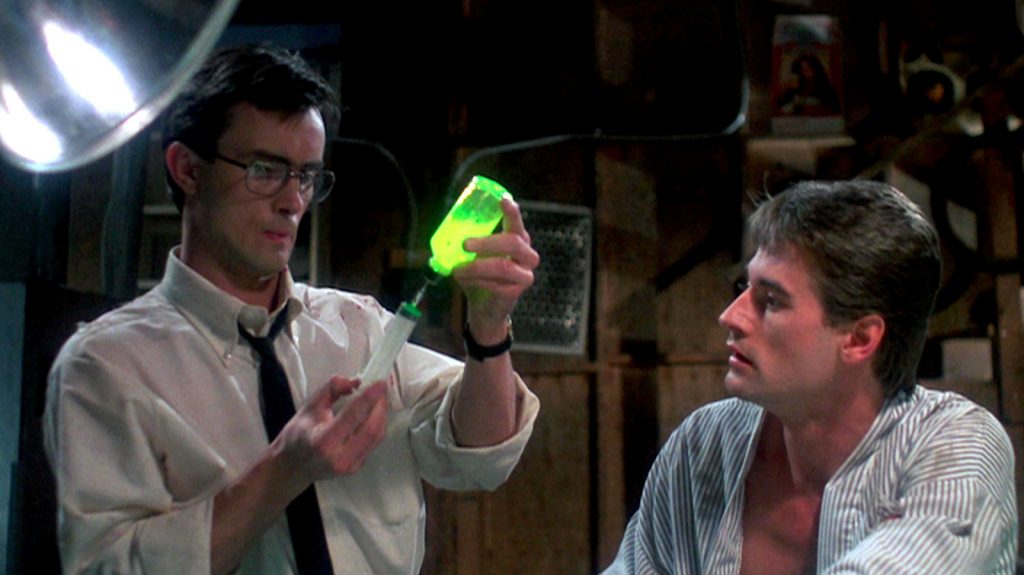
The setup is deceptively simple. Medical student Herbert West arrives at Miskatonic University after a deeply suspicious incident in Switzerland involving a dead professor and some glowing chemicals. West is brilliant, antisocial, obsessive, and carries himself with the energy of a man is supicious that even the shadows are talking about him behind his back. He quickly befriends fellow medical student Dan Cain, mostly because Dan happens to own a house with convenient basement space for illegal corpse experiments. As premises go, it is already magnificent.
But what elevates the film beyond cult curiosity is the character of Herbert West himself, brought to life by Jeffrey Combs in one of the greatest performances in horror history. Combs plays West like an overcaffeinated alien pretending to understand human interaction through observation alone. Every line delivery lands with clipped precision, every glare feels faintly homicidal, and every argument sounds like he is one step away from reanimating the dead purely out of spite. Lesser actors might have leaned into cartoon villainy, but Combs approaches West with absolute sincerity. In his mind, Herbert West is not insane. Everyone else is simply too stupid to appreciate his genius.
West is not evil in the traditional sense. He is something worse: he is intellectually arrogant. Morality barely enters the equation because morality is inefficient. The dead should live again because he can make it happen, and anyone objecting is simply delaying progress. He is a classic mad scientist filtered through 1980s lens, all sharp edges and twitchy contempt. The visual design of the character only amplifies this. The black-rimmed glasses and the clinical detachment make him look like someone who would absolutely keep human organs in a student refrigerator next to expired yogurt.
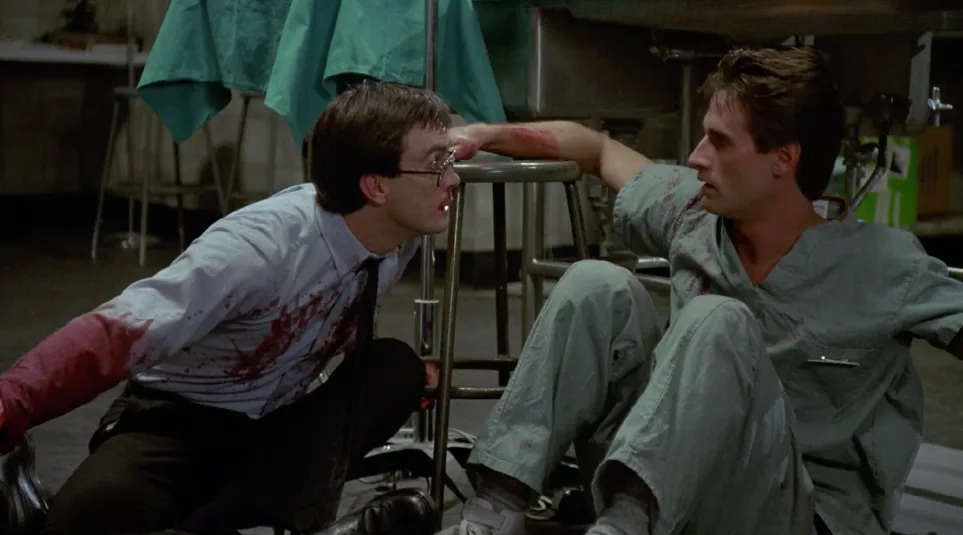
There is also something deeply funny about how utterly unimpressed Herbert West seems by normal human emotion. Romance, grief, panic, ethical concerns, social boundaries, all of these things appear to annoy him because they interrupt the experiment. Dan Cain spends large portions of the film reacting like a normal human being confronted with escalating insanity, while West reacts like somebody mildly irritated that the paperwork has become inconvenient. That contrast becomes one of the film’s secret weapons. Dan is the audience surrogate, slowly realizing he has allowed an undead chemistry goblin to move into his basement.
Bruce Abbott deserves far more credit than he usually gets for this. Playing the normal character in a film this deranged is incredibly difficult because somebody has to ground the craziness without becoming boring. Abbott pulls it off perfectly. Dan feels perpetually exhausted, horrified, and constantly on the verge of a stress-induced aneurysm at all times. His growing desperation gives the film emotional momentum even as the narrative spirals into total lunacy.

And then there is Barbara Crampton as Megan Halsey, who brings genuine warmth and humanity into a film otherwise drenched in fluorescent corpse fluid. One of the reasons Re-Animator works so well is because the cast never approaches the material with irony. Nobody winks at the audience. Nobody behaves like they are above the film. Crampton especially plays everything completely straight, which somehow makes the horror around her even more effective. When the film descends into hell during its final act, her grounded performance helps stop the movie from floating away entirely into self-parody.
Once the reanimation experiments begin, the film launches into another realm. The genius of Re-Animator lies in how aggressively it uses escalation. Most horror films build carefully towards the money shots, but this movie straps itself to a rocket and fires it through the ceiling within the first twenty minutes. Every scene exists to top the previous one in either gore, absurdity, or sheer bad taste. A corpse does not just revive; it convulses violently, screaming and flailing like existence itself is physically painful. A cat resurrection scene transforms domestic pet ownership into a demonic assault course. Decapitated heads continue speaking and limbs attack people independently.
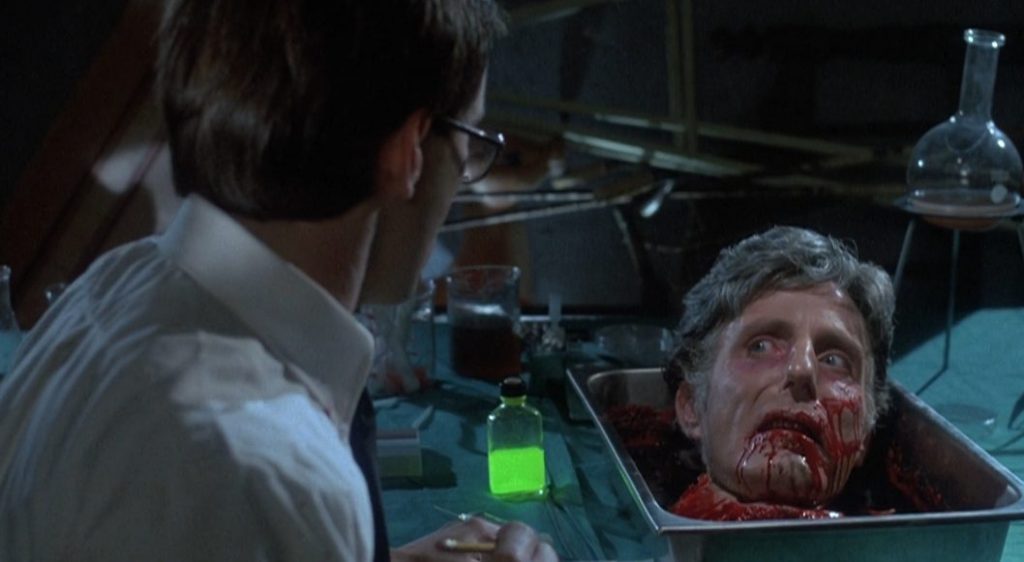
What makes these scenes so effective is the sheer audacity of them. Modern horror often relies on digital effects that feel souless, but Re-Animator understands that horror should feel sticky. You should feel like you need a shower afterward. Every creature in the film looks unpleasantly undead in the best possible way, every operating table appears contaminated, and every syringe seems capable of giving you fourteen new diseases just by looking at it. The film’s world feels unhygienic.
All of this is achieved through SFX that still look astonishingly good today. This is where the film becomes genuinely important rather than merely entertaining. The effects work is physical, and unpleasantly organic. Every effect appears to occupy real space and time, covered in slime, blood, and industrial quantities of dubious fluid. Many horror films use gore as punctuation, but Re-Animator uses it as a full sonnet. One severed head sequence in particular remains legendary for its complete commitment to the cause. It is tasteless, outrageous, and hysterically funny. The film constantly balances on a razor-thin line between horror and farce without ever falling to its death.
That balancing act comes largely from Stuart Gordon’s direction. Gordon understood that the comedy works best when nobody inside the movie realizes they are in a comedy. The characters treat every grotesque development with deadly seriousness. West is not cracking meta one-liners while intestines fly around the room; he is fully committed to his work. Gordon also brought an incredible sense of pacing. Re-Animator moves like it is being chased. At barely eighty-five minutes, the film wastes no time. There are no indulgent subplots or unnecessary detours. Every moment either advances the story or hurls another bucket of blood at the audience.
It also helps that Gordon directs the film with the energy of someone who genuinely cannot believe he is being allowed to make it. There is a contagious enthusiasm pulsing through every frame. The camera lunges into scenes, the editing keeps everything moving at a manic rate, and the movie constantly feels on the verge of spiralling, withoht ever missing a step. That sensation gives Re-Animator its personality. You are not watching a carefully planned studio horror product; you are watching a group of lunatics seeing how far they can push an audience before somebody gets so grossed out that they leave the theater.
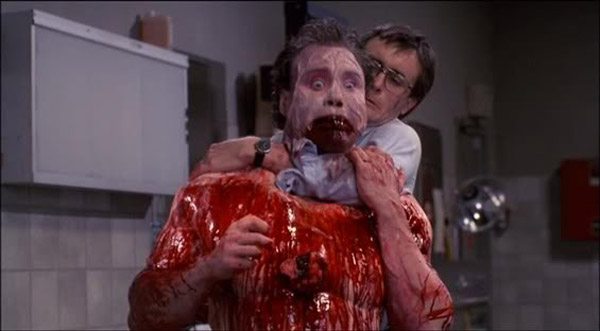
The film’s origins in Lovecraft are fascinating because it barely resembles what most people associate with Lovecraftian horror. When audiences think of that style, they imagine ancient gods and protagonists collapsing into insanity after glimpsing incomprehensible truths. Re-Animator takes one look at that material and decides to add chainsaws and severed heads instead. It works perfectly. The original stories were already unusually pulpy, but Gordon pushes everything into exploitation territory while retaining the core thematic obsession of scientific arrogance destroying humanity from within.
In many ways, Re-Animator seems rebellious toward Lovecraft himself. Lovecraft’s work is often deeply cold and pessimistic, obsessed with humanity’s insignificance in a vast and uncaring universe. Re-Animator takes that, sticks a couple of fingers up, and squeezes it through a meat grinder. The universe may still be horrifying and indifferent, but Gordon’s response is to spray it directly in the face with glowing green chemicals and see what happens.
At its core, Re-Animator is about genius disconnected from empathy. Dr. Carl Hill serves as West’s grotesque mirror image, representing corruption hidden behind academic respectability. Their rivalry transforms the film into a war between the two, until Hill literally loses his head. Few films understand the entertainment value of decapitation quite like this one. Heads are not merely removed; they become active participants in the narrative. The sheer audacity of these sequences still feels transgressive because the film refuses restraint.
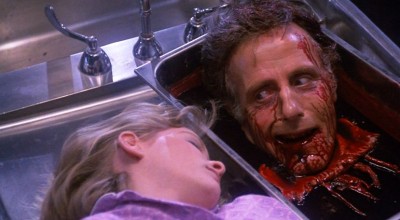
David Gale’s Hill is pompous, manipulative, creepy, and increasingly ridiculous as the film progresses, yet Gale commits to every moment with absolute conviction. By the time the character evolves into a ranting severed head controlling a corpse like some deranged biological puppeteer, the movie has completely abandoned reality and entered its own beautiful nightmare logic.
The craftsmanship remains remarkable throughout. The lighting drenches scenes in sickly greens and harsh laboratory whites that evoke classic gothic horror while maintaining a 1980s aesthetic. The glowing serum itself becomes a visual signature, a neon green substance that screams bad idea every time it appears. The score by Richard Band also plays a massive role. By mirroring the Psycho theme while twisting it into something mischievous, the music gives the film a playful, haunted carnival energy.
The production design deserves enormous credit too. Miskatonic University feels like a real place despite being populated almost entirely by reanimated corpses. The laboratories are cluttered with strange equipment, flickering lights, and enough suspicious-looking machinery to power a small dictatorship. Every room feels lived in, and slightly unsafe. The film creates an atmosphere where disaster feels inevitable from the moment Herbert West walks through the door.
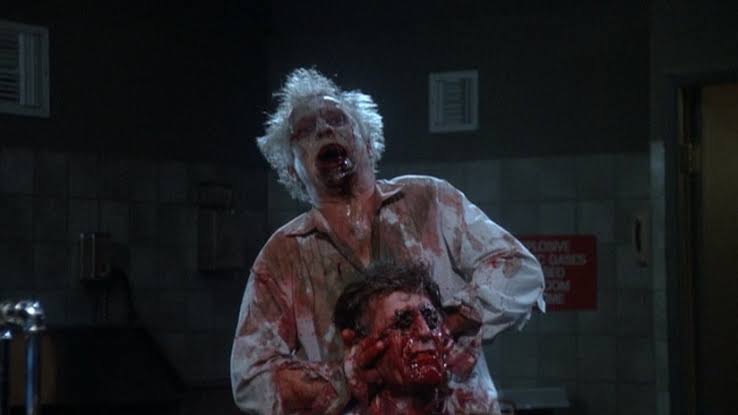
One thing that becomes increasingly impressive with age is how fearless the movie is. Re-Animator does not care about respectability. It does not care about good taste. It certainly does not care about playing things safe. Modern horror sometimes feels terrified of being perceived as silly, but Re-Animator understands that horror and absurdity have always been close relatives. The genre works best when it embraces excess. The bloodier, stranger, and more emotionally unhinged things become, the more memorable the experience is.
This movie remains a defining example of cult horror because it captures the feeling that drives people to fall in love with the genre. It is the feeling of discovering something forbidden and strange that looks like it should not exist. Watching it for the tenth time feels like reconnecting with a dangerously unstable old friend who gets more entertaining every year. Herbert West still stands at the center of it all, clutching his glowing green serum like a man who looked directly at morality and decided it was simply slowing down his experiments.
Cinema needs more lunatics like that.
Leave a Reply