
As a horror fan, whenever I mention enjoying any specific monster movie, I’ve grown used to having another horror fan pop out jump scare-style to say, “I like slasher movies because they’re realistic. It’s something that could really happen!” If you “just don’t relate” to people facing monsters, films like Renfield (2023) (screenplay by Ryan Ridley, story by Robert Kirkman, directed by Chris McKay) are coming to the rescue! Renfield the movie shows you Count Dracula (Nicolas Cage) through the eyes of Renfield the character (Nicholas Hoult), and this is what brings humanity to the vampiric proceedings.
Speaking strictly in literal terms, the fear of being stabbed by a knife is closer to most people’s sense of reality than the fear of being pursued by a vampire.
Even so, though…when have so many stories across genres and media, including horror, ever spoken in strictly literal terms?
Perhaps you’ve never faced Count Dracula…or maybe any vampire at all. Have you ever been a target of someone much more powerful than you are? Have you ever faced something or someone alone because no one would believe you if you told them or, if someone did, they wouldn’t be able to help you…or you wouldn’t want them to because they could get hurt?
Have you ever had to make a choice: follow the orders of someone with influence and they’ll give you some crumbs to reward you, or stand up for yourself and others, and…let’s just say, get on their bad side?
“Influence” takes many forms. They have authority. They have connections.
Are we getting closer to being on the same page?
Renfield zeroes in on Count Dracula’s personality as a crucial part of its story. Dracula is not just a threat because he’s a vampire. Take the vampirism away, and he’s still an intelligent, calculating, sadistic, manipulative man. A man you should steer clear of. Give this man vampiric powers…and you’d better start adding “garlic chic” to your everyday wardrobe.
I often find in artistic endeavors that the more specific you get, the more universal it becomes. I described someone “with influence” who decides to turn that influence against you. Renfield gets so specific that the film—specifically, Mark (in a hilariously earnest turn by Brandon Scott Jones), the head of a self-help “anonymous” group—calls it out by name.
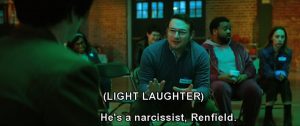
While we may or may not have encountered someone with Narcissistic Personality Disorder (and we’re not going to “diagnose” anyone here), whether an authority figure, family member, significant other, friend, or someone else entirely, we’ve all had to deal with someone who has narcissistic tendencies. In fact, this experience is so relatable that those aspects of Renfield were the focus of an episode of “Cinema Therapy”: a YouTube series hosted by Alan Seawright, “professional filmmaker who needs therapy,” and Jonathan Decker, “licensed therapist who loves movies.” (This episode also features Robert Kirkman as a guest.)
One of the brilliant parts of framing the story this way is that those who’ve seen Dracula movies or read the novel will recognize Renfield’s Dracula as the same Count from page and screen. Renfield doesn’t need to change Dracula’s character in any significant way to fill this frame…though there’s a lovely joke about which victims Dracula “prefers” that goes against what some media portrays.
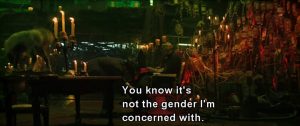
Much of the comedy comes from the contrast between Dracula’s evil and old-fashioned formality and the modern characters he’s up against, who have more casual language and, in one of the funniest and most emotionally charged scenes, come armed with “therapy speak.”
Whether we’re talking about mental health, filmmaking, storytelling, or any other subject, the language of and information about each career, study, hobby, or other pursuit is quickly becoming ever more accessible. Language like “affirmation,” “codependent,” and “grow to full power.”
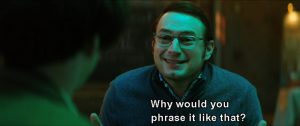
Knowledge is power (not to be confused with “full power”), but a little knowledge is a dangerous thing. Knowing the language is a great start…and it’s just that: a start.
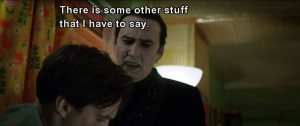
The aforementioned scene, between Renfield and Dracula in Renfield’s apartment, demonstrates this and is one of the most memorable in the movie. It has several moments reminding us of Dracula’s vampiric side: an unfortunately-placed welcome mat, a hilariously macabre “martini,” and the talk of “victims,” to name a few. But, during Dracula’s conversation with Renfield, he doesn’t use any of his powers.
Instead of Count Dracula, you could have replaced him with an everyday human…though still played by Nicolas Cage. This scene fully capitalizes on the film’s focus on Dracula being scary not because he’s a vampire, but because he’s a narcissist…who’s also a vampire. He may be slightly delusional…but with his vampiric powers, are his world-dominating delusions really that delusional?
Dracula doesn’t hypnotize Renfield, drain his blood, or use his own superhuman strength. He whacks a vase off a counter, shattering it, which most humans could do. In fact, many humans with similarly toxic personalities would do something like that to lash out and intimidate. He goes from quiet, manipulative, condescending “understanding” to yelling and accusing, before reining himself back in. Then, he uses his deep knowledge of Renfield to keep his servant in check: knowing where the cracks in Renfield’s newfound armor are, he slips a knife of a comeback into them and cuts Renfield deeply. No vampiric power needed.
This is where the second part of that saying about “a little knowledge” comes into play. Renfield has more of an understanding of his low self-esteem, his codependency, and how to defend himself against Dracula’s narcissism…in theory. Knowing something in theory doesn’t always translate to being able to apply it in practice—especially if you’ve never done it before. And poor Renfield has clearly never stood up to his toxic boss.
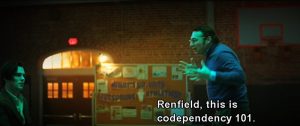
Armed with just a book and some shaky confidence, Renfield’s strategy is so by the book (literally) that he physically gets backed into a corner and shrinks when Dracula isn’t phased by his newfound “therapy speak.” In other scenes, you can see Renfield switch from trying to nudge Dracula toward another path to retreating to the well-worn path he knows so well. He knows how to tell his boss exactly what his boss wants to hear.
But in this moment, he doesn’t want to revert to the well-worn path. To Renfield’s credit, he doesn’t fully retreat. At the same time, though, he doesn’t have the confidence, strength, or flexibility to maintain his stand against this narcissist. It’s a simultaneously hilarious and emotionally impactful scene, ending with Dracula figuring out just how to add the final blow to shatter Renfield’s newfound self-worth.
While Dracula and Renfield are in a codependent relationship, actors are very often interdependent on each other’s performances, and that’s especially true in Renfield. Nicolas Cage dances strategically around the line between comedic and creepy, zig-zagging across it and even walking along it like a tightrope. Cage’s performance keeps you on the edge of your seat, watching and waiting for his next hilarious move…which keeps you off your guard enough that his vicious moments cut deeper. It’s a treat to watch.
But, Cage’s performance wouldn’t have such a powerful effect without Nicholas Hoult’s performance of Renfield toeing his own line between comedic and heartfelt. Hoult imbues Renfield with constant nerves and constant scrambling for precisely the right words and actions as he simultaneously faces Dracula and the battle within himself between groveling toward his boss and standing for himself and his own morality. But in the same “vein” (pun intended), Hoult’s heartfelt performance would look pathetic without such a threatening Dracula.
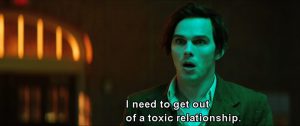
That scene and the film as a whole show how hard it is for anyone to escape from under Dracula’s thumb, and how it’s even harder for a codependent with low self-esteem like Renfield. But how did he fall under Dracula’s thrall in the first place?
A scene that’s even more understated and adds so much to the story and Renfield’s character answers that question. Renfield and Officer Rebecca Quincy (Awkwafina) (named for the American character in the Dracula novel) wait for Rebecca’s sister at an outdoor café. While the opening of the film gives us a delightful montage of Renfield’s early days with Dracula, we don’t see his life before he met the Count or what exactly it was that convinced him to willingly become Dracula’s servant. This scene delves into the “why,” giving us valuable insight into Renfield.
In Renfield’s own words, he was greedy and wanted a better life for his family and himself. He had breakfast out with his family before leaving to meet the Count, knowing a real estate deal with a wealthy Count would give them a better life…and, from what the film and Hoult’s performance imply, never saw his family again. This opens up a whole new dimension to his character. Despite leaving his family behind, he still has a picture of them handy after nearly a century. Did he ever check on them from afar? When he started seeing Dracula’s more toxic traits, did he avoid them to protect them? When and how did he fully realize the weight of his actions? Did that make his low self-esteem spiral even lower? Did Dracula ever threaten them if Renfield disobeyed him? Does Renfield’s daughter or do his other relatives have family and descendants alive in 2023?
While the answers to these questions are left a mystery, this scene does spell out how Dracula convinced Renfield to join him.



Dracula offered Renfield a better life. He offered Renfield crumbs of validation in exchange for his servitude. By the time Dracula’s dark side turned toward Renfield, Renfield was too enmeshed to even imagine that he could escape…or deserved to.
When Rebecca finds out her sister’s been kidnapped by local drug lords and springs into action, Renfield warns her that Dracula’s in cahoots with the drug lords. He’s not warning her so she can be more prepared: he’s warning her because the last time he stood up to Dracula, he killed people Renfield cared about. He knows Rebecca’s walking into a trap: he cares about her and doesn’t want her to get hurt. He thinks the best way to avoid being hurt by Dracula is to avoid him completely. But Rebecca reminds him that her sister’s life is at stake (pun intended): she doesn’t see running away as an option. She doesn’t force Renfield, who’s been trying to run from Dracula, to join her, but makes her case that heroes don’t run away: they stand up. While this certainly doesn’t apply in all circumstances involving narcissists, in this case, with people’s lives hanging in the balance, Renfield decides to help Rebecca and try to stand up to his boss again.
Yes, now we’re talking about Dracula teaming up with drug lords. But by this point in the story, the film has laid the groundwork for those less experienced in these areas. Maybe you don’t relate to fighting vampires. Or drug lords. Or vampires who team up with drug lords. But who hasn’t dealt with an authority figure or other powerful figure on a power trip? Who hasn’t realized someone they’re supposed to trust was actually corrupt? Who hasn’t dealt with someone who uses their power to manipulate people to get even more power? Who hasn’t had to choose whether or not to risk something important to them to help someone else?
Renfield’s right when he tells the self-help group that his toxic relationship is different than all of theirs. But, every one of them could probably say the same about their own relationships with narcissists. And yet, they come together to share their experiences, find their common ground to connect with each other, and use their differences to relate to each other in a different way and see that person’s situation and their own situation in a different way.
No movie will be a one-to-one matchup with your life experience. But when you’re willing to look past the surface, you may just find more to relate to than you realize…even if it’s Count Dracula played by Nicolas Cage teaming up with drug lords.
Did I miss anything?
Leave a Reply