If there’s anything I know about Takeshi Kushida, it’s that he can craft a visually striking horror movie. Whatever side of the fence you fell on with Kushida’s debut feature, Woman of the Photographs, you can’t say it wasn’t a lavishly colored and beautifully shot debut feature. Kushida’s artistic prowess combined with a love/hate relationship with technology helps draw viewers into his celluloid canvases, and his latest, My Mother’s Eyes, continues furthering his depictions of people with psychological, self-image, and perception insecurities while fettering in techno-dependency in a frightening new way.

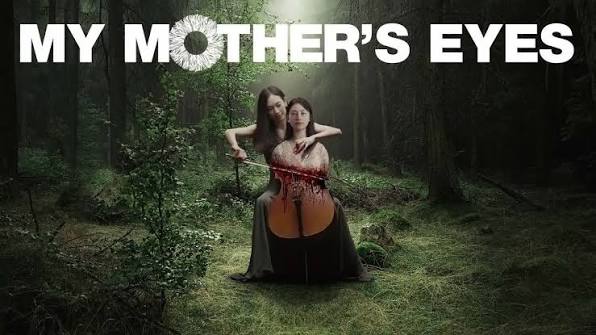
Kushida’s film concerns Hitomi and Eri (Akane Ono and Mone Shitara), a pair of tight-knit mother and daughter cellists who are left blind and disabled, respectively, after a devastating car crash. Hearing about an experimental treatment that will allow her to see again, Hitomi is able to locate the scientist who agrees to provide the surgery. Trying to reconnect with Eri leaves Hitomi guilt-ridden as her daughter can’t move her head and finds depression in the limited view of the hospital ceiling. With her new ocular implants, Hitomi can connect her vision to her daughter’s VR headset, allowing Eri to use her mother as she would a video game avatar. Complications arise when Eri and Hitomi discover the scientist who invented the technology has nefarious plans for them.
Finishing a technoparanoia film like My Mother’s Eyes this week only to discover that social media website TikTok may be banned holds a particular irony. While it’s been stated that the Chinese Government could be accessing the metadata of its users, the information that led to that discernment remains classified. There’s also little talk about the domestic companies already using that data against us. The current generations of social media acolytes have already sold their digital souls to search engines, cell phone operating systems, and simply buying a toothbrush from an online store. For the population, selling our private information is just part of downloading an app. I’m sure when Temu finds out I need toothpaste, I’ll have ads for incredibly inexpensive options. People’s reaction to AI isn’t dissimilar either. But, back to what I’m getting at and Kushida’s point in both films, it isn’t that we should be wary of technology, but rather the people who wish to control us by proxy.

My Mother’s Eyes also shows a portrait of parenthood and the willingness of parents to go to extremes for their children, even if they’re the cause of their children’s distress. Early in the film, Hitomi and Eri are seen having conversations about Eri being slightly off while practicing a hypnotic dueling cello session. The audience sees how the slightest criticism from Hitomi affects Eri, who wants to appease her mother but struggles to find warm affection from her. Comparatively, Hitomi is stirred by Eri’s direct question in the car, which serves as the catalyst to the crash. As close as these two are, neither mother nor daughter sees the opposing perception. It takes a car crash for the characters to begin to understand each other. Then Kushida pours on the irony as Eri’s identity begins to consume Hitomi’s, the way Hitomi’s has always overshadowed Eri’s.
Kushida’s latest is a deeply thought-out film that contains Hammer-era nods to mad scientists while injecting an essence of social-media-era paranoia. Parts of the film are reminiscent of Cronenberg films, the way the technology mixes with the human body. While there’s an inclination toward body horror, Kushida never goes full Cronenberg. Allegorically, the film elicits themes of body autonomy while nodding the way of internet billionaires who wield technology as a means of dominion. Ideally, these people don’t have your interests at heart. The movie goes to some fascinating lengths to craft these ideas, and though it’s written well, it is a slow roll getting there.
What’s even more palpable in the script is Kushida’s sensory design. The sound design is fantastic throughout My Mother’s Eyes, triggering points of ASMR stimulation. Kushida wants you to see, hear, and feel as much as possible and does so with a dream-like atmosphere, lush visuals, and Hitoshi Fushimi and Masateru Nishikata’s stringy, classical score. The film’s penchant for focusing on these components helps the horror elements become more visceral and unnerving when the film reaches the finale.

Overall, My Mother’s Eyes left me a little mixed. I liked a lot of it, but it can be a little sleepy, given its sensory elements. Kushida’s thematic interweaving of social control concepts against a parental molding comparison creates a powerful statement to remind us we don’t have to grow up to become our parents or our parents’ politics. There is a lot of cleverness in how the film captures your attention, as well as some stunning cinematic moments created through those concepts. Like most Japanese arthouse cinema, stillness is the vibe. The movie is meant to be meditative, but perhaps it does its job slightly too well.
Leave a Reply