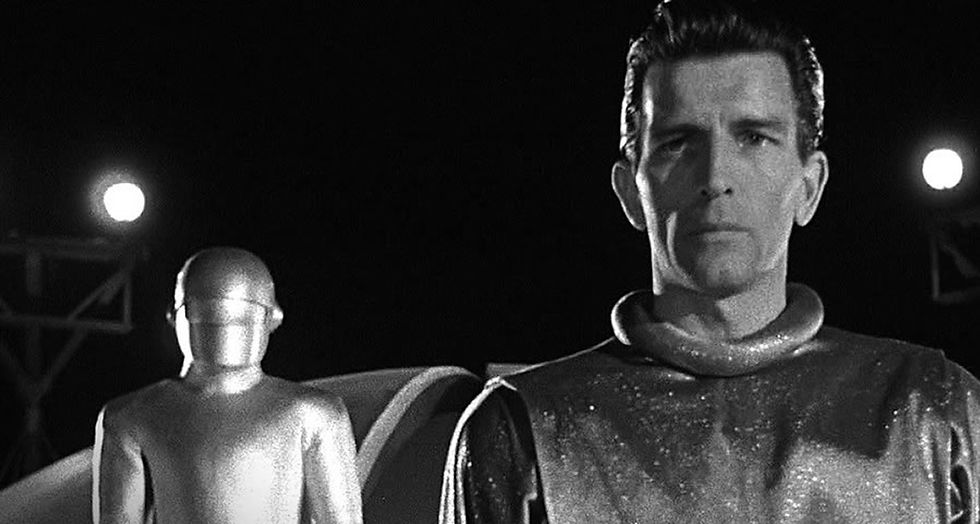
The Day the Earth Stood Still isn’t just a sci-fi movie. It is a cultural monolith. A clean, surgical slab of Cold War anxiety wrapped in chrome and delivered straight into the nervous system of 1951 America. This is Robert Wise’s The Day the Earth Stood Still. The real version. Not whatever that fucking awful remake was.
And here’s the thing: most films from the 1950s sci-fi boom have aged like milk left on a dashboard in July. Rubber monsters, cardboard cities, dialogue that sounds like it was written during a fire drill. But this one? This one didn’t just survive. It evolved. It got sharper. More relevant. Because The Day the Earth Stood Still isn’t really about aliens. It’s about us. More specifically: how quickly we reach for violence when we’re scared.
The Arrival: A Flying Saucer in the Front Yard
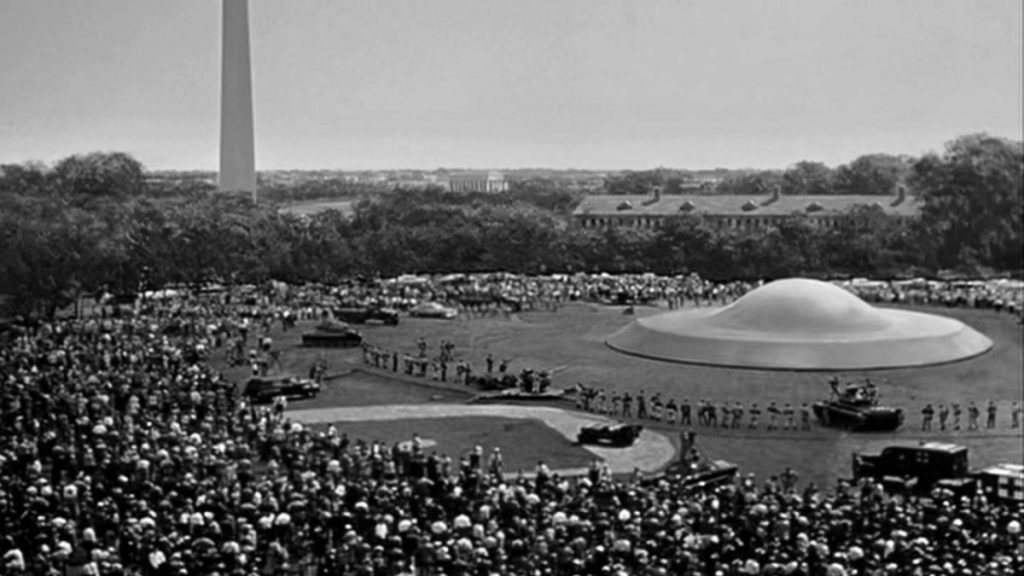
The film opens like a polite invasion.No screaming. No chaos. Just a silver disc descending into Washington, D.C. and landing near the Ellipse like it’s slightly late for an appointment. It’s one of the most iconic UFO designs ever put on screen, smooth, clinical, almost insultingly elegant. Like it belongs in a museum that humanity hasn’t earned access to yet.
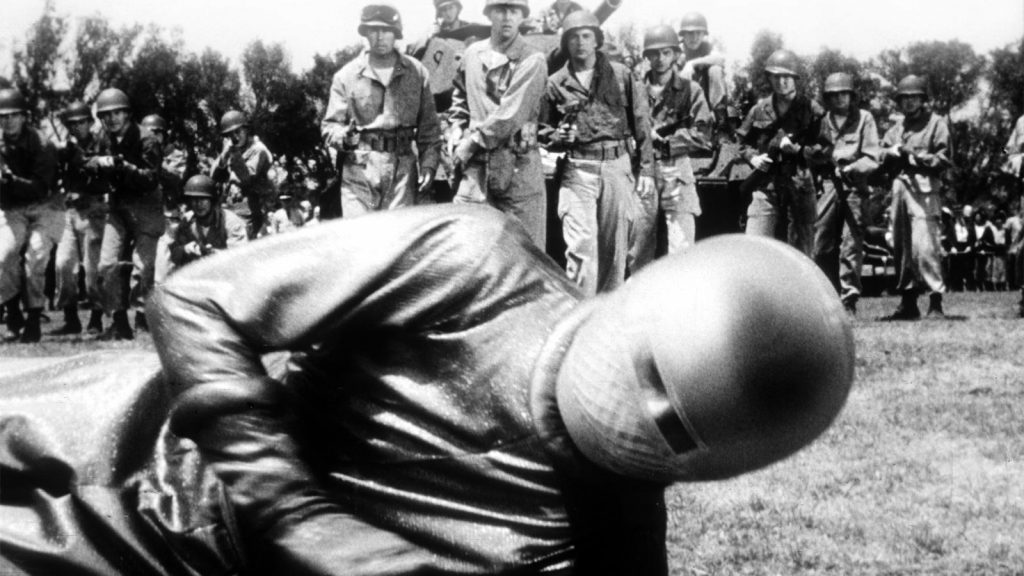
And immediately, we do what humans always do when confronted with the unknown: we surround it with guns.
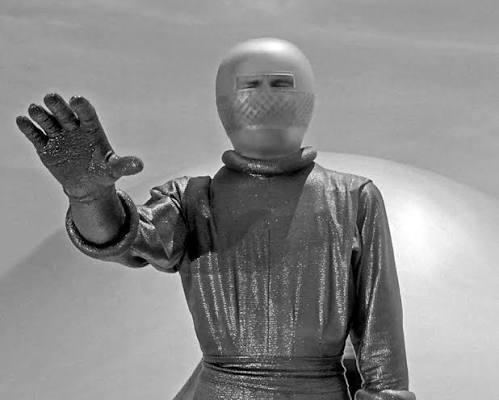
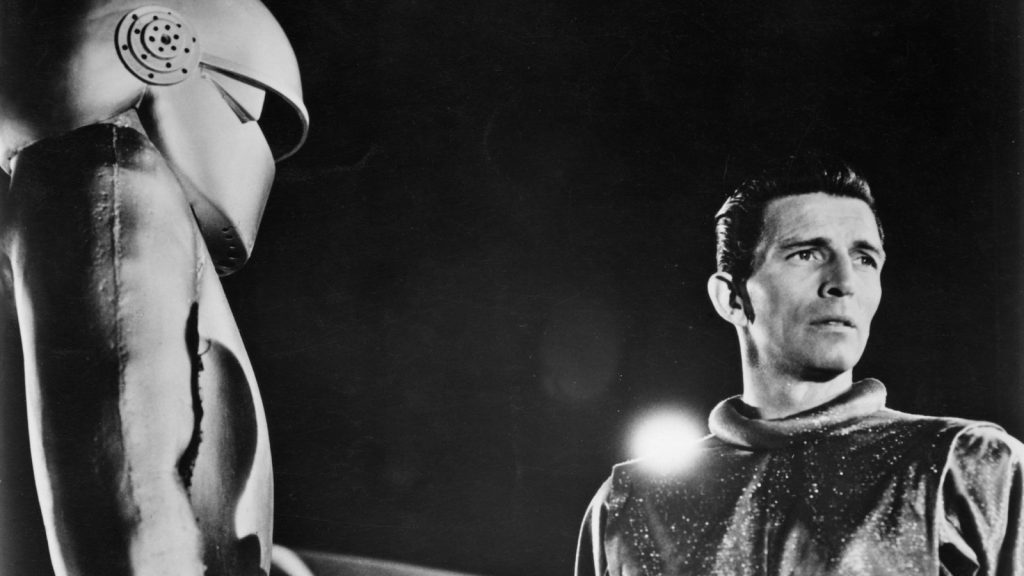
Soldiers. Tanks. Tension so thick you could build a bunker out of it. Then the hatch opens and out steps Klaatu (Michael Rennie), and he doesn’t look like a monster. He doesn’t even look like a conqueror. He looks like a diplomat who has accidentally wandered into the wrong species’ HR department.
Tall, composed, silver suit like it was designed in a civilisation that has long since stopped arguing over small things like borders or flags. He raises a device. A gesture of peace.
And someone shoots him.
Not because he’s dangerous, but because we are. That moment is the entire thesis of the film in one trigger pull.
Gort: The Quiet Apocalypse in Standing Form
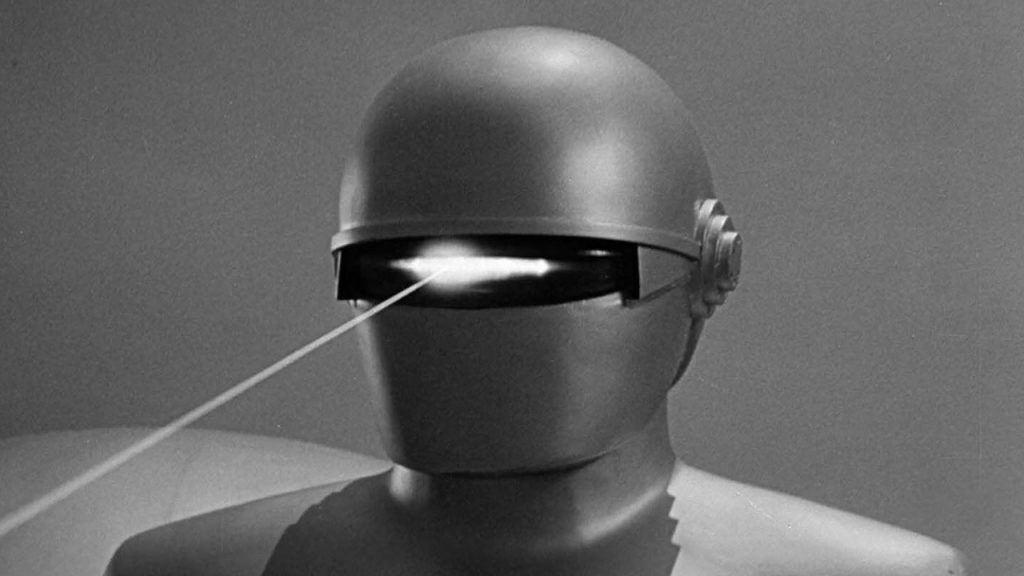
And then there’s Gort.
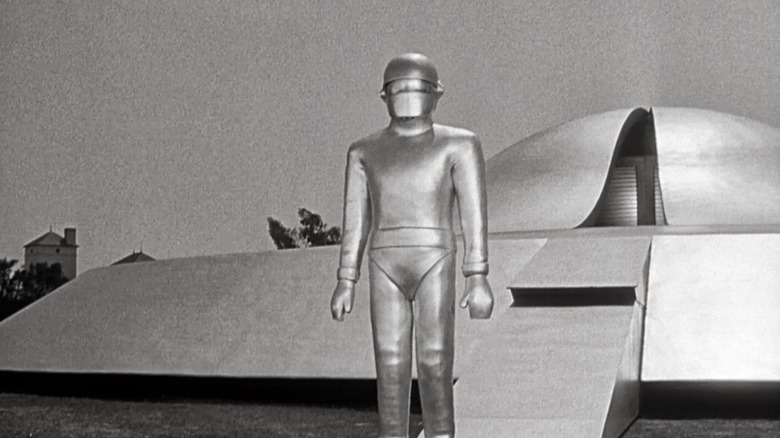
If Klaatu is the warning, Gort is the consequence. He is not a robot in the fun sci-fi companion sense. He is not R2-D2, he is not Data, he is not here to banter or learn about human emotions. Gort is eight feet of seamless metal judgement. A standing verdict. A walking ‘no’. He doesn’t speak. He doesn’t negotiate. He doesn’t escalate. He simply exists until violence occurs, and then he ends it.
The brilliance of Gort is restraint. He is the ultimate expression of power without personality. A being that does not hate you. Does not fear you. Does not even notice you as anything more than a problem to be processed. When activated, he disintegrates weapons using a focused beam. Not explosions. Not spectacle. Just clean removal from existence. Guns, tanks, artillery, gone. Not melted into dramatic slag piles like later sci-fi would do, but simply erased.
He is what happens when enforcement becomes absolute and emotion is removed from the equation entirely, and that’s what makes him terrifying.
There is no ego to argue with.
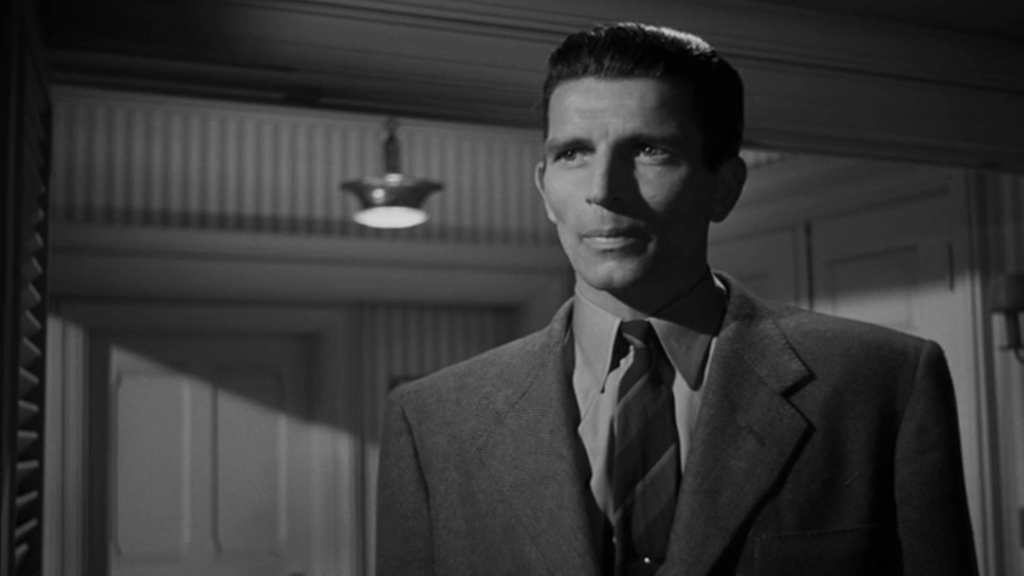
Klaatu Among Us: The Alien Who Watches Humanity Like a Documentary
After being shot, Klaatu doesn’t rage, and nor does retaliate. He doesn’t unleash Gort on Washington like a divine toddler knocking over sandcastles, which is what I would do if some bellend tried to murder me when I came in peace. Instead, he heals, quietly, efficiently. And then he does something far more unsettling:
He goes undercover.
As Mr. Carpenter. Yes, subtle as a brick to the face, but that’s the point. Klaatu walks among humans to observe us. He becomes as ordinaryas can be. He rents a room. He talks to a child. He listens. He watches how we argue, how we divide ourselves into camps over everything from politics to parking spaces. And the conclusion he slowly reaches is not anger. It’s disappointment.
Not in a melodramatic sense, but in a clinical, almost exhausted one. Like a scientist watching an experiment repeatedly set itself on fire for entertainment.
Michael Rennie plays this beautifully. There’s no arrogance in Klaatu, just distance. The unsettling calm of something that has seen too many civilisations repeat the same mistakes.
The Message: Not Peace. Compliance.
Be under no illusion, this is not a “we come in peace” story. It is a “we come in warning” story.
Klaatu’s message is simple, almost insultingly simple: Stop escalating your violence beyond your control, or you will be removed from the equation. Because humanity is now developing atomic power. Not just as a weapon, but as a potential interplanetary threat. And somewhere out there, civilisations have already learned what happens when species like ours get ambitious without maturity.
So the galaxy responds with enforcement and not diplomacy. And when Earth refuses to cooperate, because of course we do, Klaatu shows the world what true power means. Here is where the film does something quietly devastating. Gort shuts everything down. Not just weapons in one city. Not just a military base. But global weapons systems. A coordinated, planet-wide suppression of humanity’s ability to kill at scale.
Cars still exist. Lights still exist. Life continues on its merry, if slightly nervous way, but war stops. For a brief window, humanity is forced to sit in its own silence, and that silence is the point.
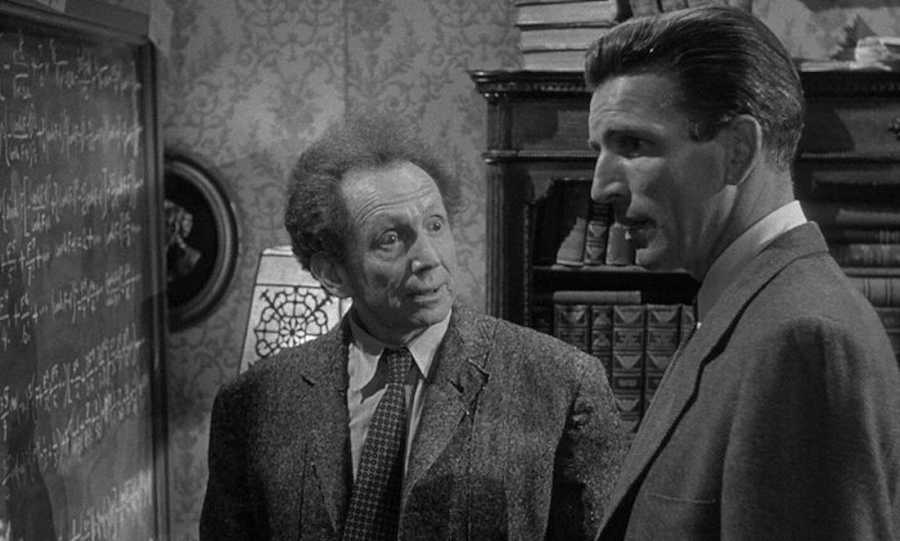
Klaatu Barada Nikto: Three Words Against Extinction
Klaatu barada nikto.
It has become sci-fi mythology, a cultural password, a spell, but in context, it is not magic. It is protocol. A failsafe instruction designed to prevent Gort from executing final judgement after Klaatu’s death, and yes, Klaatu does die. Not dramatically in a heroic blaze, but as a result of human fear and reflex.
Patricia Neal’s Helen Benson becomes the unexpected carrier of survival instructions. And her performance is crucial here,not because she is loud or forceful, but because she is rational in a world actively losing its mind. She stands in front of Gort, a being who could erase her without effort, and delivers three words that mean nothing and everything at the same time.
And it works.
Because systems like Gort do not interpret intent. They execute commands. That’s the horror and the hope of it.
The Sound of the Future: Herrmann and the Theremin
Bernard Herrmann’s score is not background music, it is atmosphere made audible.The theremin doesn’t play notes in the traditional sense, it haunts them. It wavers, trembles, vibrates like a signal from a civilisation not quite tuned to human frequency.
This is what the future sounded like in 1951. Cold. Mechanical. Beautiful in a way that feels slightly wrong. It’s easy now to forget how alien this must have felt to audiences at the time. Today we have synthetic sound everywhere, but back then? This was like hearing electricity think out loud.
The Subtext That Refuses to Stay Subtext
Let’s not dance around it: Klaatu is loaded with messianic imagery. He arrives from the sky. He is struck down by fear. He is revived through advanced means. He delivers a warning sermon about human behaviour, and he leaves once the message is delivered.
It’s not subtle, but it’s also not lazy.
The film uses religious structure not to preach faith, but to frame communication failure between intelligence levels. It’s about what happens when a species is offered wisdom it is not emotionally prepared to hear. Whether you read it as allegory or metaphor, the effect is the same:
We are not the audience being praised.
We are the audience being evaluated.
Why I Love It
Because nothing in it has aged out of relevance. Replace nuclear weapons with climate collapse, AI escalation, or anything else we are currently sprinting toward with zero brakes, and the message remains identical. Intelligence without control is just another form of destruction.
The film doesn’t scream this at you. It doesn’t explode into action. It simply shows you a world paused mid-chaos and asks you to think about what that pause means. That’s why it still works. Not because it’s loud. Because it’s calm.
The Day the Earth Stood Still is not just essential science fiction, it is foundational cinema. A film that understands spectacle is less powerful than restraint, and that silence can be louder than shouting. It features one of the most iconic robots ever created, a performance of quiet authority from Michael Rennie, and a score that basically invented alien sound design for decades to come.
It is intelligent, eerie, and still uncomfortably relevant.
If you haven’t seen it recently, fix that. Preferably in the dark. Preferably when the world already feels slightly too loud. Because Klaatu isn’t coming to save us. He’s coming to measure us.
Leave a Reply