Most horror movies are built on a foundation of “why.” Why did the killer choose this house? Why does the ghost have a grudge? Why won’t the car start? We’ve been conditioned to look for a logic that validates our fear, as if understanding the monster makes the teeth any less sharp. We want our villains to have a tragic backstory, a reason for their malice that fits neatly into a psychological profile. We want to feel like if we just knew enough, we could negotiate our way out of the dark. We want the comfort of a metaphor—grief, trauma, or social decay—to act as a buffer between us and the screen.
Then there is The Evil Dead.
Released in 1981, Sam Raimi’s debut is the cinematic equivalent of a middle finger dipped in Karo syrup and red food coloring. It doesn’t care about your “why.” It doesn’t care about your character arcs or your emotional stakes. It cares about the relentless, frantic, and claustrophobic reality of a universe that has decided, quite suddenly, that it wants to turn you into a puddle of grey sludge. If you’re waiting for a meditation on grief or a metaphor for the disintegration of the American family, you’ve come to the wrong cabin. This is a movie about five kids, a tape recorder, and a book bound in human skin that really, really hates you.
Like, really fucking hates you.
It is witty in its cruelty, clever in its technical desperation, and absolutely refuses to play by the rules of normal cinema. It is a film that was born in the mud of Tennessee and finished in the industrial cold of Michigan, and it smells like it.
The Morristown Siege
No dive on The Evil Dead can begin with Three Stooges of horror. Sam Raimi, Bruce Campbell, and Robert Tapert didn’t have a studio. They didn’t have a safety net. They had an abandoned hunting cabin in Morristown, Tennessee, that was literally rotting into the earth. They were kids from Michigan who had spent their youth making Super 8 films, and they approached horror with the same frantic, slapstick energy they applied to their comedies. But they knew one thing: to get people into the theater, they had to be the ultimate experience in grueling terror.
When they found the cabin, the floors were covered in a thick layer of manure and animal remains. There was no running water, no electricity, and no heat. They had a handful of investors—doctors and lawyers convinced they were backing a legitimate venture—and a dream of making enough money to buy a decent sandwich. They were young, they were broke, and they were completely ignorant of what couldn’t be done.
This lack of resources is exactly why the movie works. When you don’t have $50 million to hide behind, you have to be clever. You have to be defiant. They couldn’t afford a Steadicam, so they invented the Shaky Cam”—mounting the camera to the center of a fifteen-foot-long 2×4 board with a guy on each end running like hell through the woods. That POV shot of the force cutting through the marsh isn’t just stylistic flair; it’s the movie stretching beyond its resources and daring you to question how it pulled it off.
The camera in The Evil Dead is a character itself. It’s a predator. It tilts at 45-degree angles to tell you that the world is no longer level. It zooms in with a violent, rhythmic intensity that mimics a panic attack. It’s clever because it mocks the audience’s perspective. It tells you: “I know you want to see what’s behind that door, but I’m going to make you regret looking.” Raimi understood that if you can’t make the monster look perfect, you make the visuals look insane. You keep the audience off-balance. You turn the very act of watching the film into a physical endurance test.
Bruce Campbell’s Genesis of Pain
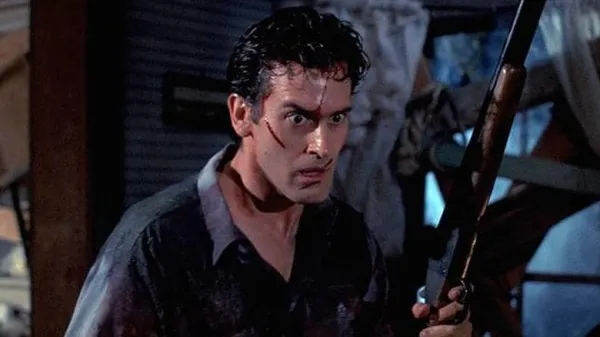
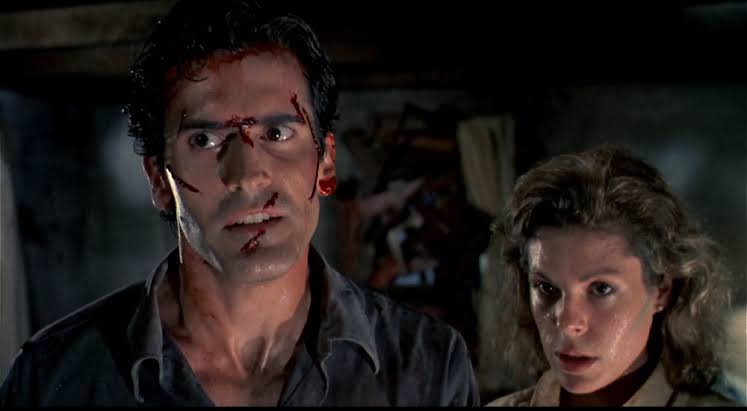
Before Ash Williams became the quippy, chainsaw-handed superhero of the sequels, he was just Ash: the guy who wasn’t quite fast enough to save his girlfriend and wasn’t quite brave enough to be a hero until he had no other choice. In 1981, Ash wasn’t The Chosen One. He was a victim. He was a punching bag for the cosmos.
Bruce Campbell’s performance in the original film is a masterclass in physical suffering. People act like anyone can be a final boy. Wrong. It takes a specific kind of wit to make getting hit in the face with a 2×4 look like high art. Campbell doesn’t play Ash as a brave warrior; he plays him as a man undergoing a nervous breakdown in real-time. He is the Everyman pushed into the splatter-zone.
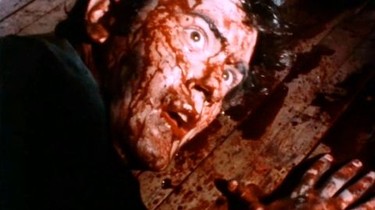
During the shoot, the conditions were borderline illegal. They were filming in a cabin with no plumbing during a freezing Tennessee winter that turned out to be much harsher than they expected. By the end of the 12-week production, the crew was burning set materials and anything flammable to stay warm. Campbell was covered in the recipe: a mixture of Karo syrup, non-dairy creamer, and red food coloring. This mixture became so sticky that it bonded with his clothes and hair. Because the cabin had no water, they had to wash the blood off with hot coffee, because anything else would have turned him into a fucking cenobite, if he was lucky. That isn’t acting uncomfortable. That’s the reality of Bruce Campbell being battered through mud, blood, and plywood for weeks on end. The heroism isn’t in the dialogue — it’s in the fact that he keeps standing. He keeps swinging the axe even when he’s literally being glued to the floorboards.
Evil as a Malicious Practical Joke
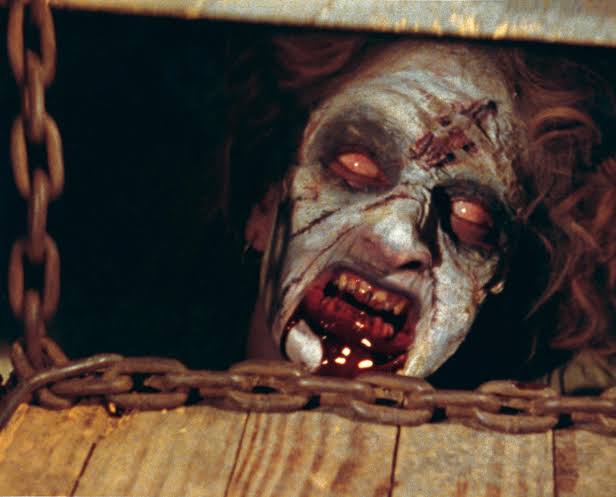
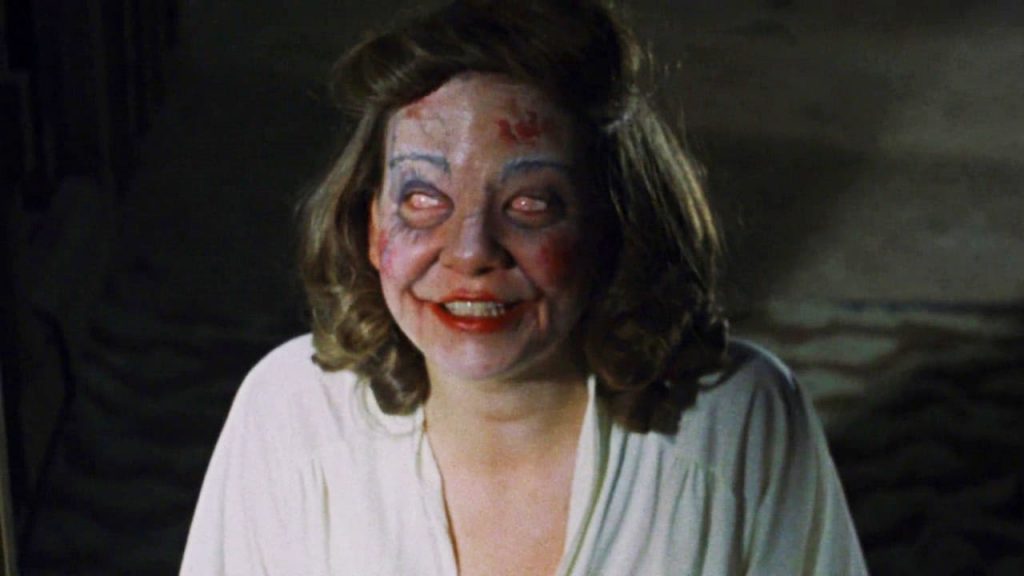
The Deadites in this film are not your standard zombies. They don’t want to eat your brains; they want to shatter your mind. They use your own memories, your own loved ones, and your own fears as punchlines. They are malicious, they are loud, and they are incredibly witty in their cruelty.
Think about the scene where Linda (Betsy Baker) sits in the doorway and giggles while humming a distorted nursery rhyme. It’s more effective than any jump-scare in modern studio horror because it plays with the uncanny valley of the familiar. It takes the person Ash loves and fills her with a malicious, cosmic wit that finds his suffering hilarious. The Deadites don’t just kill you; they mock you for being alive. They tell you your girlfriend is in hell with a smile that would make a shark flinch.
This is where the movie separates the fans from the tourists. The tree scene or the pencil in the ankle are designed to cross the line because the Evil in The Evil Dead doesn’t have a moral code. It doesn’t have a plan. It’s a prankster with a rusty chainsaw. It is the recognition that the universe is indifferent to your pain, and sometimes, it’s actively laughing at it. The Deadites are the manifestation of a void that thinks your grief is a joke. They are the ultimate defiance against the idea that death should be dignified. They turn the sacred bond of friendship into a punchline. When Cheryl (Ellen Sandweiss) turns, she doesn’t just attack; she speaks with the voice of a thousand rotting souls, mocking Ash’s inability to save her.
When Flesh Gives Way: In Defense of the Melt
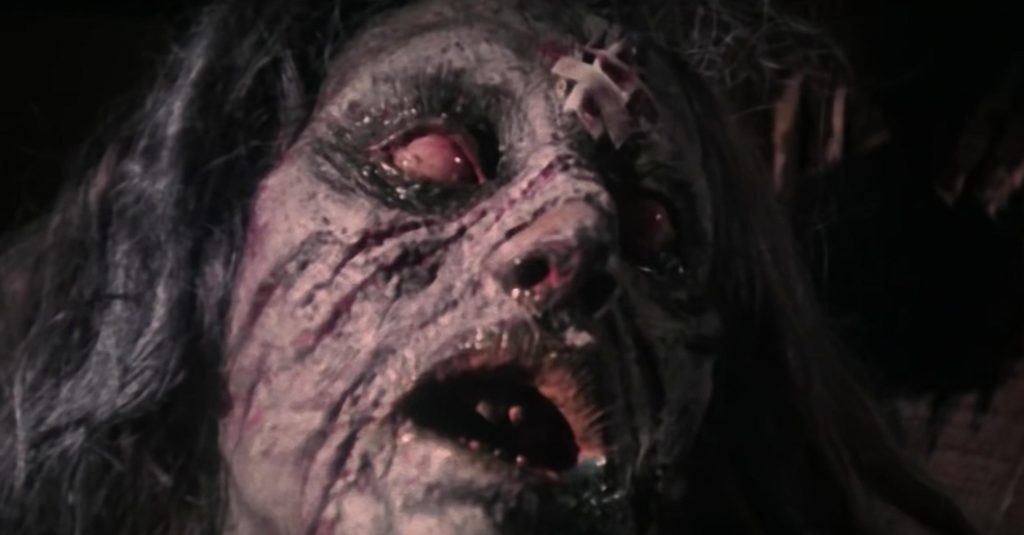
Today, we have CGI that can render every individual hair on a monster’s head, and yet it feels like nothing. It’s safe. It’s sterile. It’s a cartoon that we’ve been told to be scared of. Sam Raimi and Tom Sullivan were pioneers of the splatter age, knee-deep in oatmeal, corn syrup, and creamed corn, turning groceries into gore. When a Deadite’s head explodes in The Evil Dead, it’s a tactile experience. You can almost smell the rot. You can see the layers of clay and latex being ripped apart. It is messy, it is trashy, and it is absolutely beautiful.
In the stop-motion finale, the Deadites don’t simply die — they liquefy in a chaotic spill of clay and viscera, a deliberate refusal of polished horror. It took months to film those few minutes of footage in Detroit after the Tennessee shoot wrapped. Every frame was a battle against time and gravity. It’s a reminder that the art of the physical effect is about more than just looking real; it’s about having a presence. You can feel the sweat of the artists who spent sixteen hours a day molding that latex. That’s not cheap schlock. That’s craft. That is the flesh and bone of the genre.
We also have to talk about the Fake Shemps. When actors became unavailable or were too injured to continue, Raimi used stand-ins, crew members, and friends to fill the frame. This wasn’t laziness; it was genius. It was the refusal to let the lack of a professional cast stop the momentum of the nightmare. It’s a clever solution to a production nightmare, and it adds to the frantic, collage-like feel of the film.
Why the Censors Were Scared
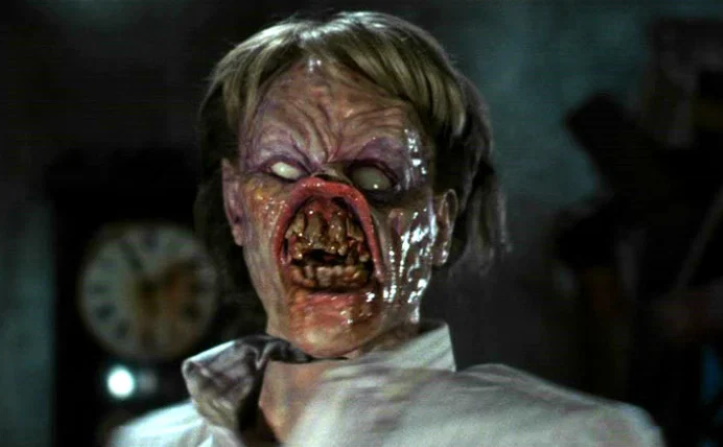
Then there was the Video Nasties panic in the UK. When the film was released on home video, it was branded as obscene by moral crusaders like Mary Whitehouse. It was confiscated by police and became one of the key titles on the Director of Public Prosecutions’ banned list.
The moral authorities recoiled. They couldn’t process how a film this savage could be having this much fun. They saw the blood, the guts, the gore, and the humor and they saw a threat to public morality. But they were wrong. The Evil Dead isn’t a threat to morality; it’s a threat to the status quo. It’s a movie that says you don’t need a permit to be creative. You don’t need a studio’s permission to scare people. You don’t need to play by the rules of good taste. It refuted the idea that horror had to behave itself.
The film’s success—fueled by a glowing review from Stephen King, who saw it at Cannes and called it “the most ferociously original horror movie of the year”—proved that the audience was hungry for something raw. King’s endorsement was the catalyst that finally landed the film a US distributor in New Line Cinema. Without that one review, we might have lost one of the most important directors of the modern era to a life of obscurity.
Final Thoughts
At its core, The Evil Dead is for fans who crave unfiltered horror—those who don’t need polish, metaphors, or safety nets. It’s for the people who want the mess, the sweat, the fear, and the chaos delivered without compromise. It’s for the those who know that a movie doesn’t need a $100 million marketing budget to be iconic; it just needs a director who isn’t afraid to get blood on the lens.
The original film is a warning shot. It was Raimi saying, “I’m here, and I don’t care about your rules.” It is the fiercest, filthiest, and most unrelenting survival horror of its era. It treats the audience like spectators in a Roman colosseum, and the only rule is: if you can’t handle the sight of a demon-possessed girl stabbing a pencil into a guy’s heel, stay out of the woods.
People think that because it’s funny in parts, it’s not scary. But the wit of The Evil Dead is the wit of the gallows. It’s the laughter of someone who has realized they are completely and utterly screwed. It’s the sound of a chainsaw starting up in the dark.
The cabin itself is gone now. It wasn’t struck by lightning as the legend goes; the owners burned it down in the early 1980s after years of trespassing. But the flame it lit in the heart of independent horror is still burning.
The first film was just the beginning. It was the moment that proved that with enough Karo syrup and enough defiance, you could change the face of horror forever.
So, are you ready to swallow your soul? Because the woods are waiting, the tape recorder is playing, and the book is already open. Stay groovy, but stay alert. Because when the Deadites come knocking, they don’t want your respect—they want your blood.
Leave a Reply