Watching the 1975 Ho Meng-hua classic The Flying Guillotine, is watching the exact moment Shaw Brothers realized that the traditional, honorable swordplay of the 1960s was dead, buried, and ready to be replaced by something deeply cynical and explicitly weaponized. Before this film, the studio’s output under directors like Chang Cheh or King Hu usually maintained a shred of martial virtue. Even the bloodiest battles were fought with steel you could see, under codes of behavior that made sense within the boundaries of the wuxia world. But Ho Meng-hua looked at the landscape of mid-1970s cinema, where audiences were growing increasingly desensitized and hungry for something different, and decided to center an implement of assassination on a hatbwith more teeth than the entire Osmond family. This isn’t a film about the beauty of kung fu; it’s a cold, calculated look at how a totalitarian regime treats death as a way to eradicate problems, and it remains one of the most structurally bizarre and visually unforgettable entries in the entire Hong Kong exploitation boom.
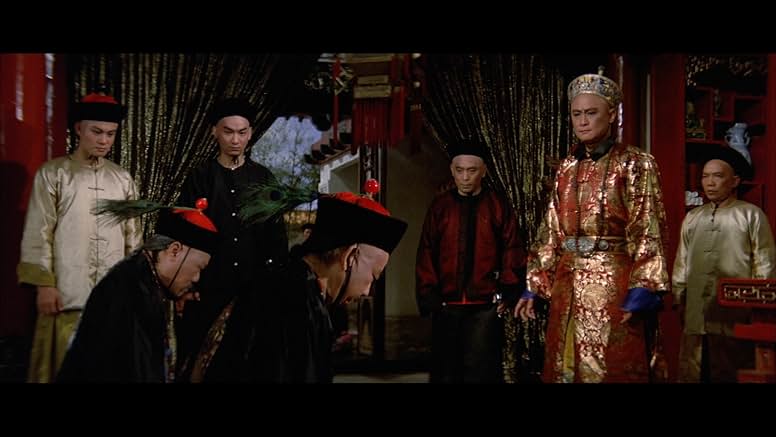
The story itself is dripping in the historical paranoia of the Qing Dynasty under the Yongzheng Emperor, played here by Chiang Yang with a sneering, dictatorial malice that feels uncomfortably grounded for a martial arts movie. Yongzheng isn’t portrayed as a majestic ruler or even a standard movie tyrant; he is a paranoid bureaucrat with an infinite budget and a total lack of empathy. He is terrified of dissent, obsessed with intellectual subversion, and completely aware that his grip on the throne is fragile. To solve his problem, he creates a secret squad of elite killers armed with one of the most infamous weapons in kung fu cinema. Which, in itself, is impractical as all hell, but undeniably cool as shit. This is where the film shifts from a historical drama into a full-blown psychological horror film disguised as a period action piece.
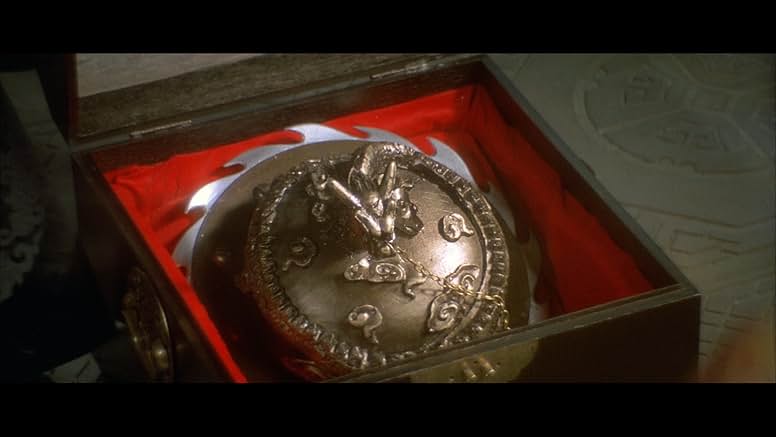
The guillotine itself is treated with the kind of reverence usually reserved for sacred relics or forbidden knowledge. In execution, it’s a hat-like weapon attached to a long chain, lined with internal blades that activate the moment the device settles over a victim’s head and neck. You pull the chain, the mechanism snaps shut, and you walk away with a head in a bag.
Which is better than any prize you’ll get when the carnival roles into town.
The mechanical design is deliberately absurd, yet within the vacuum of Ho Meng-hua’s direction, it feels terrifyingly plausible. The film spends considerable time establishing the skill required to wield the weapon effectively, showing the members of the imperial squad perfecting their technique and coordination. It feels like a military documentary about the deployment of a specialized weapons program. The recruits aren’t learning martial arts to better themselves or protect the weak; they are learning how to operate a machine that turns human beings into decapitated meat.
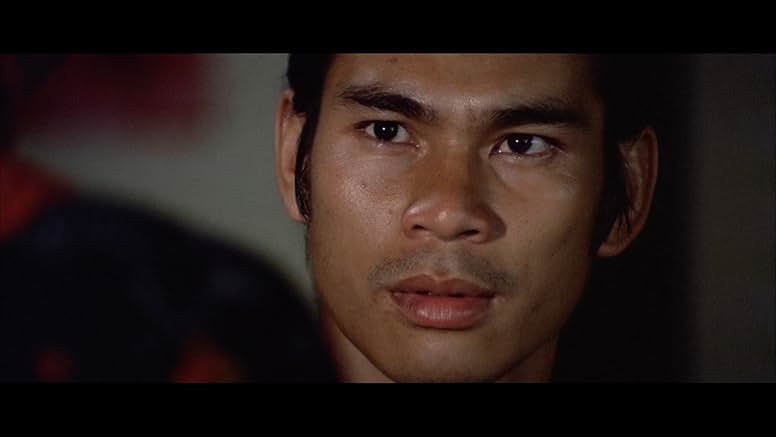
Chen Kuan-tai is the perfect physical anchor for this specific tale. Unlike the lean, operatic heroes of early Shaw cinema, Chen Kuan-tai always carried himself with the thick-necked, heavy-set density of a real street fighter. He doesn’t look like he belongs in a poetry competition; he looks like a man who understands that if you kick a motherfucker in the balls, that motherfucker will slow down. His character starts the film as a loyal soldier, blinded by the prestige of serving the emperor’s inner circle. He believes the propaganda. He thinks he is protecting the state from traitors and criminals. The tragedy of the character, and the core engine of the first half of the film, is his slow, agonizing realization that he isn’t a hero; he is an employee of a gigantic, paranoid bellend.
The turning point arrives when the squad is deployed against targets the emperor considers politically dangerous. The violence drops its theatrical mask and becomes purely political. When the guillotine flies through the air and claims its victims, Ho Meng-hua often avoids framing the killings as triumphant action beats. There is no duel, no exchange of techniques, no chance for defense. It is just an immediate, mechanical erasure of life. Because of this, the hero gradually realizes that the chain he holds in his hand is connected directly to the emperor’s twisted mind.
Once he defects, the movie undergoes a radical structural shift that separates it from almost every other Shaw Brothers production of the era. Instead of building toward a massive, multi-tiered martial arts tournament or an assault on a temple, the film shrinks into a desperate, claustrophobic survival story. He becomes a fugitive, fleeing across rural China with nothing but the clothes on his back and the constant, nagging dread that the sky above him could drop a bladed hat at any second. The pacing slows down, trading the frantic energy of the earlier sections for a heavy, atmospheric paranoia. Every time the wind blows through the trees or a shadow shifts on a dirt road, you can sense him tense, waiting for the chain to drop. The film understands that the true power of a legendary weapon isn’t just the damage it does when it hits, but the terror it inflicts while it’s still out of sight.
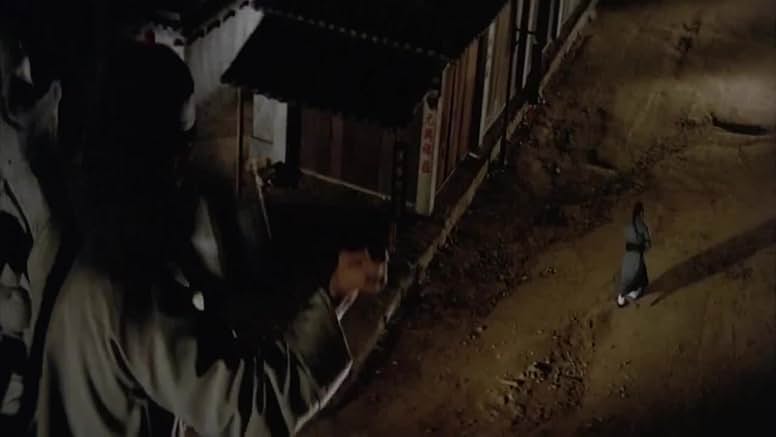
His departure triggers a bitter, deadly pursuit led by one of his former comrades. This character represents the ultimate careerist within an authoritarian system. He doesn’t care about the morality of the weapon; he only cares about the power it grants him in the eyes of the emperor. This middle section allows the film to explore life beyond the imperial court, contrasting the state ordained violence with the relative simplicity of ordinary people trying to survive.
The hero eventually attempts to build a new life away from the emperor’s reach. The contrast is stark: the pristine, cold stone architecture of the emperor’s court versus the mud, sweat, and wood of the countryside. Chen Kuan-tai plays these quieter scenes with a heavy, somber restraint. He looks like a man who knows his past is a terminal disease, and that every day of peace he gets is just a mistake the universe hasn’t corrected yet.
Of course, the correction arrives when the imperial killers finally track him down. Here, the movie discards any remaining pretense of traditional kung fu cinema and becomes something that modern viewers may recognize as remarkably close to proto-slasher suspense. The guillotines don’t just fly in broad daylight anymore; they emerge from unexpected angles, transforming ordinary environments into death traps. The sound design during these sequences is spectacular in its minimalism, the heavy clinking of the metal links, followed by the sudden, sickening sound of the blades activating. It’s a sonic signature that sticks in your ears long after the credits roll.
To survive the final confrontation, the hero can’t rely on standard techniques or training. He has to defeat the machine by thinking like an engineer. This leads to the legendary creation of the counter-weapon: the modified iron umbrella. The final duel isn’t a showcase of elegant choreography; it is an awkward, brutal, physical puzzle where he has to use the iron sheets to catch the flying blades, jam the mechanism, and pull the killers into close-quarters combat where their long chains become liabilities. Action directors Tang Chia and Yuen Cheung-yan orchestrate this with a brilliant eye for spatial geometry. It’s all about distance, leverage, and the physical weight of the implements. Every time the iron umbrella intercepts a guillotine attack, you can feel the impact travel up the actors’ arms. It is an exhausting, unglamorous fight that ends not with a grand martial arts stance, but with men bleeding in the dirt, gasping for air inside a ruined landscape.
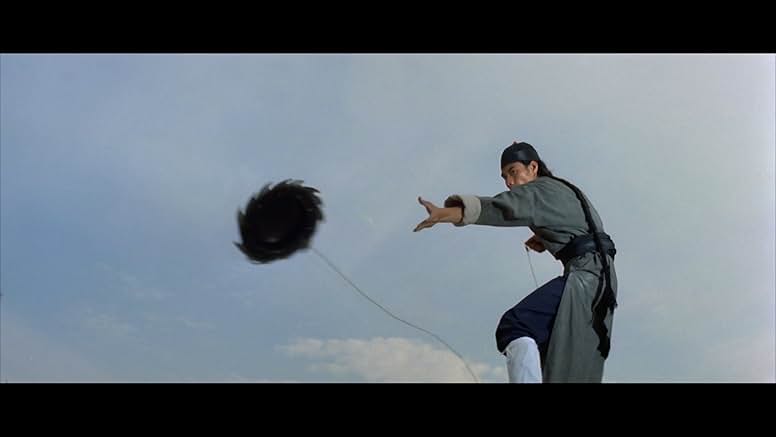
Technically, Ho Meng-hua handles the film with a functional, unpretentious professionalism that highlights the studio’s incredible efficiency at the height of its power. The cinematography utilizes the classic Shaw zoom lens not as a cheap gimmick, but as a punctuation mark to emphasize the sudden, violent arrival of the weapon. The lighting transitions effectively between the theatrical shadows of the palace interiors and the brighter exterior environments. The soundtrack contributes heavily to the film’s strange atmosphere, creating a sense that something deeply unnatural has invaded an otherwise historical setting.
The Flying Guillotine works so well because it refused to play by the established rules of the genre at a time when audiences were starting to grow weary of the same old revenge narratives. It took the historical anxiety of the Qing dynasty and transformed it into a grim, fascinating exploration of state-sponsored murder. It proved that a weapon could be a character in its own right, possessing a narrative that dictates the behavior of everyone around it. It’s a film that trades elegance for impact, philosophy for adrenaline, and martial virtue for survival. It stands as one of the most distinctive and influential martial arts films of the 1970s, a movie that doesn’t care about the beauty of the movement, but can’t look away from the precision of the kill.
Leave a Reply