There is a very specific brand of medical ethics in 1950s cinema that begins and ends with intravenous injections.
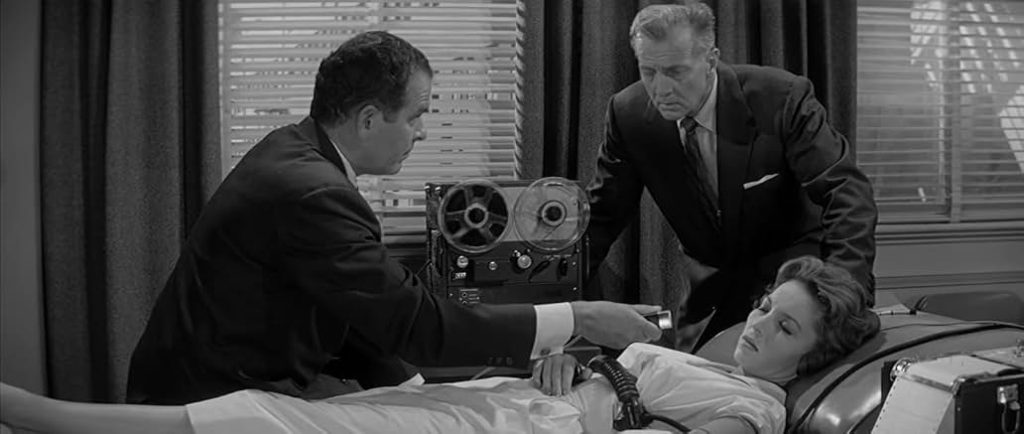
When a young woman suffering from severe amnesia sits in a psychiatric ward, the doctors don’t bother with therapy, gentle questioning, or basic patient consent. They simply pull out a syringe filled with an experimental cocktail of sodium pentothal, jab it into her arm, and sit back to watch the story unfold.
Truth drugs. Always the answer.
Welcome to The Alligator People, 20th Century Fox’s 1959 double-feature partner to Return of the Fly. Before the truth serum kicks in and takes us into the flashback, the film offers a brilliant little piece of mid-century cinematic code. The white-haired chief psychiatrist, Dr. Loraut, mentions to his colleague twice within their opening exchange just how remarkably attractive their patient, Joyce (Beverly Garland), happens to be.
It is the film’s immediate, deadpan reassurance to the audience: relax. Whatever reptilian horrors are about to unfold on screen, the leading lady hasn’t been turned into a scaly swamp beast. She’s far too pretty for the makeup department to ruin.
The horror is strictly reserved for her missing husband, Paul.
As Joyce’s drug-induced flashback begins, we discover that she and Paul were newlyweds aboard a train when he received a mysterious telegram, panicked, and promptly vanished at a station stop. Naturally, Joyce turns detective, tracking his origins down to a crumbling plantation mansion deep in the Louisiana bayou called ‘Cypresses’.
What follows is a southern gothic nightmare populated by a classic cast of B-movie archetypes.
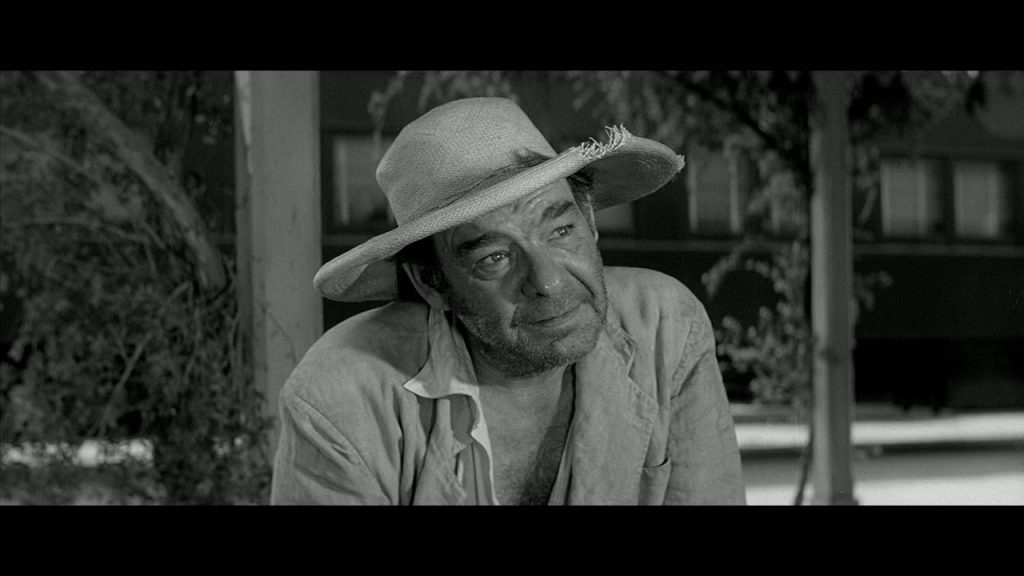
First, there is the legendary Lon Chaney Jr. playing Manon, a drunken, one-handed swamp handyman who spends his screen time harboring an unhinged hatred for alligators. Manon lost his left hand to a gator years prior and now wears a steel hook, which he uses primarily to drink heavily, harass Beverly Garland, and shoot at reptiles with a shotgun. Chaney looks gloriously miserable throughout, giving a performance that suggests he was compensated entirely in bourbon and swamp water.
Then there is Paul’s icy mother, Mrs. Hawthorne, who lives in the grand mansion and spends her days lying through her teeth, trying to convince Joyce that she’s never heard of Paul and that she should get the next train back to New York.
The truth, as it turns out, is glorious 1950s radioactive nonsense.
Paul didn’t run away because he stopped loving Joyce. He ran away because he was nearly killed in a plane crash, and his family doctor, the eccentric Dr. Sinclair, decided the best way to regenerate his crushed limbs and destroyed tissue was to inject him with serum extracted from alligators.
Because alligators can regrow their tails, of course. Perfect logic.
To speed up the process, Dr. Sinclair puts Paul inside a giant cobalt X-ray machine. If a little bit of alligator serum is good, blasting the patient with massive doses of gamma radiation in a room that looks like a budget boiler house is bound to fix everything.
Predictably, the treatment backfires.
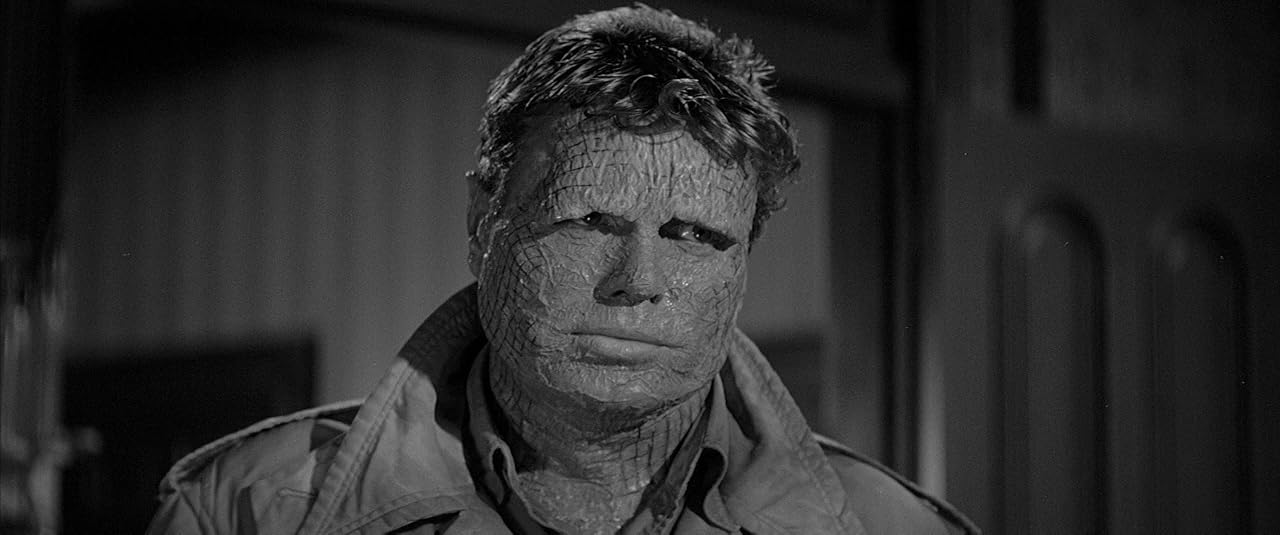
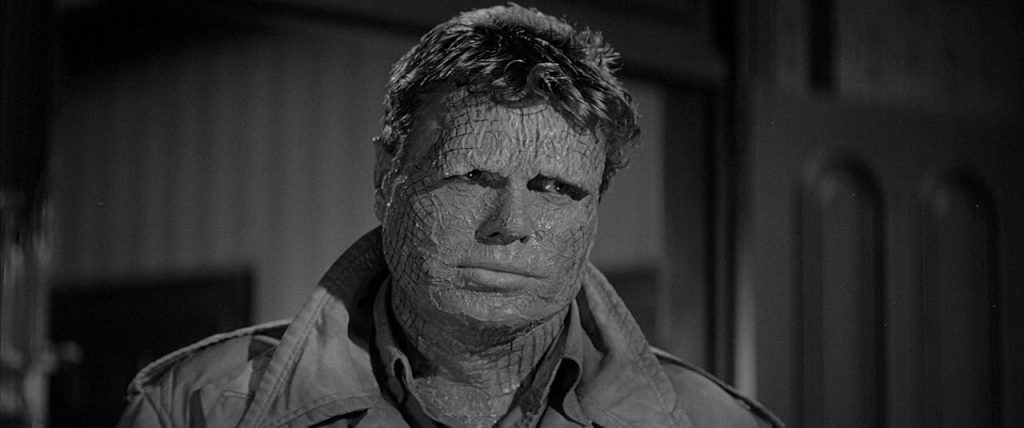
Instead of just repairing his skin, the alligator serum starts taking over completely. Paul spends the middle act of the film hiding in the dark, wearing a bizarre Terry-cloth bathrobe, and developing scaly skin alongside a deep, reptilian rasp. He refuses to let Joyce see him, leading to endless scenes of Beverly Garland wandering around the humid swamp in pristine dresses, screaming every time a reptile twitches in the mud.
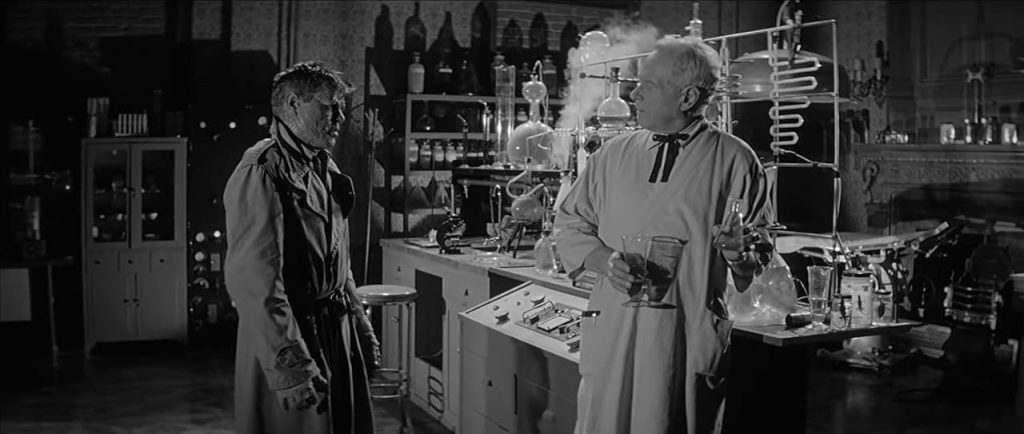
Eventually, we reach the climax. Dr. Sinclair decides the only way to reverse the mutation is to blast Paul with the cobalt generator one more time to “neutralize” the radiation.
Just as the machine is powering up, Lon Chaney Jr. barges into the laboratory, drunk as a skunk, wielding his hook, and looking to smash the gear. Manon’s obsession with killing alligators results in a chaotic laboratory brawl. Dials spin, high-voltage sparks fly, and Paul gets hit with a massive overdose of radiation.
The result is the moment the whole picture has been building toward.
Paul transforms completely. His head turns into a rigid, papier-mâché alligator head attached to a bloke in a short-sleeved shirt and trousers.
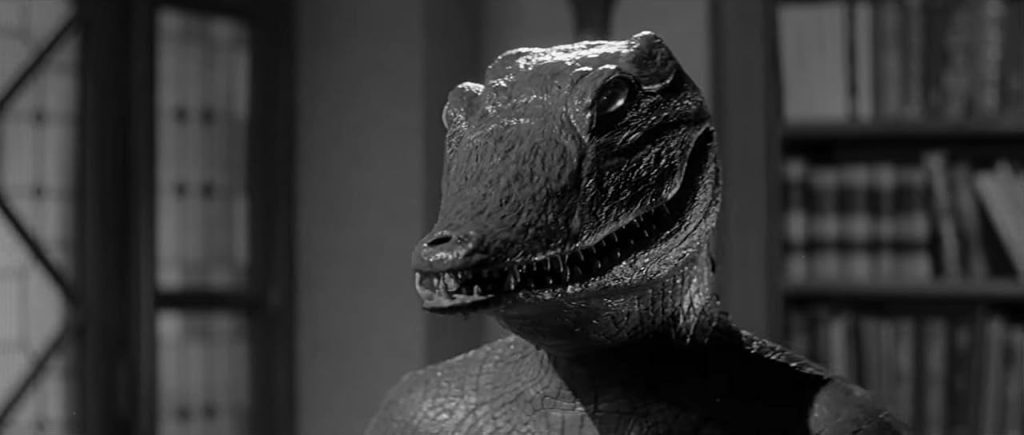
The suit is so stiff that the actor playing Paul can barely see or move, wobbling around the laboratory like a lost mascot at a theme park. As Paul comes face-to-face with Manon, the drunken handyman gets his steel hook snagged directly in the high-voltage power cables running to the overloaded machine. Manon gets instantly fried by a lethal dose of juice, sending the entire laboratory up in a spectacular cascade of explosions.
With the mansion going up in flames, Paul escapes into the bayou, with Joyce pursuing him into the marsh. In a final burst of tragedy, Paul ends up wrestling a real alligator in the mud before blundering directly into a patch of quicksand, slowly sinking beneath the surface while Beverly Garland screams her head off on the bank.
Fade back to the hospital. The truth drug wears off. Joyce wakes up from her hypnotic state with total amnesia regarding the entire swamp nightmare. The doctors decide it’s far better for her mental health never to remember that her husband turned into a reptile and sank into a bog, so they send her home completely cured.
Mental health at its finest.
It’s an incredible piece of late-1950s creature-feature schlock. The movie takes a completely unhinged premise, radioactive reptile stem-cell therapy, and plays it with the absolute gravity of a Shakespearean tragedy.
Seventy years on, watching Lon Chaney Jr. electrocute himself via his own pirate hook while a bloke in a papier-mâché snout bumbles through the mud is pure, unadulterated drive-in cinema. It is gloriously silly, utterly relentless, and an absolute triumph of late-1950s B-movie lunacy.
Leave a Reply