
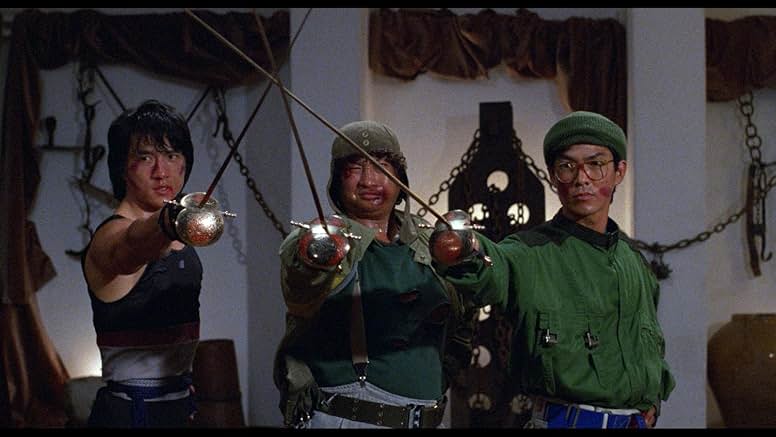
Filmed under a title that defies the basic laws of English syntax because Golden Harvest executives were genuinely superstitious about their previous box-office flops starting with the letter ‘M’ (hence Wheels on Meals instead of Meals on Wheels), this movie is an absolute high-water mark of action cinema. By the mid-1980s, the old-school, costume-heavy studio period pieces of the Shaw Brothers era were fading into the background. The new guard, spearheaded by a trio of former China Drama Academy classmates known affectionately as the “Three Dragons” (Jackie Chan, Yuen Biao, and Sammo Hung) decided to drag the entire martial arts genre kicking, screaming, and backflipping into the modern world. And for reasons that make sense only to a brilliant mind operating on pure creative adrenaline, Sammo thought that the best place to stage this revolution was the sun-drenched, gothic-tinged streets of Barcelona, Spain. It is a film that operates at a relentless, dizzying velocity, a magnificent cocktail of high-speed skateboard chases, yellow catering vans, psychiatric facility breakouts, and the single greatest one-on-one kickboxing duel ever captured on celluloid.
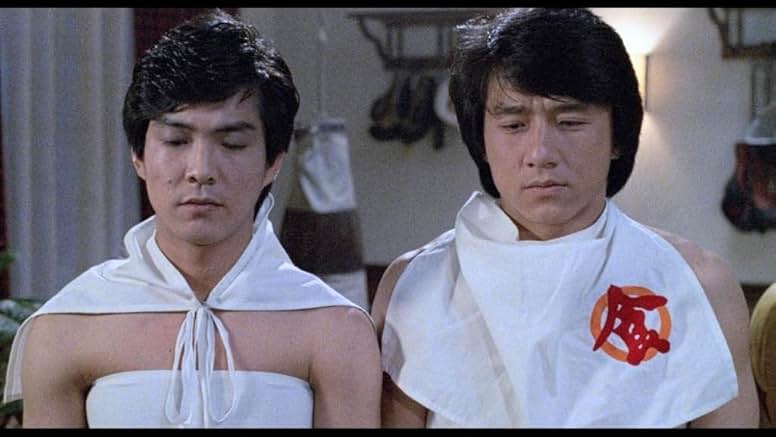
Meet Thomas and David, played by Jackie Chan and Yuen Biao respectively, who have a level of effortless, brotherly chemistry that suggests they don’t even need to speak to know exactly how to counter a roundhouse kick. Thomas and David aren’t elite secret agents, vengeful Shaolin monks, or brooding street cops; they are two expatriate Chinese cousins running a high-tech mobile fast-food business out of a yellow Mitsubishi L300 van. We meet them during a morning routine that functions as a masterclass in domestic choreography. They don’t just wake up and make coffee; they perform synchronous handstand push-ups, practice their wing chun dummy forms while brushing their teeth, before heading out to apend their day flipping burgers and pouring drinks with the precision of assembly-line robots. Thomas is the charismatic, slightly impulsive driver, while David is the more pragmatic, acrobatic anchor. Together, they treat the preparation of ham-and-cheese sandwiches like a high-stakes Olympic sport, establishing the central aesthetic of the entire film: everything, literally everything, is an opportunity for a beautifully timed physical stunt.
But the film’s comedic gravity really shifts when we meet the third hero, Moby, played by Sammo Hung himself. Sammo enters the picture sporting a glorious, curly perm and an assortment of oversized trench coats, playing a bumbling, hopelessly optimistic rookie private detective who has just been handed his very first major case. Moby has been hired by a shadowy lawyer to track down a mysterious woman named Sylvia and her mother, a task he approaches with a combination of absolute earnestness and total technical incompetence. Sammo’s physical presence here is a wonderful contradiction; he is a man of considerable bulk who moves with the terrifying speed and lightness of a hummingbird. When Moby isn’t accidentally falling backwards over furniture or getting lost in translation with the Spanish locals, he is trying to project the suave, calculating aura of a hardboiled detective, a delusion the movie systematically punishes for our amusement.
The brilliance of the films first half erupts when these two parallel plotlines collide in a beautiful explosion of circumstance and street-level chaos. Thomas and David are parked in a bustling Barcelona square, slinging sodas and fries to tourists, when they cross paths with Sylvia, played by former Miss Spain Lola Forner with a level of luminous, sharp-witted charm that makes it entirely believable that three different men would completely destroy a European city to protect her. Sylvia pretends to be a high-end escort but is actually a highly skilled pickpocket who targets wealthy men in the city’s nightlife districts. After she robs a group of aggressive local thugs, she takes refuge in the cousins’ yellow van, dragging Thomas and David headfirst into her chaotic orbit.
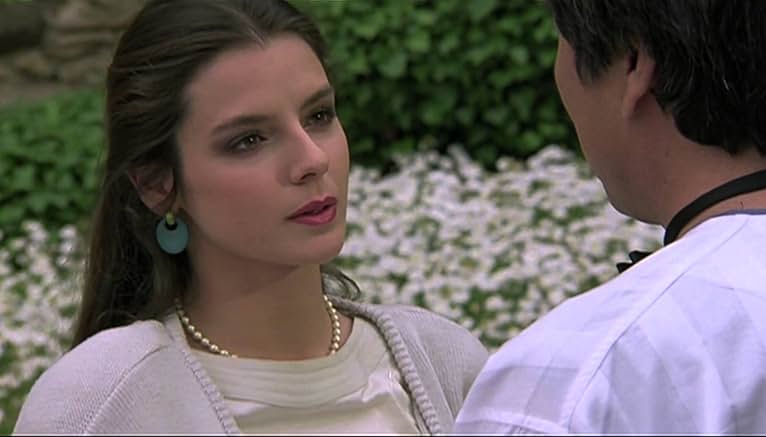
Most ordinary food truck operators in this situation would call the police, demand she leave, or lock the doors. Thomas and David do none of these things. They are completely smitten by her, blinded by a combination of chivalry and romantic desperation, and immediately agree to shelter her at their apartment. The resulting domestic sequences are filled with classic Hong Kong farce. Sylvia systematically robs them blind in the middle of the night, stealing their hard-earned business cash and slipping away into the darkness, leaving the cousins broke but strangely impressed by her efficiency. It is a moment of pure, uninterrupted character comedy. There is no deep bitterness, no realization of betrayal. There is only Jackie and Yuen Biao sitting in their empty apartment, looking at their stolen savings, and realizing they are hopelessly in love with a woman who treats them like a personal ATM.
When Moby finally tracks Sylvia down to the exact same square, the film shifts gears into a spectacular display of urban stunt coordination. Thomas and David find themselves defending Sylvia from both the street thugs she ripped off and a mysterious contingent of suited henchmen who seem to have unlimited resources. This triggers the legendary skateboard chase sequence, a scene that should be studied in film schools for its spatial geometry and rhythm. Jackie Chan does not just ride a skateboard; he treats the board as an extension of his skeletal structure, launching himself over cars, sliding under barriers, and using the architecture of Barcelona as a giant, concrete pinball machine. Yuen Biao matches him stride for stride, executing a series of jaw-dropping parkour maneuvers off historical stone walls that predate the actual invention of modern parkour by at least two decades. The stunts are captured in wide, unedited shots that allow the audience to appreciate the raw, terrifying reality of the impact. It is just three men at the absolute peak of their physical powers risking permanent orthopedic damage for a gag about a sandwich delivery.
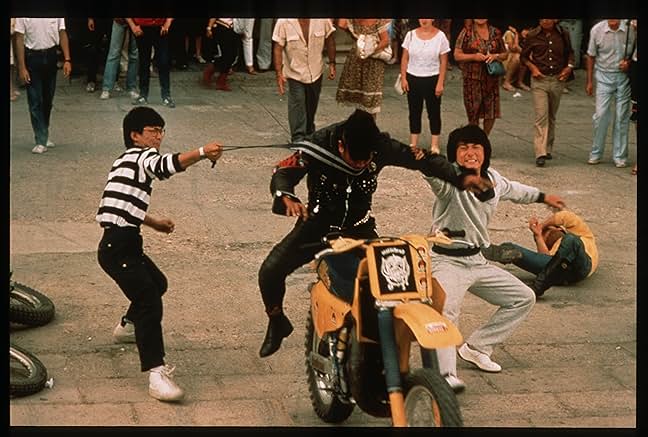
The narrative darkens, relatively speaking, when the film reveals that Sylvia isn’t just a clever pickpocket; she is actually the illegitimate heiress to a massive fortune belonging to a wealthy count. Her villainous uncle, played with magnificent, theatrical malice by Pepe Sancho, wants her dead or imprisoned so he can claim the inheritance for himself. His men kidnap Sylvia and her mother, locking them away in his sprawling, heavily fortified gothic castle on the outskirts of the city. This sets up the grand, multi-tiered assault on the fortress that occupies the entire final third of the film, a sequence that transitions from a standard rescue mission into a dazzling parade of martial arts virtuosity.
Before the final assault, however, Sammo Hung treats us to a completely surreal comedic interlude set inside a local psychiatric facility where David’s father is institutionalized. Thomas, David, and Moby visit the hospital to gather information, resulting in an extended sequence where they interact with the patients. The scene is executed with a level of politically incorrect, old-school slapstick that would be completely impossible to produce today, but it works beautifully because of the cast’s total commitment to the bit. The patients are portrayed not with malice, but as a chorus of eccentric, hyperactive comedians who systematically disrupt Moby’s attempts at serious detective work. It is a bizarre, looping detour that serves no real narrative purpose other than to give the audience a breather before the film permanently floor-boards the accelerator.
The physical mechanics of the final castle invasion are a source of endless joy for action connoisseurs. Sammo Hung handles the direction with an impeccable eye for geography, ensuring that each of the three leads gets a distinct architectural sandbox to play in. Sammo takes on Pepe Sancho in a sword-and-fist duel that showcases his incredible agility with a rapier; Yuen Biao engages in a high-flying, acrobatic skirmish across the castle’s balconies and rafters against an array of henchmen, using his legendary leg dexterity to perform flips that seem to violate the basic laws of gravity.
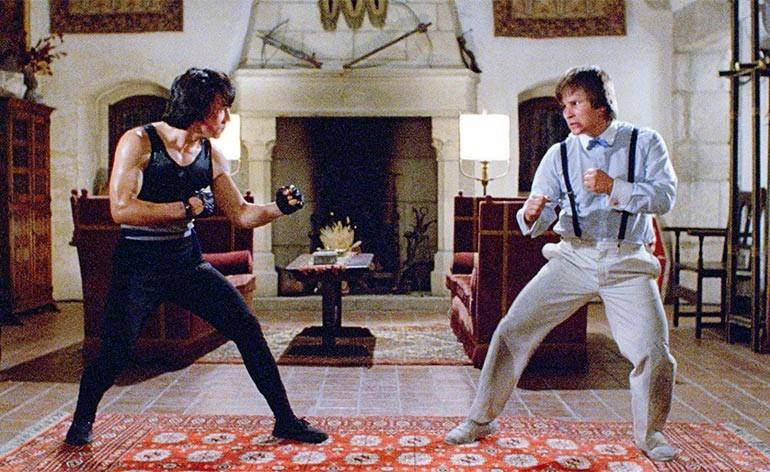
But everything else in the movie, the comedy, the plot, the car chases, the family drama, completely evaporates the moment Jackie Chan steps into the castle’s main study to confront the chief assassin, played by American kickboxing champion Benny “The Jet” Urquidez. The resulting five-minute duel is widely considered by film historians, stunt coordinators, and martial artists to be the single greatest combat sequence ever put on film. Urquidez, with his piercing eyes, slicked-back hair, and terrifyingly compact, explosive musculature, represents the absolute antithesis of the traditional Hong Kong movie villain. He doesn’t pose or use stylized animal stances; he fights with the cold, efficient, bone-crushing reality of a professional world champion.
The choreography of the Jackie vs. Benny fight is beautiful because it tells a complete story entirely through physical movement. At the start of the match, Jackie attempts his usual style of fighting, fast, improvisational, slightly theatrical. Urquidez completely dismantles him, delivering a series of devastating leg kicks and a legendary spinning back kick that is executed with such terrifying speed that the sheer wind pressure from the foot blows out a row of real candles on a nearby table. Rumour has it that the candle shot wasn’t a special effect or a trick; it was the actual displacement of air from a martial arts master moving at terminal velocity. Jackie is visibly shaken, realizing that his standard tricks won’t work here. He has to strip away the showmanship, tighten his guard, and engage in a gritty, high-speed chess match of pure reaction and counter-striking.
The technical precision of this fight is unmatched. The camera stays back, framing both men from head to toe, allowing the audience to see every feint, every block, and the incredible speed of the exchanges. When Jackie finally catches Urquidez with a brilliant, improvisational counter-punch, the movie doesn’t cut away to a reaction shot; it stays on Benny’s face as he absorbs the blow, adjusts his jaw with an icy, psychopathic grin, and signals for Jackie to bring more. It is a moment of pure, cinematic adrenaline that transforms the fight from a simple movie scene into an authentic athletic clash. The level of trust required between the two performers to execute full-contact strikes at that speed without permanently blinding or killing each other is staggering.
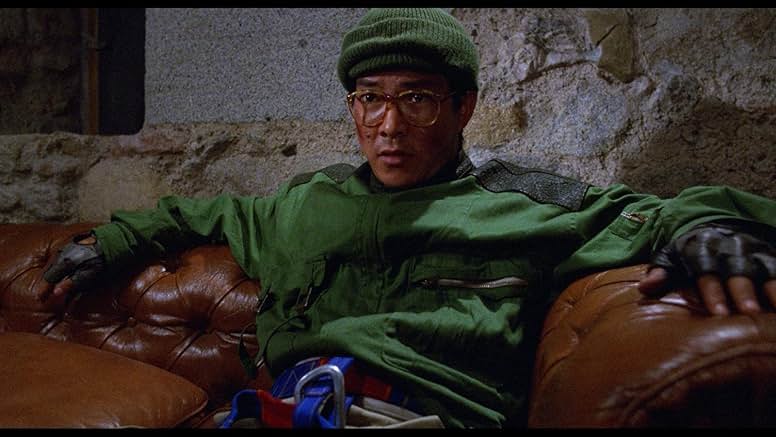
While Jackie and Benny are busy redefining the parameters of action cinema, Yuen Biao is executing his own spectacular finale. I cannot state this enough, Yuen Biao doesn’t get the credit he deserves. He is as equally as talented as both his compatriots, which he proves time and again across a myriad of films, it just so happens that his compatriots are Jackie Chan and Sammo Hung, meaning he somehow gets lost in the mix. Especially here in Wheels on Meals.
Once the dust settles, the villains are defeated, and the film wraps up its narrative loose ends with a characteristically abrupt, lighthearted Hong Kong resolution. Sylvia is reunited with her fortune, Thomas and David get their business capital back, and Moby establishes his reputation as a legitimate private investigator. The final scenes find the trio back at the yellow Mitsubishi van, joking around, ready to resume their lives as mobile catering entrepreneurs, completely unbothered by the fact that they have just dismantled an international criminal conspiracy and left a historic Spanish castle in absolute ruins.
Wheels on Meals is Sammo Hung wanting to show the absolute limit of what the human body can achieve when trained to a state of supernatural perfection. It takes a premise that is fundamentally silly, two fast-food guys and a bad detective rescuing a princess in Spain, and treats the physical execution of that premise with a level of hardcore devotion that borders on the religious. There is no digital enhancement, narrative complexity, or moody atmospheric lighting. Just three childhood friends who can jump over moving vehicles, a yellow van packed with burgers, and Benny “The Jet” Urquidez waiting in a study to blow out candles with his heels. It is fast, fluid, bone-breakingly real, and complete martial arts perfection.
Leave a Reply